
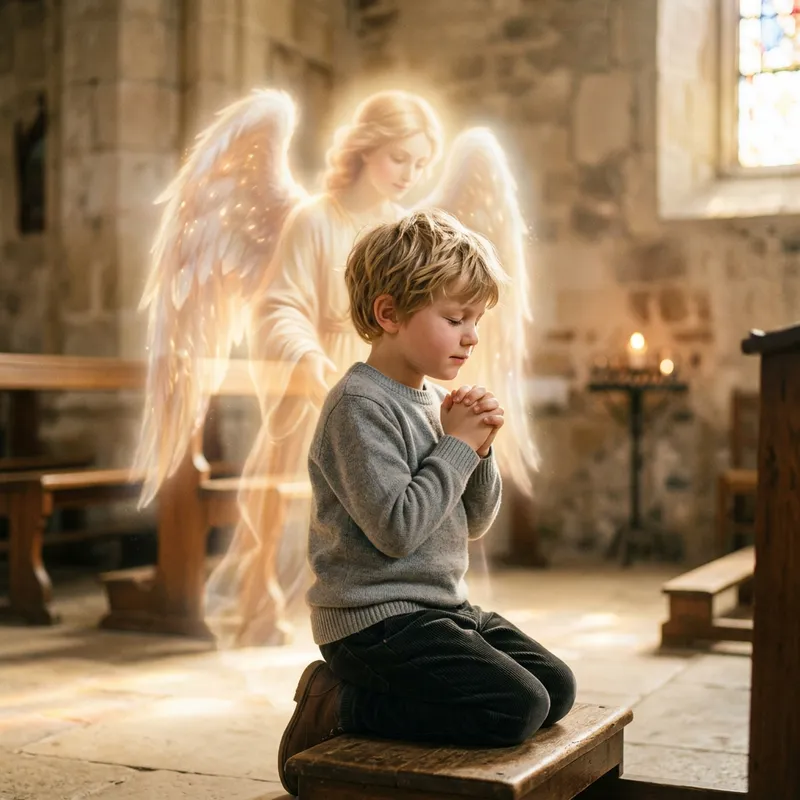
One of the most common questions Catholics receive from Protestant Christians is:
“Why do you pray to Mary, the saints, and the angels? Why not just go directly to Jesus?”
The Catholic answer is simple:
Yes, we can and do go directly to Jesus. But when we ask Mary, the saints, or the angels to pray for us, we are not choosing them instead of Jesus. Rather, we are asking them to join us in going to Jesus.
As one Catholic apologist beautifully explained:
“You could go to Jesus alone, but if you pray to Mary, you and the Virgin Mary can go directly to Jesus.”
This question touches upon an important difference between Catholic and Protestant theology. Catholics believe that God desires His children to pray for one another and that some prayers are more efficacious than others because of the holiness of those who offer them.
Far from being an invention of the Church, this belief is deeply rooted in Sacred Scripture.
The Biblical Foundation of Intercessory Prayer
1. The Prayers of the Righteous Are More Powerful
The Bible explicitly teaches that the holiness of the person praying matters.
Saint James writes:
“Therefore confess your sins to one another, and pray for one another, that you may be healed. The prayer of a righteous man is powerful and effective.” (James 5:16)
Notice that James does not merely say prayer is powerful. He specifically says that the prayer of a righteous person is powerful.
The Bible repeatedly emphasizes this truth.
Jesus’ Own Prayers
The Letter to the Hebrews tells us:
“In the days of His flesh, Jesus offered up prayers and supplications, with loud cries and tears, to Him who was able to save Him from death, and He was heard for His godly fear.” (Hebrews 5:7)
Jesus’ perfect holiness made His prayer perfectly pleasing to the Father.
The Prayer of the Wicked
Scripture also contrasts the prayers of the righteous with those who reject God.
“If one turns away his ear from hearing the law, even his prayer is an abomination.” (Proverbs 28:9)
The Psalmist likewise declares:
“If I had cherished iniquity in my heart, the Lord would not have listened. But truly God has listened; He has given heed to the voice of my prayer.” (Psalm 66:18-19)
The man born blind in John’s Gospel expresses the same principle:
“We know that God does not listen to sinners, but if anyone is a worshiper of God and does His will, God listens to him.” (John 9:31)
The message is clear: righteousness matters.
Job’s Intercession for His Friends
A striking example appears at the end of the Book of Job.
After rebuking Job’s friends, God instructs them:
“Go to My servant Job… and My servant Job shall pray for you, for I will accept his prayer.” (Job 42:8)
Job’s friends were required to seek God’s forgiveness, but God specifically chose Job’s intercession as the means through which mercy would be granted.
Scripture continues:
“The Lord accepted Job’s prayer.” (Job 42:9)
Notice that Job’s friends still prayed to God directly, yet Job’s intercession was especially effective.
This demonstrates an important biblical principle: God often works through the prayers of His faithful servants.
2. Are Some Christians’ Prayers More Effective Than Others?
If the prayers of the righteous are powerful, does Scripture suggest that certain righteous individuals possess especially powerful intercessory prayer?
The answer is yes.
Abraham’s Intercession for Sodom
One of the clearest examples is Abraham’s prayer for the city of Sodom.
Before destroying Sodom because of its wickedness, God reveals His plans to Abraham because of Abraham’s faithfulness and righteousness.
Abraham boldly intercedes:
“Wilt Thou indeed destroy the righteous with the wicked?” (Genesis 18:23)
He pleads repeatedly for mercy, asking God to spare the city if righteous people can be found there.
Eventually God agrees that He would spare the city for the sake of ten righteous persons.
Unfortunately, ten righteous persons could not be found.
Yet Lot and his family were spared.
Scripture explains why:
“God remembered Abraham, and sent Lot out of the midst of the overthrow.” (Genesis 19:29)
Lot himself was righteous, but his deliverance is explicitly connected to Abraham’s intercession.
This reveals an important truth: God often grants blessings through the prayers of particularly holy individuals.
Why Ask Others to Pray for Us?
The Bible repeatedly encourages Christians to pray for one another.
God certainly hears our personal prayers, yet Scripture also encourages us to seek the prayers of others.
Why?
Because intercessory prayer is part of God’s plan for His family.
Just as we ask fellow Christians on earth to pray for us, Catholics also ask the saints in Heaven to pray for us.
The biblical principle remains the same.
What Does It Mean to “Pray” to the Saints?
Many misunderstand the word pray.
Historically, the word simply means:
“to ask” or “to request.”
When Catholics pray to the saints, they are not worshipping them.
Worship belongs to God alone.
Rather, Catholics ask the saints to pray with them and for them before God.
Just as we might ask a friend:
“Please pray for me,”
we ask the saints:
“Please pray for me.”
The Communion of Saints
Saint Paul teaches:
“Bear one another’s burdens.” (Galatians 6:2)
And:
“Pray for one another.” (James 5:16)
He also reminds us:
“For by one Spirit we were all baptized into one body.” (1 Corinthians 12:13)
The Church is one Body in Christ.
Death does not remove the saints from that Body.
The saints in Heaven remain united with us through Christ.
Why Ask the Saints in Heaven?
James tells us:
“The prayer of a righteous person has great power.” (James 5:16)
Who could be more righteous than those already perfected in Heaven and standing before God?
Furthermore, Scripture shows that the saints care about what happens on earth.
Jesus says:
“There will be more joy in Heaven over one sinner who repents.” (Luke 15:7)
The inhabitants of Heaven are not indifferent observers. They rejoice over our conversion and salvation.
The Saints Present Our Prayers Before God
The Book of Revelation provides a beautiful glimpse into heavenly worship.
Saint John writes:
“The four living creatures and the twenty-four elders fell down before the Lamb, each holding a harp, and with golden bowls full of incense, which are the prayers of the saints.” (Revelation 5:8)
Later he sees:
“Another angel came and stood at the altar with a golden censer… and he was given much incense to mingle with the prayers of all the saints upon the golden altar before the throne.” (Revelation 8:3-4)
These passages reveal heavenly beings actively presenting prayers before God.
The symbolism is striking:
- Incense represents prayer.
- Angels and heavenly elders present those prayers before God’s throne.
- The saints in Heaven participate in God’s work of intercession.
Can Saints in Heaven Hear Our Prayers?
A common objection asks:
“How can the saints hear millions of prayers?”
The better question may be:
Why wouldn’t they?
The saints are more alive now than they were on earth.
Jesus taught:
“He is not God of the dead, but of the living.” (Matthew 22:32)
The saints are united with Christ, the true Vine, while we are His branches.
Together we form one Mystical Body.
A Great Cloud of Witnesses
The Letter to the Hebrews tells us:
“We are surrounded by so great a cloud of witnesses.” (Hebrews 12:1)
These witnesses are aware of God’s saving work and rejoice in it.
Similarly, Heaven rejoices whenever a sinner repents (Luke 15:10).
How could those who love God perfectly be unconcerned about our welfare?
The Rich Man and Abraham
In the parable of Lazarus and the Rich Man, the rich man speaks to Abraham after death and asks him to help his brothers on earth (Luke 16:19-30).
While this is a parable, it demonstrates that conscious awareness and concern for those on earth continue after death.
It shows that charity does not end at the grave.
The Beatific Vision
Catholics believe that the saints enjoy the Beatific Vision, the direct vision of God.
Saint John writes:
“We shall be like Him, for we shall see Him as He is.” (1 John 3:2)
Because they see God face to face, the saints share in His knowledge according to His will and are capable of hearing the prayers offered to them.
Their ability to intercede is not independent of God but entirely dependent upon Him.
Conclusion
The Catholic practice of asking saints and angels for their prayers is firmly rooted in Scripture and in the reality of the Communion of Saints.
Catholics do not worship saints. Worship belongs to God alone.
Rather, Catholics ask the saints—especially the Blessed Virgin Mary—to join them in prayer before Jesus Christ.
The Bible repeatedly teaches:
- The prayers of the righteous are powerful.
- God invites His faithful servants to intercede for others.
- Christians are called to pray for one another.
- The saints in Heaven remain members of Christ’s Body.
- Heavenly beings present prayers before the throne of God.
Therefore, asking the saints and angels to pray for us is simply an extension of the biblical command to pray for one another—a beautiful expression of the unity of Christ’s Church on earth and in Heaven.
Leave a Reply