

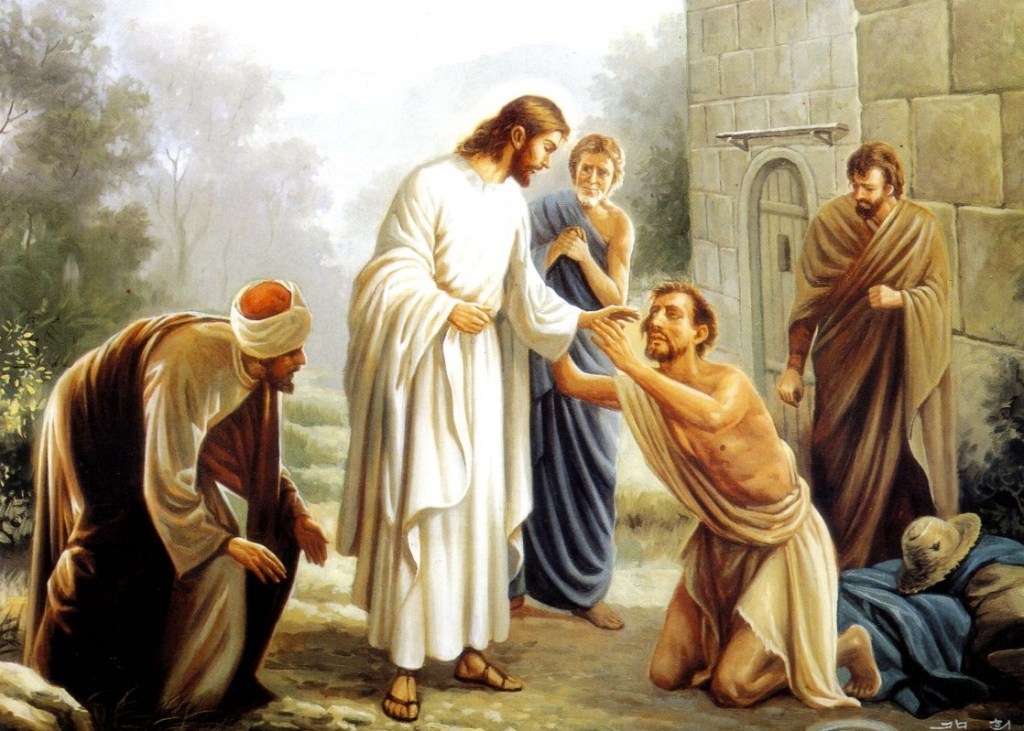
Luke 18: 35-43
“Son of David, Have Mercy on Me” — The Cry That Changes the Road
Today’s gospel begins by saying, as he approached Jericho a blind man was sitting by the roadside begging. Gospel of Mark gives him a name Mark 10:46–52: The blind beggar is named Bartimaeus, son of Timaeus. He cries out, “Jesus, Son of David, have mercy on me!” But Luke doesn’t give any name. For Luke, the blind man is not just one individual; he represents every disciple who must move from blindness to sight, from exclusion to following Jesus on the way. By leaving him unnamed, the blind man becomes “every person” who comes to faith.
He hears that Jesus is passing and cries out, “Jesus, Son of David, have mercy on me!” The crowd reacts badly. They rebuke him and tell him to be silent. Their rebuke is not merely about noise; it reveals a deeper refusal: a refusal to be disturbed by another’s need, a refusal to let God’s mercy interrupt their plans. Yet the more they try to silence him, the more persistently he cries out until Jesus himself stops, summons him, and heals him. Jesus rewards not the crowd’s decorum but the beggar’s faith. “Go; your faith has made you well.”
This story offers several rich lessons, and I would like to draw these out with the help of the Fathers and the saints so their wisdom can illumine our pastoral practice.
Today we stand at a roadside with Blind Man at Jericho / Bartimaeus — a man on the edge of the road, a blind beggar whose one bold line, “Jesus, Son of David, have mercy on me,” breaks through the crowd and changes everything. The story looks simple: a shout, a rebuke from the crowd, a pause in Jesus’ journey, a healing, and then a decision to follow.
St. Augustine says “Bartimaeus is the figure of the human race: blind and begging. He sat by the wayside, for the Truth was passing by, and unless Jesus had passed by, he would not have been healed.” (Sermon 88) For him, he represents all of us: blind without grace, begging for the light of Christ.
The crowd tries to silence him — just as worldly voices try to silence prayer, faith, and witness today — but faith cannot be silenced. Their rebuke is not only to keep order; it is the instinct to preserve comfort, to avoid being inconvenient by the poor or disturbed by need. Many of our modern rebukes are subtler: “Not now,” “Later,” “There’s nothing we can do,” “That makes us uncomfortable.” Those words are the same spirit as “Be silent.” They are polite ways of shutting down mercy.
How often do we let politeness, shame, or the fear of being inconvenient muffle our prayer?
The world around us, and sometimes the voices inside us will say that our cries are untimely or unseemly. Yet the saints teach that the life of faith begins with honest pleading: naming our need and asking for mercy. Bartimaeus shows us that faith is not timid; it is urgent and persistent.
St. Bede says the crowd also represents our own inner doubts—the anxieties and temptations that whisper, “God has no time for you. Your prayer is unworthy.” But Bartimaeus teaches us to resist these lies and to cry even louder: “Son of David, have mercy on me!” Augustine reminds us: “Truth is not overcome by reproach.” Faith must cry out even louder.
The Blind Man teaches us something essential about prayer. The prayer that touches the heart of God is not always neat, polite, or whispered within church walls. Often it is the raw, urgent cry that comes from the margins of life: ‘Jesus, Son of David, have mercy on me!’ And when that cry rises, Jesus does not pass by. He stops. He always stops for the one the crowd would rather overlook.
Jesus is on His way to Jerusalem, the path of His saving work, and yet He interrupts His journey because one poor man cries out for mercy. The crowd tries to push him aside, but Jesus stops for him. This is the scandal of God’s mercy: our Lord makes room in His itinerary for the marginal, the needy, the inconvenient. It reminds us that God is never deaf to the cry of the poor.
Jesus “steps aside” from the crowd’s procession to meet the one who cries out. He delights in leaving the safety of the well-trodden path to meet the lonely, the voiceless, the forgotten. And so our parishes, too, must be places where Jesus still steps aside—places where those wounded by life and excluded by society find welcome, healing, and a merciful heart.
Mother Teresa once said: “The world is full of people who are spiritually blind. If we do not cry out for them, who will bring them to Jesus?” Like Bartimaeus, we are called to cry out for our own healing—and also for our brothers and sisters who cannot yet find their way to the Lord. In that prayer, Jesus will always stop. He will always make space for the one the world overlooks.
Then Jesus asks, “What do you want me to do for you?” he is not testing ignorance; he is inviting the blind man to name his desire. That naming is part of the healing.
St. Thomas Aquinas, in reflecting on Christ’s pedagogy, reminds us that Jesus often asks so that we might articulate our need and thus claim God’s mercy more consciously. Asking produces desire, and desire opens the way for healing.
Bartimaeus answers simply, “Master, let me see.” His request is concrete and immediate. Many of our spiritual ailments are cured the moment we name them to the Lord. Confession, for example, is precisely that: we name our blindness and invite Christ’s healing. The sacramental life of the Church—Eucharist, Reconciliation, Anointing—works this way: the Lord asks, we name, and healing begins.
And St. Augustine says: “He asked for his sight, that he might see and follow Christ. He was healed, and immediately followed Him, showing us that those who are enlightened should not remain idle, but follow Him on the way.”
After his sight is restored, he does not return to his former place by the roadside. He follows Jesus on the way, healing always leads to following. When God heals, he does not merely fix a problem; he forms a disciple. The liberty of sight becomes service; restored vision becomes a vocation.
He ends his encounter by following Jesus on the way. That final image is everything. To follow is to enter the pilgrim’s life: healed, grateful, and sent. The Gospel does not let us remain neutral: once you see, you either follow, or you turn away. The blind man follows.
So let us rise. Let us cast aside the cloaks that keep us comfortable: our fear of disorder, our politeness that becomes cruelty, our shame that keeps us silent. Let us cry out persistently for what we need. And when God answers, let us not return to the roadside, but step onto the road with the Lord and walk toward Jerusalem — toward the cross and the resurrection — together.
Prepared by Fr James Abraham
 Nelson MCBS
Leave a comment