
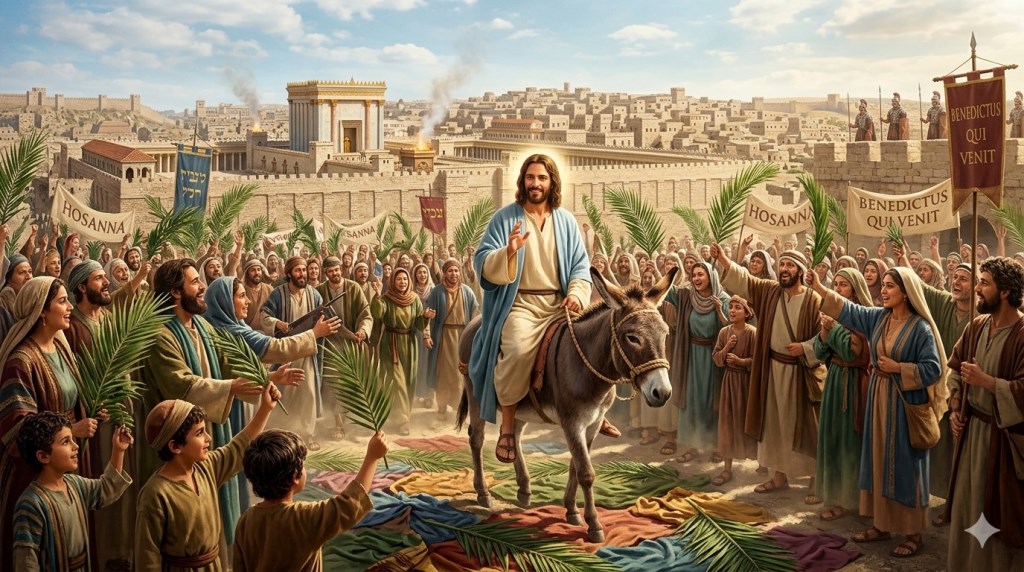
The Triumphal Entry of Jesus into Jerusalem is a pivotal moment in salvation history, marking the transition from Christ’s public ministry to his Passion. In the Catholic tradition, this event—recorded in all four Gospels (Matthew 21:1–11, Mark 11:1–11, Luke 19:28–44, and John 12:12–19)—is far more than a parade; it is a complex tapestry of fulfilled prophecy, liturgical foreshadowing, and the formal installation of the Messianic King.
Because of the depth required, this analysis will synthesize insights from the Catena Aurea (St. Thomas Aquinas’s compilation of Patristic thought), the Ignatius Catholic Study Bible, and the works of Pope Benedict XVI.
1. The Context: The Ascent to the Temple
The journey begins at the ascent to Jerusalem. As the Ignatius Catholic Study Bible (ICSB) notes, Jesus has been traveling toward this moment since Luke 9:51, when he “set his face to go to Jerusalem.”
The Geography of Salvation
Jesus approaches from Bethphage and Bethany, near the Mount of Olives. According to Catholic commentary, this location is highly symbolic:
- The Mount of Olives: In Zechariah 14:4, the Mount of Olives is the site where God’s presence will stand on the Day of the Lord.
- Bethany: The home of Lazarus, whom Jesus recently raised from the dead (John 11). As St. Augustine notes in the Catena Aurea, the proximity to Bethany links the Triumphal Entry to Christ’s power over death.
2. The Donkey: Humility and Kingship
The choice of a donkey (and a colt) is the primary theological signifier of the passage.
Fulfillment of Zechariah
Matthew explicitly cites Zechariah 9:9: “Behold, your king comes to you, humble and riding on a donkey.” Pope Benedict XVI, in Jesus of Nazareth: Holy Week, explains that this choice deliberately distinguishes Jesus’ kingship from worldly power:
“Jesus is not a king who builds his power on military force… He is the King of peace, and he comes in poverty and humility.”
The “Unridden” Colt
The Gospels specify the colt was one “on which no one has ever sat.” In Catholic liturgical and sacrificial understanding, an animal used for sacred purposes had to be “untouched” or “unblemished” (Numbers 19:2). St. Ambrose suggests that the unridden colt represents the Gentile world—those who had not yet been “yoked” to the Mosaic Law but would now carry Christ into the world.
3. The Liturgy of the Crowd: “Hosanna”
The actions of the crowd—spreading cloaks and waving branches—are deeply rooted in Jewish festal traditions, specifically the Feast of Tabernacles (Sukkot) and the Hallel Psalms.
The Cloaks and Branches
- Cloaks: Spreading garments on the road was a gesture of fealty to a new king (2 Kings 9:13). The Catena Aurea quotes St. Jerome, who suggests that the cloaks represent the “laying down of our old selves” to prepare a path for the Lord.
- Palm Branches: In the Maccabean tradition, palms were symbols of victory and national liberation (1 Maccabees 13:51). However, the ICSB points out that Jesus redefines this victory; it is not over Rome, but over Sin and Death.
The Cry of “Hosanna”
The word Hosanna is a transliteration of the Hebrew Hoshia-na, meaning “Save us, we pray!” By the time of Jesus, it had become a shout of jubilation. The crowd quotes Psalm 118:25–26: “Blessed is he who comes in the name of the Lord!”
Note from the Roman Missal: This cry is preserved in every Catholic Mass during the Sanctus. When we say “Hosanna in the highest,” we are literally re-enacting the Triumphal Entry, welcoming Christ’s presence upon the altar just as the Jerusalemites welcomed him into the city.
4. The Hidden Sorrow: Jesus Weeps (Luke 19:41-44)
Unique to Luke’s account is the detail that as Jesus drew near and saw the city, he wept over it.
Catholic commentators emphasize the “Two-fold Vision” of Christ here:
- The Immediate Rejection: He knows that the same voices shouting “Hosanna” will cry “Crucify him” in five days.
- The Future Destruction: He prophesies the destruction of Jerusalem in 70 AD. St. Cyril of Alexandria (Catena Aurea) explains that Jesus weeps because Israel failed to recognize the “time of its visitation.” His kingship is offered, but the people seek a political savior rather than a spiritual Redeemer.
5. Catholic Dogmatic Themes
From a dogmatic perspective, the Triumphal Entry establishes three key “titles” for Jesus:
| Title | Meaning | Catholic Significance |
| Son of David | Messianic Lineage | Confirms he is the heir to the eternal throne promised to David. |
| Prince of Peace | Non-violence | His entry on a donkey rejects the “chariot and war horse” (Zech 9:10). |
| The New Solomon | Wisdom/Temple | Solomon rode his father’s mule to his anointing (1 Kings 1:33). Jesus is the True Solomon entering his Temple. |
6. Summary of Patristic Interpretations
The Catena Aurea provides a beautiful allegorical summary. The donkey (the older, yoked animal) represents the Jewish people who knew the Law, while the colt represents the Gentiles. By bringing both to Jesus, the disciples signify the unification of all humanity under one Shepherd.
As St. John Chrysostom writes:
“He sat upon the donkey not as a matter of necessity, but to provide a mystery… showing that He would bring the wild and untamed Gentiles under His hand.”
Conclusion: The Entry into the Passion
The Triumphal Entry is the “prologue” to the Paschal Mystery. It sets the stage for the Cleansing of the Temple and the Last Supper. For the Catholic believer, this passage serves as a reminder that Christ’s kingdom is “not of this world,” yet it demands a public witness.
To provide a truly comprehensive Catholic analysis of the Triumphal Entry, we must examine the nuances between the four Evangelists and the specific Old Testament threads they weave into the narrative. In the Catholic tradition, these differences are not seen as contradictions but as “polyphonic” truths that reveal different facets of Christ’s mission.
1. Comparative Analysis of the Four Gospels
While all four Gospels record the entry, each Evangelist emphasizes a specific theological dimension of Christ’s kingship, as noted by the Ignatius Catholic Study Bible and the Catena Aurea.
Matthew: The Messianic King (Matt 21:1–11)
Matthew is the most concerned with fulfillment of prophecy. He is the only one to mention two animals: a donkey and a colt.
- The Two Animals: St. Jerome (quoted in the Catena Aurea) interprets this allegorically. The donkey, used to the yoke, represents the Jewish people; the young colt, unbroken, represents the Gentiles. Jesus’ command of both signifies his lordship over all humanity.
- The Title: Matthew highlights the crowd shouting, “Hosanna to the Son of David,” emphasizing Jesus’ legal right to the throne of Israel.
Mark: The Priestly Preparation (Mark 11:1–11)
Mark’s account is lean and focused on the sacredness of the event.
- The Return to Bethany: Unlike Matthew, who suggests Jesus went straight to the Temple to cleanse it, Mark notes that Jesus entered the Temple, “looked around at everything,” and then returned to Bethany because it was late.
- Significance: Catholic commentators suggest this “looking around” was a priestly inspection of the Temple’s corruption before he returned the next day to judge it.
Luke: The King of Peace and Tears (Luke 19:28–44)
Luke adds the most poignant emotional and prophetic details.
- The Descent: Luke specifies the “descent of the Mount of Olives.”
- The Omission of “Hosanna”: Interestingly, Luke (writing for Gentiles) omits the Hebrew word “Hosanna” and replaces it with “Peace in heaven and glory in the highest,” echoing the angels’ song at Christ’s birth (Luke 2:14).
- The Lament: Only Luke records Jesus weeping over the city (Flevit super illam). This shows the “Merciful Heart” of the King, who mourns the coming judgment of 70 AD.
John: The Victorious Lamb (John 12:12–19)
John places the entry immediately after the raising of Lazarus.
- The Palm Branches: John is the only one to specify they were palm branches (phoix). In Roman and Jewish culture, these were symbols of military triumph.
- The Motivation: John notes the crowd came because they heard about the miracle of Lazarus. Thus, in John, the Triumphal Entry is a witness to Christ as the “Resurrection and the Life.”
2. Old Testament Prophecies Fulfilled
The Triumphal Entry is a “symphony” of Old Testament echoes. Below are the primary prophecies cited by Catholic scholars like Dr. Scott Hahn and St. Thomas Aquinas.
I. The Prophecy of Zechariah (Zech 9:9)
“Rejoice greatly, O daughter of Zion! Shout aloud, O daughter of Jerusalem! Behold, your king is coming to you; righteous and having salvation is he, humble and mounted on a donkey, on a colt, the foal of a donkey.”
- Catholic Commentary: As Pope Benedict XVI explains in Jesus of Nazareth, this prophecy redefined kingship. Ancient Near Eastern kings rode horses into war but donkeys when coming in peace. Jesus enters as the King who abolishes the “war horse” and speaks peace to the nations.
II. The Promise to Judah (Genesis 49:10–11)
“The scepter shall not depart from Judah… binding his foal to the vine and his donkey’s colt to the choice vine.”
- Catholic Commentary: St. Alcuin notes that by “binding the colt,” Jesus fulfills the ancient blessing of Jacob over the tribe of Judah. He is the “Shiloh” (the one to whom the scepter belongs) who tames the “foal” of the Gentiles and grafts them into the vine of Israel.
III. The Solomon Archetype (1 Kings 1:33–34)
When David ordered the coronation of Solomon, he commanded: “Cause Solomon my son to ride on my own mule, and bring him down to Gihon… and blow the trumpet, and say, ‘Long live King Solomon!’”
- Catholic Commentary: The use of a royal mule/donkey was a specific sign of the Davidic Dynasty. By riding into the city on a donkey, Jesus is visually claiming the throne of his father David. He is the “Greater Solomon” who comes to build the definitive Temple (his Body).
IV. The Liturgy of Psalm 118
“Save us, we pray, O Lord! [Hosanna!]… Blessed is he who comes in the name of the Lord! We bless you from the house of the Lord.” (Psalm 118:25–26)
- Catholic Commentary: This Psalm was part of the Hallel (Psalms 113–118) sung during Passover. By applying these verses to Jesus, the crowd was identifying him as the Sacrificial Lamb entering the city on the very day the paschal lambs were being chosen (the 10th of Nisan).
3. The Theological “Pivot”
The Triumphal Entry represents the “Great Reversal.” Jesus is accepted by the “little ones” (the children and the poor) but rejected by the “builders” (the religious authorities). This fulfills another part of Psalm 118: “The stone that the builders rejected has become the cornerstone.”
In the Catholic Liturgy of Palm Sunday, we begin outside the church and process inward. This reminds the faithful that we are a “pilgrim people” following our King into the “New Jerusalem” of the Eucharist.
Summary Table: Prophetic Significance
| Symbol | Old Testament Reference | Theological Meaning |
| Mount of Olives | Zechariah 14:4 | The site of God’s final manifestation and judgment. |
| Donkey/Colt | Genesis 49:11 / Zech 9:9 | The humble King of Peace; the Davidic Heir. |
| Spreading Cloaks | 2 Kings 9:13 | Submission to a newly anointed King (like Jehu). |
| Palm Branches | 1 Maccabees 13:51 | National liberation and victory over enemies. |
| Hosanna | Psalm 118:25 | A prayer for salvation that becomes a shout of joy. |
The Triumphal Entry of Jesus into Jerusalem is not merely a historical event for the Catholic Church; it is a living liturgical reality. To understand its full depth, we must examine how the Church weaves this biblical passage into the Holy Sacrifice of the Mass and how the Church Fathers (the Patristic authors) extracted spiritual mysteries from the specific details of the text.
1. The Liturgical Connection: The Sanctus and the Palm Procession
In the Catholic Mass, the Triumphal Entry is made present in every celebration through the Sanctus (Holy, Holy, Holy). This is one of the most profound examples of “Lex Orandi, Lex Credendi” (as we pray, so we believe).
The Sanctus as a Perpetual Triumphal Entry
Every time the priest prepares for the Consecration, the congregation sings:
“Benedictus qui venit in nomine Domini. Hosanna in excelsis.” (“Blessed is he who comes in the name of the Lord. Hosanna in the highest.”)
According to Pope Benedict XVI in The Spirit of the Liturgy, this is a deliberate “re-enactment” of the entry into Jerusalem.
- The Presence: Just as the crowd welcomed the physical presence of Jesus into the Holy City, the congregation welcomes the sacramental presence of Jesus onto the Altar.
- The Meeting of Heavens: The first half of the prayer (“Holy, Holy, Holy”) comes from the vision of Isaiah (Isaiah 6:3) in the heavenly court. The second half (“Blessed is he…”) comes from the earthly crowd in the Triumphal Entry. In the Mass, heaven and earth join to greet the King.
The Palm Sunday Procession
The Roman Missal prescribes a solemn procession for Palm Sunday. The Ignatius Catholic Study Bible notes that this is a public profession of faith.
- The “Two Entries”: St. Bernard of Clairvaux famously preached that there are two entries of Christ—one into the earthly Jerusalem to suffer, and one into the soul to reign. The liturgical procession invites the believer to let Christ enter the “Jerusalem of the heart.”
- The Red Vestments: While the entry was joyful, the priest wears red, the color of blood and martyrdom. This signals that the King’s “throne” will be the Cross.
2. Patristic Allegory: The Donkey and the Colt
The Church Fathers, compiled in St. Thomas Aquinas’s Catena Aurea, looked beyond the literal animals to see a “mystery of the nations.”
The Donkey (The Old Law)
The older donkey, already used to the yoke, was seen by St. John Chrysostom and St. Jerome as a symbol of the Jewish people.
- They had already been “yoked” to the Law of Moses.
- By “loosing” the donkey, Jesus signifies the fulfillment and “unbinding” of the Old Law’s shadows to reveal the substance of the Gospel.
The Colt (The Gentiles)
The young colt, “on which no one has ever sat,” is a symbol of the Gentile world.
- Wildness: The Gentiles were “untamed” by the Law of God and lived in the “wilds” of idolatry.
- The Subduing of Grace: Christ sitting upon the unbroken colt shows how the Grace of God can tame the most rebellious heart. As St. Ambrose writes: “He sat upon the colt to show that He would bring the wild and untamed Gentiles under His hand, and that they should no longer wander in their errors.”
The Disciples’ Cloaks
Why did the disciples put their cloaks on the animals before Jesus sat?
- The Patristic View: The cloaks represent the teachings of the Apostles. Before Christ can “sit” in the hearts of the nations, the Apostles must first cover them with the “garment of doctrine” and the “cladding of virtue.”
3. The Mystery of the “Time of Visitation” (Luke 19:44)
In Catholic theology, the Triumphal Entry is the moment of Final Opportunity.
St. Cyril of Alexandria (in the Catena Aurea) emphasizes that when Jesus wept over Jerusalem, he was mourning the loss of souls. He writes that the “visitation” was the offer of the New Covenant. Because the institutional leaders (the Sanhedrin) rejected the “King of Peace” in favor of seeking a political liberator, they missed the “Day of Salvation.”
Catholic Reflection: This serves as a warning in Catholic spiritual life. St. Augustine famously said, “Timeo Jesum transeuntem” (“I fear Jesus passing by”), meaning he feared missing the moment when God offered a specific grace. The Triumphal Entry is the ultimate “moment of passing by.”
4. Summary of Spiritual Senses
| Element | Literal Meaning | Allegorical/Moral Meaning |
| Bethphage | “House of Figs” | The Church, which must bear fruit for the Master. |
| Loosing the animals | Untying the donkey | The Apostles’ power to “loose” sins (Confession). |
| “The Lord has need” | Christ’s temporary use | Everything we “own” belongs to Christ’s mission. |
| The City Gates | Entrance to Jerusalem | The “Gates of the Soul” which must be opened. |
Final Synthesis: The King Who Serves
The Catholic understanding of the Triumphal Entry is summarized in the Preface of Palm Sunday:
“For, though innocent, he suffered willingly for sinners and accepted unjust condemnation to save the guilty. His Death has washed away our sins, and his Resurrection has purchased our justification.”
The entry is the “Beginning of the End”—the moment the Lamb of God voluntarily enters the “slaughterhouse” (Jerusalem) to take away the sins of the world.
To complete this comprehensive Catholic study, we will examine the Holy Week Timeline—the “Great Week” (Hebdomada Sancta)—and the Cleansing of the Temple, which serves as the King’s first official act of “judgment” upon entering his capital.
1. The Divine Timeline: From Palm Sunday to Holy Thursday
According to the Ignatius Catholic Study Bible and traditional Catholic chronologies, the events following the Triumphal Entry move with a sense of “divine necessity” toward the Passover.
Palm Sunday: The Day of Entry
- The Event: Jesus enters Jerusalem, visits the Temple, and looks around at everything (Mark 11:11).
- Catholic Significance: This is the 10th of Nisan. According to Exodus 12:3, this was the day the Passover lamb was chosen and brought into the home to be inspected for four days before being sacrificed. Jesus, the “Lamb of God,” enters the “Home of God” (the Temple) to begin his four days of inspection/interrogation by the Pharisees and Sadducees.
Monday: The Day of Authority
- The Event: Jesus curses the fig tree (symbolizing a fruitless Israel) and cleanses the Temple.
- Catholic Significance: Jesus asserts his “Architectural Authority.” He is the Lord of the House returning to find it in disarray.
Tuesday: The Day of Controversy
- The Event: Jesus engages in intense debates with the religious leaders (The “Tribute to Caesar,” the “Resurrection of the Dead,” and the “Greatest Commandment”). He delivers the Olivet Discourse (Matthew 24) regarding the end of the age.
- Catholic Significance: This fulfills the “Prophetic Office” of Christ. He speaks the Truth to power before he becomes the “Silent Lamb.”
Wednesday: The Day of Betrayal (“Spy Wednesday”)
- The Event: Judas Iscariot conspires with the Sanhedrin to betray Jesus for thirty pieces of silver.
- Catholic Significance: Traditionally, the Church marks this day with the Tenebrae service, reflecting on the darkness of betrayal.
Holy Thursday: The Day of the New Covenant
- The Event: The Last Supper, the Institution of the Eucharist and the Priesthood, and the Agony in the Garden.
- Catholic Significance: The “Triumphal Entry” reaches its liturgical climax; the King who entered on a donkey now kneels to wash the feet of his subjects.
2. The Cleansing of the Temple (Matthew 21:12–17)
Immediately after the entry, Jesus proceeds to the Temple. Catholic commentary, particularly from St. Thomas Aquinas and Pope Benedict XVI, views this not as a “fit of temper,” but as a prophetic sign.
The “Den of Robbers” vs. “House of Prayer”
Jesus quotes Isaiah 56:7 (“My house shall be called a house of prayer for all nations”) and Jeremiah 7:11 (“Has this house… become a den of robbers in your eyes?”).
- The Meaning: The Temple was intended to be the place where the Gentiles (the nations) could encounter the living God. By filling the “Court of the Gentiles” with money-changers and livestock, the religious leaders had blocked the nations from God.
- The Catholic View: Jesus is clearing the way for the Gentiles—the same “wild colt” he just rode into town.
The Zeal for Thy House
The Catena Aurea cites St. Augustine, who explains that Jesus acted with “Holy Zeal.”
“He who casts out of the Church those who seek their own, and not the things of Jesus Christ, is the one who ‘overturns the tables’ of the money-changers.”
3. The Symbolism of the Blind and the Lame
Matthew 21:14 adds a detail often overlooked: “And the blind and the lame came to him in the temple, and he healed them.”
- The Old Law: Under the Levitical Law (and 2 Samuel 5:8), the blind and the lame were often barred from certain parts of the Temple.
- The New Law: By healing them inside the Temple, Jesus shows that his Kingship is one of restoration. He is the “New David” who welcomes those the “Old David” (in a moment of military pride) had excluded.
4. Conclusion: The “Three Entries” of Christ
Catholic spiritual writers (such as St. Bernard of Clairvaux) summarize the Triumphal Entry as a three-fold mystery:
- The Historical Entry: Jesus riding into the physical Jerusalem to die.
- The Sacramental Entry: Jesus entering the “City of the Church” through the Eucharist.
- The Escatological Entry: Jesus entering the “New Jerusalem” at the end of time to reign forever.
Final Reflection: The Triumphal Entry teaches the Catholic faithful that the “Way of Glory” is inseparable from the “Way of the Cross.” We wave the palms, but we do so while looking at the Crucifix.
This study guide synthesizes the Catholic theological, liturgical, and patristic understanding of the Triumphal Entry. It is designed to serve as a comprehensive reference for the “Great Week” of salvation.
🏛️ Catholic Study Guide: The Triumphal Entry
Biblical References: Matt 21:1–11 | Mark 11:1–11 | Luke 19:28–44 | John 12:12–19
I. The Messianic Signs (Prophecy Fulfilled)
Catholic exegesis identifies four primary “layers” of fulfillment in Christ’s entry:
- The Donkey and the Colt (Zech 9:9): * Significance: Christ rejects the “war horse” of worldly conquerors.
- Catholic Citation: “Jesus is not a king who builds his power on military force… He is the King of peace” (Pope Benedict XVI, Jesus of Nazareth).
- The Spreading of Cloaks (2 Kings 9:13): * Significance: An ancient gesture of fealty.
- Patristic Interpretation: Representing the “laying down of the old man” (St. Jerome).
- The Palm Branches (1 Mac 13:51): * Significance: Victory and national liberation.
- Theological Shift: Jesus redefines “victory” as the conquest of Sin, not Rome.
- The Mount of Olives (Zech 14:4): * Significance: The prophesied site of God’s final manifestation.
II. The Fourfold Gospel Portraits
Each Evangelist emphasizes a specific “Office” of Christ during the entry:
| Gospel | Primary Theme | Key Detail |
| Matthew | The Promised King | Focuses on the “Son of David” and the two animals. |
| Mark | The High Priest | Jesus “looks around” at the Temple in a priestly inspection. |
| Luke | The Merciful Savior | Jesus weeps over the city (Flevit super illam). |
| John | The Lord of Life | Linked to the Raising of Lazarus; uses Palm branches. |
III. Patristic Allegories (From the Catena Aurea)
The Church Fathers provide “spiritual senses” for the physical details of the text:
- The Donkey (Jewry): Those already yoked to the Mosaic Law.
- The Colt (Gentiles): The “wild and untamed” nations whom Christ subdues with grace (St. Ambrose).
- Bethphage (“House of Figs”): Symbolizes the Church which must bear the fruit of good works.
- The Two Disciples: Often interpreted as representing the two-fold mission to the Jews and Gentiles.
IV. Liturgical Continuity: The Mass
The Triumphal Entry is not a past event, but a present mystery in Catholic life:
- The Sanctus: “Blessed is he who comes…” (Psalm 118:26). We greet the Sacramental Presence on the Altar just as the Hebrews greeted the physical Presence in Jerusalem.
- Palm Sunday: The red vestments signify that the King’s “coronation” is his Martyrdom.
- The “Visitation”: St. Augustine’s warning (Timeo Jesum transeuntem) reminds us that the Triumphal Entry is the moment to welcome Grace before it passes by.
V. Essential Commentary Citations
- On the Donkey: “He sat upon the colt to show that He would bring the wild and untamed Gentiles under His hand” (St. Ambrose, Catena Aurea).
- On the “Hosanna”: “It is a cry of jubilation, but also a prayer: ‘Save us, we pray!’” (Ignatius Catholic Study Bible).
- On the Temple: “Jesus clears the Court of the Gentiles to make his House a ‘house of prayer for all nations’” (Dr. Scott Hahn).
VI. Summary of the “Three Entries”
- Historical: To Jerusalem to suffer.
- Sacramental: Into the Soul through the Eucharist.
- Eternal: Into the New Jerusalem at the Second Coming.
 Nelson MCBS
Leave a comment