
Kaithakalam 5th Sunday
Seeing Lazarus at Our Gate: A Call to Compassion
Brothers and sisters in Christ,
Today’s Gospel gives us one of the most powerful and unsettling parables of Jesus—the story of the rich man and Lazarus.
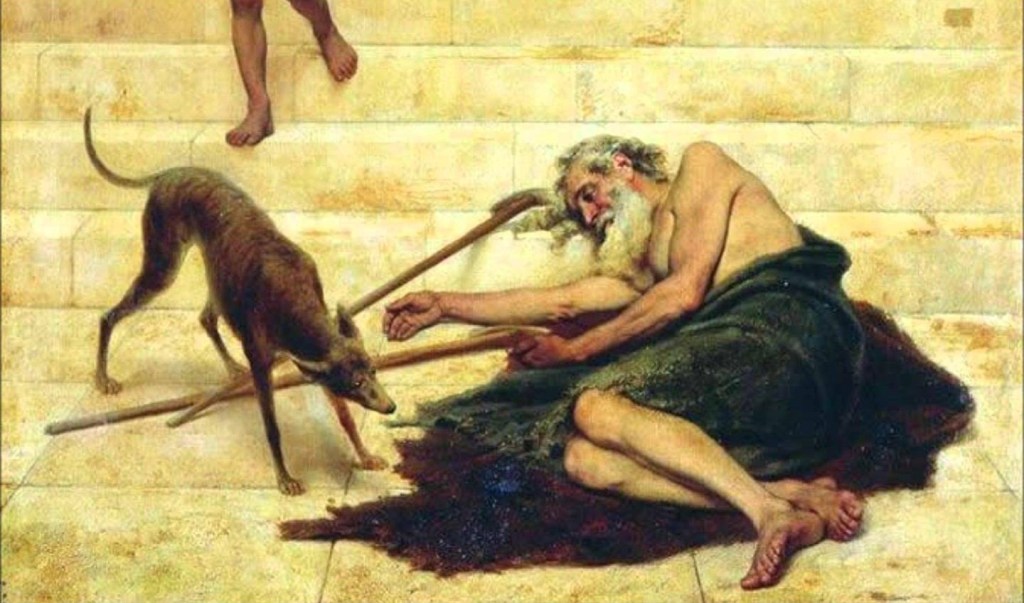
The parable begins with a striking contrast. First, we see the rich man—dressed in purple and fine linen, dining sumptuously each day. He lives in luxury, surrounded by abundance. And then there is Lazarus—poor, sick, covered with sores, laid outside the rich man’s gate. He has nothing to offer, nothing useful, nothing that would raise anyone’s status. His very presence was seen as an offense.
But notice his name: “Lazarus,” which means “God helps.” Even when people ignore him, God knows him. Even when society forgets him, God remembers him. Jesus restores dignity to one the world considered worthless.
In the parable, Lazarus is silent. He never speaks a word. He is described only in the third person, visible but voiceless. Meanwhile, the rich man speaks often, even after death, bargaining, demanding, pleading. But his words carry no weight. Lazarus’ silence represents all those whose cries are ignored, the poor, the suffering, the marginalized. They are seen but not truly listened to. Yet God hears what the world does not.
St. Jerome once wrote that Lazarus was laid at the gate and not hidden in a corner. He was placed where he could not be missed. Every day, the rich man stepped over him, choosing not to see him. The gate became the point of decision, where mercy or indifference was enacted. And every day, the rich man chose indifference.
That is the heart of this parable: sin is not only active cruelty but also willful blindness. It is not only about harming others, but about ignoring them. The cost of indifference is eternal.
When both men die, the great reversal is revealed. Lazarus, who suffered in silence, is carried by angels into the bosom of Abraham. The rich man, who enjoyed every comfort, now cries out in torment. Abraham reminds him: “My child, remember that you received what was good in your lifetime, while Lazarus received what was bad; but now he is comforted here, whereas you are tormented.”
This is not arbitrary punishment, it is the fruit of the rich man’s choices. He shaped his eternity by living as though Lazarus did not exist.
And even in the afterlife, he clings to pride. Notice: he still sees Lazarus as a servant, asking Abraham to send Lazarus to bring him water, or to warn his brothers. He does not repent. He does not ask forgiveness. He only asks for service. As St. Gregory of Nyssa observed, even in death the rich man is bound to his self-interest.
And then Abraham describes the “great chasm” fixed between them. That chasm mirrors the gate that separated Lazarus from the rich man’s table. On earth, it could have been bridged so easily, with scraps of food, with a gesture of mercy. But the rich man refused. The true chasm was not geographical. It was the chasm in his heart, too full of pride to allow compassion.
Brothers and sisters, this parable asks us to examine our own lives:
· Who is being left at the gates of our life, those we see but pass by?
· Whose silent cries go unheard?
· Who is longing for scraps of time, attention, kindness, or dignity that we could so easily give?
The modern-day Lazarus is not hard to find. He is not hidden. He may be the homeless man on the street, the refugee seeking safety, the elderly neighbor who is lonely, or the child who goes hungry in our own town. Lazarus is still at our gate—and our salvation may depend on whether we stop to help or keep walking.
St. Paul VI, in Populorum Progressio, urged us to build “a world where every person can live a fully human life… where the poor man Lazarus can sit down at the same table with the rich man.” It is an image of God’s kingdom breaking into human history. To build a world where Lazarus dines with the rich is to anticipate the heavenly banquet where God Himself will wipe away every tear.
St. John Paul II reminded us that this parable “must always be present in our memory; it must form our conscience.” He named the Lazaruses of the Modern World, the poor, the marginalized, the forgotten. And he also pointed to another Lazarus: our pre-born brothers and sisters, whose silent cries for justice must not be ignored. He warned us that we cannot remain indifferent, enjoying comfort and freedom, while Lazarus lies suffering at our gates.
The rich man was not condemned for being wealthy, but for failing to recognize Lazarus as his brother. His sin was indifference, the refusal to see the suffering at his doorstep. And if we, too, fail to see the most vulnerable—including the child in the womb—we repeat the rich man’s mistake.
The parable demands a response. If we truly believe every human life is sacred, we cannot remain silent. We are called to prayer, to advocacy, to compassion, to action—for both mother and child, for both neighbor and stranger.
Every Eucharist confronts us with this truth. Christ comes to us silently, humbly, under the appearance of bread and wine. If we can recognize Him here, we must also recognize Him in the Lazaruses of our world—in the poor, the lonely, the forgotten, those waiting at our gates.
May this parable awaken us from indifference. May it open our eyes to see, our ears to hear, and our hearts to respond with compassion—so that, at the end of our journey, we too may be carried by angels into the eternal banquet of God’s kingdom, alongside Abraham, Lazarus, and Christ our Lord.
Amen.
Lazarus was laid at the gate, and not in a corner, making his presence apparent. – St. Jerome
Lazarus only wished for what the rich man considered garbage and, unlike the rich man, did not seek the best food or to fatten himself. – Aphrahat, the Persian sage
🪶 Fr James Abraham
ChatGPT Summary
Summary of Reflection on Luke 16:19–31 (The Rich Man and Lazarus)
Key Contrasts in the Parable
- Rich Man: Wealthy, clothed in luxury, feasted daily, indifferent to others.
- Lazarus: Poor, sick, voiceless, laid at the gate, ignored by society but remembered by God.
Themes and Lessons
- Indifference as Sin:
- Sin is not just cruelty but willful blindness to suffering.
- The rich man’s daily choice to ignore Lazarus condemned him.
- Reversal after Death:
- Lazarus is comforted in Abraham’s bosom.
- The rich man suffers torment, shaped by his earthly choices.
- Pride Beyond the Grave:
- Even in torment, the rich man treats Lazarus as a servant.
- Fails to repent or acknowledge Lazarus as a brother.
- The Great Chasm:
- Mirrors the earthly gate separating them.
- Could have been bridged by mercy in life, but pride created a permanent divide.
Contemporary Application
- Examination of Conscience:
- Who are the Lazaruses at our gates today?
- Homeless, refugees, elderly, hungry children, the unborn.
- Church Teachings:
- St. Jerome: Lazarus was placed visibly at the gate.
- St. Gregory of Nyssa: Rich man’s self-interest persisted in death.
- St. Paul VI: Urged creation of a world where rich and poor share one table.
- St. John Paul II: Parable must shape conscience; modern Lazaruses include the poor and unborn.
- Eucharistic Connection:
- Christ comes silently and humbly in the Eucharist.
- Recognizing Him there means recognizing Him in the poor and marginalized.
Call to Action
- Reject indifference; respond with compassion.
- Defend dignity of all human life—poor, marginalized, unborn.
- Live mercy daily to avoid the fate of the rich man.


 Nelson MCBS
Leave a reply to Nelson MCBS Cancel reply