

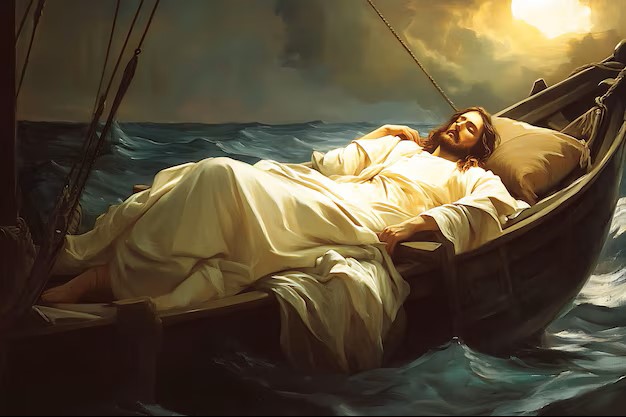
Faith in the Storm | Matthew 8:23–34
Today’s Gospel paints a vivid and deeply human picture of Jesus asleep in the boat while a storm rages around Him. The image is striking: the waves crash, the wind howls, and the disciples panic — yet Jesus sleeps peacefully.
This scene reminds us that though Jesus is truly God, He is also truly human. After a long day of preaching, teaching, healing, and ministering to the crowds, He is physically exhausted. His divine nature does not cancel out His human needs. Even the pounding waves cannot disturb His rest. And yet, while Jesus sleeps peacefully, His disciples are in turmoil, fearing for their lives.
Their fear is understandable. The Sea of Galilee is known for sudden, violent storms that can overwhelm even experienced fishermen. They cry out,
“Lord, save us! We are perishing!” (Mt 8:25).
In their cry, we hear both desperation and doubt — they believe Jesus can save them, but they fear He may not. Their hearts are torn between faith and fear, trust and panic.
Then Jesus awakens. Before calming the storm outside, He addresses the storm within:
“Why are you afraid, O you of little faith?” (v. 26).
His question is not meant to shame but to awaken — to help His disciples recognize the weakness of their trust. The real danger was not the storm on the sea, but the storm of unbelief in their hearts. Jesus shows us that true faith is not the absence of fear, but the courage to trust even when fear surrounds us.
St. Augustine beautifully reflects on this passage:
“When you have to listen to abuse, that is the wind beating against you. When your anger is aroused, you are being tossed by the waves. So when the winds blow and the waves mount high, the boat is in danger, your heart is in peril, your faith is being tossed by the waves. Awake Christ then; let Him speak to you.” (Sermon 63)
The winds are not only external forces of nature but the harsh words, insults, and injustices that buffet us in daily life. The greater danger is not the external storm but the inner one — the storm of our own emotions. Anger, resentment, bitterness, and pride are like high waves rising within our hearts. They can toss our peace and threaten to drown our faith.
This is the moment of spiritual crisis. Fear and anger rush in, and the presence of Christ within us seems to fall asleep — not because He is absent, but because we have allowed our trust to rest. Augustine reminds us that Christ dwells within every baptized believer. When faith falters, when anxiety or temptation arises, we must awaken Christ within us through prayer, through the remembrance of His Word, through that quiet act of trust that says, “Lord, I cannot handle this storm — but You can.” When Christ speaks, peace returns.
Every Christian experience storms — not just external troubles, but interior conflicts. The key is not to panic but to awaken Christ through faith. As Augustine says elsewhere, “Your heart is the vessel of your soul. If you remember Christ, it will not sink.”
In our moments of struggle — when emotions rage, when pride flares, when fear grips us — we must remember that Jesus is in the boat. He is not absent; He is only waiting to be called upon.
In every life, there are moments when the winds rise unexpectedly: a serious illness, a broken relationship, financial hardship, loss, disappointment, or betrayal. These are the storms that test the strength of our faith and reveal the depth of our trust in God. Like the disciples, we may cry out, “Lord, save us! We are perishing!” And often it feels as though He is asleep — silent, unresponsive. Yet His apparent silence is not absence; it is an invitation to deeper faith.
The storm, then, becomes a place of encounter. It exposes our fears and reminds us of our need for Christ. When everything seems out of control, we are drawn to realize that only God truly holds all things together. Faith is not the denial of the storm; faith is the courage to believe that Jesus is in the boat — that He is Lord over wind and wave, over fear and failure, over every chaos that threatens our peace.
Storms will always come — that is part of life’s journey. But what makes all the difference is who is in your boat. When Jesus is there, even if He seems to be sleeping, you can be certain that the boat will never sink. The waters may rise, but His presence remains steady. The winds may roar, but His word still carries power: “Peace! Be still!”
Just because Christ is at the center of your life does not mean you will avoid suffering. The Catechism of the Catholic Church reminds us:
“By His passion and death on the Cross, Christ has given a new meaning to suffering: it can henceforth configure us to Him and unite us with His redemptive Passion.” (CCC 1505)
Following Jesus does not shield us from pain, loss, or hardship — in fact, discipleship often leads us straight into the mystery of the Cross. But what changes everything is the meaning of suffering. When we suffer with Christ, our pain is no longer empty or purposeless; it becomes a path of transformation, a participation in His saving love.
Catechism also teaches:
“Suffering, a consequence of original sin, acquires new meaning; it becomes a participation in the saving work of Jesus.” (CCC 1521)
This means that every cross we bear — whether physical pain, emotional struggle, rejection, or failure — can unite us more intimately with the Lord who suffered for us and with us. When we carry our crosses in faith, they no longer crush us; they purify us, strengthen our compassion, and draw us closer to God’s heart.
Christ never promised a life free of storms or suffering. He promised something greater: His presence in the midst of them. Just as He was in the boat with His disciples, He remains with us in every trial. His presence does not eliminate the storm, but it transforms our fear into trust and our despair into hope.
To have Christ at the center of your life is not to be spared the storm — it is to have an anchor within it. It is to know that even in pain, you are not alone; even in darkness, the light of His love still shines. As St. Paul says,
“We are afflicted in every way, but not crushed; perplexed, but not driven to despair… always carrying in the body the death of Jesus, so that the life of Jesus may also be manifested in our bodies.” (2 Corinthians 4:8–10)
Suffering is not a sign of God’s absence, but a privileged moment of grace. It is there, in the storm, that faith matures and love deepens. To keep Christ at the center means to trust that He can bring resurrection out of every cross and calm out of every storm — in His time and in His way.
Remember:
· Storms are inevitable.
· Fear is optional.
· Faith is powerful.
· And Jesus is in your boat.
May the intercession of Our Lady, Star of the Sea (Stella Maris), guide us safely through every storm to the harbor of eternal peace.
Fr James Abraham
 Nelson MCBS
Leave a comment