

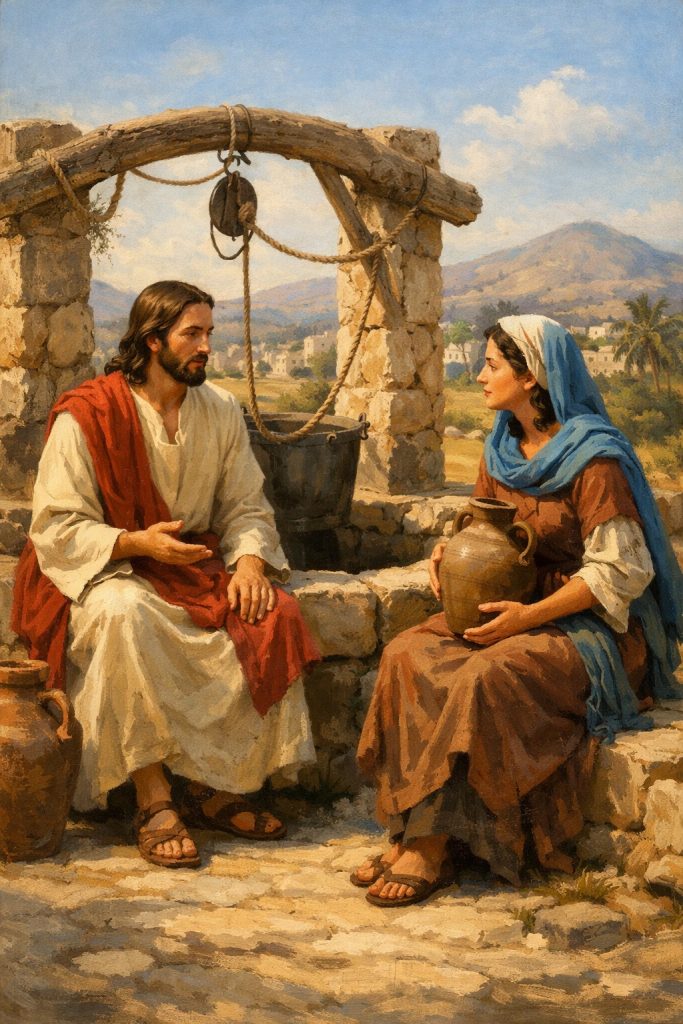
“Give me a drink.” (John 4:5-42)
The story of Jesus and the Samaritan woman at Jacob’s well is one of the most beautiful and moving encounters in the Gospel of John. It’s a story about thirst, our human thirst for love, acceptance, and meaning and about Christ’s thirst for our hearts. It’s about how God meets us where we are, even in the ordinary moments of life, and gradually leads us into faith, healing, and mission.
The setting itself is important. Jacob’s well—a place of water, of daily labor, of need. Throughout Scripture, wells are not just sources of water; they are places of encounter, of covenant, of life-changing meetings. Abraham’s Servant and Rebekah (Genesis 24:15-18), Jacob and Rachel (Genesis 29:1-10), Moses and Zipporah (Exodus 2:15-21), Hagar and God (Genesis 21:19)
The woman comes at noon, alone. That detail already speaks volumes. Perhaps she wants to avoid the crowd, to hide her pain or her past. She carries her water jar, but she also carries something heavier: her loneliness, her broken relationships, her search for love and meaning.
She comes simply to draw water. Nothing extraordinary. An ordinary task, an ordinary day. Yet she finds Christ waiting. So often God meets us in the routine moments of life, not only in dramatic events.
Augustine reminds us that this woman is more than an individual figure; she represents the Church, “not yet justified, but about to be.” In her, we can see our own story: ordinary people, going about ordinary tasks, yet ready to encounter something extraordinary.
When Jesus says, “Give me a drink,” it is first a simple, human request. But soon, it reveals a deeper thirst, the thirst of God for souls. Jesus is asking for more than water; He is asking for her trust, her heart, her faith. Faith begins not with our seeking, but with God’s search for us. Conversion is not simply something we accomplish; it is Christ’s thirst being satisfied in our response.
St. Augustine links this thirst to the shedding of blood. The thirst at Jacob’s well anticipates the thirst on Calvary.
The request, “Give me to drink,” echoes forward to Calvary. There, too, He will say, “I thirst.” This is not only as bodily thirst but as divine longing the thirst for faith, for love, for the salvation of humanity. The Samaritan woman stands as a representative of all humanity wounded, searching, incomplete.
At the well, two thirsts meet: her thirst for water, His thirst for her faith. And in the end, she leaves her water jar behind. She no longer needs it, because she has found something far greater: living water, grace that satisfies the deepest longing of the heart.
Jesus draws her gently, step by step: from misunderstanding to curiosity, from curiosity to recognition, from recognition to mission. Faith is not only knowing about God—it is offering ourselves to the One who first thirsted for us. And when she runs to the town to share her encounter, we see the first fruits of God’s harvest: the woman becomes a witness, and many believe because of her testimony.
Notice how Jesus leads her patiently. When He offers “living water,” she misunderstands, thinking in purely physical terms. How often do we do the same? We interpret divine realities in earthly categories. We measure grace by our experience. We measure God by human limitations. We approach Christ with our practical concerns or daily routine. Yet Christ is there, waiting at the well of our ordinary life, ready to transform it into something extraordinary.
Jesus patiently continued to lead her, step by step, from physical thirst to spiritual awakening. Now, Jesus introduces a deeper truth: “Go, call your husband.” He does not condemn or shame her; He simply invites her to truth. She wants living water, but she wants it without conversion. She wants relief without repentance. Christ gently but firmly brings her to the wound. Grace cannot be received without truth.
In Augustine’s reading, the “husband” represents the intellect, the capacity to grasp truth. Only when we face ourselves honestly can we receive the fullness of God’s gift. The soul must allow wisdom to guide it before receiving the fullness of the Spirit. Christ calls her to self-awareness.
The five husbands she had represent the soul’s journey through worldly desires, through experiences of life, through the senses. Her present situation represents error, attachment to things that cannot satisfy. Only Christ, the true spouse of the soul, can bring living water, can bring wisdom, understanding, and true life.
Jesus meets her where she is, yet He leads her beyond. He teaches her that the water of the world will never fully satisfy. Human desires, pleasures, and achievements can refresh for a moment, but the deeper thirst remains. Only the water of the Spirit, the living water He gives, truly satisfies.
Step by step, Jesus leads her from physical thirst to spiritual awakening. And step by step, she begins to understand. She moves from curiosity to faith, and then to mission. She recognizes Him as a prophet. She begins to see that He offers something more than physical relief. Finally, when Jesus reveals, “I who speak with you am He,” she is fully awakened. She leaves her jar behind and runs to proclaim the Good News. Her thirst is replaced by the living water of Christ, and she becomes the first witness in her town.
This story teaches us much about how God works in our lives. God meets us in our ordinary moments, but He calls us to deeper understanding, conversion, and mission. Faith grows through encounter, witness, and personal experience of the Lord. Some sow, some reap, and both share in the joy of God’s harvest.
The harvest continues today. Some of us sow; others reap. Some of us bear witness; others come to faith through that witness. God’s work may seem hidden, small, or routine, but it is always fruitful. Like the Samaritan woman, each encounter, each act of faith, each word of testimony contributes to the harvest that God is bringing to completion.
May we, like her, leave our jars behind and run to share the living water we have received. Like the Samaritan woman, we are called to leave behind what no longer satisfies, to drink deeply from the living water, and to share the joy of Christ with others.
May we recognize Christ at the well of our lives, respond to His thirst for our hearts, and become joyful witnesses of His grace to all we meet.
🪶Fr James Abraham


 Nelson MCBS
Leave a comment