
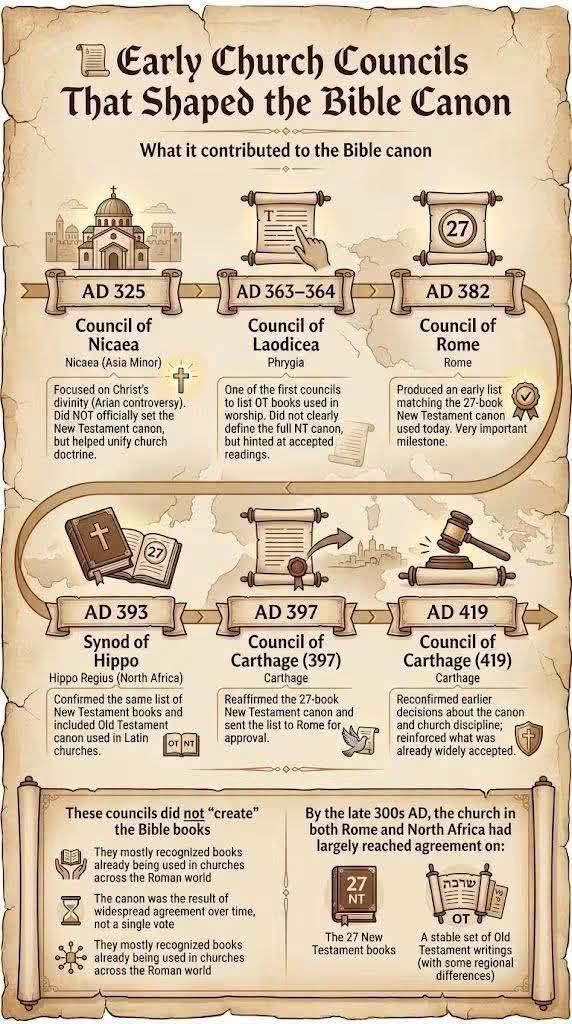
 Early Church Councils That Shaped the Bible Canon
What it contributed to the Bible canon
AD 325
Council of Nicaea
(Nicaea / Asia Minor)
– Focused on Christ’s divinity (Arian controversy).
– Did not officially set the New Testament canon, but helped unify church doctrine.
AD 363–364
Council of Laodicea
(Phrygia)
– One of the first councils to list OT books used in worship. Did not fully clarify the NT canon, but hinted at accepted readings.
AD 382
Council of Rome
(Rome)
– Produced an early list matching the 27-book New Testament canon used today. Very important milestone.
AD 393
Synod of Hippo
(Hippo Regius / North Africa)
– Confirmed the same list of New Testament books and included Old Testament canon used in Latin churches.
AD 397
Council of Carthage (397)
(Carthage)
– Reaffirmed the 27-book New Testament canon and sent the list to Rome for approval.
AD 419
Council of Carthage (419)
(Carthage)
– Reconfirmed earlier decisions about the canon and church discipline; reinforced what was widely accepted.
These councils did not “create” the Bible books
– They mostly recognized books already being used in churches across the Roman world.
– The canon was the result of widespread agreement over time, not a single vote.
– They mostly recognized books already being used in churches across the Roman world.
By the late 300s AD, the church in both Rome and North Africa had largely reached agreement on:
 The 27 New Testament books
A stable set of Old Testament books (with some regional differences)
Source: Catechists of St. Francis Xavier
How Early Church Councils Recognized and Shaped the Bible Canon
One of the most common questions among Christians is: How did the Bible come into existence? While the books of Scripture were written under the inspiration of the Holy Spirit, the process of recognizing which books belonged in the Bible took several centuries. The early Church played a crucial role in preserving, discerning, and officially recognizing the canon of Sacred Scripture.
Understanding how the Bible canon was formed helps us appreciate the intimate relationship between Scripture and the Church, and the guidance of the Holy Spirit throughout Christian history.
What Is the Bible Canon?
The word canon comes from a Greek term meaning “rule” or “measuring rod.” In Christianity, the canon refers to the official collection of books recognized as inspired by God and authoritative for faith and morals.
Today, the Catholic Bible contains 73 books: 46 in the Old Testament and 27 in the New Testament. However, these books were not gathered into a single volume immediately after they were written.
The Early Christian Communities
The first Christians did not possess a complete New Testament. Instead, they relied on:
- The teachings of Jesus passed down by the Apostles.
- Oral Tradition preserved by the Church.
- The Jewish Scriptures (the Old Testament).
- Individual letters and writings of the Apostles.
As Christianity spread throughout the Roman Empire, numerous Christian writings circulated among believers. Some were genuine apostolic writings, while others were not.
This situation raised an important question: Which books truly belonged to Sacred Scripture?
The Need for a Defined Canon
By the second and third centuries, various groups began promoting teachings that differed from apostolic Christianity. Some accepted only certain books, while others introduced writings of doubtful origin.
Church leaders recognized the need to identify clearly which writings faithfully conveyed the apostolic faith. Several criteria were used:
Apostolic Origin
A book needed to be written by an Apostle or closely connected to apostolic teaching.
Orthodoxy
Its teachings had to agree with the faith handed down by the Apostles.
Universal Acceptance
The book needed to be widely used in Christian worship and accepted throughout the Church.
Spiritual Authority
The faithful recognized these writings as inspired by God and spiritually fruitful.
The Role of Early Church Councils
The canon was not invented by Church councils; rather, the councils formally recognized the books that had already been accepted and used by the Church.
The Council of Rome (382 AD)
Under the leadership of Pope Damasus I, the Council of Rome produced a list of biblical books corresponding to the modern Catholic canon. This was one of the earliest official declarations regarding the contents of Scripture.
The Council of Hippo (393 AD)
Held in North Africa, this council affirmed the list of biblical books recognized by the Church. It helped establish greater unity regarding the canon.
The Council of Carthage (397 AD)
The bishops gathered at Carthage reaffirmed the same canon and requested confirmation from the Bishop of Rome. This list included the Deuterocanonical books of the Old Testament, which are present in Catholic Bibles today.
The Council of Carthage (419 AD)
A later council again confirmed the same canon, strengthening the Church’s consensus.
The Influence of Saint Jerome
At the request of Pope Damasus I, Saint Jerome translated the Bible into Latin. His translation, known as the Vulgate, became the standard Bible of the Western Church for more than a thousand years.
Jerome’s work greatly contributed to preserving and transmitting the biblical canon throughout Christian history.
The Council of Trent
During the sixteenth century, some Reformers questioned the status of certain biblical books. In response, the Council of Trent solemnly reaffirmed the traditional canon of 73 books in 1546.
This declaration did not create a new canon but confirmed the one that had been recognized and used by the Church since ancient times.
Scripture and Tradition
The formation of the Bible canon demonstrates an important Catholic principle: Scripture and Tradition work together. The same Holy Spirit who inspired the biblical authors also guided the Church in recognizing the inspired books.
Without the discernment of the early Church, Christians would not have a definitive list of biblical writings. The Bible itself is a witness to the Church’s role in preserving God’s revelation.
Lessons for Christians Today
The history of the biblical canon teaches several important lessons:
- God guides His Church through history.
- The Bible emerged within the life of the Church.
- Sacred Scripture is a gift preserved by faithful generations of Christians.
- Unity in faith requires both Scripture and apostolic Tradition.
- The Holy Spirit continues to guide believers in understanding God’s Word.
Conclusion
The Bible did not simply fall from heaven as a completed book. Rather, through centuries of prayer, discernment, and guidance by the Holy Spirit, the early Church recognized the writings that faithfully conveyed God’s revelation. Councils such as Rome, Hippo, and Carthage played a vital role in affirming the canon that Christians continue to read today.
For Catholics, the story of the Bible canon is a powerful reminder that Christ entrusted His truth to the Church, which faithfully preserved and transmitted the Word of God through the ages. The Bible and the Church stand together as enduring witnesses to God’s saving plan for humanity.
Leave a Reply