
Introduction
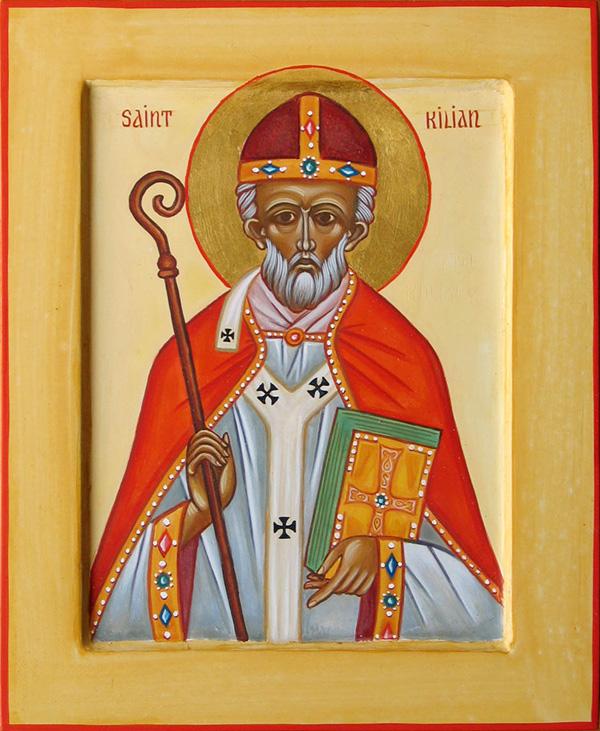
Saint Killian is one of the great missionary saints of the early medieval Church. An Irish bishop and missionary, he left his homeland to proclaim the Gospel among the pagan peoples of central Europe during the seventh century. Through his fearless preaching, deep holiness, and unwavering commitment to Christ, he brought countless people to the Christian faith. His missionary journey eventually led him to the region of Franconia, in present-day Germany, where he met a martyr’s death around the year 689.
Saint Killian is especially revered as the Apostle of Franconia. Along with his companions, Saint Colman and Saint Totnan, he remains a powerful example of missionary courage, pastoral zeal, and fidelity to the Gospel even at the cost of life itself.
His feast is celebrated on July 8, and he continues to inspire missionaries, priests, bishops, and all Christians who seek to witness to Christ with boldness and love.


Historical Background
The seventh century was a remarkable period of missionary activity throughout Europe. Ireland had become a vibrant center of Christian learning and monastic spirituality. Following the examples of saints such as Saint Patrick, Saint Columba, and Saint Columbanus, many Irish monks voluntarily left their homeland to evangelize distant lands.
These missionaries were known as peregrini—pilgrims for Christ—who willingly abandoned family, homeland, and possessions to spread the Gospel.
Saint Killian belonged to this extraordinary missionary movement.
Early Life
Very little historical information survives regarding Killian’s childhood. Tradition holds that he was born around 640 AD in Ireland, probably in what is now County Cavan or County Kerry, though historians differ on the exact location.
From an early age, Killian displayed:
- Deep faith
- Love for Scripture
- A spirit of prayer
- Compassion for the poor
- Desire to preach Christ
He entered religious life and eventually became a priest. Because of his wisdom, holiness, and leadership, he was later consecrated a bishop.
Even after becoming a bishop, Killian felt called to missionary work beyond Ireland.
Missionary Calling
Inspired by the Great Commission of Christ:
“Go therefore and make disciples of all nations” (Matthew 28:19),
Killian gathered several companions.
Among them were:
- Saint Colman
- Saint Totnan
Together they left Ireland, trusting completely in Divine Providence.
They crossed the sea into continental Europe, traveling through present-day France before reaching the Germanic territories.
Their journey involved:
- dangerous forests
- pagan tribes
- political instability
- language barriers
- constant hardships
Yet they continued preaching with joy.
Journey to Rome
Before beginning their missionary work, Killian made an important decision.
He traveled to Rome to seek the blessing of the Pope.
There he met Pope Conon.
The Pope:
- approved his missionary plans
- confirmed his episcopal authority
- encouraged him to preach in Germany
- gave him apostolic blessing
This demonstrates Killian’s strong communion with the universal Church and his obedience to the successor of Saint Peter.
Mission in Franconia
Killian eventually settled in the region of Franconia.
The principal city was Würzburg.
At that time the area remained largely pagan.
Killian began preaching:
- repentance
- conversion
- faith in Christ
- Christian morality
- baptism
- charity
His preaching was simple yet powerful.
Many people embraced Christianity.
Conversion of Duke Gozbert
Among those deeply impressed by Killian’s preaching was Gozbert.
The duke eventually accepted Christianity.
This represented an enormous breakthrough for the Church because rulers often influenced entire populations.
However, Killian’s work soon encountered a serious challenge.
Speaking the Truth
After the duke’s conversion, Killian discovered that Gozbert had married his brother’s widow, Geilana.
According to Christian teaching and Church law, this marriage was unlawful.
Killian courageously explained the Church’s teaching.
He urged the duke to separate from the unlawful marriage.
The duke was willing to obey.
Geilana, however, became furious.
She feared losing her power and influence.
Her anger gradually turned into hatred toward the missionaries.
Martyrdom
When Duke Gozbert left on a military campaign, Geilana seized the opportunity.
She ordered soldiers to kill the missionaries.
Around 689 AD, Killian, Colman, and Totnan were murdered while praying.
According to tradition:
- they offered no resistance
- they accepted death peacefully
- they forgave their killers
- they remained faithful until the end
Thus they became martyrs.
Their blood became the seed of Christianity in Franconia.
Burial and Rediscovery
The murderers secretly buried the bodies of the missionaries.
For many years their burial place remained unknown.
Later, during the episcopate of Saint Burchard in the eighth century, the relics of the martyrs were discovered.
Their remains were solemnly transferred to the cathedral.
Many miracles were reported through their intercession.
This greatly strengthened devotion to Saint Killian.
Saint Killian and Würzburg
Today, Würzburg remains the spiritual center of devotion to Saint Killian.


The city’s magnificent Würzburg Cathedral is dedicated to Saint Kilian.
His relics rest there and continue to attract pilgrims from across Germany and beyond.
Every year, thousands participate in the Kiliani Festival, honoring the saint through:
- Holy Mass
- processions
- prayer
- cultural celebrations
- charitable activities
Spiritual Characteristics
Saint Killian’s life reflects many Christian virtues.
1. Missionary Zeal
He willingly left home to preach Christ.
His example challenges Christians to become missionaries wherever they live.
2. Obedience to the Church
Before beginning his mission, he sought papal approval.
His ministry remained firmly rooted in unity with the Church.
3. Courage
Killian never compromised the truth.
Even when addressing powerful rulers, he proclaimed the Gospel faithfully.
4. Holiness
His preaching flowed from prayer.
He evangelized first through the witness of his life.
5. Martyrdom
He valued eternal life more than earthly safety.
His martyrdom reminds believers that faith sometimes demands heroic sacrifice.
Patronage
Saint Killian is the patron saint of:
- Franconia
- Würzburg
- Missionaries
- Evangelists
- Those suffering persecution for the faith
Many churches throughout Germany, Ireland, and other countries bear his name.
Lessons for Modern Christians
Saint Killian’s witness remains highly relevant today.
Live the Truth
He reminds Christians that love and truth must always remain together.
Evangelize with Joy
Mission is not limited to priests or religious.
Every baptized Christian is called to share Christ.
Trust God’s Providence
Killian traveled without wealth or security.
His confidence rested entirely in God.
Defend Christian Morality
He demonstrated that authentic pastoral care includes speaking difficult truths with charity.
Persevere Through Opposition
Opposition should never discourage faithful discipleship.
Miracles and Legacy
Many miracles have been attributed to Saint Killian’s intercession throughout the centuries.
Pilgrims continue to pray for:
- healing
- family unity
- conversion
- courage
- missionary vocations
- protection
His influence extended far beyond his lifetime.
The Christian faith became firmly rooted in Franconia largely through the witness of Killian and his companions.
Saint Killian in Christian Art
Saint Killian is commonly portrayed with:
- a bishop’s mitre
- a crozier
- a sword (symbolizing martyrdom)
- a palm branch
- a book of the Gospels
- missionary companions beside him
These symbols express both his episcopal ministry and his martyr’s crown.
Feast Day
The Church celebrates the feast of Saint Killian on July 8.
In Würzburg and throughout Franconia, the celebration includes:
- Eucharistic celebrations
- relic processions
- pilgrimages
- community festivals
- prayers for missionaries
Prayer to Saint Killian
O glorious Saint Killian,
faithful bishop, courageous missionary, and heroic martyr, you left your homeland to proclaim the Gospel to those who had not yet known Christ. Obtain for us the grace to love the Lord with our whole heart and to bear witness to Him with courage in our daily lives.
Help us to remain faithful to the truth, even when it is difficult or unpopular. Strengthen missionaries throughout the world, protect those who suffer for their faith, and inspire many young people to answer God’s call to serve His Church.
Through your powerful intercession, may our families grow in holiness, our communities be renewed in faith, and our hearts be filled with the joy of the Gospel.
We ask this through Christ our Lord. Amen.
Conclusion
Saint Killian stands among the greatest missionary saints of the early Church. His life demonstrates that genuine evangelization requires prayer, sacrifice, obedience, courage, and unwavering fidelity to Christ. Though his earthly ministry ended in martyrdom, his witness transformed an entire region and continues to bear fruit more than thirteen centuries later.
His example calls every Christian to become a fearless witness to the Gospel, speaking the truth with charity, trusting completely in God’s providence, and remaining faithful even in the face of suffering. As the Apostle of Franconia, Saint Killian reminds us that one life surrendered to Christ can illuminate generations and lead countless souls to the saving love of God.
Leave a Reply