
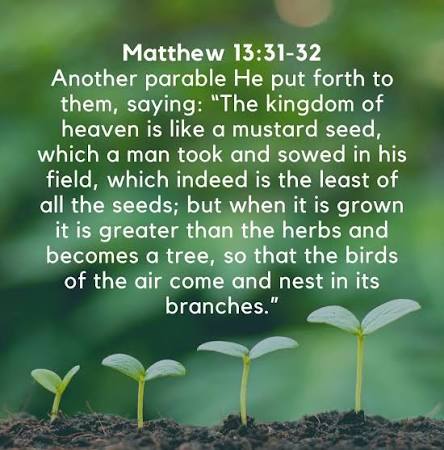
Matthew 13:31–32
After hearing the Parable of the Sower, the disciples could hardly have felt encouraged. Jesus had just revealed that many who hear the word of God never bear lasting fruit. Some reject it immediately. Others receive it with joy but fall away when persecution arises. Still others allow the cares and pleasures of this life to choke the word until it becomes unfruitful. Even among those who belong to the Kingdom, the enemy continues to sow weeds among the wheat.
Such teaching naturally raises an important question. If so, many reject the Gospel, if many who begin well later fall away, and if evil continues to flourish alongside the good, will God’s Kingdom truly prevail?
The Parable of the Mustard Seed is Christ’s answer to that question.
“The kingdom of heaven is like a grain of mustard seed, which a man took and sowed in his field.” (Matthew 13:31)
At first glance, the comparison seems surprising. Why would our Lord compare the Kingdom of Heaven to one of the smallest seeds?
Because He is teaching us that His Kingdom is never to be measured by outward appearance.
Again and again throughout Scripture, God delights in accomplishing His greatest works through what the world considers small, weak, and insignificant. He chose an elderly couple to become the parents of a great nation, a shepherd boy to defeat a giant, an obscure virgin from Nazareth to bear the Savior of the world, and a handful of fishermen to proclaim salvation to the nations. In the same way, the Kingdom begins as a mustard seed—not because it lacks power, but because its power is hidden.
This is the great lesson of the parable. Divine power often conceals itself beneath humble beginnings. What appears insignificant to human eyes already contains within itself the life and power of God. The Kingdom begins in humility, yet it ends in glory.
Thus, the discouragement created by the previous parables is answered. Many will reject the Gospel. Others will abandon it. Evil will continue to oppose the work of God until the final judgment. Yet none of these realities can prevent the Kingdom from accomplishing the purpose for which God established it.
But what does Jesus mean by “the Kingdom of Heaven”?
Here the Kingdom refers to God’s saving reign made present through the proclamation of the Gospel. Wherever Christ is preached, wherever His Word is believed, wherever hearts are brought into obedience to Him, there the Kingdom is at work. It is God’s gracious rule established not by armies or political authority but by the saving truth that leads men and women to eternal life.
For this reason Jesus later declares,
“The kingdom of God will be taken away from you and given to a people producing its fruits.” (Matthew 21:43)
The privilege of receiving and proclaiming God’s saving truth would no longer belong to those who rejected the Messiah but to those who welcomed Him in faith. From that moment onward, the Kingdom would advance, not through earthly dominion, but through the preaching of Christ crucified and risen.
The Fathers of the Church saw still greater richness in this image. St. Augustine observes that the mustard seed signifies “the warmth of faith” and its remarkable power as an antidote against poison.
What a fitting description of Christian faith.
Faith often begins quietly. A child learns to pray. A sinner turns to God in repentance. A person hears the Gospel and believes. These beginnings may appear almost imperceptible, yet genuine faith possesses within itself the very life of God. It is never merely intellectual agreement with certain doctrines or the preservation of inherited customs. True faith unites the believer to Christ, kindles love for God, and transforms the whole person.
Like the mustard seed, faith also possesses extraordinary strength. A small measure of genuine faith resists the poison of sin, overcomes falsehood with truth, strengthens the believer against temptation, and perseveres through suffering. What appears weak to the world becomes mighty because it is sustained by divine grace.
Jesus continues,
“A man took and sowed it in his field.”
The Fathers identify this man as Christ Himself. He is the Divine Sower who continually plants His Gospel in the world, in His Church, and within every human heart prepared to receive it. In every generation Christ continues to sow the seed of His Word wherever hearts are willing to receive it.
The seed may be small, but the Sower is the Lord of heaven and earth. Therefore, its growth does not depend upon human ingenuity, eloquence, or influence. It depends upon God.
As St. Paul writes,
“I planted, Apollos watered, but God gave the growth.” (1 Corinthians 3:6)
Every conversion, every faithful church, every holy life, every act of spiritual growth is ultimately God’s work. Christ plants; His servants labor faithfully; but only God gives life.
History itself bears witness to the truth of this parable.
When the Gospel first appeared in the ancient world, it seemed utterly insignificant. It seemed destined to disappear almost as quickly as it had begun. Against the immense power of the Roman Empire, the prestige of Greek philosophy, and the religious traditions of the ancient world, Christian message appeared weak, unimpressive, and even absurd.
To educated Greeks and Romans, wisdom consisted in eloquent rhetoric, refined philosophy, and human achievement. By comparison, the proclamation of a crucified Messiah seemed foolish. To many Jews, it was an offense; to the Gentiles, an object of ridicule.
As St. Paul himself admits,
“We preach Christ crucified, a stumbling block to Jews and foolishness to Gentiles.” (1 Corinthians 1:23)
Yet what the world dismissed as foolish proved to be the wisdom of God. What appeared weakest became stronger than kingdoms. The empire that persecuted the Church eventually disappeared, while the Gospel continued to spread.
What began with twelve ordinary disciples eventually reached the ends of the earth.
The apostles possessed neither wealth, political influence, nor military power. Their strength lay solely in the power of the Holy Spirit, fulfilling Christ’s promise
As Jesus promised,
“You shall receive power when the Holy Spirit has come upon you; and you shall be My witnesses…to the ends of the earth.” (Acts 1:8)
The history of the Church is therefore nothing less than the history of the mustard seed. Again and again God has accomplished immeasurably more than human strength could ever explain.
Finally Jesus tells us that the mustard seed becomes a great tree,
“…so that the birds of the sky come and dwell in its branches.”
The tiny seed has become a place of refuge.
The tree represents the mature Kingdom of God manifested in the life of the Church. Its branches symbolize the fullness of Christ’s saving gifts; His truth, His sacraments, His grace, and the communion of His people. The birds signify all who come from every nation to find rest, protection, and eternal life in Him.
This image is also deeply personal. We ourselves are invited to dwell within the life-giving branches of this tree—to make our home in the truth of Christ, to rest beneath His gracious care, and to allow His Word to lift our hearts above the passing concerns of this world toward the eternal realities of His Kingdom.
Brothers and sisters, we began with a question: Will God’s Kingdom truly prevail?
Christ answers with a mustard seed.
Never judge God’s work by what your eyes can presently see. A faithful prayer, a quiet word of witness, a child instructed in the faith, a parish that humbly serves Christ, or a single act of sacrificial love may appear insignificant today. Yet in the hands of God these are mustard seeds from which He builds His everlasting Kingdom.
Therefore, let us never despise small beginnings. Let us remain steadfast in sowing the Gospel, trusting that the God who gives the growth will accomplish His saving purpose in His perfect time.
And may we ourselves become like the birds that find their home among the branches of the mustard tree, abiding securely in Christ until the day He gathers us into the fullness of His eternal Kingdom.
Amen.
✍ Fr James Abraham
Leave a Reply