

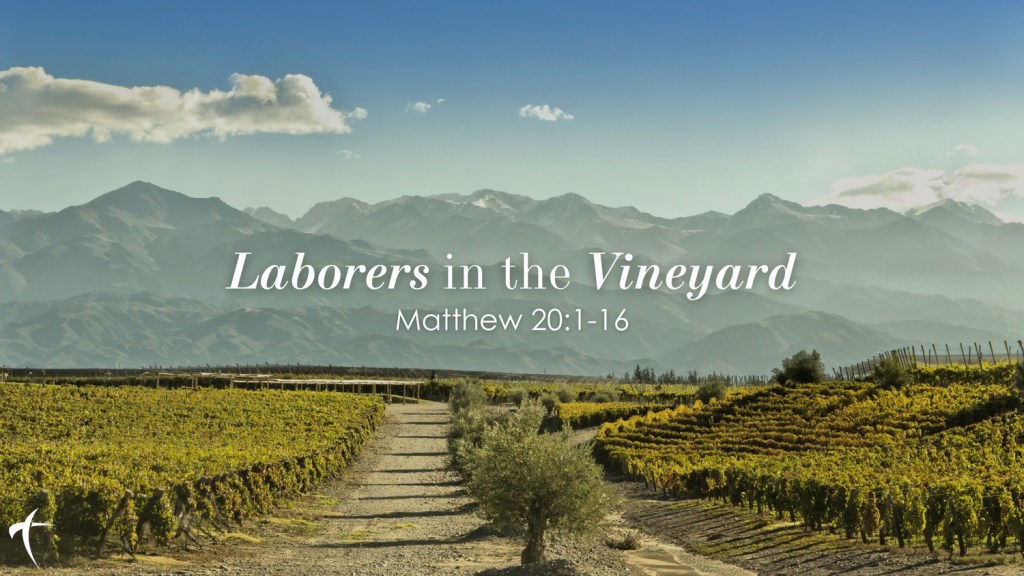
“Yes, to the Master: Discovering Life in God’s Vineyard”
Matthew 20:1-16 – The Parable of the Laborers in the Vineyard
This story of Jesus comes at a pivotal moment. He is on the road to Jerusalem, moving from Galilee to Judea (Mt 19:1), on the path that will lead Him to the Passion, death, and Resurrection. From chapter 19 to 25, Matthew shows Jesus teaching, challenging, and confronting the religious authorities, preparing His disciples—and all who would listen—to understand the coming kingdom of God.
Jesus presents Himself as the Master of the vineyard, the one who cultivates and tends His kingdom. He is not distant or indifferent. He surrounds the vineyard with care, cultivates it with love, and prepares it to bear good fruit (Mt 21:33ff). He invites to His table not the strong or proud, but the most overlooked—the crippled, the lame, the blind (Lk 14:21ff). He calls us to stay vigilant, keeping watch for His return, whether it comes in the evening, at midnight, or at the rooster’s crow (Mk 13:35).
The image of the vineyard, simple at first glance, carries a deep meaning in Scripture. From the Old Testament to the fullness of revelation in Jesus Christ, the vineyard is a symbol of God’s love, care, and patient cultivation of His people.
In the First Book of Kings, we read about Naboth, who refused to give up his vineyard to King Ahab. His vineyard was not just land; it was his heritage, his identity, his most precious possession. Out of love, he gave his life rather than surrender it. The vineyard here symbolizes what is most vital to us, what holds our roots and dignity—what is worth protecting at every cost.
The prophet Isaiah also uses this image: “Now, the vineyard of the Lord of hosts is the house of Israel; and the people of Judah are His cherished plant” (Is 5:7). God’s people are His vineyard. He loves us with an infinite, unbreakable love. He tends, waters, prunes, and cultivates us so we may bear good fruit. Each of us is a branch of this vineyard, a part of God’s beloved people, the Church.
In Jesus, the vineyard reaches its ultimate meaning. He is the true Vine, and we are the branches (Jn 15:1ff). The Father, the vine-dresser, continues His patient work in us. He prunes what is unfruitful, nurtures what is weak, and sends us into the world to bear fruit for His Kingdom. Our mission is clear: we are called to give of ourselves, offering the fruits of our love, mercy, and service to others. We are called to remain united to the Vine.
The Master of the vineyard promises the laborers a denarius for a day’s work—a fair wage, enough to live with dignity. At that time, it was a good sum, similar to the drachma mentioned in the story of Tobit (Tb 5:15).
But Jesus gives this denarius a deeper meaning. He calls it “that which is just” (Mt 20:4). Here, the reward is not just money; it is what is truly good, what is lasting, what fulfills the deepest needs of the human heart. That reward is Himself. Our inheritance in God’s Kingdom is not gold or silver, not status or recognition—it is Jesus Christ.
He assures us: “I am with you not only today, but all days, until the end of the world” (Mt 28:20). He is our reward, our inheritance, our denarius. To work in His vineyard is to receive the priceless gift of His presence. It is the face of Christ, His love poured into our lives—a reward that cannot be taken, taxed, or lost.
The Gospel also invites us to look honestly at something we often try to hide: the murmuring and grumbling in our hearts. These are the silent complaints that disfigure our peace, distance us from God, from others, and even from ourselves.
We see them in the story of the laborers who complained against the Master. But murmuring is not new. In the desert, the people of Israel doubted God’s care: “The Lord hates us; that is why He brought us out of Egypt to hand us over to the Amorites” (Dt 1:27). Today, similar murmurs rise within us: jealousy, envy, irritation, and the quiet grumbling when God’s mercy touches others in ways we find hard to understand.
Murmuring comes from a heart that does not fully accept God’s love, His ways, or His timing. It arises when we want to measure God’s action by our standards, to “adjust” His generosity to fit our sense of fairness. Jesus sees this in us—not to condemn us, but to heal us. Out of love, He reveals what is hidden, brings our hearts into the light, and restores the sight of our spiritual eyes, just as He healed physical eyes in His ministry.
Saint Peter gives us a practical path: “Practice hospitality with one another, without murmuring” (1 Pt 4:9). To practice hospitality is to accept, to open our hearts to God, to others, and to life itself. When we accept Jesus as He is, with His ways of loving, waiting, and calling, the harshness of murmuring softens. When we stop comparing, resenting, or judging, our hearts are freed to bear fruit and to live in true peace.
God comes to offer His love, His presence, His friendship. He comes to seal a covenant with us. He offers us the beauty of His vineyard—the gift of Himself and the Kingdom.
This parable asks us: How will we respond to God’s call? Will we cling to our comfort, our “earned” rewards, or will we step into the freedom of His love? Will we fear surrendering, or will we humbly say, like Mary, “Yes, Lord, may it be done to me according to Your word” (Luke 1:38)
Jesus’ call can unsettle us. It reaches deep into our hearts, gently exposing our fears, our attachments, and the ways we try to protect ourselves from His love. Yet this unsettling is not meant to frighten us—it is meant to awaken us. His call is a call to freedom, to abundance, to a life rich in His grace and presence.
Saying “yes” to Him does not mean denying who we are; rather, it is the path to discovering who we truly are in Him—beloved, chosen, and invited to participate in His work and share in His joy. Every act of surrender, every moment we trust Him, allows His vineyard to grow, and allows His love to bear fruit through us. In saying yes, we step into the life we were created for—a life of love, service, and deep, lasting fulfillment.
Let us enter the vineyard today, carrying our hearts open, ready to serve, ready to rejoice, and ready to receive His generous love. Amen.
✍ Fr James Abraham
 Nelson MCBS
Leave a comment