
“When God Speaks in Silence”
(Matthew 1:18–25)
As we come to the final step of our advent waiting, the Church, like Mary and Joseph, stands on the edge of wonder. Soon we will kneel before the manger and hear angels sing, “Glory to God in the highest.”
Today, the Church places before us a quiet but decisive figure: St. Joseph. Gospel gives us one last quiet scene the Annunciation to Joseph, a moment not of proclamation but of silence, not of triumph but of trust.
The Gospel today tells us very little about what Joseph said, but it tells us everything about what Joseph did. Joseph teaches us that God’s greatest works often unfold in silence, obedience, and trust.
Matthew begins simply: “Now the birth of Jesus Christ was in this way.” After recounting forty-two generations from Abraham through kings and exiles to Joseph he suddenly pauses. The rhythm of “Abraham begot Isaac… David begot Solomon…” stops.
Something new begins. Matthew deliberately breaks the pattern.
Here, God enters history in a way never seen before through a virgin’s womb, by the power of the Holy Spirit.
The Creator enters His creation not in the halls of kings, but in the hidden home of Nazareth, a place so small it was never once mentioned in the Old Testament.
The eternal Word becomes flesh not to overwhelm us with glory, but to accompany us in humility. He comes not to dazzle, but to dwell.
So, in the Incarnation, Christ does not come in overwhelming majesty, but in humble littleness: not to coerce our fear, but to draw our love.
Joseph’s Trial: When Faith Meets Mystery
Mary has already said her fiat, her “yes.” But now, the story unfolds through Joseph’s eyes.
“When Mary was betrothed to Joseph, before they came together, she was found with child of the Holy Spirit.”
Matthew presents Joseph at a moment of deep inner crisis. Mary, his wife, is found to be with child. Joseph knows he is not the father.
Imagine Joseph’s heartbreak. He knows Mary’s holiness. He has seen her purity. And yet now she is with child. Everything he believed about her seems to crumble.
The Fathers of the Church call this the “holy perplexity” of Joseph. He does not accuse; he does not act rashly. He remains silent, thinking, praying, searching for what is right. Joseph stands before the mystery of God’s saving plan, a mystery greater than his understanding.
The law gives him options, but love shapes his response. Scripture calls him a “just man”. Joseph’s justice is love in action. His justice is not rigid legalism; it is mercy informed by faith.
St. John Chrysostom says, “Justice and mercy are so united, that the one ought to be mingled with the other; justice without mercy is cruelty; mercy without justice, profusion.” He was just because his justice was full of mercy. True righteousness is not cold law, but compassionate love.
St. John Paul II, in Redemptoris Custos, reflects that Joseph’s justice was a synthesis of fidelity to the Law and openness to the will of God. He loved rightly because he trusted God even when he did not understand.
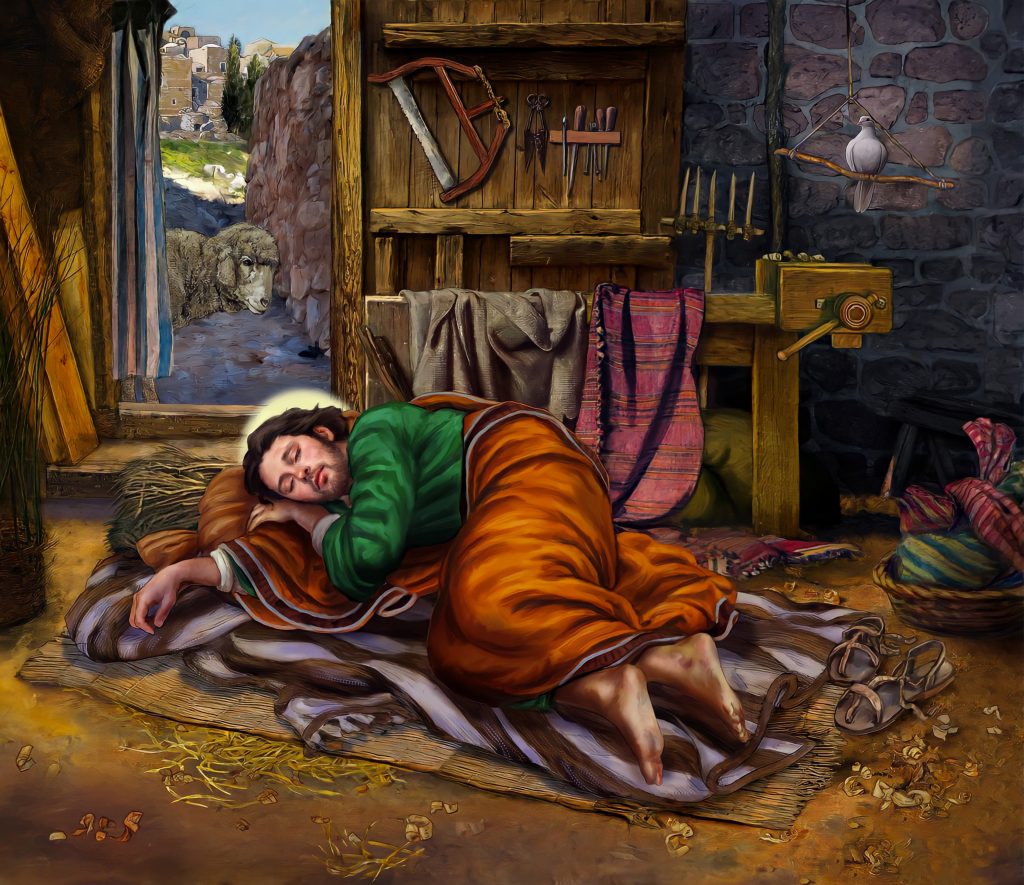
Faith often begins in the space between confusion and obedience. Joseph does not yet know what God is doing but he stays silent, he prays, he listens.
And in that silence, into Joseph’s uncertainty, God speaks:
“Joseph, son of David, do not be afraid to take Mary your wife into your home, for that which is conceived in her is of the Holy Spirit.”
He does not understand everything. He feels the wound of confusion, the fear of acting wrongly, the weight of responsibility. But he remains open. When the angel speaks, he receives the mystery not with arguments but with obedience.
“Joseph, son of David, do not be afraid…” the same words the angel had spoken to Mary, the same words God speaks to every heart preparing for Christ.
Every time God begins something new, He says the same words:
“Do not be afraid.”
To Abraham, to Moses, to Mary, and now to Joseph. And through Joseph, to us. Faith gives us courage to walk even in the dark. God does not remove the darkness from our path, but He gives us the light to walk through it.
Fear is always the first obstacle to faith. Joseph is afraid not of responsibility, but of unworthiness. Yet God reassures him and entrusts him with what is most precious: Mary and the Child.
Joseph’s response is immediate and total:
“He did as the angel of the Lord commanded him.”
Joseph does not demand explanations. He does not negotiate conditions. He entrusts his future entirely to God’s word.
That is what makes Joseph great: not miracles, not speeches, but faith that acts. The Fathers called him “the silent saint.”
Joseph’s “yes” is quiet, but it changes the world.
Pope St. John Paul II calls Joseph “the guardian of the mystery of God”.
He shelters the Word made flesh.
He guards the Virgin Mother.
He welcomes God into his home.
“You Shall Call His Name Jesus”
The angel gives Joseph a mission: “you shall call His name Jesus,”
Jesus – “God saves – is not just a name, it is a promise, a mission, a revelation of God’s heart.
And so, the Child whom Joseph will name “Jesus” is not just a human child; He is the Savior, the Son of the living God.
St. Peter Chrysologus said, “He saves not others’ people, but His own for by faith all become His.” Christ does not come to rescue us from hardship or discomfort, but from sin and death, from the deepest captivity of the human heart.
At the end of the Gospel, Joseph names the child Jesus and in doing so, he becomes the first human voice to speak the Savior’s name. That name still carries power. It is the name we whisper in prayer, the name we invoke in confession, the name we receive in blessing.
The God who once entered the world through Joseph’s obedience still enters our lives through our faith.
As we stand on the brink of Christmas, the Church invites us to stand beside Joseph in quiet trust, humble obedience, and steadfast love.
“Joseph teaches us that faith is not about explaining everything but about trusting that God can make even confusion fruitful.”
So let us, like Joseph, rise in faith and welcome Christ into our homes and hearts.
May the Holy Family guide us to Bethlehem, so that when the Child is born, He may also be born anew in us and we may echo Joseph’s silent faith with our own living “Yes”.
✍ Fr James Abraham
 Nelson MCBS
Leave a comment