
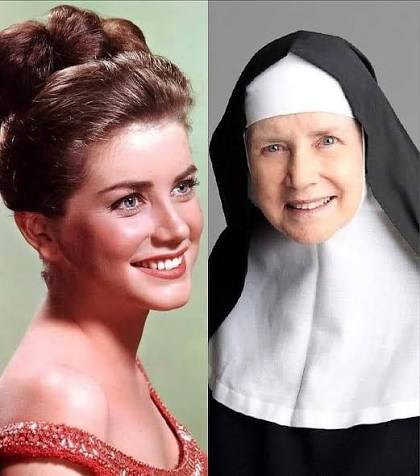
The story of Dolores Hart is one of the most extraordinary journeys in the history of Hollywood. She entered the film industry as a beautiful and talented young actress, worked opposite some of the biggest stars of the 1950s and early 1960s—including Elvis Presley—and appeared to be on the path toward major Hollywood stardom.
Yet, at the age of 24, while her career was flourishing and she was engaged to be married, Dolores Hart made a decision that shocked Hollywood: she left the movie business and entered a Benedictine monastery.
Her story is not simply about an actress who abandoned fame. It is about a woman who believed that she had discovered a deeper calling and chose to follow it.


Early Life
Dolores Hicks was born in Chicago, Illinois, on October 20, 1938, to Bert and Harriet Hicks. Her father was an actor, and the family eventually moved to Hollywood. Growing up around the movie industry gave Dolores an early glimpse into the world of acting.
Her grandparents also played an important role in her upbringing. Her grandfather worked as a movie-theater projectionist, and Dolores developed an early fascination with films.
Although she was surrounded by show business, her spiritual life was also developing. Dolores became a Roman Catholic at the age of 10, an important part of the story that would later shape the direction of her life. (Wikipedia)
She attended Catholic schools and later studied at Marymount College near Los Angeles. While performing in a college production, she attracted the attention of people connected with Hollywood producer Hal B. Wallis.
Her acting career was about to begin.
Becoming a Hollywood Actress
In 1957, Dolores Hart made her film debut in Loving You, starring opposite a young Elvis Presley.
The film was significant in Presley’s career, and Dolores became the actress who shared his first on-screen kiss. Her performance attracted attention, and she quickly became one of Hollywood’s promising young actresses. (Los Angeles Times)
The following year she reunited with Elvis in King Creole (1958), a film that remains one of Presley’s most highly regarded early movies.
But Dolores was not merely known because she acted with Elvis.
She demonstrated that she could work in serious dramatic roles as well as popular entertainment. She appeared in Wild Is the Wind with Anthony Quinn and Anna Magnani and in Lonelyhearts with Montgomery Clift and Robert Ryan. She later appeared in films such as Where the Boys Are, Francis of Assisi, and Come Fly with Me. (Los Angeles Times)
Her career was developing rapidly.
A Rising Star
By the early 1960s, Dolores Hart had become a familiar face to American movie audiences.
She was sometimes compared with actresses such as Grace Kelly because of her appearance, poise, and screen presence. Hollywood appeared to offer her a promising future.
She also demonstrated her talent on the stage. In 1959, she received a Tony Award nomination for her Broadway debut in the romantic comedy The Pleasure of His Company. (Los Angeles Times)
From an ordinary young woman in Chicago, she had entered the glamorous world of Hollywood and Broadway.
Everything seemed to be going in the right direction.
But something else was happening inside her.
A Different Calling
Dolores had been a practicing Catholic since childhood, but her religious vocation did not suddenly appear overnight.
In 1959, she visited the Abbey of Regina Laudis, a Benedictine monastery in Bethlehem, Connecticut. That experience left a deep impression on her.
At the time, however, she continued her acting career.
She was also in a serious relationship with Don Robinson, an architect. The two became engaged and planned to marry. From the outside, Dolores seemed to have everything: a successful career, beauty, recognition, and a future husband.
But internally, she was asking a much deeper question:
What did God want her to do with her life?
According to accounts of her life, Dolores increasingly felt that acting and worldly success could not fully satisfy the deepest desires of her heart. Her decision was not an escape from failure. She was actually leaving Hollywood while her career was still promising. (Los Angeles Times)
The Extraordinary Decision of 1963
In 1963, Dolores Hart made the decision that would change her life forever.
She broke off her engagement to Don Robinson and entered the Benedictine Abbey of Regina Laudis.
She was only 24 years old.
For Hollywood, the news was astonishing.
Here was a beautiful and successful young actress who had worked with Elvis Presley and other major stars. She had appeared on Broadway. She was engaged to be married. She had every reason to continue pursuing fame.
Instead, she chose a life of prayer, community, discipline, and contemplation.
She entered the monastery as a woman seeking God rather than applause.
Her final film, Come Fly with Me, was released in 1963, the same year she left Hollywood. (Wikipedia)
Why Did She Become a Nun?
This is the question that has fascinated people for decades.
Why would a successful actress give up Hollywood?
Dolores herself has explained her decision in terms of a religious vocation. She did not see her choice simply as “giving up” Hollywood.
She believed that she was responding to a call from God.
In one often-reported reflection on her vocation, she explained that she did not feel she was simply walking away from Hollywood but moving toward something she considered more significant.
Her story therefore should not be understood merely as a rejection of acting or fame.
It was, for her, a choice of vocation.
She believed that the life she was being called to was worth more than the fame she had achieved.
Her Connection with Saint Clare
One especially important episode in Dolores Hart’s spiritual journey came through her role as Saint Clare of Assisi in the 1961 film Francis of Assisi.
Playing a saint required her to enter deeply into the world of faith, prayer, sacrifice, and religious vocation.
Her encounter with Catholic spirituality during this period became significant in her developing understanding of her own vocation.
The role also gave her an opportunity to reflect on what it meant to dedicate one’s entire life to God.
For Dolores, the distinction between playing a religious character on screen and actually discerning a religious vocation gradually became very personal.
Life in the Abbey
After entering Regina Laudis, Dolores began a radically different life.
Hollywood was replaced by the rhythm of monastic life.
Instead of film sets, premieres, costumes, cameras, and publicity, there were prayer, work, silence, community, study, and contemplation.
She eventually became known as Mother Dolores Hart, O.S.B.
Her life at the abbey did not mean that her artistic abilities disappeared.
Quite the opposite.
The monastery itself has a strong connection with the arts, and Hart remained involved in artistic and cultural activities. She helped develop an outdoor theater at the abbey, where theatrical productions became part of the community’s cultural life. (National Catholic Register)
In 2001, she became prioress of the abbey, a position of leadership within the Benedictine community. (National Catholic Register)
Thus, the former Hollywood actress did not simply disappear from the world. She continued to use many of her gifts—leadership, communication, artistic appreciation, hospitality, and cultural understanding—in the service of her religious community.
Her Friendship with Hollywood
One of the fascinating aspects of Dolores Hart’s story is that she never completely rejected her Hollywood past.
She continued to maintain friendships and connections with people from the entertainment industry.
Her former fiancé, Don Robinson, remained a close friend after her decision to enter religious life. According to biographical accounts, he never married and continued to visit and support her. (IMDb)
This is an important part of her story because it shows that her decision was not necessarily rooted in hatred of the people or world she had known.
She simply believed that God was calling her to a different way of life.
The Nun Who Still Votes for the Oscars
One of the most unusual facts about Dolores Hart is that she remained connected to the film industry through the Academy of Motion Picture Arts and Sciences.
She is widely noted as a voting member of the Academy.
Thus, the former Hollywood actress who became a Benedictine nun could still watch films and participate in the Academy’s Oscar voting process. (IMDb)
There is something wonderfully symbolic about this.
Dolores did not have to deny the fact that she had once been an actress.
Her past remained part of her story, but it no longer defined her identity.
God Is the Bigger Elvis
Dolores Hart’s remarkable life reached a much wider audience through the 2012 documentary God Is the Bigger Elvis.
The documentary explored her journey from Hollywood actress to Benedictine nun.
The title itself captures the central idea of her story: the fame of Hollywood, even represented by a figure as iconic as Elvis Presley, was ultimately not the greatest reality in her life.
The documentary received an Academy Award nomination for Best Documentary Short Subject. (Los Angeles Times)
The film introduced a new generation to a woman whose story had already fascinated people for decades.
Her Book: The Ear of the Heart
In 2013, Dolores Hart and journalist Richard DeNeut published The Ear of the Heart: An Actress’ Journey from Hollywood to Holy Vows.
The book tells the story of her journey from childhood and Hollywood to religious life.
The title is significant.
“The ear of the heart” suggests a willingness to listen—not merely with the physical ear, but with the deepest part of oneself.
For Dolores, discerning her vocation meant learning to listen to what she believed God was asking of her. (Los Angeles Times)
A Life of Faith and Discernment
Perhaps the most interesting thing about Dolores Hart is that her story is not simply a dramatic story of “Hollywood star becomes nun.”
It is a story about discernment.
She had to make a decision between two very different futures.
One offered fame, money, romance, success, and public recognition.
The other offered prayer, sacrifice, discipline, community, and a hidden life.
She chose the second.
That choice does not mean that every person should leave a career or family life to enter religious life. Rather, her story illustrates the importance of asking a fundamental question:
What is the purpose of my life?
For Dolores Hart, the answer she discovered was religious vocation.
A Message for the Modern World
Her story has relevance far beyond Hollywood.
We live in a culture that often measures success through wealth, popularity, beauty, influence, professional achievement, and public recognition.
Dolores Hart’s life presents a different way of thinking about success.
She had fame—and voluntarily left it.
She had a promising career—and chose another path.
She was engaged to be married—and discerned a different vocation.
She had access to the glamorous world of Hollywood—and chose the hidden life of a monastery.
Her story challenges us to ask:
What is truly valuable?
What gives life meaning?
What is success?
Are we listening to the deepest desires of our hearts?
These are questions that apply to everyone, regardless of religious belief.
From Stardom to Service
It would be easy to describe Dolores Hart’s life as a dramatic movement from “Hollywood glamour to a convent.”
But that description is incomplete.
Her story is really about a movement from public recognition to a deeper understanding of identity and vocation.
As a young actress, she was known because millions of people watched her on screen.
As a Benedictine nun, she became known for a very different reason: her commitment to prayer, community, service, and spiritual life.
The person did not disappear.
The vocation changed.
The talents remained.
The stage changed.
The Lasting Legacy of Dolores Hart
Dolores Hart’s story remains remarkable because it brings together two worlds that seem completely different: Hollywood and the monastery.
She kissed Elvis Presley on screen.
She acted with some of the great performers of her generation.
She appeared on Broadway.
She was nominated for a Tony Award.
And then, at the height of her career, she entered a Benedictine monastery.
Her life reminds us that the deepest decisions in life cannot always be understood from the outside.
What looks like giving something up may, for the person making the decision, be the discovery of something greater.
Dolores Hart once belonged to a world where people sought her autograph.
She later chose a life in which she sought something entirely different: the presence of God.
And that is perhaps the most enduring lesson of her extraordinary story.
Conclusion
The life of Mother Dolores Hart is one of the most unusual and inspiring stories to emerge from twentieth-century Hollywood.
She began as a young actress with a promising future, appeared opposite Elvis Presley, worked with celebrated actors, performed on Broadway, and enjoyed the attention of the entertainment world.
But she eventually heard a different call.
At only 24, she walked away from Hollywood and entered the Benedictine Abbey of Regina Laudis.
More than six decades later, her story continues to fascinate people because it raises questions that every human being must eventually confront:
What is my purpose?
What is worth giving my life to?
What does true happiness mean?
What am I being called to become?
Dolores Hart’s answer was extraordinary.
She discovered that the applause of the world was not enough for her.
She wanted a deeper kind of life.
And she had the courage to follow it.
From Hollywood star to Benedictine nun, the life of Dolores Hart stands as a remarkable testimony to the power of vocation, faith, courage, and the search for a deeper meaning in life.
Leave a Reply