
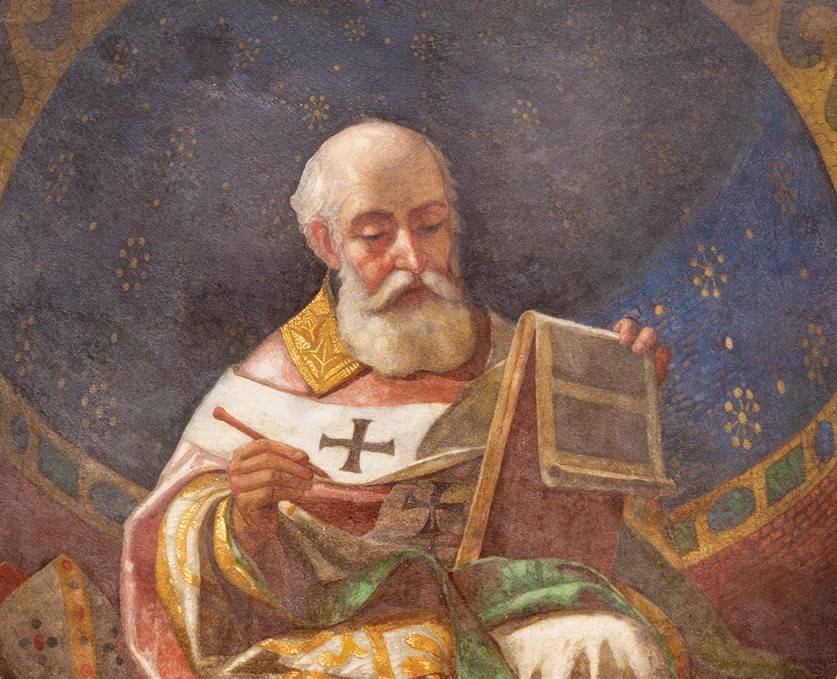
For Holy Thursday / Maundy Thursday, St. Augustine’s preaching is especially rich on the institution of the Eucharist, the washing of the disciples’ feet, Christ’s humility, charity, and the unity of the Church.
Below is a homily written in a form suitable for parish preaching, while drawing on themes and passages from St. Augustine’s works.
MAUNDY THURSDAY HOMILY
“Do You Understand What I Have Done to You?”
John 13:1–15


Dear brothers and sisters in Christ,
Today is one of the most beautiful and profound evenings in the whole Christian year.
We gather on Maundy Thursday, the night on which Jesus gathered His disciples for the Last Supper.
It is the night of the Eucharist.
It is the night of the priesthood.
It is the night of the commandment of love.
And it is the night when Jesus, the Son of God, knelt before His disciples and washed their feet.
The Gospel tells us:
“Having loved his own who were in the world, he loved them to the end.”
— John 13:1
That sentence contains the entire mystery of Holy Thursday:
“He loved them to the end.”
Jesus knew what was coming.
He knew Judas would betray Him.
He knew Peter would deny Him.
He knew the disciples would abandon Him.
He knew the cross was waiting for Him.
And yet He loved them.
Not because they were perfect.
Not because they deserved it.
But because He is love.
1. Jesus Kneels Before His Disciples
Imagine the scene.
The disciples are sitting at table.
They know Jesus as their Master and Lord.
But suddenly Jesus gets up.
He takes off His outer garment.
He wraps a towel around Himself.
He pours water into a basin.
And He begins washing their feet.
The One who created the heavens is kneeling before human beings.
The Lord is serving His servants.
The Master is washing the feet of His disciples.
St. Augustine was deeply moved by this mystery of Christ’s humility.
The One who is Lord of heaven and earth becomes a servant.
The One who needs nothing from us gives Himself completely to us.
This is the paradox of Christianity:
The greatness of God is revealed through humility.
Jesus does not merely tell us:
“Be humble.”
He shows us what humility looks like.
2. “Unless I Wash You…”
When Jesus comes to Peter, Peter protests:
“Lord, do you wash my feet?”
Peter cannot understand.
He thinks that the Lord should never kneel before the disciple.
But Jesus tells him:
“If I do not wash you, you have no share with me.”
Peter then says:
“Lord, not my feet only but also my hands and my head!”
There is something very important here.
Before Jesus asks us to serve others, He first asks us to allow Him to serve us.
Before we wash another person’s feet, we must allow Christ to wash our hearts.
Before we give mercy, we must receive mercy.
Before we forgive, we must experience God’s forgiveness.
Before we become servants, we must understand that Christ has become our servant.
This is the mystery of grace.
Christianity begins not with what we do for God, but with what God has done for us.
3. The Eucharist: “This Is My Body”
Tonight we also remember the institution of the Holy Eucharist.
Jesus takes bread and says:
“This is my body, which is given for you.”
Then He takes the cup:
“This cup which is poured out for you is the new covenant in my blood.”
Jesus does not simply say:
“Remember me.”
He gives us Himself.
The Eucharist is not merely a symbol of Christ’s love.
It is the sacramental memorial of His saving sacrifice.
At every Holy Qurbana, the Church enters into the mystery of Christ’s self-giving love.
The altar tells us:
“This is how much God loves you.”
Christ does not give us something.
He gives us Himself.
4. The Eucharist and the Poor
St. Augustine repeatedly reminds Christians that we cannot separate love for Christ from love for our neighbour.
We cannot come to the altar and say:
“Lord, I love You,”
while refusing to love the person standing beside us.
The Eucharist creates communion.
We receive the one Christ, and therefore we are called to become one body in Him.
This is why Holy Thursday is not only about the altar.
It is also about the feet of our brothers and sisters.
It is about the family member whom we have stopped speaking to.
It is about the person who hurt us.
It is about the poor person whom we overlook.
It is about the sick person who needs our attention.
It is about the lonely person who needs someone to listen.
The Eucharistic Jesus asks:
“If I have given myself for you, how can you refuse to give yourself to others?”
5. “I Have Given You an Example”
After washing their feet, Jesus says:
“Do you understand what I have done to you?”
And then:
“For I have given you an example, that you also should do as I have done to you.”
Jesus is not asking every Christian literally to wash feet every day.
He is asking us to adopt the attitude of the servant.
In the family, sometimes love means saying:
“I will do it.”
Even when we are tired.
Even when nobody thanks us.
Even when we think we are right.
Sometimes holiness is simply washing someone’s feet without expecting applause.
A mother serves her family.
A father sacrifices for his children.
A husband serves his wife.
A wife serves her husband.
Children care for their parents.
A priest serves his people.
A Christian serves the poor.
This is the Gospel.
6. The Eucharist Must Become Charity
St. Augustine gives us a beautiful principle:
What we receive at the altar must become visible in our lives.
If we receive Christ who humbled Himself for us, we must become humble.
If we receive Christ who forgives us, we must forgive.
If we receive Christ who gives Himself, we must learn to give ourselves.
If we receive Christ who loves us to the end, we must love others to the end.
Otherwise, we have not understood the Eucharist.
We may receive Holy Communion with our lips, but the Eucharist must also reach our hearts.
7. Judas Was Also at the Table
There is another painful detail in tonight’s Gospel.
Judas was there.
Jesus knew that Judas would betray Him.
Yet Jesus washed his feet too.
Think about that.
Jesus washed the feet of the man who would betray Him.
He did not withdraw His love because He knew Judas’ weakness.
This does not mean that betrayal is acceptable.
It means something much deeper:
Christ’s love is not controlled by the worthiness of the person receiving it.
Jesus loves even when love is rejected.
Jesus gives even when His gift is not appreciated.
Jesus remains faithful even when human beings are unfaithful.
This should make us examine our own hearts.
Perhaps there is someone whom we find difficult to love.
Perhaps there is someone whose name we do not even want to hear.
Tonight Jesus asks:
“Can you love as I have loved?”
8. The Priesthood and Service
Holy Thursday is also traditionally celebrated as a day especially associated with the institution of the ministerial priesthood.
The priest stands at the altar in the person of Christ.
But the priesthood is not a position of privilege.
It is a vocation to service.
The priest must be willing to kneel.
He must listen.
He must forgive.
He must accompany the suffering.
He must bring Christ to the people and the people to Christ.
The priest’s hands are meant to bless.
His lips are meant to proclaim the Gospel.
His heart is meant to carry the people entrusted to him.
The priesthood finds its deepest meaning not in authority, but in self-giving love.
9. “Love One Another”
The washing of the feet leads us to the new commandment:
“Love one another as I have loved you.”
Notice that Jesus does not simply say:
“Love one another.”
He says:
“As I have loved you.”
That changes everything.
We often love according to our preferences.
We love those who love us.
We forgive those who apologize.
We help those who help us.
But Jesus says:
Love as I have loved you.
Love sacrificially.
Love generously.
Love patiently.
Love when it is difficult.
Love without keeping accounts.
Love even when it costs something.
10. A Holy Thursday Examination of Conscience
Tonight, before we enter into the silence of Gethsemane, let us ask ourselves some questions.
Have I become proud?
Whom have I refused to forgive?
Is there someone in my family whom I have wounded?
Do I receive the Eucharist while carrying hatred in my heart?
Have I forgotten the poor?
Do I serve only when people appreciate me?
Am I willing to humble myself?
Do I truly believe that Jesus gives Himself to me in the Eucharist?
Perhaps tonight Jesus wants to wash not our feet but our wounded hearts.
Let Him.
11. “He Loved Them to the End”
Brothers and sisters,
the most beautiful words of today’s Gospel are:
“He loved them to the end.”
Jesus loves us to the end.
He loves us in our weakness.
He loves us in our failures.
He loves us when we return after sin.
He loves us when we are suffering.
He loves us when we feel unworthy.
He loves us when we have nothing to offer.
And tonight He says:
“Receive my love.”
Then He says:
“Go and love as I have loved you.”
Conclusion
Dear brothers and sisters,
Maundy Thursday gives us three great gifts:
The Eucharist — Christ gives Himself to us.
The Priesthood — Christ continues His saving work through His ministers.
The Commandment of Love — Christ asks us to give ourselves to one another.
The question Jesus asks us tonight is not:
“How much do you know about the Eucharist?”
It is:
“What has the Eucharist done to your life?”
Have you become more loving?
More forgiving?
More humble?
More generous?
More willing to serve?
As we approach the altar tonight, let us remember:
The hands that give us the Eucharist are the hands that washed the feet of the disciples.
And the Eucharist we receive must make us servants.
Let us come to the altar with humble hearts.
Let us allow Jesus to wash us.
Let us receive His Body.
Let us receive His Blood.
Let us receive His love.
And then let us go into our homes, our families, our communities, and our world—and wash one another’s feet through love and service.
May our Holy Thursday prayer be:
“Lord Jesus,
give me a heart like Yours.
Teach me to kneel.
Teach me to serve.
Teach me to forgive.
Teach me to love.
And teach me to give myself
as You have given Yourself for me.
Amen.”
May Jesus in the Holy Eucharist bless you and your families.
May He give us the grace to remain united with Him,
and may His love make us humble servants of one another. Amen.
Leave a Reply