
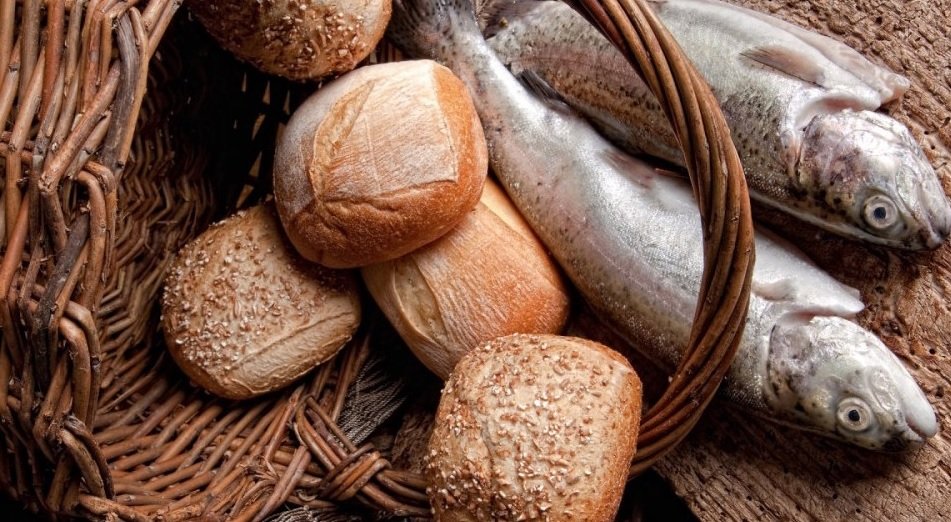
Matthew 14:13–21
The miracle of the multiplication of the loaves is one of the few miracles recorded in all four Gospels, reminding us of its profound importance in the life of the Church. It is far more than a story of feeding hungry people. It reveals the compassionate heart of Christ, foreshadows the Holy Eucharist, and unveils the mission of the Church to nourish a hungry world.
The Gospel begins with a beautiful picture of faith. A great crowd follows Jesus into a deserted place. They remain with Him for hours, forgetting even their physical needs because they have found something greater than earthly bread. Their hunger for the Word of God surpasses their hunger for food.
That challenges each one of us. What do we hunger for most? In a world filled with endless distractions and constant noise, do we long for Christ with the same desire? Our hearts were created for Him, and only He can satisfy the deepest hunger of the human soul.
As evening approaches, the disciples offer what seems to be a practical solution: “Send the crowds away so that they may buy food for themselves.” Yet Jesus replies with words that reveal the very heart of the Gospel: “They need not go away. Give them something to eat.”
Jesus never sends away those who seek Him. He welcomes them, heals them, teaches them, and feeds them. No one is excluded from His love. The Bread of Life is not reserved for one nation, one culture, or one privileged group. In Christ, God’s promise to Abraham is fulfilled: “All the nations of the earth shall be blessed.” (Genesis 22:18) The Kingdom of God is open to everyone.
Jesus’ command, “Give them something to eat,” is not addressed only to the Twelve. It is also addressed to the Church in every age. Christ entrusts His disciples with the mission of feeding a hungry world, not only with bread but with the Gospel, with hope, with forgiveness, and above all with the Bread of Life.
The Lord knew perfectly well that the Apostles had almost nothing to offer. Yet He still commanded them to feed the multitude. Why? So that when the miracle occurred, the Apostles could bear witness that it was entirely the work of God. They would become witnesses that God’s work is accomplished not by human strength but by divine grace.
That lesson remains true today. The Church does not nourish the world by relying on her own resources or wisdom but by distributing what she first receives from Christ. The Gospel is not our invention. The sacraments are not our creation. She faithfully hands on what she has received from Christ. Every bishop, priest, and deacon receives from Christ and faithfully distributes His gifts to His people.
Christ remains the source of every grace, yet He chooses to distribute His gifts through apostolic ministry. The Church’s mission is to receive from the hands of Jesus and faithfully distribute His grace to His people.
This is also true in our own lives. The Lord often asks us to do what seems impossible, not because He needs our strength, but because He wants us to discover His power. He asked Moses to stretch out his staff over the sea. He asked the servants at Cana to fill jars with water before changing it into wine. Here He asks the Apostles to feed thousands with almost nothing. God delights in revealing His power through our weakness.
The disciples answer honestly: “We have only five loaves and two fish.” They see only limitations, but Jesus sees an opportunity for grace.
St. Hilary of Poitiers interprets the five loaves as representing the five books of Moses, while the two fish symbolize either the Prophets and the Psalms. Together they remind us that the entire Old Testament points toward Christ. Jesus does not abolish the Law and the Prophets; He fulfills them. As St. Augustine beautifully said, “The New Testament lies hidden in the Old, and the Old Testament is unveiled in the New.”
Then comes the turning point of the Gospel. Jesus says, “Bring them here to me.”
The loaves remain insufficient until they are placed into His hands. Once entrusted to Christ, they become more than enough.
The same is true for us. Our talents may seem small. Our resources may seem inadequate. Even our weaknesses and failures can become instruments of grace when surrendered to Christ. God does not ask us to begin with abundance. He does not ask us to begin with abundance; He asks us to begin with faith.
Jesus then tells the people to sit down on the grass. St. Hilary sees the grass as a symbol of the Law, upon which God’s people rested while being prepared for Christ. Mark tells us the crowds sat in groups of fifties and hundreds. St. Jerome reflects on the groups of fifty and one hundred. Fifty recalls the Jubilee and the freedom that comes through repentance; one hundred points to the fullness of holiness. The Christian life always begins with conversion and leads toward communion with God.
Jesus blesses the bread, breaks it, and gives it to the disciples, who distribute it to the people. The miracle unfolds precisely in this act of giving.
St. Jerome sees another beautiful mystery here. As Jesus breaks the bread, He also opens the meaning of the Scriptures. Just as He later explained to the disciples on the road to Emmaus how Moses and the Prophets spoke about Him, so every page of Sacred Scripture finds its fulfillment in Christ. Every authentic reading of Sacred Scripture finds its fulfillment in Christ. Every Catholic reading of Scripture should begin with Christ, because He is the fulfillment of every promise.
The multiplication of the loaves also reveals the apostolic nature of the Church. Christ is the source of every grace, yet He chooses to work through His Apostles and their successors. Christ entrusted the Gospel to the Apostles to proclaim, the Eucharist to celebrate, and the power to forgive sins in His name (cf. Matthew 28:19–20; Luke 22:19; John 20:22–23). Through apostolic succession, this ministry continues in the Church. Every bishop and priest shares in this apostolic mission, feeding God’s people with the Word, the Eucharist, and the mercy of Christ in the Sacrament of Reconciliation.
The Gospel concludes with twelve baskets of fragments remaining. These baskets are more than a record of abundance; they are living testimony that the miracle was real. Jesus entrusted the fragments to the Apostles rather than to the crowd.
The twelve baskets also remind us that Christ entrusted His treasures to the Apostles and, through them, to the Church. The Church is not the owner of these mysteries but their faithful steward, preserving and handing on what she has received from the Lord.
My brothers and sisters, this Gospel is as relevant today as it was two thousand years ago.
Our world still hungers, not only for food but for truth, hope, forgiveness, peace, and eternal life. Christ’s answer has not changed: “They need not go away.” The Church possesses, in Christ, everything necessary to nourish the human soul. He continues to feed His people through the preaching of His Word, through the ministry of His Church, and above all through the gift of the Holy Eucharist.
Every Mass echoes this miracle. Christ once again takes ordinary bread, blesses it, breaks it, and gives Himself to us as the true Bread of Life.
As we come to this altar today, let us place into His hands our own “five loaves and two fish” , our gifts and weaknesses, our joys and struggles, our hopes and fears. What seems so little to us becomes abundant in His hands.
Fr. Tojan Abraham MCBS
Leave a Reply