
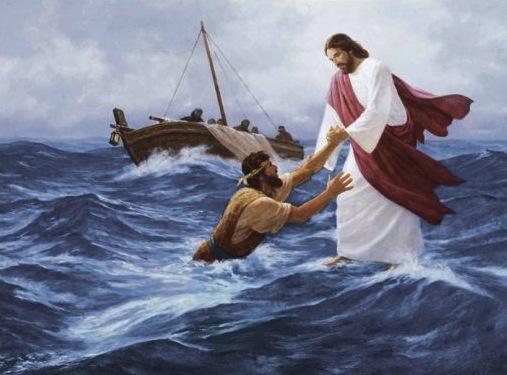
“Take courage, it is I; do not be afraid.”
Matthew 14:22–33
Today’s Gospel follows immediately after the miraculous feeding of the five thousand. Having revealed Himself as the compassionate Shepherd who satisfies the hunger of His people, Jesus now leads His disciples into a deeper lesson about faith. The miracle of the loaves showed His power to provide; the storm on the sea reveals His power to sustain. Together, these two miracles teach us that the Lord who nourishes His people is also the Lord who never abandons them in the midst of life’s storms.
After the miraculous feeding of the five thousand, Jesus sends His disciples ahead in the boat while He goes up the mountain alone to pray. These two images – the mountain and the boat – carry a profound spiritual meaning.
Throughout Sacred Scripture, the mountain is the place of God’s self-revelation. Moses received the Law on Mount Sinai; Elijah encountered the still, small voice of God on Horeb; and later Jesus would be transfigured on another mountain before Peter, James, and John. Here, the mountain points beyond a geographical location. It symbolizes the glory of heaven, where the risen Christ is seated at the right hand of the Father, continually interceding for His Church (cf. Hebrews 7:25).
Christ alone ascends because He alone comes from the Father and eternally shares in the Father’s glory. He is not simply a prophet who approaches God; He is the Son of God who reveals the Father. He is the true Mediator between God and humanity.
This transforms the way we read the Gospel. Jesus does not withdraw because He has forgotten His disciples. While they struggle on the sea, He is praying for them. His apparent absence is, in fact, another expression of His loving presence.
This scene beautifully foreshadows the mystery of Ascension. Christ has ascended into heaven, yet He has not abandoned His Church. As our eternal High Priest, He continually intercedes for us before the Father and guides His people toward the fullness of eternal life.
While Jesus is on the mountain, the disciples find themselves in a violent storm.
From the earliest centuries, the Fathers of the Church recognized the boat as an image of the Church herself. Just as Noah’s ark carried humanity safely through the flood, so the Church carries God’s people through the turbulent waters of history.
The sea, by contrast, often symbolizes the instability of a fallen world, a world marked by suffering, persecution, temptation, doubt, and uncertainty.
The disciples did not wander into this storm by accident. Jesus Himself placed them in the boat. The boat may be battered by the waves, but it cannot sink because it belongs to Christ. The waves may strike Christ’s boat, but they can never destroy it, for Christ Himself remains its foundation.
This is an important lesson for every Christian. Faith is not a promise that life will be free from suffering. Rather, it is the assurance that no storm can separate us from the love of Christ.
Our own lives may be shaken by storms. We experience illness, grief, broken relationships, financial burdens, anxiety about the future, and moments of spiritual dryness. Sometimes the storms are external; at other times they arise within our own hearts through fear, discouragement, or temptation.
We may feel as though the waves are stronger than our faith. Yet Christ never ceases to pray for His people.
As He once prayed for Peter that his faith would not fail (Luke 22:32), so He continues to intercede for every believer. His prayer is the foundation of our perseverance.
This is a powerful invitation to confidence. When the world seems turbulent or our own lives feel overwhelmed, we need not despair. The One who ascended the mountain to pray now reigns in glory, continually interceding for His people.
Then comes the heart of today’s Gospel. Walking upon the sea, Jesus speaks words that have comforted believers for two thousand years: “Take courage. It is I. Do not be afraid.”
These words carry a meaning far deeper than a simple identification. In the Greek text, Jesus says, ego eimi – “I AM.” This echoes God’s revelation to Moses at the burning bush: “I AM WHO AM” (Exodus 3:14).
Jesus is not merely identifying Himself. He is revealing His divine identity. The One who created the seas now walks upon them. The One who brought order out of chaos now stands above the forces of chaos.
The greatest miracle is not that Jesus walks on water. The greatest miracle is that God Himself has come to His frightened people.
Jesus does not first remove the storm. He first reveals Himself. The disciples’ greatest need was not calmer waters but the presence of Christ.
The same is true for us. Very often our first prayer is, “Lord, remove this suffering.” Sometimes He does. But often He gives us something greater than changed circumstances, He gives us Himself. His presence does not always remove the cross, but it gives us the strength to carry it. His grace does not always eliminate suffering, but it transforms suffering into a path of communion with Him.
Peter immediately responds: “Lord, if it is You, command me to come to You on the water.” Peter does not ask Jesus to stop the storm or bring the boat safely to shore. He asks only to come to Christ.
Here we discover the essence of Christian discipleship. Faith is not primarily believing that God can solve our problems. Faith is entrusting ourselves completely to the Person of Jesus Christ. Peter walks on the water because he trusts the One who called him. As long as his eyes remain fixed on Christ, he walks securely above the waves. The moment his attention shifts from Christ to the violence of the wind, fear enters his heart, and he begins to sink.
This is not merely Peter’s story. It is ours too. How often we begin our Christian life with enthusiasm and generous trust. Yet little by little our gaze shifts toward our fears, disappointments, failures, and anxieties. We become preoccupied with the storms around us rather than the Savior before us.
As he sinks beneath the waves, he cries out with one of the shortest and most powerful prayers in Scripture: “Lord, save me!” This prayer contains the essence of the Gospel. It is the prayer of a heart that knows it cannot save itself.
Immediately Jesus stretched out His hand and caught him. Jesus does not first calm the wind; He first saves Peter. The deepest danger was not the storm outside but the doubt within.
Like a loving father lifting a fallen child, Christ reaches down and raises His disciple. Peter discovers that salvation comes not through his own courage but through the mercy of Christ.
The Gospel concludes with Jesus entering the boat, the wind ceasing, and the disciples falling down in worship: “Truly You are the Son of God.”
This confession is the goal of every miracle. The signs performed by Jesus always lead to worship and faith. Every Eucharist is a continuation of this Gospel. The risen Lord enters the boat of His Church once again. He comes not walking upon the waters but hidden beneath the humble appearances of bread and wine. His presence remains just as real. He still speaks to every fearful heart:
“Take courage. It is I. Do not be afraid.”
Whatever storm we may be facing today, let us keep our eyes fixed on Christ. And whenever we begin to sink, let Peter’s prayer become our own: “Lord, save me.”
For the hand that reached out across the waters is still stretched out to us in every Eucharist, every confession, every prayer, and every moment of grace.
✍ Fr Tojan Abraham Kuttentharappel MCBS
Leave a Reply