
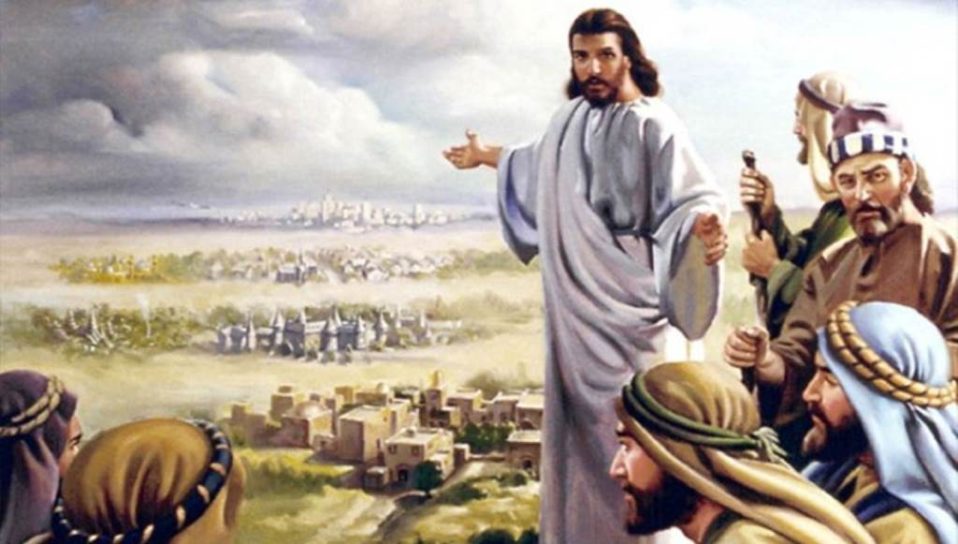
He must go to Jerusalem….
Matthew 16:21-27
At Caesarea Philippi, Peter makes the great confession of faith: “You are the Christ, the Son of the living God.” It is a glorious moment. Peter speaks the truth not simply from human understanding, but because the Father has revealed it to him.
And yet, immediately after this confession, Jesus tells his disciples not to tell anyone that he is the Christ. Why? Not because this truth is meant to remain hidden, but because it cannot yet be proclaimed in its fullness. The disciples know who Jesus is, but they do not yet understand what it means for Jesus to be the Christ.
For many people, the word Messiah carried expectations of power, victory, political freedom, and earthly triumph. They imagined a king who would defeat Israel’s enemies and restore its glory. But Jesus begins to reveal a very different path:
“He must go to Jerusalem and suffer greatly… and be killed, and on the third day be raised.”
Jesus is teaching his disciples that the Messiah does not save by avoiding suffering but by entering into it. His kingdom will not be established through worldly power, but through the obedience of love. His victory will come through the Cross.
Origen recognized the danger of proclaiming Christ without understanding the Passion. If we call Jesus “Christ” but remove the Cross, we can easily reduce him to a teacher, a miracle-worker, a moral example, or even a political hero. But this is not the Christ whom the Church proclaims.
The Church proclaims Jesus Christ crucified and risen.
Peter himself shows us how easy it is to make a partial confession of faith. His lips have confessed Jesus as the Christ, but his heart still imagines the Messiah according to human expectations. He wants the glory of the Messiah, but he does not yet understand the Cross of the Messiah.
And perhaps we can recognize ourselves in Peter.
We want a Messiah who removes every hardship but does not ask us to carry a cross.
We want Easter Sunday without Good Friday.
We want mercy without repentance.
We want a kingdom without sacrifice.
We want glory without conversion.
But Jesus patiently teaches Peter and us that God’s victory does not look like the world’s victory.
The world sees the Cross and calls it defeat. It sees weakness, humiliation, suffering, and death. But God sees something else. In the Cross, God reveals a love stronger than sin, stronger than suffering, and stronger than death.
The Cross does not weaken our confession that Jesus is the Christ. The Cross gives that confession its deepest meaning.
After Peter’s magnificent confession, Jesus begins to reveal what it means for him to be the Christ: The Cross reveals the Christ
“He must go to Jerusalem, suffer… be killed, and on the third day be raised.”
Matthew tells us that Jesus “began to show” his disciples that he must suffer, die, and rise. He is not merely giving them information about the future. He is gradually unveiling the mystery of salvation. He is teaching them to see that his journey to Jerusalem is not a tragic interruption of his mission. It is the very path through which the Father will accomplish our redemption.
The disciples must learn that the Cross is not outside God’s love. They must learn that suffering freely embraced in obedience and love can become the place of redemption. And they must learn something else: the Cross is never separated from the Resurrection.
Jesus does not say only that he will suffer and die. He says that “on the third day he will be raised.”
Even while speaking about Calvary, Jesus is already speaking about Easter.
This is important for every Christian who carries a cross.
Some carry the grief of losing someone they deeply love. Some struggle with illness, anxiety, loneliness, family difficulties, financial burdens, disappointment, or wounds that no one else can see. Sometimes we ask, “Why is this happening to me?”
Christ does not always give us the explanation we desire.
But he gives us himself.
He knows what it means to walk through darkness. He knows what it means to experience abandonment and pain. Yet he remained faithful to the Father.
Christian hope does not pretend that suffering is easy. It does not tell us that grief does not matter or that death does not hurt. Christianity does not deny the reality of Good Friday.
Rather, Christian hope proclaims that Good Friday is not the final word.
Death is not the final word.
Suffering is not the final word.
Sin is not the final word.
Jesus Christ has the final word—and his word is Resurrection.
St. John Chrysostom reflects on the patience of Christ with his disciples. Jesus does not reveal everything to them at once. He prepares them gradually because he knows how deeply they will be shaken when they see him arrested and crucified. He strengthens their faith before the hour of trial arrives.
This is also how Christ works in us.
Some truths must be planted deeply within us before the storms of life come. A truth suddenly received can be easily shaken by suffering. But a truth patiently received, repeatedly heard, prayed over, and lived can take deep root in the heart.
That is why the Church continually places the Paschal Mystery before us.
We hear it in the Scriptures.
We proclaim it at every Eucharist: “We proclaim your Death, O Lord, and profess your Resurrection.”
We contemplate it in the Rosary, especially in the Sorrowful Mysteries.
We enter into it during Holy Week.
And we proclaim it even in the midst of death at Christian funerals.
The Church repeats the mystery of Christ’s death and Resurrection not because she has nothing new to say, but because we need this truth to become the foundation of our lives.
When suffering comes, we need to remember: Christ has gone before us.
When sin discourages us, we need to remember: Christ’s mercy is stronger.
When we experience loneliness, we need to remember: Christ has not abandoned us.
When death frightens us, we need to remember: Christ is risen.
And when the road seems dark and we cannot see where it is leading, we need to remember what Jesus told his disciples on the road to Jerusalem:
The Cross is not the end of the story.
The third day is coming.
The Christ whom Peter confessed is the Christ who went to Calvary. The Christ who died is the Christ who rose. And the Christ who rose is the Christ who walks with us now. And here, at this Eucharist, the crucified and risen Christ is truly present among us. He gives us the very Body that was broken for us and the Blood that was poured out for us. As we receive him, may we have the grace to embrace our crosses with faith, trusting that the Cross always leads to Resurrection.
Therefore, when we confess, “You are the Christ,” we are not merely proclaiming that Jesus is powerful. We are proclaiming that he is the crucified and risen Lord, the Savior who has entered into our suffering, conquered sin and death, and opened for us the way to eternal life.
The Cross reveals who Christ truly is.
The Resurrection reveals that his Cross was not defeat, but victory.
And because Christ is risen, we can face our crosses with hope.
✍ Fr. Tojan Abraham MCBS
Leave a Reply