
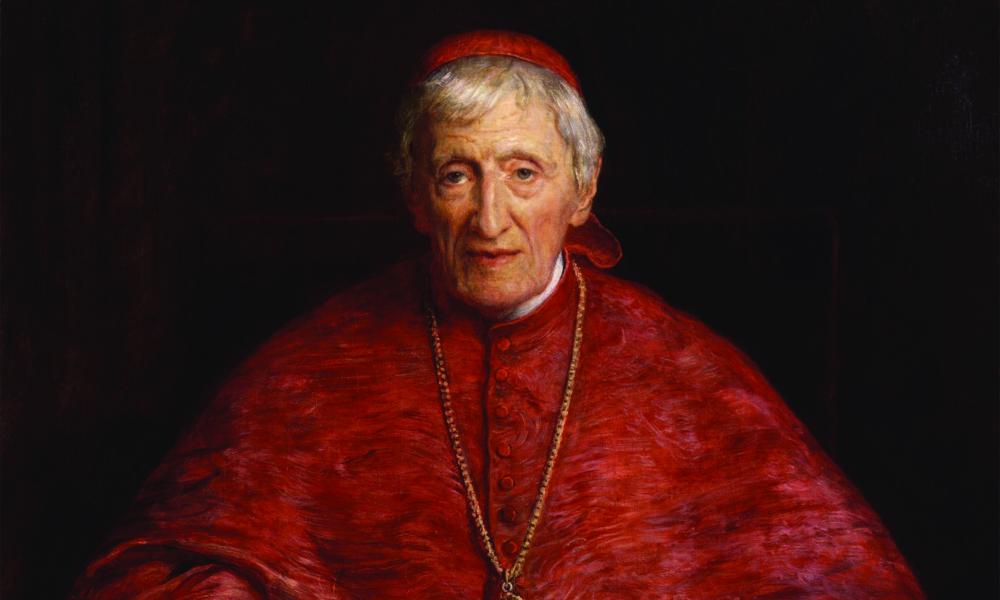
Saint John Henry Newman (1801–1890), Doctor of the Church, left a rich spiritual and intellectual legacy through his sermons, prayers, hymns, autobiographical writings, and theological works. The collection below draws on his published writings, including Parochial and Plain Sermons, Apologia Pro Vita Sua, The Idea of a University, and An Essay in Aid of a Grammar of Assent.
1. God’s purpose and our personal vocation
Source for quotations 1–10: John Henry Newman, “Hope in God—Creator,” in Meditations and Devotions. The original meditation is available in the Newman Reader.
1. “We are all created to His glory—we are created to do His will.”
2. “I am created to do something or to be something for which no one else is created.”
3. “I have a place in God’s counsels, in God’s world, which no one else has.”
4. “Whether I be rich or poor, despised or esteemed by man, God knows me and calls me by my name.”
5. “God has created me to do Him some definite service.”
6. “He has committed some work to me which He has not committed to another.”
7. “I have my mission—I never may know it in this life, but I shall be told it in the next.”
8. “Somehow I am necessary for His purposes.”
9. “I am as necessary in my place as an Archangel in his.”
10. “I am a link in a chain, a bond of connexion between persons.”
2. Trusting God’s guidance
Source for quotations 11–19: “The Pillar of the Cloud,” commonly known as Lead, Kindly Light, written on 16 June 1833 and published in Verses on Various Occasions, poem 90.
11. “Lead, kindly Light, amid the encircling gloom.”
12. “Lead Thou me on!”
13. “The night is dark, and I am far from home.”
14. “Keep Thou my feet.”
15. “I do not ask to see the distant scene.”
16. “One step enough for me.”
17. “I loved to choose and see my path, but now / Lead Thou me on!”
18. “Pride ruled my will: remember not past years.”
19. “So long Thy power hath blest me, sure it still / Will lead me on.”
3. Education and the pursuit of knowledge
Source for quotations 20–31: John Henry Newman, The Idea of a University, with the discourse or section indicated.
20. “A University should teach universal knowledge.” — Discourse II, “Theology a Branch of Knowledge.”
21. “Knowledge is capable of being its own end.” — Discourse V, “Knowledge Its Own End.”
22. “Truth is the object of Knowledge of whatever kind.” — Discourse III, “Bearing of Theology on Other Knowledge.”
23. “Knowledge is one thing, virtue is another.” — Discourse V, “Knowledge Its Own End.”
24. “Liberal Education makes not the Christian, not the Catholic, but the gentleman.” — Discourse V, “Knowledge Its Own End.”
25. “A great memory does not make a mind, any more than a dictionary is a piece of literature.” — Discourse VI, “Knowledge Viewed in Relation to Learning.”
26. “The heart is commonly reached, not through the reason, but through the imagination.” — Discourse III, “Bearing of Theology on Other Knowledge.”
27. “The enlargement of mind is the power of viewing many things at once as one whole.” — Discourse VI, “Knowledge Viewed in Relation to Learning.”
28. “The general culture of mind is the best aid to professional study.” — A summary of Newman’s educational argument; not included as a verified verbatim quotation.
29. “Knowledge is then especially liberal, or sufficient for itself, apart from every external and ulterior object, when and so far as it is philosophical.” — Discourse V, “Knowledge Its Own End.”
30. “A University, I should lay down, by its very name professes to teach universal knowledge.” — Discourse II, “Theology a Branch of Knowledge.”
31. “The Church is necessary for its integrity.” — Preface to The Idea of a University, referring to the university’s fulfilment of its purpose.
4. Faith, difficulties, and conviction
Source for quotations 32–37: John Henry Newman, Apologia Pro Vita Sua, especially Part V and Part VII.
32. “Ten thousand difficulties do not make one doubt.”
33. “Difficulty and doubt are incommensurate.”
34. “I have never been able to see a connexion between apprehending those difficulties, however keenly, and multiplying them to any extent, and, on the other hand, doubting the doctrines to which they are attached.”
35. “I have a work to do in England.”
36. “I have not sinned against light.”
37. “I shall not die, for I have not sinned against light.”
Editorial note: Quotations 36–37 are from Newman’s account of his illness and journey in Sicily. They are historical recollections recorded in his Apologia, not general theological definitions.
5. Conscience and moral responsibility
Source for quotations 38–41: John Henry Newman, A Letter Addressed to His Grace the Duke of Norfolk, Chapter V, “Conscience.”
38. “Conscience has rights because it has duties.”
39. “To Conscience first, and to the Pope afterwards.”
40. “The right of thinking, speaking, writing, and acting, according to their judgment or their humour.”
41. “The duty to Him, in thought and deed, of the creature.”
Context matters: Newman argues that conscience is an obligation before God, not permission to do whatever one pleases. Quotations 39–41 are excerpts from a larger argument and should not be presented as independent definitions of his position.
6. Reason, assent, and the human mind
Source for quotations 42–46: John Henry Newman, An Essay in Aid of a Grammar of Assent, with chapter references.
42. “Assent is more than assertion.”
43. “Assent is in its nature absolute and unconditional.”
44. “We cannot assent to a proposition, without some intelligent apprehension of it.” — Chapter I.
45. “When we infer, we consider a proposition in relation to other propositions.” — Chapter II.
46. “When we assent to it, we consider it for its own sake and in its intrinsic sense.” — Chapter II.
7. Character, friendship, and the Christian gentleman
Source for quotations 47–48: John Henry Newman, The Idea of a University, Discourse VIII, “Knowledge Viewed in Relation to Religious Duty.”
47. “A gentleman is one who never inflicts pain.”
48. “He has his eyes on all his company.”
Context: These excerpts come from Newman’s description of the gentleman’s conduct. His concern is not merely social politeness but consideration for others, self-restraint, and the avoidance of needless offence.
8. Hope beyond death
Source for quotations 49–50: John Henry Newman, “The Pillar of the Cloud,” Verses on Various Occasions, poem 90.
49. “And with the morn those angel faces smile.”
50. “Which I have loved long since, and lost awhile.”
These closing lines express hope and longing. They should be understood in the poem’s full context, not as a precise doctrinal statement about the identity or destiny of particular persons.
Primary sources for checking the quotations
- Newman Reader — Meditations and Devotions, “Hope in God—Creator”
- Newman Reader — “The Pillar of the Cloud” (Lead, Kindly Light)
- Newman Reader — The Idea of a University
- Newman Reader — Apologia Pro Vita Sua
- Newman Reader — An Essay in Aid of a Grammar of Assent
- Newman Reader — Letter to the Duke of Norfolk, Chapter V
Leave a Reply