
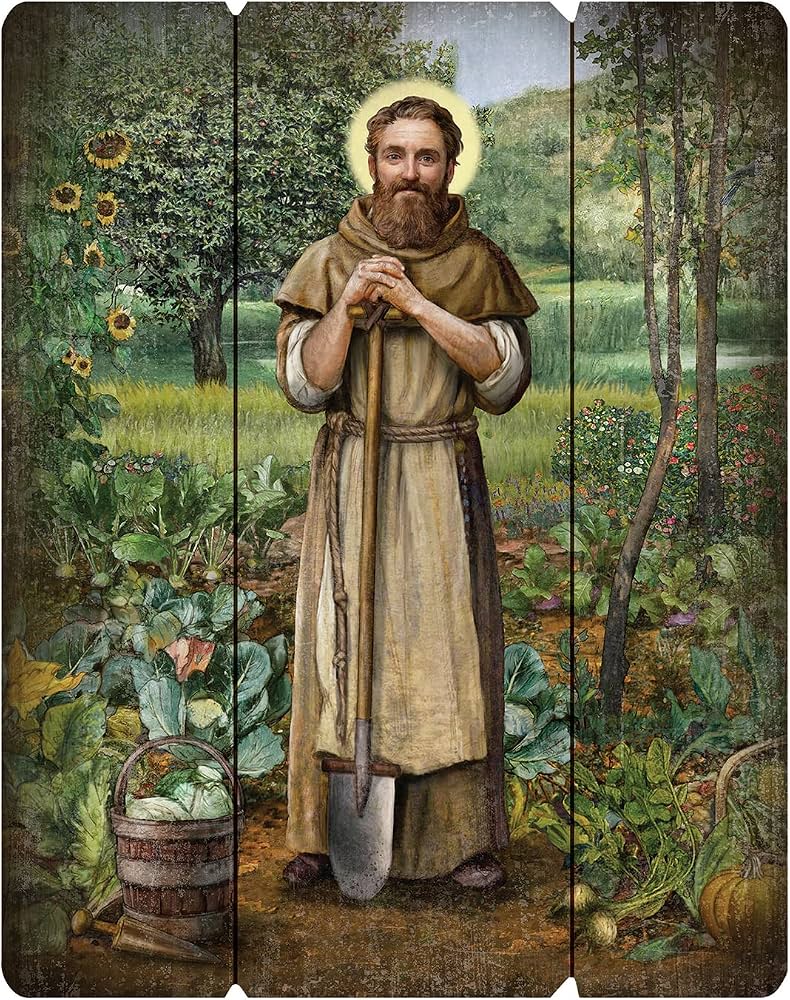
Saint Fiacre was a seventh-century Irish priest, hermit, abbot, and gardener who became one of the most beloved saints associated with agricultural work, gardening, healing, and service to the poor. He left Ireland and settled in France, where he established a hermitage at Breuil near Meaux. His life combined prayer, solitude, manual labour, hospitality, and charity. He is especially honoured as the patron saint of gardeners and horticulturists. His feast is celebrated on 30 August in the Roman Catholic tradition. (New Advent)


Early Life in Ireland
Saint Fiacre was born in Ireland toward the end of the sixth century. The historical details of his early life are limited, and later traditions contain various accounts concerning his family background. What is more firmly preserved in the traditional accounts is that he became a priest and sought a life of prayer and solitude.
He initially established himself as a hermit beside the River Nore in Ireland. His holiness soon attracted disciples and people seeking his spiritual guidance. Yet Fiacre desired a more secluded life dedicated entirely to God. Consequently, he eventually left Ireland and travelled to Gaul, in present-day France. (New Advent)
His journey reflects a characteristic feature of the spirituality of the Irish monks of the early Middle Ages: a willingness to leave homeland and security in order to seek God through pilgrimage, asceticism, prayer, and missionary service.
His Arrival in France
Tradition places Fiacre’s arrival in the region of Meaux around 628. At that time, Saint Faro (Faron) was bishop of Meaux. Faro received the Irish monk kindly, partly because his family had benefited from the missionary work associated with the Irish monk Saint Columbanus.
Faro granted Fiacre a secluded piece of land at Breuil, surrounded by forest. There Fiacre established a small religious settlement. He constructed:
- a cell where he could live in solitude,
- an oratory dedicated to the Blessed Virgin Mary, and
- a hospice for travellers and strangers. (New Advent)
Thus, his solitude was never selfish isolation. Even while seeking silence and prayer, Fiacre created a place where others could find welcome, nourishment, spiritual counsel, and assistance.
The Hermit’s Garden
One of the most famous traditions associated with Saint Fiacre concerns the garden at Breuil.
According to the traditional story, Bishop Faro promised Fiacre as much land as he could enclose or cultivate in a single day. Fiacre is said to have marked out the land with his staff or spade, and the ground was miraculously cleared.
The story became part of the saint’s popular tradition and helped establish his connection with gardening and cultivation. Historical sources caution that many details of Fiacre’s life belong to later legendary traditions, but his association with manual labour and gardening became an enduring part of his devotion. (New Advent)
Fiacre cultivated vegetables and medicinal plants. His garden was not simply a place of work; it became an expression of his spirituality.
For him, working the earth could become prayer.
Prayer and Work
Saint Fiacre’s life presents a beautiful Christian understanding of manual labour.
He prayed, fasted, kept vigils, and performed physical labour. His garden provided food, while his hospitality provided shelter. His hands worked the soil, but his heart remained directed toward God.
This makes Saint Fiacre especially relevant today. In a world in which work is often separated from spirituality, his life reminds Christians that ordinary labour can be offered to God.
A farmer cultivating his field, a gardener planting vegetables, a mother caring for her home, a worker doing an honest day’s labour, or a person caring for the environment can all transform work into an offering when it is done with love and responsibility.
A Friend of the Poor and Travellers
Fiacre’s hermitage included a hospice where travellers and strangers were welcomed. He personally served those who came to him.
His life therefore united three important dimensions:
Prayer — Work — Charity.
He did not consider holiness merely a matter of withdrawing from the world. His relationship with God overflowed into service.
This is one of the most beautiful lessons of his life: true solitude with God should produce greater love for others.
A person who genuinely encounters God does not become indifferent to human suffering. Rather, prayer opens the heart to the hungry, the sick, the lonely, the traveller, and the poor.
Saint Fiacre the Healer
Saint Fiacre became famous for his reputation as a healer. Traditional accounts attribute numerous cures to his prayers and the laying on of hands. People suffering from various illnesses came to his hermitage seeking his intercession.
After his death, his reputation for miraculous healing continued, and pilgrims travelled to his shrine at Breuil. His relics became an object of devotion, and numerous churches and chapels were placed under his patronage. (New Advent)
The Church’s traditional devotion to such saints does not mean that Christians should replace medical treatment with miracles. Rather, Saint Fiacre’s example reminds us to bring illness, suffering, and human weakness before God while also exercising the ordinary means of care and compassion.
Patron Saint of Gardeners
Saint Fiacre is particularly famous as the patron saint of gardeners.
He is traditionally represented carrying a spade, shovel, or gardening tool, sometimes accompanied by vegetables or a garden. (blog.metmuseum.org)
His patronage is particularly meaningful because gardening requires virtues that are deeply Christian:
- Patience — a seed does not become a tree overnight.
- Hope — the gardener works for a harvest not yet visible.
- Perseverance — weeds and difficulties must continually be overcome.
- Care — plants need attention and protection.
- Humility — the gardener cooperates with God’s creation rather than controlling it completely.
- Gratitude — the final harvest is ultimately received as a gift.
The garden therefore becomes a wonderful image of Christian life.
Saint Fiacre and the Soil
Saint Fiacre teaches us to respect the dignity of creation.
A garden begins with something apparently insignificant: a seed placed in the soil. Yet from that tiny seed can come a plant, a flower, fruit, or food for an entire family.
Jesus himself frequently used agricultural images to explain the Kingdom of God:
“The kingdom of God is as if someone would scatter seed on the ground.”
The spirituality of Saint Fiacre can therefore be understood as a spirituality of planting, waiting, cultivating, and trusting God.
We often want immediate results in our spiritual lives. Saint Fiacre reminds us that God’s work frequently resembles gardening. We plant today, cultivate tomorrow, wait patiently, and eventually receive the harvest.
His Connection with France
Saint Fiacre’s hermitage at Breuil eventually became an important centre of devotion. His name became associated with the locality now known as Saint-Fiacre in Seine-et-Marne.
His shrine attracted pilgrims, particularly those seeking healing. His relics were eventually transferred for safekeeping to Meaux during the religious conflicts of the sixteenth century. (New Advent)
His devotion spread widely throughout France, and many churches and religious institutions were placed under his patronage.
Why Are Parisian Taxis Called “Fiacres”?
One of the most fascinating facts about Saint Fiacre is that his name gave rise to the French word fiacre, traditionally used for a hired carriage.
In seventeenth-century Paris, one of the establishments that hired coaches was associated with the Hôtel de Saint-Fiacre on the Rue Saint-Martin. Because the establishment displayed an image of Saint Fiacre, the hired coaches eventually became known as fiacres. (New Advent)
Thus, the name of a seventh-century Irish hermit unexpectedly became connected with public transportation in Paris.
Saint Fiacre and the Virgin Mary
An important feature of Fiacre’s spirituality was his devotion to the Blessed Virgin Mary.
At Breuil he built an oratory dedicated to the Blessed Virgin Mary. (New Advent)
This detail is significant. Fiacre’s spirituality was not simply an austere search for solitude. His life was rooted in Christ and accompanied by devotion to Mary.
His Marian devotion can inspire Christians to imitate Mary’s virtues:
- humility,
- obedience,
- purity of heart,
- silence,
- service,
- trust in God.
His Death
Saint Fiacre died around 18 August 670, after many years of prayer and service at Breuil. His liturgical feast is traditionally observed on 30 August. (New Advent)
After his death, devotion to him continued to grow. His tomb became associated with numerous cures, and pilgrims continued to visit his shrine.
Saint Fiacre’s Spiritual Message
Saint Fiacre’s life offers several powerful lessons for Christians today.
1. Make your work a prayer
Fiacre did not separate his spiritual life from his physical work. He prayed and cultivated the earth.
Our daily work can become an offering to God.
“Whatever your task, put yourselves into it, as done for the Lord.”
— Colossians 3:23
2. Learn the virtue of patience
A gardener cannot command a seed to become a tree immediately.
Likewise, spiritual growth takes time.
We should not become discouraged when we do not see immediate results from our prayers, sacrifices, or good works.
3. Serve others with what God has given you
Fiacre used his garden, his home, his knowledge, and his spiritual gifts for others.
Every Christian has something that can be shared:
time, food, knowledge, encouragement, prayer, money, skills, or simply a listening heart.
4. Care for creation
The garden of Saint Fiacre reminds us that creation is God’s gift.
Christians are called not merely to use creation but to care for it responsibly.
A small vegetable garden, planting a tree, avoiding unnecessary waste, protecting water, or caring for animals can become expressions of Christian stewardship.
5. Combine contemplation with action
Saint Fiacre was a hermit, but he was not useless to society.
He prayed deeply and served generously.
His life demonstrates that contemplation and charity belong together.
6. Do not seek worldly glory
According to tradition, Fiacre desired a hidden life rather than honour and prestige.
The Christian does not need to be famous to be fruitful.
A person can live an unnoticed life and yet become a great instrument of God’s grace.
Saint Fiacre as a Model for Families
Saint Fiacre’s spirituality can be especially meaningful for families.
A family garden can become a small school of Christian values. Parents can teach children to plant seeds, water plants, care for animals, avoid waste, and appreciate God’s creation.
The garden can teach children something that modern life often forgets:
Good things take time.
A seed must be planted.
A plant must be watered.
The weeds must be removed.
The gardener must wait.
And finally, there is a harvest.
This is also the story of faith.
Saint Fiacre and Kerala
Saint Fiacre’s spirituality has a special resonance in a land like Kerala, where agriculture, gardens, trees, vegetables, spices, and small-scale cultivation have traditionally been part of family life.
His feast can be an occasion to pray for:
- farmers,
- gardeners,
- agricultural workers,
- plantation workers,
- labourers,
- those who depend on the land for their livelihood,
- those suffering from crop failures,
- families facing financial difficulties because of agricultural losses,
- and all who care for God’s creation.
His life can remind us that the dignity of work is also the dignity of the person who works.
A Prayer to Saint Fiacre
Prayer to Saint Fiacre, Patron Saint of Gardeners
O glorious Saint Fiacre,
faithful servant of God and patron of gardeners,
you left the comforts of your homeland
to seek the Lord in prayer, solitude, and humble labour.
Teach us to sanctify our daily work
and to offer everything we do to God
with patience, love, and perseverance.
You cultivated the earth with your own hands
and used its fruits to serve the poor and the needy.
Help us to respect God’s creation
and to become generous stewards of the gifts
that the Lord has entrusted to us.
Pray for farmers, gardeners, agricultural workers,
and all who labour upon the land.
Obtain for them strength in hardship,
rain in times of drought,
good harvests, fair wages,
and protection from every danger.
Saint Fiacre,
you welcomed travellers and cared for the sick.
Teach us to recognize Christ
in the poor, the stranger, the suffering, and the forgotten.
When we become impatient, teach us to wait.
When we become discouraged, teach us to hope.
When our work seems fruitless, teach us to trust God.
When we receive abundance, teach us to share.
May our lives become like a fruitful garden
where faith, hope, love, and good works grow.
Saint Fiacre, pray for us.
Pray for our families, our parish,
our farmers and workers,
and for all who entrust themselves to your intercession.
Through Christ our Lord.
Amen.
Feast Day
Feast of Saint Fiacre: 30 August
Born: Ireland, approximately late sixth century
Died: approximately 670
State of life: Priest, hermit and abbot
Place of ministry: Breuil near Meaux, France
Patronage: Gardeners and those associated with horticulture
Traditional symbols: Spade, shovel, garden, vegetables
Principal spiritual themes: Prayer, work, charity, healing, patience, care for creation
Saint Fiacre’s story ultimately teaches a simple but profound lesson: God can make a garden out of an ordinary piece of earth, and He can make a saint out of an ordinary life surrendered to Him.
His life invites us to pray deeply, work faithfully, serve generously, wait patiently, and trust God for the harvest. (New Advent)
Leave a Reply