
Feast Day: August 10
Also known as: Saint Lawrence of Rome, Saint Laurence
Died: August 10, 258
Vocation: Deacon of the Church of Rome
Patron Saint of: Deacons, the poor, cooks, chefs, firefighters, and several other groups
Symbol: Gridiron, palm of martyrdom, alms, or purse
“The treasures of the Church are the poor.”
Saint Lawrence of Rome stands among the most beloved martyrs of the early Church. A deacon of Rome under Pope Saint Sixtus II, he devoted his life to the service of God, the Eucharist, the Church, and the poor. During the persecution of Emperor Valerian in the year 258, Lawrence gave the ultimate witness to Christ by accepting martyrdom.
His story has been told for centuries because it combines faith, courage, charity, humility, service, and joyful sacrifice. The Church remembers him especially on August 10, only four days after the feast of Pope Saint Sixtus II, whose martyrdom preceded that of Lawrence.
Who Was Saint Lawrence?
Very little is known with certainty about the early life of Saint Lawrence. Ancient Christian tradition identifies him as a deacon of the Church of Rome and one of the principal assistants of Pope Saint Sixtus II.
The Vatican notes that Lawrence was associated with the charitable ministry of the Roman Church and was responsible for distributing Church resources to those in need, including widows, orphans, and the poor.
As a deacon, Lawrence had a special responsibility for service. His ministry was not simply administrative. He saw Christ in those who were suffering and understood that the Church’s material possessions existed for the mission of the Gospel and the care of people.
For Lawrence, Christian service meant giving oneself to Christ through service to others.
Saint Lawrence and Pope Sixtus II
Saint Lawrence served during the brief pontificate of Pope Saint Sixtus II, who became Bishop of Rome in 257.
In 258, the Roman Emperor Valerian intensified persecution against Christians. An imperial decree ordered the execution of bishops, priests, and deacons.
Pope Sixtus II was arrested and executed on August 6, 258, together with several deacons. Four days later, Lawrence himself suffered martyrdom. The Church’s ancient tradition preserves August 10 as the anniversary of his martyrdom.
The relationship between Sixtus and Lawrence became an important part of the Christian memory of the Roman martyrs.
According to the ancient tradition reported by Saint Ambrose, Lawrence lamented that his spiritual father was being taken away without him. The story portrays Lawrence as longing not merely to survive, but to remain faithful to Christ and to accompany his bishop in witness.
The Treasures of the Church
Perhaps the most famous story associated with Saint Lawrence concerns the treasures of the Church.
After Pope Sixtus II had been executed, Lawrence was ordered by the Roman authorities to surrender the wealth of the Church.
Lawrence asked for time to gather the Church’s treasures.
According to the ancient tradition, instead of collecting gold, silver, sacred vessels, and other possessions, he distributed Church resources among the poor.
When the authorities demanded that he present the treasures, Lawrence appeared with the poor, the sick, the widows, orphans, and other needy people whom the Church served.
He presented them as the true treasures of the Church.
This beautiful tradition expresses one of the deepest principles of Christian discipleship:
The people whom society considers insignificant are precious in the eyes of God.
The Vatican preserves this tradition, describing Lawrence as presenting the needy and marginalized as the Church’s true treasure.
The story is particularly powerful because it reverses the world’s understanding of wealth.
The Roman authorities looked for gold.
Lawrence showed them people.
The world counted possessions.
Lawrence counted human lives.
The world saw poverty.
Lawrence saw Christ.
“The Poor Are the Treasure of the Church”
The story of Lawrence invites us to ask a challenging question:
What do we consider valuable?
A society can measure success by money, property, influence, education, position, popularity, or power. But the Gospel gives us another measure.
Jesus identifies himself with the hungry, thirsty, stranger, naked, sick, and imprisoned:
“Whatever you did for one of the least of these brothers of mine, you did for me.”
— Matthew 25:40
Lawrence understood this Gospel profoundly.
The poor were not simply recipients of charity.
They were brothers and sisters in Christ.
This is why the example of Saint Lawrence remains so relevant today. Christian charity is not merely giving something away because we feel sorry for someone. It is recognizing the dignity of every human person and seeing Christ in those who suffer.
His Martyrdom
Saint Lawrence was eventually condemned to death.
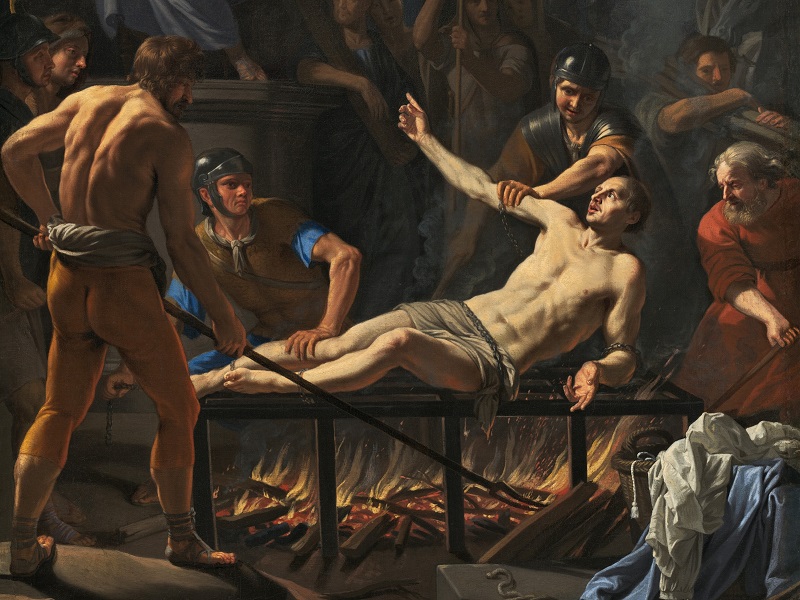
The traditional account says that he was placed upon a gridiron over a fire and suffered a terrible martyrdom.
The story of the gridiron became one of the most famous elements of Lawrence’s legend. Ancient Christian writers, including Saint Ambrose, helped transmit this tradition.
It is important, however, to distinguish between what is historically certain and details preserved in later accounts. The historical evidence firmly establishes Lawrence as a Roman deacon and martyr during the persecution of Valerian in 258. The precise details of the manner of his execution are less certain, even though the gridiron tradition became deeply rooted in Christian devotion.
What cannot be doubted is the central witness of Lawrence:
He remained faithful to Christ even when faithfulness demanded his life.
A Martyr Who Served Before He Died
The greatness of Lawrence did not begin at the moment of his martyrdom.
His martyrdom was the culmination of a life of service.
He served at the altar.
He served the Church.
He served the poor.
He served the needy.
And finally, he gave himself completely to Christ.
This is an important lesson for Christians today.
Martyrdom does not suddenly create holiness.
Rather, the courage to make the ultimate sacrifice grows from the ordinary sacrifices of daily Christian life.
A person who learns to serve faithfully in small things becomes capable of heroic love when great trials come.
Saint Lawrence and the Diaconate
Saint Lawrence has a special significance for deacons.
The word “deacon” comes from the Greek diakonos, meaning servant or minister.
The life of Lawrence beautifully illustrates the meaning of Christian diakonia.
The Vatican’s reflection on Saint Lawrence emphasizes that the ministry of the deacon is deeply connected with service, charity, the Eucharist, the Word of God, and care for the poor.
Saint Lawrence teaches every deacon:
- Serve with humility.
- Love the Eucharist.
- Care for the poor.
- Protect the dignity of the vulnerable.
- Remain close to the bishop and the Church.
- Proclaim Christ through both words and actions.
- Be ready to sacrifice for the Gospel.
His life reminds the Church that service is not secondary to holiness; service is one of the paths to holiness.
Lawrence: From the Eucharistic Table to the Table of the Poor
There is a beautiful connection between Lawrence’s ministry at the altar and his ministry among the poor.
The Eucharist teaches Christians that Christ gives himself as food for the life of the world.
Therefore, those who receive Christ in the Eucharist are called to become people who give themselves in love.
Saint Lawrence understood this connection.
He did not separate worship from charity.
He did not separate the altar from the poor.
He did not separate prayer from service.
His life teaches us:
The Eucharist must lead us to charity, and charity must lead us back to Christ.
This is especially important for Christians today. We cannot claim to love Christ while deliberately ignoring people who are hungry, lonely, abandoned, homeless, sick, elderly, or forgotten.
Courage in the Face of Persecution
Lawrence lived during a period when being a Christian could cost a person everything.
He could have chosen safety.
He could have abandoned his faith.
He could have attempted to hide.
Instead, he remained faithful.
His courage was not the absence of fear. Christian courage is something deeper: the decision to trust God more than we trust the power of the world.
Saint Lawrence knew that earthly life is temporary, but Christ is eternal.
His martyrdom therefore became a victory rather than a defeat.
The Joy of the Martyrs
The early Christians did not regard martyrdom simply as tragedy.
They saw martyrdom as the supreme witness to the truth of the Gospel.
Saint Lawrence’s life demonstrates the words of Jesus:
“Do not fear those who kill the body but cannot kill the soul.”
— Matthew 10:28
The martyr knows that death does not have the final word.
Christ does.
The Roman authorities could destroy Lawrence’s body, but they could not destroy his faith.
They could take his earthly life, but they could not take his eternal hope.
Saint Lawrence and the Poor Today
The witness of Saint Lawrence is particularly meaningful in a world where many people continue to experience poverty and exclusion.
His example challenges Christians to look beyond statistics and see persons.
Behind every number is a human being.
Behind every homeless person is a child of God.
Behind every abandoned elderly person is someone worthy of love.
Behind every hungry child is a person whose dignity must be respected.
Behind every migrant and refugee is a human being created in the image of God.
Behind every person forgotten by society is someone whom Christ loves.
Saint Lawrence invites the Church to ask:
Where are the treasures of the Church today?
They are not only in beautiful churches, sacred objects, institutions, or buildings.
They are also in the poor, the suffering, the lonely, the forgotten, and everyone who needs the love of Christ.
Patron Saint of Firefighters and Cooks
Saint Lawrence is traditionally invoked as a patron of firefighters and cooks, among others, largely because of the traditional account of his death by fire and the gridiron. The Vatican lists him among the patron saints of deacons, chefs, and firefighters.
He is also associated with a remarkable celestial phenomenon.
The annual Perseid meteor shower, which occurs around the time of his feast, has historically been connected in popular tradition with the “tears of Saint Lawrence.” The bright meteors were poetically regarded as the saint’s tears falling from heaven.
Although the meteor shower has a natural astronomical explanation, the traditional association has become part of the cultural memory surrounding his feast.
The Basilica of Saint Lawrence
Saint Lawrence’s tomb became an important place of Christian pilgrimage.
A basilica was built over his burial place on the Via Tiburtina in Rome. The Basilica of Saint Lawrence Outside the Walls remains one of the important churches associated with the saint.
The place of his martyrdom was also associated with the church of San Lorenzo in Panisperna.
The enduring presence of these churches reminds us that the memory of the martyrs was not merely recorded in books. The early Christians remembered them by venerating the places where they lived, suffered, died, and were buried.
Saint Lawrence in the Roman Canon
Saint Lawrence’s importance in the ancient Church is also reflected in the Eucharistic liturgy.
His name appears among the saints remembered in the Roman Canon, or Eucharistic Prayer I.
This is a remarkable testimony to the esteem in which the ancient Roman Church held him.
Lawrence was not merely remembered as a courageous historical figure.
He was remembered as a Christian who offered his life completely to Christ.
What Saint Lawrence Teaches Us
The life of Saint Lawrence offers many lessons for Christians.
1. Serve rather than seek power
Lawrence used his position to serve others.
Christian leadership is not about control. It is about service.
2. See Christ in the poor
The poor are not a problem to be avoided.
They are persons loved by God.
3. Give generously
Lawrence teaches us that possessions are entrusted to us for a purpose.
Everything we have ultimately belongs to God.
4. Do not compromise your faith
Lawrence refused to surrender what mattered most.
Christ was worth more to him than life itself.
5. Unite Eucharist and charity
Our worship should transform our lives.
If we receive Christ, we must learn to love as Christ loved.
6. Be courageous
Faith may sometimes demand sacrifice.
Saint Lawrence reminds us that courage grows from complete trust in God.
7. Remember the eternal
Earthly power does not last.
Earthly wealth does not last.
Earthly fame does not last.
But love of God leads to eternal life.
A Reflection for Today
Imagine Saint Lawrence standing before the powerful authorities of Rome.
They ask him:
“Where are the treasures of the Church?”
He does not point to gold.
He points to people.
What would we point to if we were asked the same question?
Would we point to our buildings?
Our bank accounts?
Our institutions?
Our achievements?
Our possessions?
Or would we point to the people whom we have loved and served?
That question is at the heart of Saint Lawrence’s witness.
The true treasure of the Church is Christ.
And because Christ identifies himself with the least of his brothers and sisters, the Church must always treasure the poor, the weak, the vulnerable, and the forgotten.
A Message for Priests and Deacons
Saint Lawrence has a special message for those who serve in ordained ministry.
Ministry is not about personal recognition.
It is not about titles.
It is not about comfort.
It is not about being admired.
It is about giving oneself.
The priest gives himself through the Eucharistic sacrifice.
The deacon gives himself through the ministry of service.
Religious give themselves through consecrated life.
Every Christian is called to give himself or herself through love.
Saint Lawrence reminds all ministers:
Do not merely serve at the altar; carry the love of the altar into the world.
A Message for Every Christian
We may never be called to shed our blood as Lawrence did.
But we are all called to make sacrifices.
We can sacrifice our time to visit someone who is lonely.
We can sacrifice our comfort to help someone in need.
We can sacrifice our money to support the poor.
We can sacrifice our pride by forgiving someone.
We can sacrifice our anger by choosing peace.
We can sacrifice our selfishness by serving our family.
We can sacrifice our convenience to stand beside someone who is suffering.
In this way, the spirit of martyrdom can live even in ordinary Christian life.
Prayer to Saint Lawrence
O glorious Saint Lawrence,
faithful deacon and courageous martyr of Christ,
you served the Church with humility
and cared for the poor with a generous heart.
Obtain for us the grace
to recognize Christ in every person,
especially in the poor, the suffering,
the lonely and the forgotten.
Teach us to use the gifts God has entrusted to us
for the good of others.
Give courage to deacons and all who serve the Church.
Strengthen those who suffer persecution for their faith.
Help us to remain faithful to Christ
in times of trial and difficulty.
May we learn from you
that the greatest treasure is not earthly wealth
but Jesus Christ,
whom we love, serve and adore.
Saint Lawrence,
faithful servant of Christ,
pray for us.
Amen.
Feast Day of Saint Lawrence
The Catholic Church celebrates the Memorial of Saint Lawrence, Deacon and Martyr, on August 10.
His feast is an invitation to rediscover the beauty of Christian service and the dignity of every human person.
Saint Lawrence reminds us that the Church is richest when she serves the poor, strongest when she remains faithful to Christ, and most beautiful when she gives herself in love.
His life can be summed up in one profound Christian truth:
Christ is the treasure, and love is the way to share that treasure with the world.
Saint Lawrence of Rome — Pray for Us!
Short Feast-Day Message
Happy Feast of Saint Lawrence!
May Saint Lawrence, the courageous deacon and martyr of Rome, teach us to recognize the poor and suffering as the treasures of the Church. May his example inspire us to serve with humility, give generously, remain faithful to Christ in times of trial, and place God above every earthly possession.
Saint Lawrence, faithful servant and martyr of Christ, pray for us!
Suggested Scripture for Reflection
“Whoever wishes to be first among you will be the servant of all.”
— Mark 10:44
Leave a Reply