
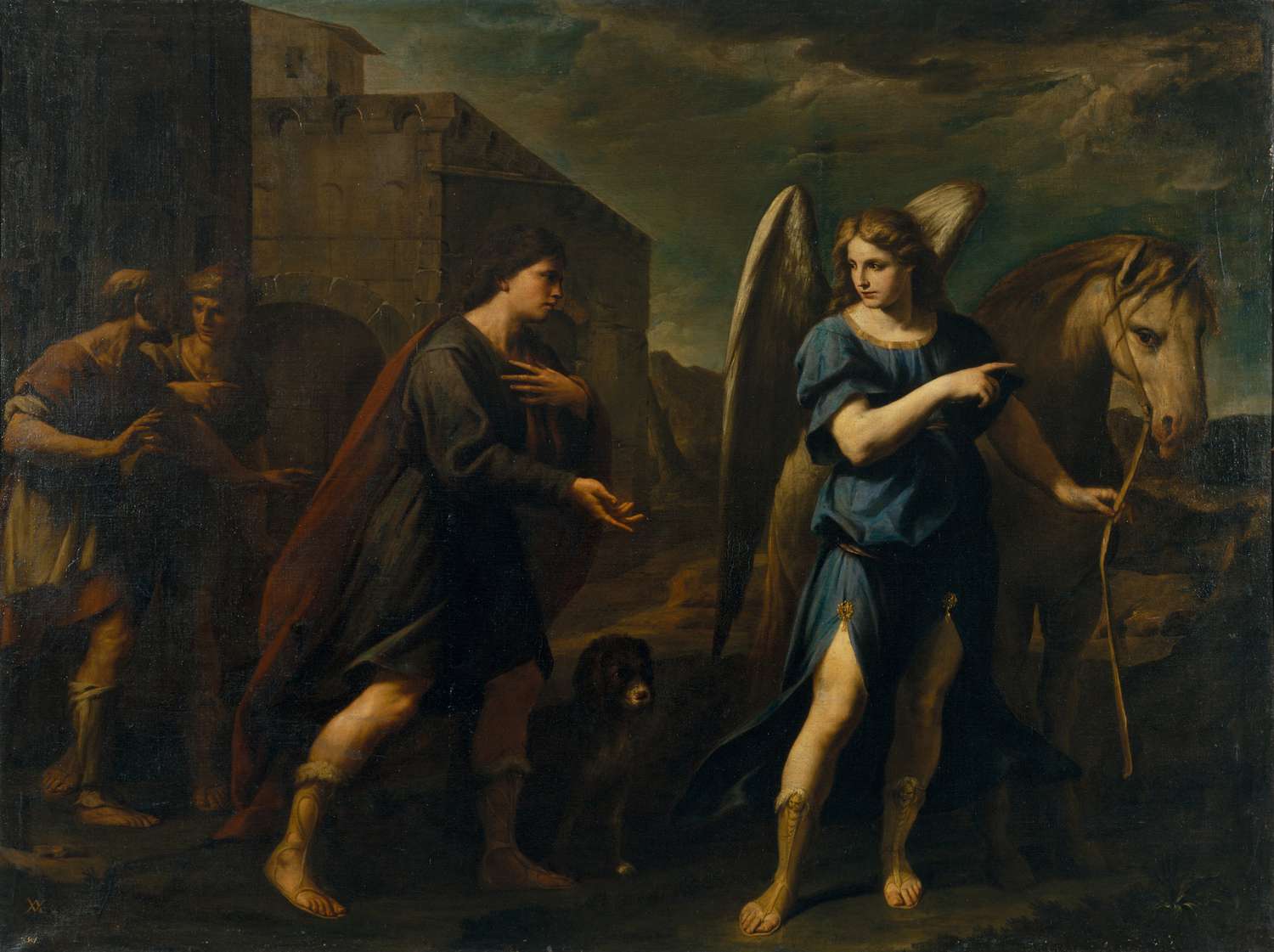
Saint Raphael the Archangel
The Healing Archangel, Guide of Travellers, and Companion of Those Who Seek God
Saint Raphael the Archangel is one of the seven archangels who stand before the throne of God. His name means “God heals” or “God has healed.” Among the angels named in Sacred Scripture, Raphael holds a special place because he appears prominently in the Book of Tobit, where God sends him to accompany, protect, guide, and heal Tobiah and his family.
Raphael is especially loved by the faithful as the angel of healing, safe journeys, protection, marriage, and God’s providential guidance. His story reminds us that God’s help often comes quietly: through an unexpected companion, a timely word, a journey that changes our lives, or a healing that restores hope.


Feast of Saint Raphael the Archangel
The Catholic Church celebrates the Feast of Saints Michael, Gabriel, and Raphael the Archangels on September 29.
Raphael is traditionally invoked especially by:
- the sick and those seeking healing
- travellers and pilgrims
- families
- married couples
- those discerning their vocation
- people facing difficult journeys in life
- those seeking protection and guidance
- caregivers and medical professionals
1. The Meaning of the Name Raphael
The name Raphael comes from the Hebrew Rāfāʾēl, generally understood as:
“God heals.”
This meaning beautifully summarizes Raphael’s biblical mission.
Raphael does not heal through his own power. Rather, he is God’s servant and messenger. His very name directs our attention away from the angel himself and toward God, the source of healing.
In the Book of Tobit, Raphael accompanies Tobiah on a journey and becomes an instrument through which God brings healing to several members of the family.
This gives Raphael a particularly beautiful spiritual message:
When God sends His help, we may not always recognize the messenger immediately.
2. Raphael in the Book of Tobit
The principal biblical account of Raphael is found in the Book of Tobit.
Tobit was a righteous Israelite living in exile. Although faithful to God, he experienced suffering and blindness. At the same time, a young woman named Sarah was suffering from another terrible affliction.
Both Tobit and Sarah prayed to God.
Their prayers were heard.
God sent the angel Raphael.
“The prayer of both was heard in the presence of the glory of the great God.”
— Tobit 3:16
This verse introduces one of the most beautiful themes of Raphael’s story:
God hears the prayers of those who suffer.
Tobit did not know how God would answer his prayer.
Sarah did not know how God would answer hers.
But God was already preparing an answer.
3. Raphael Is Sent by God
Tobit wanted his son Tobiah to travel to Media to recover money that had been entrusted to a man named Gabael.
Tobiah needed a trustworthy companion for the journey.
Raphael appeared in human form and offered to accompany him.
Tobiah did not initially know that his companion was an angel.
Raphael introduced himself as:
“Azariah, son of the great Hananiah.”
— Tobit 5:18
Thus began one of the most remarkable journeys in the Bible.
Raphael travelled with Tobiah, protected him, instructed him, and guided him toward God’s providential plan.
4. Raphael and Tobiah’s Journey
The journey of Tobiah and Raphael is more than a physical journey.
It is also a spiritual journey.
Tobiah leaves his father’s home not knowing everything that awaits him.
Raphael walks beside him.
This becomes an image of the Christian journey.
We often begin a journey without knowing:
- where it will lead,
- what difficulties will appear,
- whom we will meet,
- what suffering we will encounter,
- or how God will use our experiences.
Yet God does not abandon His children.
The story of Raphael reminds us that divine providence can accompany us even when we cannot see it.
5. Raphael and the Fish
During their journey, Tobiah encounters a large fish in the Tigris River.
Raphael instructs him:
“Cut open the fish and take the heart and liver and gall and put them away safely.”
— Tobit 6:4
These unusual instructions become important later.
The fish becomes an instrument in God’s plan for healing.
Raphael tells Tobiah that the heart and liver can be used to drive away the evil spirit troubling Sarah, while the gall will later be used to heal Tobit’s blindness.
This episode shows an important biblical theme:
God can use ordinary created things as instruments of His providence.
The fish itself is not divine.
The healing power does not come from magic.
Rather, the narrative presents these things as instruments within God’s saving action.
6. Raphael and Sarah
Sarah was the daughter of Raguel and Edna.
She had experienced enormous suffering. She had been married several times, but each husband died before the marriage could be consummated because of the evil spirit afflicting her.
Sarah was deeply distressed and prayed to God.
Her prayer is one of the most moving prayers in the Book of Tobit.
She says:
“Blessed are you, O merciful God, and blessed is your name forever.”
— Tobit 3:11
Sarah’s prayer is important because she does not allow suffering to destroy her trust in God.
She turns toward God.
And God responds.
7. Raphael and Tobiah’s Marriage
Raphael guides Tobiah toward Sarah.
Tobiah does not simply enter into marriage without understanding the seriousness of the situation.
Raphael instructs him about what he should do.
Tobiah follows Raphael’s instructions.
Sarah and Tobiah pray together.
Their prayer before their marriage is one of the beautiful prayers for married couples found in Scripture.
Tobiah says:
“Now, Lord, you know that I take this wife of mine not because of lust, but for a worthy purpose.”
— Tobit 8:7
This prayer presents marriage as something sacred before God.
Tobiah and Sarah ask God to bless their union.
Their marriage therefore becomes part of God’s healing plan.
8. Raphael and the Healing of Sarah
Following Raphael’s instructions, Tobiah uses the fish’s heart and liver.
The evil spirit leaves Sarah.
The marriage that appeared impossible becomes possible.
The family that had lived in fear experiences joy.
Sarah’s suffering becomes part of a larger story of God’s providence.
This does not mean that every suffering person receives an immediate miraculous healing.
Rather, Raphael’s story teaches us to continue praying even when we cannot see the answer.
9. Raphael and the Healing of Tobit
Raphael’s mission was not finished.
When Tobiah returned home, he used the gall of the fish according to Raphael’s instructions.
Tobit’s blindness was healed.
The old man’s sight was restored.
The family was reunited.
Joy returned to the household.
Tobit then praised God.
The healing ultimately led not merely to physical restoration but to thanksgiving and renewed faith.
This is an important spiritual lesson:
Healing should lead us toward gratitude.
10. Raphael Reveals His Identity
At the end of the story, Tobit and Tobiah want to reward Raphael.
But Raphael refuses.
He tells them:
“I am Raphael, one of the seven angels who stand ready and enter before the glory of the Lord.”
— Tobit 12:15
The mystery is revealed.
The man who travelled with Tobiah was actually an angel of God.
Tobit and Tobiah are astonished.
Raphael then tells them:
“I was sent to heal you.”
— Tobit 12:14
His mission was never about receiving glory for himself.
He was sent by God.
11. Raphael Teaches Tobit About Prayer
One of Raphael’s most beautiful teachings concerns prayer.
He tells Tobit:
“Prayer is good when accompanied by fasting, almsgiving, and righteousness.”
— Tobit 12:8
Raphael therefore connects prayer with a transformed life.
Christian prayer is not merely asking God for things.
Authentic prayer should lead us toward:
- repentance,
- charity,
- justice,
- generosity,
- mercy,
- trust,
- and holiness.
12. “I Presented Your Prayers”
Raphael gives Tobit an extraordinary glimpse into the spiritual world.
He says:
“I now declare to you the whole truth: I am Raphael, one of the seven angels who stand ready and enter before the glory of the Lord.”
— Tobit 12:15
He also explains that he had been involved in presenting their prayers before God.
This is one reason Raphael has become especially associated with intercession.
His story reminds Christians that our prayers are not meaningless words.
God hears them.
Even prayers spoken through tears can reach the presence of God.
13. Raphael and Healing
Because of his biblical mission, Saint Raphael has traditionally become associated with healing.
His name itself means:
God heals.
Catholics may therefore ask for Raphael’s intercession for:
- physical healing,
- emotional consolation,
- spiritual healing,
- healing within families,
- healing from past wounds,
- healing in marriages,
- strength during illness,
- and guidance for caregivers.
But Christian devotion must always keep the proper order:
Raphael is not the source of healing. God is.
The angel leads us toward the Lord.
14. Raphael and Travellers
Raphael is also widely honored as a protector of travellers.
This comes directly from his journey with Tobiah.
He walked with him through an unfamiliar land.
He protected him from danger.
He guided him toward the people and circumstances God had prepared for him.
For this reason, Christians have traditionally sought Raphael’s intercession before:
- long journeys,
- pilgrimages,
- flights,
- road trips,
- missionary journeys,
- difficult relocations,
- and important transitions in life.
A simple prayer can be:
“Saint Raphael the Archangel, accompany me on my journey and lead me safely according to God’s will.”
15. Raphael and Marriage
The story of Tobiah and Sarah has also made Raphael especially associated with marriage.
He helped Tobiah understand that marriage was not merely a matter of attraction or personal desire.
Tobiah prayed that his marriage would be founded upon God’s purposes.
Therefore, couples may seek Raphael’s intercession for:
- faithful marriages,
- discernment before marriage,
- healing in troubled marriages,
- peace within families,
- protection of married love,
- and openness to God’s will.
The prayer of Tobiah and Sarah provides a beautiful biblical model for married couples: begin the marriage by placing God at its centre.
16. Raphael and Divine Providence
Perhaps the deepest message of Raphael’s story is the mystery of divine providence.
Consider the sequence:
Tobit becomes blind.
Sarah suffers.
Both pray.
Tobiah must travel.
Raphael appears.
Tobiah meets Sarah.
A marriage takes place.
Sarah is freed from her affliction.
Tobit receives his sight.
The family rejoices.
What initially appears to be a collection of unrelated events becomes one story under God’s providence.
This is often how God’s work appears in our own lives.
We see individual events.
God sees the whole journey.
17. Raphael and the Angels
Raphael’s story also reminds us of the Catholic teaching concerning angels.
Angels are spiritual creatures created by God.
They are not gods.
They do not replace God.
They serve God.
The Catechism of the Catholic Church teaches:
“With their whole beings the angels are servants and messengers of God.”
— Catechism of the Catholic Church, 329
The angels therefore exist for God’s glory and participate in His plan of salvation.
Raphael is an especially beautiful example of this angelic ministry.
He serves by accompanying, guiding, protecting, and healing according to God’s command.
18. Raphael, Michael, and Gabriel
Raphael is traditionally grouped with two other archangels named in Scripture:
Saint Michael
Michael is associated particularly with spiritual combat and the defense of God’s people.
Saint Gabriel
Gabriel is God’s messenger in important moments of salvation history, especially in the Annunciation to the Blessed Virgin Mary.
Saint Raphael
Raphael appears especially as a companion, guide, protector, and instrument of healing.
Together, these three archangels remind us of different dimensions of God’s work:
Michael — protection
Gabriel — proclamation
Raphael — guidance and healing
Above all, however, their ministry points toward God Himself.
19. Raphael and the Christian Journey
The journey of Tobiah can be understood as an image of every Christian life.
There are moments when we know where we are going.
There are other moments when the road seems uncertain.
Sometimes we encounter unexpected dangers.
Sometimes we meet people who transform our lives.
Sometimes God gives us healing.
Sometimes He gives us strength to continue even before the healing comes.
Raphael teaches us:
Do not be afraid of the journey when God is your guide.
20. Raphael and Those Who Are Sick
For someone who is sick, Raphael’s story can be particularly consoling.
The Book of Tobit does not present suffering as proof that God has abandoned someone.
Tobit suffered.
Sarah suffered.
Both prayed.
And God heard them.
The presence of Raphael demonstrates that God’s response can already be at work before the suffering person understands what God is doing.
For the sick, therefore, Raphael can be a companion in prayer.
A Christian can pray:
“Saint Raphael, servant of the merciful God, stand beside me in my suffering. Intercede for me before the Lord and obtain for me whatever healing God desires for my body, mind, and soul. Give me patience, courage, and trust. Amen.”
21. Raphael and the Modern World
The story of Raphael remains remarkably relevant today.
We live in a world filled with anxiety about:
- health,
- family,
- relationships,
- travel,
- employment,
- the future,
- loneliness,
- and uncertainty.
The story of Tobit tells us that God remains present even in complicated circumstances.
Raphael does not remove every difficulty immediately.
Instead, he walks with Tobiah through the difficulty.
That may be one of the most beautiful images of divine accompaniment in Scripture.
22. Raphael as a Model of Angelic Service
Raphael’s ministry teaches us something about Christian service as well.
He does not seek attention.
He does not demand praise.
He does not draw people toward himself.
He serves God’s plan.
After completing his mission, he disappears from the story.
This gives us a powerful lesson:
True Christian service ultimately points beyond the servant to God.
A priest, parent, teacher, missionary, caregiver, or any Christian servant can learn from Raphael:
Accompany others.
Guide them toward God.
Protect the vulnerable.
Serve without seeking glory.
And rejoice when others encounter God’s grace.
23. Raphael and Catholic Devotion
Catholic devotion to Saint Raphael developed from the biblical account in Tobit and the Church’s longstanding devotion to the holy angels.
He is especially invoked by those who need:
- healing,
- safe travel,
- guidance,
- protection,
- help in marriage,
- and God’s providential care.
Devotion to Raphael should always remain Christ-centred.
The purpose of asking for the intercession of an angel or saint is not to replace prayer to God but to join our prayers with the heavenly family.
24. A Spiritual Lesson from Raphael
The story of Raphael can be summarized in one simple truth:
God often accompanies us before we recognize His presence.
Tobiah saw a travelling companion.
He did not initially realize that God had sent an angel.
Sometimes we may look back upon our own lives and recognize moments when help came through:
- a person,
- a conversation,
- an unexpected opportunity,
- a warning,
- a friendship,
- a priest,
- a family member,
- or a seemingly ordinary event.
We may never know how many times God protected us without our realizing it.
25. Prayer to Saint Raphael the Archangel
Saint Raphael the Archangel,
faithful servant of the Most High God,
you accompanied Tobiah on his journey
and brought healing and blessing to his family.
Be my companion on the journey of life.
Guide me when I am uncertain,
protect me when I am in danger,
strengthen me when I am afraid,
and lead me closer to God.
Intercede for the sick and suffering.
Bring comfort to those who are discouraged.
Pray for families in difficulty.
Protect travellers and pilgrims.
Guide young people in their decisions
and help couples build their lives upon God.
Ask the Lord to heal what is wounded in me,
to strengthen what is weak,
to restore what has been broken,
and to give me grace to accept His will.
Saint Raphael,
angel of healing and companion of travellers,
pray for us.
Amen.
26. Prayer for Healing Through the Intercession of Saint Raphael
O glorious Saint Raphael,
God’s messenger of healing and mercy,
pray for me before the throne of the Most High.
Ask the Lord to touch me with His healing grace.
If it is God’s will,
may He restore my health.
If healing must take time,
give me patience.
If my suffering cannot immediately be removed,
obtain for me courage.
If I am afraid,
obtain peace.
If I am discouraged,
obtain hope.
If I am lonely,
remind me that God never abandons His children.
May I always remember that true healing comes from God.
Saint Raphael the Archangel,
pray for us.
Amen.
27. Prayer for Travellers
Saint Raphael the Archangel,
companion of Tobiah,
walk with us on our journey.
Protect us from accidents and dangers.
Guide those who drive, fly, sail, or travel.
Keep us attentive and responsible.
Protect our families while we are away from home.
Bring us safely to our destination
and safely back to those we love.
Above all,
help us remember that every journey of this earthly life
ultimately leads toward God.
Saint Raphael, guide us.
Saint Raphael, protect us.
Saint Raphael, pray for us.
Amen.
28. Lessons We Can Learn from Saint Raphael
1. God hears our prayers.
Tobit and Sarah prayed, and God heard them.
2. God can work through unexpected people.
Tobiah did not initially know the identity of his companion.
3. We should not be afraid of difficult journeys.
Raphael accompanied Tobiah.
4. Healing comes from God.
Raphael’s very name means “God heals.”
5. Marriage belongs under God’s providence.
Tobiah and Sarah prayed together.
6. Prayer should transform our lives.
Raphael connects prayer with righteousness, fasting, and almsgiving.
7. God’s providence can connect apparently unrelated events.
Tobit’s suffering, Sarah’s suffering, Tobiah’s journey, and the eventual healing were woven together.
8. True servants of God do not seek personal glory.
Raphael fulfilled his mission and directed attention toward God.
29. Saint Raphael and the Hope of Christians
Saint Raphael’s story ultimately is not merely the story of an angel.
It is the story of God’s mercy.
God saw Tobit’s suffering.
God saw Sarah’s tears.
God heard their prayers.
God sent Raphael.
And God brought healing and joy.
The same God who heard their prayers remains the God whom Christians worship today.
Therefore, when we pray to Saint Raphael, our hearts should ultimately turn toward the Lord:
God who heals,
God who guides,
God who protects,
God who hears,
God who accompanies us,
God who never abandons His children.
Conclusion
Saint Raphael the Archangel stands before us as one of the most beautiful biblical images of God’s healing presence and loving providence.
He accompanied Tobiah when the road ahead was uncertain.
He guided him toward Sarah.
He helped bring healing to Sarah.
He helped restore Tobit’s sight.
He protected a family.
And when his mission was complete, he revealed that he had been sent by God.
The message of Raphael is therefore simple and profound:
You are not alone on the journey.
When the road is uncertain, God can guide you.
When you are wounded, God can heal you.
When you are afraid, God can strengthen you.
When you are travelling, God can protect you.
When you cannot see the way forward, God already sees the destination.
May Saint Raphael the Archangel accompany us, intercede for us, and lead us ever closer to the merciful God who heals.
Saint Raphael the Archangel,
Angel of healing,
Companion of travellers,
Protector of families,
Guide of God’s children,
pray for us.
Amen.
Biblical and Catholic References
- Book of Tobit, especially chapters 3–12
- Tobit 3:16 — God hears the prayers of Tobit and Sarah
- Tobit 5–6 — Raphael accompanies Tobiah
- Tobit 6 — The fish and Raphael’s instructions
- Tobit 8 — Tobiah and Sarah’s prayer
- Tobit 11 — Tobit’s healing
- Tobit 12:6–22 — Raphael reveals his identity and teaches about prayer
- Catechism of the Catholic Church, §§328–336 — Angels
- Catechism of the Catholic Church, §329 — Angels as servants and messengers of God
- Daniel 10:13; 12:1 — Michael and the heavenly beings
- Luke 1:26–38 — Gabriel and the Annunciation
- Revelation 8:3–4 — Angelic ministry associated with the prayers of God’s people
Leave a Reply