
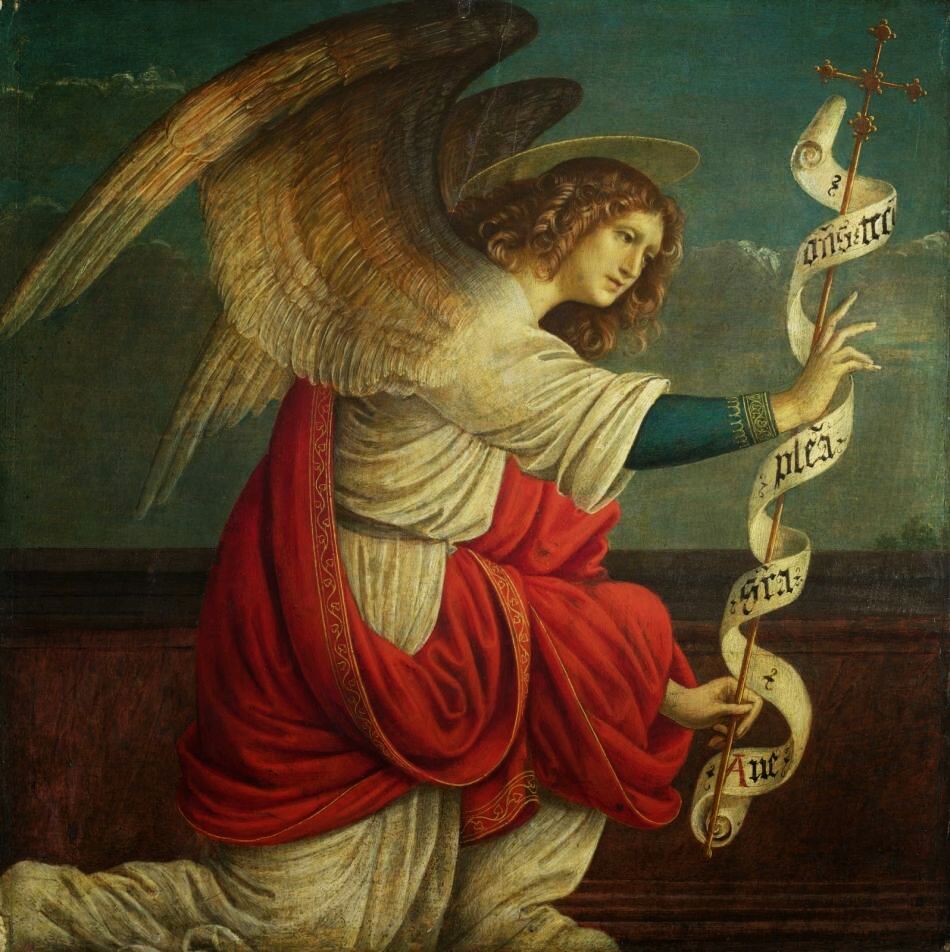
Gabriel the Archangel
The Messenger of God and Herald of the Incarnation
Feast Day: September 29
Name: Gabriel
Meaning: “God is my strength” / “Strength of God”
Venerated by: Catholic Church, Eastern Orthodox Church and other Christian traditions
Biblical Books: Daniel and Luke
Special Mission: Announcer of God’s saving plan, especially the births of John the Baptist and Jesus Christ
Patronage: Communications and communicators, messengers, postal workers, broadcasters, and various groups associated with communication
Introduction
Among all the angels mentioned in Sacred Scripture, Gabriel the Archangel occupies a unique place in the history of salvation.
He appears at decisive moments when God reveals His plan to humanity. In the Old Testament, Gabriel appears in the Book of Daniel as an interpreter of visions and a messenger concerning God’s purposes. In the New Testament, Gabriel appears to Zechariah, announcing the birth of John the Baptist, and to the Virgin Mary, announcing the Incarnation of the Son of God.
His greatest biblical mission is therefore connected with the mystery of the Annunciation.
Gabriel comes to Mary with a message that changed the history of humanity:
“You will conceive in your womb and bear a son, and you will name him Jesus.”
— Luke 1:31
Through Gabriel, God announces that the eternal Son will take human flesh.
Pope Benedict XVI described Gabriel as “the messenger of God’s Incarnation”, emphasizing that through Gabriel God asks Mary for her “yes” to become the Mother of the Redeemer.
Who Is Gabriel?
Gabriel is one of the few angels whom Sacred Scripture identifies by name.
The Bible explicitly names three heavenly beings as Michael, Gabriel and Raphael. The Catholic Church celebrates these three archangels together on September 29.
Gabriel’s name is generally understood as meaning “God is my strength” or “Strength of God.”
The meaning of his name is beautifully appropriate to his biblical mission.
Gabriel does not proclaim his own power.
He announces the power and saving action of God.
His presence in Scripture directs attention away from himself and toward the Lord.
That is an essential characteristic of an angelic messenger.
Angels in Catholic Faith
Before considering Gabriel’s individual missions, it is important to understand what the Catholic Church teaches about angels.
Angels are not gods.
They are created spiritual beings who serve and worship God.
The Catechism of the Catholic Church teaches that angels are spiritual, non-corporeal creatures and that they are personal and immortal beings who surpass visible creatures in perfection.
The word angel means messenger.
Thus, when Scripture presents an angel speaking to a human being, the angel is acting as a servant and messenger of God.
Pope Francis similarly emphasized that angels serve and contemplate God while also being sent to accompany human beings on their earthly journey.
Gabriel in the Book of Daniel
Gabriel’s first explicit appearance in Sacred Scripture occurs in the Book of Daniel.
Daniel receives mysterious visions that he struggles to understand. Gabriel is sent to help him understand their meaning.
Daniel writes:
“And I heard a man’s voice between the banks of the Ulai, and it called, ‘Gabriel, make this man understand the vision.’”
— Daniel 8:16
Gabriel then explains the vision to Daniel.
Later, while Daniel is praying, Gabriel comes to him again:
“While I was speaking and praying… the man Gabriel, whom I had seen before in the vision, came to me in swift flight.”
— Daniel 9:20–21
Gabriel therefore appears in Daniel as a messenger and interpreter of divine revelation.
His mission prepares the biblical reader for his later appearance in the Gospel of Luke.
Gabriel and the Mystery of God’s Plan
The Book of Daniel contains difficult prophetic material concerning the future of God’s people.
Gabriel’s role is significant because he does not simply appear as a supernatural figure.
He brings understanding.
This is one of the important characteristics associated with Gabriel throughout Scripture:
God sends him to communicate what human beings could not discover by themselves.
The angel’s mission is therefore connected with revelation.
God speaks.
Gabriel communicates.
The human person listens.
This pattern reaches its greatest expression in the Gospel.
Gabriel Appears to Zechariah
Gabriel’s first appearance in the Gospel of Luke occurs in the Temple of Jerusalem.
The priest Zechariah is performing his priestly service when an angel appears to him.
Luke identifies the angel:
“I am Gabriel. I stand in the presence of God.”
— Luke 1:19
This is one of the most important statements about Gabriel’s identity in Scripture.
He says that he stands in the presence of God.
His authority does not originate in himself.
He is a servant of God.
Gabriel announces that Zechariah’s wife, Elizabeth, will have a son.
That son will be John the Baptist.
The Birth of John the Baptist
Gabriel tells Zechariah:
“Your wife Elizabeth will bear you a son, and you will name him John.”
— Luke 1:13
Gabriel explains that this child will have a special role in God’s plan.
John will prepare the people for the coming of the Lord.
He will go before Him in the spirit and power of Elijah.
Thus Gabriel’s announcement concerning John is not simply a promise of a child.
It is a declaration that salvation history is moving toward fulfillment.
The Messiah is approaching.
The prophet who will prepare His way is about to be born.
Zechariah’s Doubt
Zechariah struggles to believe the message because he and Elizabeth are advanced in age.
Gabriel responds:
“I am Gabriel. I stand in the presence of God, and I have been sent to speak to you and to bring you this good news.”
— Luke 1:19
The expression “good news” is important.
Gabriel is a messenger of God’s good news.
The Greek New Testament uses language associated with proclaiming the Gospel.
The angel therefore stands at the threshold of the Gospel story.
Gabriel and the Annunciation
Gabriel’s most famous mission occurs six months later.
God sends him to Nazareth.
There he encounters a young Jewish woman named Mary.
Luke records:
“In the sixth month the angel Gabriel was sent by God to a town in Galilee called Nazareth.”
— Luke 1:26
The wording is extraordinary.
Gabriel is sent by God.
He does not appear according to his own initiative.
He comes because God has entrusted him with a message.
“Hail, Full of Grace”
Gabriel greets Mary:
“Hail, favored one! The Lord is with you.”
— Luke 1:28
This greeting is central to Catholic devotion to Mary.
The traditional Latin translation uses the expression “Ave, gratia plena”, reflected in the opening of the Hail Mary.
The angel’s greeting reveals something extraordinary about Mary.
She has received a unique grace from God.
The Lord is with her.
“Do Not Be Afraid, Mary”
Mary is troubled by Gabriel’s greeting.
Gabriel reassures her:
“Do not be afraid, Mary, for you have found favor with God.”
— Luke 1:30
The message begins with reassurance.
Whenever God calls someone to participate in His plan, grace accompanies the call.
Mary is not asked to accomplish God’s work by her own strength.
God’s grace will act through her.
The Greatest Announcement
Gabriel then reveals the heart of his message:
“You will conceive in your womb and bear a son, and you will name him Jesus.”
— Luke 1:31
This child will be great.
He will be called the Son of the Most High.
He will receive the throne of David.
His kingdom will have no end.
Gabriel is announcing the Incarnation.
The eternal Son of God will become man.
This is the central mystery of Christianity.
“How Can This Be?”
Mary asks:
“How can this be, since I have no relations with a man?”
— Luke 1:34
Mary’s question is not a rejection of God’s will.
She seeks to understand how God’s promise will be fulfilled.
Gabriel explains:
“The Holy Spirit will come upon you, and the power of the Most High will overshadow you.”
— Luke 1:35
The conception of Jesus will be the work of the Holy Spirit.
The child will truly be holy.
He will be called the Son of God.
Gabriel Announces God’s Power
The Annunciation ends with one of the great statements of biblical faith:
“For nothing will be impossible for God.”
— Luke 1:37
These words summarize Gabriel’s message.
Human beings see limitations.
God sees possibilities.
Human beings see impossibility.
God sees His plan.
Elizabeth is expecting a child despite her age.
Mary will conceive Jesus through the power of the Holy Spirit.
The history of salvation demonstrates that God’s power exceeds human limitations.
Mary’s Fiat
Gabriel announces God’s plan, but Mary must respond.
She says:
“Behold, I am the handmaid of the Lord. May it be done to me according to your word.”
— Luke 1:38
This is Mary’s fiat—her loving “yes” to God.
Gabriel does not force Mary.
God invites.
Mary freely responds.
Her response becomes one of the greatest acts of faith in salvation history.
Through Mary’s “yes,” the mystery of the Incarnation enters human history.
Gabriel and Jesus
Gabriel never becomes the center of the Annunciation.
Jesus is the center.
Mary is the chosen Mother.
Gabriel is the messenger.
This is important for understanding Catholic devotion to angels.
The Church honors angels, but angels always direct worship toward God.
Gabriel’s mission is successful precisely because he brings people closer to Christ.
Gabriel as Messenger of the Gospel
Gabriel’s role in Scripture can be summarized in one word:
message.
He brings:
- God’s promise to Daniel;
- good news to Zechariah;
- God’s call to Mary;
- the announcement of John the Baptist’s birth;
- the announcement of Jesus’ conception.
He is therefore closely associated with divine communication.
Pope Benedict XVI called Gabriel the messenger of the Incarnation.
Gabriel and Communication
Because of his role as God’s messenger, Gabriel has traditionally been associated with communication.
The Holy See has explicitly noted that Gabriel is regarded as the patron of those who work in radio.
This association has broader spiritual significance.
Communication can build or destroy.
Words can heal or wound.
Messages can bring peace or create conflict.
Gabriel reminds Christians that communication should serve truth and God’s purposes.
Gabriel and the Hail Mary
Every time Catholics pray:
“Hail Mary, full of grace, the Lord is with thee…”
they echo the angelic greeting recorded by Saint Luke.
The opening words of the Hail Mary therefore come directly from the biblical scene of the Annunciation.
Gabriel’s greeting has become part of one of Christianity’s most beloved prayers.
The Rosary repeatedly brings the Christian back to the mystery announced by Gabriel:
God became man for our salvation.
Pope John Paul II noted that the Angelus begins by recalling the Annunciation of the Archangel Gabriel to the Virgin Mary.
Gabriel and the Angelus
The Angelus is another important Christian prayer associated with Gabriel’s announcement.
The prayer recalls three moments:
- The angel’s announcement to Mary.
- Mary’s acceptance of God’s will.
- The Word becoming flesh.
The Angelus therefore brings the believer back to the mystery of the Incarnation.
Traditionally, it is prayed in the morning, at noon and in the evening.
Its central message is simple:
The Word became flesh and dwelt among us.
Gabriel and Advent
Gabriel’s message is especially meaningful during Advent.
Advent prepares Christians for Christmas.
But before there was the manger at Bethlehem, there was the announcement at Nazareth.
Before Mary gave birth to Jesus, she first received God’s invitation.
Before the shepherds heard the angels at Bethlehem, Gabriel had already announced the mystery to Mary.
The Annunciation is therefore an important doorway into the mystery of Christmas.
Gabriel and Christmas
Christmas celebrates the birth of Jesus.
Gabriel announces His conception.
Both events are connected.
The angel announces:
“You will name him Jesus.”
The shepherds later hear:
“Today in the city of David a savior has been born for you who is Messiah and Lord.”
— Luke 2:11
The message begins with Gabriel.
The Good News continues through the angels, the apostles and the Church.
Gabriel and God’s “Good News”
Gabriel’s message to Zechariah is explicitly described as good news.
This reminds us that Christianity is fundamentally a proclamation.
The Gospel is not merely a philosophy.
It is news:
God has acted to save humanity.
God has entered human history.
The Son has become man.
Salvation has come near.
Gabriel stands at the beginning of this proclamation in the Gospel of Luke.
Gabriel and Human Freedom
The Annunciation also teaches something profound about human freedom.
God’s plan is revealed to Mary.
But Mary must freely respond.
Her response is:
“May it be done to me according to your word.”
God’s grace does not destroy human freedom.
Grace enables a free response to God.
Mary’s “yes” becomes a model for every Christian.
When God calls us, we too are invited to say:
“Let it be done according to Your word.”
Gabriel and Obedience
Gabriel himself is an example of obedience.
He is repeatedly described as being sent.
He does not invent his message.
He does not modify God’s will.
He communicates what God commands.
This teaches Christians the importance of obedient service.
The question for the disciple is not:
“What do I want to communicate?”
but:
“What does God want me to communicate?”
Gabriel and Humility
Although Gabriel is an archangel who stands in God’s presence, he never draws attention to himself.
His purpose is to point toward God.
This is a powerful lesson in humility.
A Christian apostle should not seek personal glory.
A priest should point people toward Christ.
A catechist should point toward Christ.
A parent should lead children toward Christ.
A Catholic website, ministry or social-media apostolate should ultimately point toward Christ.
Gabriel’s ministry can be summarized:
Do not look at the messenger. Listen to the message.
Gabriel and the Priesthood
Gabriel’s mission also offers a beautiful spiritual reflection for priests.
A priest is called to proclaim God’s Word.
Like Gabriel, he is not the source of the message.
He is a servant of God’s message.
The priest must therefore communicate Christ faithfully and humbly.
The goal is not:
“Look at me.”
The goal is:
“Look at Christ.”
Gabriel and Evangelization
The Church continues the work of announcing the Gospel.
Every Christian shares in this mission according to his or her vocation.
Parents evangelize children.
Teachers evangelize students.
Catechists teach the faith.
Priests preach the Gospel.
Missionaries proclaim Christ.
Catholic media communicate the faith.
In this sense, Christians can learn from Gabriel’s example.
Our communication should be:
- truthful;
- charitable;
- clear;
- faithful to Christ;
- directed toward salvation;
- respectful of human dignity.
Gabriel and the Power of Words
The story of Gabriel reminds us that words matter.
One sentence changed Mary’s life:
“You will conceive in your womb and bear a son.”
One sentence changed Zechariah’s understanding of his future:
“Your wife Elizabeth will bear you a son.”
God used words to reveal His plan.
Christians should therefore use words responsibly.
Before speaking, we can ask:
Is this true?
Is this necessary?
Is this charitable?
Will this bring someone closer to God?
Gabriel in Catholic Art
Christian artists commonly portray Gabriel with:
- wings;
- a white or luminous garment;
- a staff;
- a scroll;
- a lily;
- a trumpet;
- or a gesture of announcing God’s message.
At the Annunciation, Gabriel is often depicted standing before Mary.
The lily is especially associated with purity and is frequently included in artistic representations of the Annunciation.
The scroll represents the message entrusted to Gabriel.
The trumpet symbolizes proclamation, although it is more strongly connected with broader angelic imagery than with a specific biblical description of Gabriel.
It is important to distinguish biblical descriptions from later artistic tradition.
Gabriel and the Lily
The lily has become a familiar symbol in depictions of the Annunciation.
It represents purity and is particularly associated with Mary.
In countless paintings, Gabriel offers or stands beside a lily as he announces God’s plan.
The image beautifully connects Gabriel’s message with Mary’s purity and the mystery of the Incarnation.
Gabriel and the White Garment
Artists frequently portray Gabriel in radiant white.
This symbolizes:
- purity;
- heavenly glory;
- holiness;
- and his role as a servant of God.
Scripture does not provide a detailed physical description of Gabriel’s appearance.
The artistic representations therefore belong to Christian tradition rather than a literal description given by the Bible.
Gabriel in Christian Tradition
Beyond the explicit biblical accounts, many traditions have developed around Gabriel.
Some are ancient and deeply rooted in Christian devotion; others belong to later pious tradition.
Catholics should distinguish between:
what Scripture explicitly teaches,
what the Church officially teaches,
and
later devotional traditions.
The central facts are clear:
Gabriel is a heavenly messenger.
He is named in Daniel.
He appears in Luke.
He announces the birth of John.
He announces the Incarnation to Mary.
He stands in God’s presence.
He is sent by God.
These are the foundations of Catholic devotion to Gabriel.
Gabriel and the Archangels
The Church celebrates Saint Michael, Saint Gabriel and Saint Raphael together on September 29.
Each has a distinctive biblical mission:
Michael is associated particularly with spiritual warfare and the defense of God’s people.
Gabriel is associated with God’s messages and the proclamation of the Incarnation.
Raphael is associated with healing and God’s providential care in the Book of Tobit.
Pope Benedict XVI noted that each of these archangels carried out a special mission in salvation history.
September 29 – Feast of the Archangels
The Catholic liturgical calendar celebrates the three archangels together on September 29.
The Church’s Directory on Popular Piety notes September 29 as the feast of the Archangels Michael, Gabriel and Raphael, while October 2 is the memorial of the Guardian Angels.
The feast invites Christians to remember the mysterious ministry of the angels and to give glory to God for His providential care.
Gabriel and the Mystery of the Incarnation
Above everything else, Gabriel should be remembered in connection with the Incarnation.
The Christian faith proclaims something astonishing:
The eternal Word became flesh.
God did not remain distant.
He entered our human history.
He took flesh from the Virgin Mary.
He became truly human while remaining truly divine.
Gabriel announces this mystery.
That is why his role is so important.
He stands at the threshold between promise and fulfillment.
Gabriel and Mary
The relationship between Gabriel and Mary is one of the most beautiful encounters in Scripture.
The angel speaks.
Mary listens.
God’s plan is revealed.
Mary asks.
Gabriel explains.
Mary trusts.
Mary responds.
And the Word becomes flesh.
This scene teaches us the spirituality of Christian discipleship:
listen → receive → trust → respond → cooperate with God.
Gabriel and Prayer
The Annunciation teaches us how to pray.
Mary’s attitude is one of openness.
She does not understand everything immediately.
But she trusts God.
Sometimes we too do not understand what God is doing.
We may have questions about:
- our vocation;
- our family;
- our health;
- our future;
- our work;
- our relationships;
- our ministry.
Gabriel’s message reminds us that God’s plan can be greater than our understanding.
Like Mary, we are called to trust.
Gabriel and Difficult Messages
Not every message Gabriel brings is easy.
Zechariah receives a message that challenges his expectations.
Mary receives a message that changes her entire life.
The Gospel does not promise that God’s call will always be comfortable.
Sometimes God’s will requires courage.
Sometimes obedience means stepping into uncertainty.
Sometimes faith means saying “yes” before we understand everything.
Mary teaches us how to respond.
Gabriel and the New Evangelization
In today’s world, communication has become incredibly powerful.
A message can reach millions of people within seconds.
Catholic evangelization therefore has extraordinary opportunities.
But the example of Gabriel reminds us:
communication should serve truth.
The Church’s mission is not simply to produce more content.
It is to proclaim Christ.
Every Catholic communicator can ask:
- Does this point toward Christ?
- Is it faithful to the Gospel?
- Is it truthful?
- Does it build people up?
- Does it respect human dignity?
- Does it communicate hope?
Gabriel, the messenger of the Incarnation, becomes a powerful spiritual model for Christian communication.
Gabriel and the Digital Age
The modern world is filled with messages.
Phones.
Websites.
Social media.
Podcasts.
Videos.
Emails.
News.
Artificial intelligence.
Millions of messages travel around the world every day.
But the greatest message remains the Gospel.
Jesus Christ is Lord.
Gabriel reminds Christians that communication is most fruitful when it becomes an instrument of God’s truth and love.
Patron of Communicators
Because Gabriel is a divine messenger, Christian tradition has naturally associated him with communication.
The Holy See has explicitly referred to Gabriel as the patron of those who work in radio.
His patronage can be understood spiritually as an invitation to everyone involved in communication to seek:
truth, clarity, charity and service.
What Saint Gabriel Teaches Us
1. Listen to God
Gabriel’s message begins with God’s initiative.
We must learn to listen.
2. Be faithful messengers
When we receive the Gospel, we are called to share it.
3. Point people toward Christ
Gabriel never makes himself the center.
His message leads to Jesus.
4. Trust God when His plan is difficult
Mary did not understand everything, but she trusted.
5. Use words responsibly
Our words can become instruments of healing or destruction.
6. Be humble
A messenger exists for the message.
7. Say “yes” to God
Mary’s fiat remains one of the greatest examples of Christian obedience.
8. Remember that nothing is impossible for God
Gabriel’s message to Mary contains a timeless truth:
“For nothing will be impossible for God.”
— Luke 1:37
A Prayer to Saint Gabriel the Archangel
Saint Gabriel the Archangel,
messenger of the Most High God,
pray for us.
You who stand in the presence of God,
help us to live always in His presence.
You who were sent to announce
the birth of John the Baptist,
help us to prepare the way for Christ
in our own lives.
You who announced to the Virgin Mary
the mystery of the Incarnation,
teach us to listen to God’s voice
with humility and faith.
Obtain for us a heart like Mary’s,
ready to say:
“Let it be done to me according to your word.”
Help us when we are afraid.
Strengthen us when God’s plan
seems difficult to understand.
Teach us to trust God’s promises.
Help parents to communicate faith to their children.
Help priests and catechists to proclaim the Gospel faithfully.
Help writers, journalists, broadcasters and communicators
to use words for truth and peace.
Help all who work in the media
to communicate with wisdom, responsibility and charity.
Protect us from lies, deception and harmful words.
May our speech bring hope to the discouraged,
comfort to the suffering,
truth to those who are confused,
and faith to those who are searching for God.
Saint Gabriel,
messenger of the Incarnation,
lead us closer to Jesus.
May we proclaim with our lives
the Good News of salvation.
Saint Gabriel the Archangel, pray for us.
Amen.
Short Prayer to Saint Gabriel
Saint Gabriel the Archangel,
messenger of God,
help me to hear God’s voice,
understand His will,
and courageously say “yes” to Him.
Teach me to speak words of truth,
love and hope.
Lead me closer to Jesus
and help me, like Mary,
to receive God’s Word with faith.
Amen.
A Reflection on Gabriel
Gabriel came to Mary with a message.
But Mary’s response transformed the message into action.
This is an important lesson for every Christian.
It is possible to hear God’s Word without allowing it to change our lives.
We hear Scripture at Mass.
We read the Bible.
We listen to homilies.
We pray.
But the question remains:
What is my response?
Mary did not merely hear.
She believed.
She trusted.
She responded.
And God’s Word took flesh.
The Christian life begins when we move from merely hearing God’s Word to living it.
Conclusion
Gabriel the Archangel stands at some of the most important moments in salvation history.
He appears in Daniel as a messenger and interpreter.
He appears to Zechariah to announce the birth of John the Baptist.
And most gloriously, he appears to the Virgin Mary to announce the coming of Jesus Christ.
His mission is summarized in one beautiful truth:
Gabriel brings God’s message, but the message is always about God’s saving action.
He points us toward Christ.
He teaches us to listen.
He teaches us to trust.
He teaches us to communicate truth.
He teaches us to say “yes” to God.
Above all, Gabriel reminds us of the mystery announced at Nazareth:
God became man for our salvation.
May we learn from Gabriel to become faithful messengers of the Gospel in our families, parishes, workplaces and communities.
May our words bring truth rather than confusion, hope rather than despair, peace rather than division, and Christ rather than ourselves.
And whenever we face something that appears impossible, may we remember the angel’s message:
“For nothing will be impossible for God.”
Saint Gabriel the Archangel, messenger of God and herald of the Incarnation, pray for us.
Amen.
Biblical and Catholic References
- Daniel 8:15–17 — Gabriel is sent to explain Daniel’s vision.
- Daniel 9:20–23 — Gabriel comes to Daniel while he is praying.
- Luke 1:11–20 — Gabriel announces the birth of John the Baptist to Zechariah.
- Luke 1:26–38 — Gabriel announces the Incarnation to the Virgin Mary.
- Hebrews 1:14 — Angels are described as ministering spirits sent to serve those who are to inherit salvation; Pope Benedict XVI also cited this passage when explaining the angels’ ministry.
- Pope Benedict XVI, Homily, September 29, 2007 — Gabriel as messenger of the Incarnation.
- Pope Francis, Morning Meditation, September 29, 2017 — reflection on the ministry of Michael, Gabriel and Raphael.
- Directory on Popular Piety and the Liturgy, Vatican — September 29 as the feast of Michael, Gabriel and Raphael.
- Pope John Paul II, Angelus, September 29, 2002 — the Annunciation and Gabriel’s role in the prayer of the Angelus.
- Vatican, Pontifical Council for Social Communications — Gabriel’s traditional designation as patron of those working in radio.
Leave a Reply