
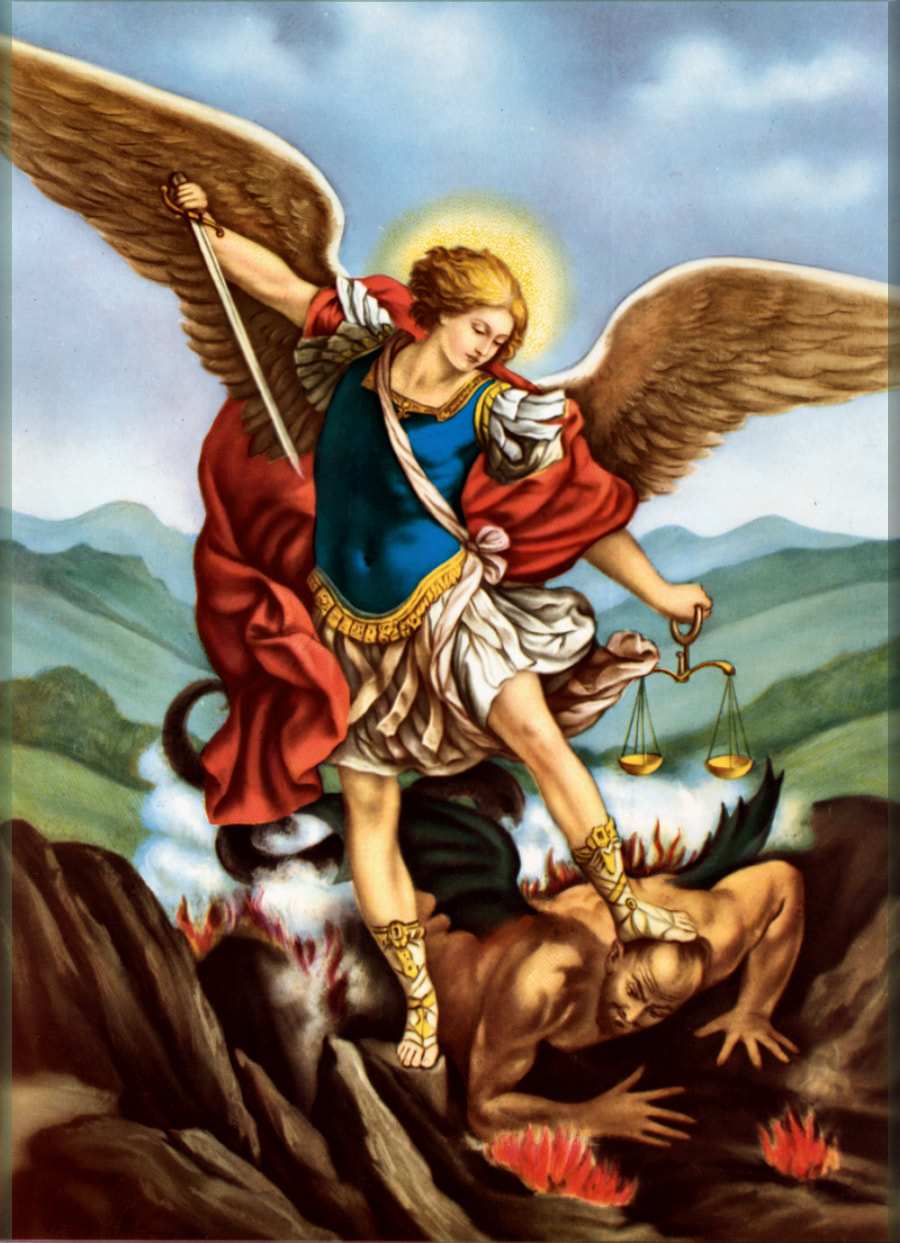
Michael the Archangel
Prince of the Heavenly Host and Defender of God’s People
Feast Day: September 29
Name: Michael
Meaning: “Who is like God?”
Biblical Books: Daniel, Jude and Revelation
Title: Archangel
Special Mission: Defender of God’s sovereignty and protector of God’s people
Traditional Patronage: Soldiers, police officers, firefighters, sailors, and those seeking protection from evil
Liturgical Feast: September 29, with Saints Gabriel and Raphael
Introduction
Among the angels named in Sacred Scripture, Saint Michael the Archangel occupies a unique place.
His very name is a proclamation of faith:
“Who is like God?”
The name Michael is traditionally understood as a rhetorical question affirming the incomparable greatness of God. No creature is like God. No power can equal Him. No authority stands above Him.
This truth lies at the heart of Michael’s biblical mission.
Michael appears in the Book of Daniel as a protector of God’s people. He appears in the Letter of Jude as an archangel who confronts the devil without presumption. He appears most dramatically in the Book of Revelation, where he leads the heavenly battle against the dragon.
The Catholic Church celebrates Saint Michael, Saint Gabriel and Saint Raphael together on September 29. The Church’s Directory on Popular Piety describes September 29 as the feast of the three archangels and recalls the mysterious assistance of the holy angels in the life of the Church.
Saint Michael therefore represents a powerful spiritual reality:
God is greater than evil.
Who Is Saint Michael?
Michael is one of the three angels explicitly named in the Catholic Bible.
The three named archangels are:
- Michael
- Gabriel
- Raphael
Pope Benedict XVI noted that these three archangels are specifically named in Sacred Scripture and each has an important role in salvation history.
Michael’s particular mission is associated with defense, spiritual combat and the protection of God’s people.
Pope Benedict XVI described Michael’s two principal biblical roles as defending God’s sovereignty and protecting the People of God.
The Meaning of the Name Michael
The Hebrew name Mîkhā’ēl is traditionally understood as:
“Who is like God?”
It is not simply a question seeking an answer.
It is a proclamation.
No one is like God.
The name itself can therefore be understood as a spiritual weapon against pride.
Whenever creatures attempt to place themselves above God, Michael’s name declares:
Who is like God?
Whenever human beings are tempted to believe that power, wealth or influence can replace God, Michael’s name reminds us:
Who is like God?
Whenever evil appears powerful, Michael’s name proclaims:
Who is like God?
Angels in Catholic Teaching
Michael is an angel, not a god and not a divine being.
The angels are created spiritual beings who serve God.
The Catholic Church teaches that angels are personal and immortal creatures who continually glorify God and serve His saving plan.
Their greatness comes from their relationship with God.
Michael’s power is therefore never independent of God.
This is essential to authentic Catholic devotion.
We do not worship Michael.
We honor him as a faithful servant of God and ask for his intercession.
Michael in the Book of Daniel
Michael’s first explicit biblical appearance is in the Book of Daniel.
Daniel describes Michael as:
“Michael, one of the chief princes, came to help me.”
— Daniel 10:13
Later, Michael is described as:
“Michael, the great prince, the guardian of your people.”
— Daniel 12:1
These passages establish an important aspect of Michael’s mission.
He is associated with the protection of God’s people.
Pope Benedict XVI specifically referred to Daniel 10:21 and 12:1 when explaining Michael’s role as protector of the People of God.
Michael the Protector
The biblical image of Michael is therefore not merely that of a warrior.
He is a guardian.
He stands in defense of God’s people.
This has profound spiritual meaning.
God does not abandon His people in times of danger.
His providence operates in ways that human beings cannot always see.
The ministry of the angels is mysterious, but the Church recognizes it as part of God’s care.
The Vatican’s Directory on Popular Piety states that the Church continually experiences the “mysterious and powerful assistance” of the angels.
Michael and Spiritual Warfare
The Christian life involves a real struggle between good and evil.
Saint Paul reminds us:
“Our struggle is not with flesh and blood but with the principalities, with the powers…”
— Ephesians 6:12
This does not mean that Christians should see other human beings as enemies.
The Christian battle is ultimately spiritual.
The enemy is sin.
The enemy is temptation.
The enemy is hatred.
The enemy is pride.
The enemy is deception.
The enemy is whatever separates us from God.
Michael’s biblical image reminds Christians to remain spiritually vigilant.
Michael in the Letter of Jude
The Letter of Jude contains a brief but remarkable reference to Michael:
“Yet the archangel Michael, when he argued with the devil in a dispute over the body of Moses, did not venture to pronounce a reviling judgment upon him but said, ‘May the Lord rebuke you!’”
— Jude 9
This passage teaches something extremely important.
Even Michael does not act independently of God.
He does not boast about his own authority.
He invokes the authority of the Lord.
His response is:
“May the Lord rebuke you.”
This is an extraordinary lesson in humility.
Michael and Humility
Michael’s name proclaims God’s greatness.
His words in Jude reinforce the same truth.
He does not say:
“I will defeat you by my own power.”
Instead:
“May the Lord rebuke you.”
The lesson is profound.
Christian spiritual warfare is not about self-confidence in our own strength.
It is about confidence in God.
We do not overcome evil merely through human determination.
We need God’s grace.
Michael in the Book of Revelation
The most dramatic biblical account of Michael occurs in Revelation 12.
Saint John describes:
“Then war broke out in heaven; Michael and his angels battled against the dragon.”
— Revelation 12:7
The dragon represents the devil.
The passage continues:
“The huge dragon was thrown down, the ancient serpent, who is called the Devil and Satan.”
— Revelation 12:9
Michael and the heavenly forces overcome the dragon.
This is one of the most important biblical images associated with the Archangel Michael.
Michael and the Dragon
Christian art has frequently represented Michael standing over a dragon or serpent.
This image comes from the biblical description in Revelation.
The dragon represents the devil and the forces opposed to God.
Michael’s victory therefore symbolizes the ultimate defeat of evil.
The victory does not mean that Christians will never experience suffering.
Revelation itself describes persecution and struggle.
Rather, it proclaims that evil does not have the final word.
God’s victory is certain.
“Who Is Like God?”
The meaning of Michael’s name becomes especially powerful when connected with Revelation.
The dragon represents rebellion against God.
Michael’s name declares:
Who is like God?
The answer is:
No one.
God alone is Creator.
God alone is Lord.
God alone is the source of salvation.
God alone deserves worship.
Michael’s mission is therefore fundamentally a defense of God’s sovereignty.
Michael and Satan
The Book of Revelation identifies the dragon with:
- the devil;
- Satan;
- the ancient serpent;
- and the great deceiver.
Michael’s battle against the dragon is therefore traditionally understood as a spiritual battle against Satan.
Pope Francis, reflecting on the archangels in 2017, described Michael as the one who fights against the devil and protects Christians from his seductions.
The Pope emphasized that the devil seeks to deceive and lead people away from God.
Michael’s ministry points Christians toward vigilance and fidelity.
Michael and the Fall of the Angels
Christian tradition has commonly connected the battle of Michael and the dragon with the rebellion and fall of Satan and the fallen angels.
However, it is important to distinguish the biblical texts.
Revelation 12 explicitly describes Michael and his angels fighting the dragon.
The traditional Christian understanding connects this imagery with Satan’s rebellion.
Other biblical passages, particularly Isaiah 14 and Ezekiel 28, have sometimes been interpreted in Christian tradition in connection with the fall of Satan, although their immediate literary contexts concern earthly rulers.
Therefore, it is better to say that Christian tradition has developed a rich theology of the fall of the angels from several biblical passages rather than claiming that every detail comes from one explicit biblical account.
Michael and the Victory of God
Michael’s victory is ultimately God’s victory.
This is essential.
Michael is not an independent divine power competing with Satan.
He is God’s servant.
The angels fight because God commands.
The victory belongs to God.
This is why the devotion to Saint Michael should always lead us toward greater trust in God.
Michael and the People of God
Daniel calls Michael:
“the great prince, the guardian of your people.”
— Daniel 12:1
This is one of the most comforting descriptions of Michael.
The Church is not alone.
Christians are not abandoned.
The spiritual world is not empty.
God’s providence extends beyond what human beings can see.
The ministry of Michael points toward the protective care of God over His people.
Michael and the Church
The Church has long cultivated devotion to Saint Michael.
Churches, chapels and shrines have been dedicated to him throughout the Christian world.
Among the most famous is Mont-Saint-Michel in France.
Other historic centers of devotion include Monte Sant’Angelo in Italy and Sacra di San Michele in Piedmont.
The Vatican’s Directory on Popular Piety specifically identifies these among the important shrines dedicated to the holy angels.
Michael and the Mass
The angels have an important place in Catholic worship.
At every Mass, the Church joins the heavenly hosts in praising God.
The Sanctus proclaims:
“Holy, Holy, Holy Lord God of hosts.”
The Preface of the Mass reminds us that we join the angels and saints in giving glory to God.
The Eucharistic liturgy therefore points toward the heavenly worship in which the angels continually contemplate and praise God.
Michael’s presence in Catholic spirituality should always lead us back to this central truth:
God alone is worthy of worship.
Michael and the Eucharist
The Eucharist is not a spiritual battle against human enemies.
Rather, it is the sacramental celebration of Christ’s victory over sin and death.
The Cross and Resurrection are the foundation of Christian victory.
Michael serves God’s plan, but Christ is the Redeemer.
This distinction is essential.
Saint Michael is not our Savior.
Jesus Christ is.
Michael is God’s servant.
Christ is the Son of God.
Michael points toward the victory that Christ has already won.
Michael and the Cross
The true victory over Satan was accomplished through Jesus Christ.
Christ conquered sin and death through His Passion, Death and Resurrection.
The Cross therefore stands above every image of spiritual warfare.
Michael’s battle points toward this victory.
The Christian does not need to live in fear.
Christ has conquered.
Saint Michael reminds us to remain faithful to that victory.
The Prayer to Saint Michael
One of the most famous Catholic prayers associated with the Archangel is the Prayer to Saint Michael, composed by Pope Leo XIII.
It begins:
“Saint Michael the Archangel, defend us in battle…”
The prayer asks Michael to protect the Church against the snares of the devil.
In 2018, the Holy See reported Pope Francis’ request that Catholics pray the Rosary during October and conclude it with the ancient invocation to Saint Michael, asking his protection for the Church against the devil and evil.
The prayer should be understood as a humble appeal to God for protection through the intercession of His heavenly servant.
The Traditional Prayer to Saint Michael
Saint Michael the Archangel, defend us in battle.
Be our protection against the wickedness and snares of the devil.
May God rebuke him, we humbly pray;
and do thou, O Prince of the heavenly host,
by the power of God,
cast into hell Satan and all the evil spirits
who prowl about the world seeking the ruin of souls.
Amen.
This prayer is deeply associated with Catholic devotion to Saint Michael.
Pope Leo XIII and Saint Michael
The prayer became particularly associated with Pope Leo XIII.
The traditional account connects its composition with Pope Leo XIII’s concern for the Church’s spiritual battle.
It subsequently became widely used after Low Masses in the Latin Church.
Although the prayer is no longer universally prescribed after Mass in the post-conciliar Roman liturgy, it remains a popular Catholic prayer for protection and spiritual warfare.
Michael and the Rosary
Saint Michael’s intercession has also been associated with the Rosary.
In 2018, Pope Francis asked Catholics throughout the world to pray the Rosary during October and to conclude it with the prayer to Saint Michael and the ancient Marian prayer Sub Tuum Praesidium.
This combination is spiritually significant.
Mary leads us to Christ.
Michael represents the defense of God’s people.
The Christian turns toward God through prayer rather than fear.
Michael and Mary
Michael and Mary appear together frequently in Catholic devotional art.
This does not mean that Michael and Mary are equal.
Mary is the Mother of Jesus and occupies a unique place in salvation history.
Michael is a created angel and servant of God.
Yet Christian devotion frequently places them together because both are associated with God’s victory over evil.
Mary’s fiat opened the way for the Incarnation.
Michael’s biblical mission includes opposition to the dragon.
Both point beyond themselves toward God’s triumph.
Michael and Humility
One of the deepest lessons of Saint Michael is humility.
His name asks:
“Who is like God?”
The answer destroys pride at its root.
Human beings are tempted by the desire to be self-sufficient.
We want to control everything.
We want recognition.
We want power.
We want to be independent of God.
Michael’s name challenges all of this.
Who is like God?
Not me.
Not you.
No creature.
Only God.
Michael and the Battle Against Pride
Pride lies at the root of many sins.
It can appear as:
- arrogance;
- self-centeredness;
- refusal to forgive;
- contempt for others;
- desire for control;
- refusal to accept correction;
- rejection of God.
Michael’s name offers a spiritual remedy.
Whenever pride says:
“I am enough.”
Faith responds:
“Who is like God?”
Whenever pride says:
“I need no one.”
Faith responds:
“I need God’s grace.”
Whenever pride says:
“I am the center.”
Faith responds:
“God is the center.”
Michael and Courage
Michael is also a symbol of courage.
Christian courage does not mean aggression.
It means fidelity.
A Christian must have courage to:
- reject sin;
- resist temptation;
- defend truth;
- protect the vulnerable;
- forgive enemies;
- remain faithful to Christ;
- reject evil without hating people.
Michael’s courage is directed toward God’s will.
Michael and Spiritual Discernment
The spiritual life requires discernment.
Not every thought should be accepted.
Not every desire should be followed.
Not every voice deserves our trust.
Saint Michael’s biblical role encourages Christians to discern between:
truth and deception,
good and evil,
God’s voice and temptation.
Prayer, Scripture, the sacraments and the teaching of the Church help Christians make these distinctions.
Michael and Temptation
Every Christian experiences temptation.
Jesus Himself was tempted in the desert.
Michael’s example reminds us that temptation should not be treated casually.
When temptation comes, we can:
- turn toward God;
- reject the temptation;
- pray;
- seek help;
- receive the sacraments;
- avoid situations that repeatedly lead us into sin.
We should not become obsessed with evil.
Instead, we should become firmly rooted in Christ.
Michael and Confession
The Sacrament of Reconciliation is one of the Church’s great weapons against sin.
When we fall, we do not remain defeated.
We return to Christ.
We confess.
We receive mercy.
We begin again.
Saint Michael’s spiritual warfare is therefore not a call to fear.
It is a call to conversion.
Pope Francis has repeatedly connected the Christian struggle against evil with conversion and prayer. In his 2017 reflection on the archangels, he emphasized that the angels accompany believers on their journey toward salvation.
Michael and Families
Families can also invoke Saint Michael in prayer.
Parents can ask for God’s protection over:
- their marriage;
- their children;
- their homes;
- their faith;
- their relationships;
- their elderly family members.
But Catholic prayer should never become superstition.
A medal, statue or image of Saint Michael does not have magical power.
The Christian’s confidence is always in God.
Sacramentals and devotions are aids to faith and prayer.
Michael and Children
Saint Michael can also teach children about courage.
Children can learn that being brave does not mean fighting others.
True courage means doing what is right.
A child who refuses to bully another child is courageous.
A child who tells the truth is courageous.
A child who apologizes is courageous.
A child who stands up for someone being bullied is courageous.
A child who prays when afraid is courageous.
Saint Michael can become a beautiful model of holy courage.
Michael and Soldiers
Because of his image as defender and warrior, Saint Michael has traditionally been associated with soldiers and military communities.
He is also associated with police forces and other protective services.
For example, the Vatican identifies Saint Michael as patron and protector of the Vatican Gendarmerie Corps, whose feast is celebrated on September 29.
His patronage is best understood in terms of protection, service and courage, rather than glorification of violence.
Michael and Those Who Protect Others
The symbolism of Saint Michael is particularly meaningful for people whose vocation involves protecting others.
This includes:
- police officers;
- firefighters;
- soldiers;
- security personnel;
- rescue workers;
- emergency responders;
- and others entrusted with public safety.
The Christian ideal is not domination.
It is service.
Those entrusted with authority are called to protect human dignity and promote peace.
Michael and the Last Battle
Christian tradition frequently portrays Michael in connection with the final victory over evil.
The Book of Revelation provides the biblical foundation for this imagery.
But Christians should avoid sensational speculation about the precise details or timing of the end of the world.
Christ Himself teaches that no one knows the day or hour.
The appropriate response is not fear.
It is faithfulness.
Be ready.
Pray.
Repent.
Love.
Serve.
Remain close to Christ.
Michael and Christian Hope
Revelation can appear frightening because it speaks about battles, persecution and judgment.
But its fundamental message is one of hope.
God wins.
The dragon does not win.
Evil does not win.
Death does not win.
Christ is victorious.
Saint Michael’s role in Revelation therefore becomes a sign of Christian hope.
Michael and the Guardian Angels
Saint Michael should not be confused with our individual guardian angels.
Catholic tradition teaches that each human being has a guardian angel who accompanies and protects them.
Michael has a different role.
He is an archangel associated particularly with God’s people and spiritual defense.
The Church celebrates the Guardian Angels on October 2, only a few days after the September 29 feast of Michael, Gabriel and Raphael.
Michael and the Three Archangels
The Church’s September 29 feast brings together three great biblical figures.
Saint Michael
Defender and protector
He is associated with spiritual combat and the defense of God’s people.
Saint Gabriel
Messenger
He announces God’s saving plan, especially the Incarnation.
Saint Raphael
Companion and healer
He accompanies Tobiah and is associated with healing and God’s providential care.
Pope Francis summarized their traditional missions beautifully: Michael defends, Gabriel brings the Good News, and Raphael accompanies the believer along the journey.
Michael and the Christian Life
The Christian life can be understood through three movements:
Listen to God.
Follow God.
Defend the faith through faithful living.
Gabriel teaches us to receive God’s message.
Raphael teaches us to walk with God’s guidance.
Michael reminds us to remain faithful when evil and temptation oppose us.
Together they point toward one destination:
God.
What Saint Michael Teaches Us
1. God must always come first
Michael’s name itself proclaims God’s supremacy.
2. Evil is real
The Bible does not treat evil as merely an abstract idea.
3. Christians need spiritual vigilance
We must recognize temptation and resist it.
4. We should never fight evil with hatred
Christian spiritual warfare is directed against sin and evil, not against the dignity of human persons.
5. True courage comes from God
Michael’s strength is not independent of God.
6. Humility is essential
Even Michael says, in effect, “May the Lord rebuke you.”
7. God protects His people
Daniel presents Michael as guardian of God’s people.
8. Christ is the ultimate victor
Michael serves God’s victory; Christ is the Redeemer and Savior.
9. Prayer is essential
The Church repeatedly turns to prayer when confronting spiritual danger.
10. Hope is stronger than fear
Revelation ultimately announces the triumph of God.
A Prayer to Saint Michael the Archangel
Saint Michael the Archangel,
great defender of God’s people,
stand with us in our spiritual battles.
Help us to recognize evil
without becoming consumed by fear.
Protect our minds from lies,
our hearts from hatred,
our families from division,
and our souls from sin.
Help us resist temptation
and remain faithful to Jesus Christ.
Teach us humility,
so that we may never place ourselves above God.
When we are weak, strengthen us.
When we are afraid, give us courage.
When we are tempted, obtain for us the grace
to turn immediately toward Christ.
Protect the Church
and all her faithful children.
Watch over priests, religious, families and young people.
Protect those who serve and protect others:
soldiers, police officers, firefighters, rescue workers
and all who risk their lives in service.
Defend us against the snares of the evil one.
May we never forget that our true victory
comes from Jesus Christ.
Saint Michael the Archangel,
Prince of the heavenly host,
pray for us.
Amen.
The Traditional Prayer of Pope Leo XIII
Saint Michael the Archangel, defend us in battle;
be our protection against the wickedness and snares of the devil.
May God rebuke him, we humbly pray;
and do thou, O Prince of the heavenly host,
by the power of God,
cast into hell Satan and all the evil spirits
who prowl about the world seeking the ruin of souls.
Amen.
The Holy See reproduced this traditional prayer in 2018 when Pope Francis encouraged the faithful to pray it for the protection of the Church.
Short Prayer
Saint Michael the Archangel,
defend us in battle.
Protect us from evil and temptation.
Help us to remain faithful to Christ.
Teach us humility and courage.
Guard our families and the Church.
May God be glorified in our lives,
and may we always remember:
Who is like God?
No one.
Amen.
A Reflection: “Who Is Like God?”
The entire spirituality of Saint Michael can be summarized in one question:
Who is like God?
We often become afraid because we look at the size of our problems.
We look at sickness.
We look at debt.
We look at family difficulties.
We look at uncertainty.
We look at temptation.
We look at injustice.
We look at the future.
And sometimes the problem appears bigger than our faith.
Saint Michael invites us to look in another direction.
Look at God.
Who is greater than your problem?
God.
Who is stronger than your temptation?
God.
Who can forgive your sin?
God.
Who can give you courage?
God.
Who can bring light into darkness?
God.
Who is like God?
No one.
This is the spiritual heart of Saint Michael.
Conclusion
Saint Michael the Archangel stands in Sacred Scripture as a powerful servant of God, protector of God’s people and opponent of the forces represented by the dragon.
His name itself is a proclamation:
“Who is like God?”
Michael teaches us that the Christian battle is ultimately not about human power.
It is about remaining faithful to God.
He teaches courage without aggression, strength without pride, protection without domination, and spiritual warfare without hatred.
He reminds us that evil is real, but it is not ultimate.
The devil is not equal to God.
Darkness is not equal to light.
Death is not equal to life.
And evil will not have the final word.
The final word belongs to God.
Above all, Saint Michael’s ministry points us toward Jesus Christ, whose Cross and Resurrection are the foundation of Christian victory.
May Saint Michael protect the Church, strengthen families, encourage those who defend and serve others, and help every Christian remain faithful in the spiritual battle of daily life.
May we learn to reject sin, resist temptation, forgive others, defend the truth with charity and place our complete trust in God.
And whenever fear overwhelms us, may the name of Michael remind us:
“Who is like God?”
Saint Michael the Archangel,
Prince of the heavenly host,
defender of God’s people,
pray for us!
Amen.
Biblical References
- Daniel 10:13 — Michael appears as one of the chief princes.
- Daniel 10:21 — Michael is associated with the people of Israel.
- Daniel 12:1 — Michael is called the great prince and guardian of God’s people.
- Jude 1:9 — Michael is explicitly called an archangel and is described disputing with the devil.
- Revelation 12:7–12 — Michael and his angels battle the dragon.
- Ephesians 6:10–18 — Saint Paul describes the Christian struggle against spiritual powers.
- Luke 10:18 — Jesus speaks of Satan falling like lightning from heaven.
- Revelation 12:10 — Satan is described as “the accuser” of God’s people. The USCCB notes identify Michael in Revelation as the archangel, guardian and champion of Israel.
Catholic References
- Pope Benedict XVI, Homily, September 29, 2007 — Michael’s biblical roles as defender of God’s sovereignty and protector of God’s people.
- Pope Francis, Morning Meditation, September 29, 2017 — reflection on Michael, Gabriel and Raphael and their missions.
- Directory on Popular Piety and the Liturgy, Vatican — September 29 feast of Michael, Gabriel and Raphael and Catholic devotion to the angels.
- Holy See Press Office, September 29, 2018 — Pope Francis’ request to pray the Rosary and the Prayer to Saint Michael for the protection of the Church.
- Pope John Paul II, Angelus, September 29, 2002 — the feast of the three archangels.
Leave a Reply