
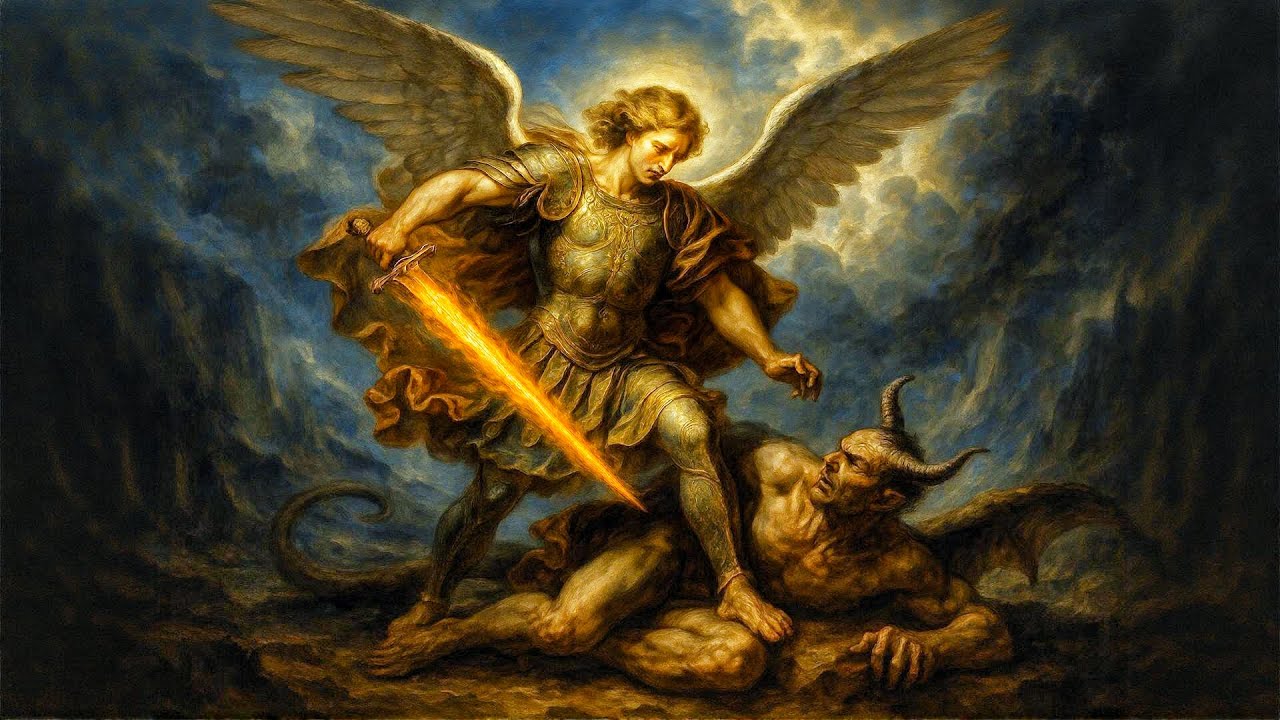
Saint Michael — Defender of God’s People, Protector of the Church, and Warrior Against Evil
Saint Michael the Archangel occupies a unique and powerful place in Catholic devotion.
His name, Michael, comes from the Hebrew Mikha’el, meaning “Who is like God?” It is not merely a name but a proclamation of faith. It expresses the fundamental truth at the heart of every spiritual battle:
No creature is like God.
No power is equal to God.
No darkness can overcome the light of God.
Sacred Scripture presents Michael as a heavenly prince and defender of God’s people. In the Book of Daniel, Michael is described as a great prince who stands in defense of God’s people. In the Letter of Jude, he is explicitly called “the archangel.” In the Book of Revelation, Michael and his angels battle against the dragon, identified as the Devil and Satan.
For Catholics, devotion to St Michael is therefore deeply connected with the reality of spiritual warfare, the protection of the Church, perseverance in faith, and the final victory of Christ over Satan.
But the Catholic understanding of this battle must always begin with an essential truth:
Christ has already won the decisive victory.
Saint Michael is a servant of God. He is not a rival to Satan, and he is certainly not equal to God.
The battle belongs ultimately to God.
1. Who Is Saint Michael?
Saint Michael is one of the three angels whose names are revealed in Sacred Scripture and officially celebrated in the Catholic liturgy:
- Michael
- Gabriel
- Raphael
Michael is explicitly called “the archangel” in Jude 9.
His identity is particularly associated with spiritual combat and the defense of God’s people.
The Book of Daniel presents him as:
“the great prince, guardian of your people.”
In Daniel 10, Michael appears as “one of the chief princes” who comes to assist another heavenly messenger. Daniel 10:21 again associates Michael with the protection of God’s people.
The Book of Revelation presents the most dramatic biblical image of Michael:
“Michael and his angels battled against the dragon.”
The dragon is identified as:
“the Devil and Satan.”
Thus Scripture gives us a consistent picture:
Michael is a heavenly servant of God associated with the defense of God’s people and the defeat of the powers of evil.
2. What Does “Archangel” Mean?
The word archangel means a chief or leading angel.
The Catholic Church teaches that angels are real spiritual creatures.
The Catechism states that the existence of angels is:
“a truth of faith.”
Angels are spiritual, personal and immortal beings endowed with intelligence and will. They are servants and messengers of God.
Michael therefore is not a mythical symbol invented by the Church.
He belongs to the biblical and Catholic understanding of God’s invisible creation.
At the same time, Christians must never put angels on the same level as God.
Angels are creatures.
God alone is Creator.
Angels serve.
God reigns.
Angels obey.
God commands.
Angels worship.
God alone is worthy of worship.
3. The Meaning of the Name “Michael”
The name Michael means:
“Who is like God?”
This question is itself a declaration of faith.
It confronts the temptation that lies at the heart of sin:
“I will be like God.”
The Catechism teaches that the fall of the angels involved a free and irrevocable rejection of God and His Kingdom. The Church identifies Satan and the demons as fallen angels who freely turned away from God.
The spiritual battle therefore concerns much more than spectacular supernatural events.
At its deepest level, the battle is between:
obedience and rebellion,
truth and deception,
humility and pride,
love and hatred,
God’s will and self-will.
Saint Michael’s very name gives us the answer:
Who is like God?
No one.
4. Saint Michael in the Book of Daniel
The first major biblical portrait of Michael appears in the Book of Daniel.
Daniel 10 describes a mysterious spiritual conflict involving heavenly beings.
Michael comes to assist the messenger who speaks with Daniel:
“until finally Michael, one of the chief princes, came to help me.”
Later the angel says:
“No one supports me against these except Michael, your prince.”
Daniel 12 gives an even more explicit description:
“At that time there shall arise Michael, the great prince, guardian of your people.”
The biblical picture is therefore one of heavenly assistance in the midst of spiritual conflict.
5. Saint Michael in the Letter of Jude
The Letter of Jude contains a brief but very important reference:
“Yet the archangel Michael, when he argued with the devil… said, ‘May the Lord rebuke you!’”
This passage teaches something important about spiritual warfare.
Michael does not act independently of God.
He does not say:
“I will defeat you by my own power.”
Instead:
“May the Lord rebuke you!”
This is profoundly Catholic.
The power belongs to God.
The angel serves God’s authority.
The lesson for Christians is equally important:
We do not defeat evil through our own power.
We stand under the authority of God.
6. Saint Michael in the Book of Revelation
The most famous biblical account of Michael is found in Revelation 12.
John sees:
“war… in heaven”
and:
“Michael and his angels battled against the dragon.”
The dragon and his angels are defeated and cast down.
The dragon is explicitly identified as:
“the Devil and Satan.”
This passage has become one of the foundational biblical texts for Catholic devotion to St Michael.
It presents Michael as the commander of the heavenly forces in the struggle against Satan.
But the passage also tells us something even more important.
The victory song that follows speaks of:
“the blood of the Lamb”
and the faithful witness of God’s people.
Therefore the victory over Satan is ultimately connected with Jesus Christ, the Lamb.
Michael serves Christ.
The angels fight under God’s authority.
The victory belongs to God.
7. The Spiritual Battle Is Real
Catholic Christianity does not reduce evil merely to psychology, social structures or human weakness.
The Church teaches the reality of Satan and the fallen angels.
The Catechism states that Satan and the demons were originally created good by God but became evil through their own free and irrevocable choice.
The Church also teaches that Satan’s power is limited.
He is a creature.
He is not God.
He is not omnipotent.
He is not omniscient.
He cannot prevent the establishment of God’s Kingdom.
The Catechism explicitly states:
“The power of Satan is… not infinite.”
This is a crucial Christian truth.
Evil is real, but evil is not ultimate.
Satan is powerful, but Satan is not God.
Darkness exists, but darkness does not have the final word.
8. What Is Spiritual Warfare?
Spiritual warfare is the Christian struggle to remain faithful to God in the midst of temptation, sin, deception, suffering and opposition to the Gospel.
It includes the struggle against:
- temptation,
- pride,
- hatred,
- unforgiveness,
- impurity,
- greed,
- envy,
- discouragement,
- despair,
- falsehood,
- addiction,
- hatred of God,
- hatred of neighbour,
- spiritual indifference,
- and deliberate rejection of God’s truth.
St Paul describes this struggle using military imagery:
“Our struggle is not with flesh and blood, but with… the spiritual forces of evil.”
The Christian therefore needs spiritual armour.
9. The Armour of God
Ephesians 6:10–18 gives Christians the famous image of the Armour of God.
The Christian is called to put on:
The belt of truth
because Satan is associated with deception.
The breastplate of righteousness
because Christian life requires holiness.
Shoes of readiness for the Gospel of peace
because disciples are sent to proclaim Christ.
The shield of faith
because faith extinguishes the “flaming arrows” of the evil one.
The helmet of salvation
because salvation belongs to Christ.
The sword of the Spirit
which is the Word of God.
Prayer
because the Christian cannot win spiritual battles through human strength alone.
This is the context in which devotion to St Michael should be understood.
10. Saint Michael as the Model of the Spiritual Warrior
Michael represents the spiritual warrior who does not fight for personal glory.
He fights in obedience to God.
This is important because Christian spiritual warfare is radically different from worldly warfare.
The Christian does not fight people as enemies to be destroyed.
Our enemies are not:
- our family members,
- our neighbours,
- people who disagree with us,
- people of another religion,
- political opponents,
- difficult parishioners,
- or those who have hurt us.
The spiritual battle is against sin and evil.
The human person remains someone for whom Christ died.
Therefore:
We resist evil without hating people.
This is an essential Christian principle.
11. Saint Michael and the Battle Within
The spiritual battle is not only “out there.”
It takes place within every human heart.
There can be a battle between:
- pride and humility,
- anger and forgiveness,
- lust and purity,
- selfishness and charity,
- greed and generosity,
- despair and hope,
- resentment and mercy,
- self-will and obedience.
In this sense, St Michael becomes a spiritual model.
His name asks us:
Who is like God?
Whenever we place our own desires above God’s will, we need to hear that question again.
12. Michael and the Humility of the Angels
One of the most important lessons of St Michael is humility.
The angel does not seek to replace God.
He serves God.
He does not seek independent glory.
He gives glory to God.
This is precisely the opposite of the rebellion represented by Satan.
The spiritual battle therefore begins with a very simple prayer:
Lord, You are God. I am Your creature.
Your will be done.
This is not weakness.
It is the beginning of spiritual strength.
13. Saint Michael and the Church
Catholic tradition has long regarded St Michael as a special protector of the Church.
This devotion is closely related to his biblical role as defender of God’s people.
The Church herself invokes the assistance of the angels in her liturgy. The Catechism teaches that the Church joins the angels in worship, invokes their assistance and commemorates St Michael, St Gabriel, St Raphael and the guardian angels.
The Church therefore does not regard devotion to St Michael as an optional fascination with supernatural beings.
It belongs within the wider Christian understanding of:
Christ → His Church → the angels → the spiritual struggle of God’s people.
14. Saint Michael and the Protection of the Church
The Church exists in the midst of spiritual opposition.
From the beginning, Christians have faced:
- persecution,
- false teaching,
- division,
- temptation,
- moral corruption,
- hatred,
- violence,
- and rejection of the Gospel.
Yet Christ promised:
“I will build my church, and the gates of Hades shall not prevail against it.”
The Church’s ultimate protection is Christ Himself.
St Michael’s ministry is subordinate to that divine protection.
Thus we can confidently pray:
Saint Michael the Archangel, defend the Church of Christ and help her remain faithful to her Lord.
15. Saint Michael and the Protection of the Faithful
Catholic tradition has frequently invoked St Michael against spiritual evil.
This does not mean that every difficulty is caused by a demon.
Nor does Catholic faith teach that every illness, accident or psychological struggle is demonic.
Discernment is essential.
Nevertheless, because the Church acknowledges the reality of spiritual evil, it is entirely appropriate to pray for protection.
A Christian can simply say:
Saint Michael the Archangel, pray for me and protect me from every spiritual danger.
The power of the prayer is ultimately found in God.
16. Saint Michael and the Hour of Death
Catholic tradition has long associated St Michael with the protection and assistance of the dying.
This is connected with his role as defender and with the Christian hope of salvation.
The Church’s liturgy itself speaks of angelic assistance at death:
“May the angels lead you into Paradise.”
The Catechism explains that the Church invokes angelic assistance in the funeral liturgy.
Catholic art and devotional tradition therefore frequently depict St Michael near the dying or at the moment of judgment.
These images express Christian hope in God’s justice and mercy.
17. Does St Michael Literally Carry Every Soul to Heaven?
A distinction is important here.
There is a longstanding Catholic devotional tradition portraying St Michael as an angel associated with the souls of the departed and with their presentation before God.
He is also frequently depicted holding scales and weighing souls.
However, Catholics should not present every element of this iconography as a defined doctrine of the Catholic Church.
The Church teaches the reality of judgment, salvation, angels and God’s providence.
The particular imagery of Michael personally carrying every soul or literally weighing souls is best understood as traditional devotional and artistic symbolism rather than a dogma that Catholics are required to believe.
The image nevertheless conveys an important spiritual truth:
Every human life ultimately stands before the judgment of God.
And our hope is not in our own perfection.
Our hope is in Jesus Christ, the merciful Judge and Redeemer.
18. Saint Michael and the Last Judgment
Christian art frequently depicts Michael holding scales at the Last Judgment.
One side may represent the weight of a person’s deeds, while the other represents divine judgment.
Such imagery reminds us that our earthly choices matter.
Our actions have eternal significance.
But Catholic theology does not teach salvation by accumulating enough “good points.”
Salvation is God’s grace.
As St Paul teaches, we are saved by grace through faith.
Good works matter because authentic faith works through love.
Therefore the proper response is not fear alone.
It is:
repentance, faith, conversion and perseverance in Christ.
19. Saint Michael and the Defeat of Satan
The biblical image of Michael defeating the dragon has become one of the most powerful images in Christian art.
The dragon represents Satan.
Michael represents the faithful servant of God.
The scene announces that evil will not ultimately prevail.
But Revelation places the victory within the larger victory of Christ.
The dragon is overcome in the context of:
“the blood of the Lamb.”
Therefore the Christian should never become fascinated with Satan.
The Christian looks to Christ.
We do not glorify the enemy.
We glorify the Victor.
20. “Who Is Like God?”
The name Michael can become a daily spiritual weapon.
When pride says:
“I know better than God.”
Michael asks:
“Who is like God?”
When temptation says:
“This sin will make you happy.”
Michael asks:
“Who is like God?”
When despair says:
“There is no hope.”
Michael points toward God.
When fear says:
“Evil will win.”
Michael reminds us:
God is Lord.
When we are tempted to trust ourselves completely:
Who is like God?
This simple question can become a prayer.
21. Saint Michael and the Sacred Name of Jesus
St Michael’s mission is never independent of Jesus.
The angels serve Christ.
The Catechism teaches that Christ is the centre of the angelic world and that the angels belong to Him because they were created through Him and for Him.
Therefore a Christian should never think:
“Michael will save me.”
Rather:
“Christ is my Saviour, and Saint Michael is God’s servant who assists His people.”
This distinction protects Catholic devotion from superstition.
22. The Prayer to Saint Michael
The most famous Catholic prayer to St Michael begins:
“Saint Michael the Archangel, defend us in battle.”
It continues by asking Michael to be our defense against:
- the wickedness of the Devil,
- the snares of the Devil,
- Satan,
- and the evil spirits seeking the ruin of souls.
The prayer concludes by asking that evil be cast down by the power of God.
That final point is crucial.
The prayer does not teach that Michael possesses divine power independently.
It asks Michael to act:
“by the power of God.”
The Holy See itself reproduced the prayer of Leo XIII in 2018 when Pope Francis called for the faithful to pray for the protection of the Church from the attacks of the devil.
23. The Prayer of Pope Leo XIII
The prayer became especially associated with Pope Leo XIII.
It was used in connection with the prayers traditionally known as the Leonine Prayers after Low Mass.
The traditional prayer is:
Saint Michael the Archangel, defend us in battle.
Be our defense against the wickedness and snares of the Devil.
May God rebuke him, we humbly pray;
and do thou, O Prince of the heavenly hosts,
by the power of God,
thrust into hell Satan and all the evil spirits
who prowl about the world seeking the ruin of souls.
Amen.
The Holy See published this prayer in 2018 in connection with Pope Francis’s appeal for prayer for the Church’s protection.
24. How Should Catholics Pray the Prayer to Saint Michael?
It should be prayed with:
Faith
Trusting in God rather than magical formulas.
Humility
Recognizing that God alone is Lord.
Repentance
Rejecting sin in our own lives.
Perseverance
Remaining faithful when temptation becomes difficult.
Charity
Refusing to hate people.
Confidence in Christ
Remembering that Christ has already conquered sin and death.
25. The Chaplet of Saint Michael
Another traditional devotion is the Chaplet of Saint Michael the Archangel.
It contains nine salutations corresponding to the traditional nine choirs of angels.
The chaplet is a devotional practice rather than a required element of Catholic faith.
It can be prayed as a way of honouring the angels and asking for their intercession.
As with all Catholic devotions, its purpose should be to deepen Christian faith and lead the believer toward God.
26. Saint Michael and the Nine Choirs of Angels
Catholic tradition commonly speaks of nine choirs of angels:
- Seraphim
- Cherubim
- Thrones
- Dominions
- Virtues
- Powers
- Principalities
- Archangels
- Angels
This classification is especially associated with the Christian tradition represented by writers such as Pseudo-Dionysius and later developed by theologians including St Thomas Aquinas.
The Chaplet of St Michael incorporates this traditional angelic structure.
It should be understood as theological and devotional tradition rather than as a list of dogmas individually defined by the Church.
27. Saint Michael and the Guardian Angels
St Michael should not be confused with our personal guardian angels.
Catholic teaching holds that human beings are assisted by guardian angels.
The Catechism says:
“From infancy to death human life is surrounded by their watchful care and intercession.”
It also describes the guardian angel as a protector and shepherd leading the believer toward life.
St Michael has a different role in Christian tradition.
He is associated especially with:
- spiritual combat,
- defense of God’s people,
- protection of the Church,
- and the defeat of the powers of evil.
Thus:
Guardian Angel — personal spiritual guardian
Saint Michael — archangel associated with heavenly defense and spiritual warfare
Both ultimately serve God’s providence.
28. Saint Michael and Mary, Queen of Angels
Catholic tradition gives the Blessed Virgin Mary a unique place among God’s creatures.
Mary is honoured as Queen of Angels.
This does not mean that Mary is an angel.
She is fully human, the Mother of Jesus Christ and a unique participant in God’s plan of salvation.
The angels serve God’s will, and Mary perfectly responded:
“Let it be done to me according to your word.”
The humility of Mary and the humility represented by Michael belong together.
Both point away from self and toward God.
29. Saint Michael and the Holy Eucharist
The Church’s Eucharistic worship is surrounded by angelic imagery.
The Catechism teaches that in the liturgy the Church joins with the angels in adoring the thrice-holy God.
This gives a beautiful perspective on Holy Mass.
When we enter a church and approach the altar, we are not merely attending a human gathering.
We are participating in the worship of heaven.
The angels adore Christ.
We adore Christ.
The saints adore Christ.
The entire heavenly Church directs its worship toward God.
30. Saint Michael and Confession
Spiritual warfare cannot be separated from repentance.
If we are asking St Michael to defend us from evil while deliberately holding on to serious sin, we have misunderstood the battle.
The Christian’s greatest defense is life in Christ.
That means:
- regular Confession,
- faithful reception of the Eucharist,
- prayer,
- Scripture,
- fasting,
- charity,
- forgiveness,
- obedience to God’s commandments.
The sacramental life is far more important than fascination with extraordinary spiritual experiences.
31. Saint Michael and the Sacrament of Reconciliation
When a Christian goes to Confession, he is not merely trying to feel better.
He is turning away from sin and returning to God.
This is a decisive act in spiritual warfare.
The enemy seeks separation from God.
Christ restores communion.
Therefore every sincere Confession is a victory of grace.
A powerful prayer before Confession can be:
Saint Michael the Archangel, help me to reject sin, overcome shame, speak the truth honestly, and return to Christ with a sincere heart.
32. Saint Michael and Spiritual Protection in the Family
Families can invoke St Michael together.
Parents may teach children:
“Saint Michael the Archangel, protect our family and help us remain close to Jesus.”
A family Rosary may conclude with the Prayer to St Michael.
Families may also pray for:
- peace in the home,
- protection from hatred,
- freedom from addiction,
- healing of divisions,
- perseverance in faith,
- protection of children,
- strength in suffering,
- and fidelity to Christ.
The prayer should always be directed toward God.
33. Saint Michael and Young People
Young people today encounter many spiritual challenges:
- pornography,
- addiction,
- online manipulation,
- bullying,
- hatred,
- materialism,
- despair,
- loneliness,
- false ideologies,
- and the pressure to conform.
The Christian response is not fear.
It is formation.
Young Catholics need:
- Christ,
- Scripture,
- Eucharist,
- Confession,
- prayer,
- wise friendships,
- good parents and mentors,
- healthy discipline,
- and a strong Catholic community.
St Michael can become a symbol of courageous fidelity:
Stand for Christ.
Reject evil.
Choose truth.
Remain faithful.
34. Saint Michael and Priests
Priests have a particular responsibility to protect the flock entrusted to them.
They are called to:
- preach the Gospel,
- celebrate the Sacraments,
- forgive sins,
- teach the faith,
- defend truth,
- care for the wounded,
- and lead people toward Christ.
Prayer to St Michael can therefore be offered for priests.
Saint Michael the Archangel, protect our priests. Give them courage, purity, wisdom, humility and fidelity to Christ. Defend them from temptation and strengthen them in their ministry.
35. Saint Michael and the Mission of the Church
The Church’s mission is not merely institutional.
She exists to proclaim Jesus Christ.
Every parish, priest, religious community, catechist, missionary and Catholic family participates in this mission.
Because the Gospel encounters spiritual resistance, the Church needs prayer.
St Michael can therefore be invoked for:
- missionaries,
- evangelization,
- catechists,
- seminaries,
- vocations,
- religious communities,
- families,
- youth ministry,
- and persecuted Christians.
36. Saint Michael and Christians Suffering Persecution
Throughout history Christians have suffered because of their faith.
The Book of Revelation itself presents the Church in conflict with the dragon and its powers. The biblical imagery points to a Church that must remain faithful amid opposition.
Catholics may therefore pray:
Saint Michael, defender of God’s people, strengthen persecuted Christians and obtain for them courage, perseverance and faithfulness to Christ.
37. Spiritual Warfare Does Not Mean Fighting People
This point deserves special emphasis.
A Christian should never use devotion to St Michael to justify hatred or violence against another person.
The Christian battle is not:
“Me against that person.”
It is:
“Christ helping me resist sin and evil.”
Even when someone harms us, Christ commands us to love our enemies and pray for those who persecute us.
Therefore:
Reject the sin.
Forgive the sinner.
Protect the innocent.
Seek justice when necessary.
Pray for conversion.
Remain faithful to Christ.
38. Do Not Become Obsessed with the Devil
Catholic teaching recognizes Satan as real.
But Christianity is not Satan-centred.
A person who constantly thinks about demons, curses, supernatural attacks and evil manifestations can lose sight of the Gospel.
The proper focus is:
Jesus Christ.
The Cross.
The Resurrection.
The Eucharist.
The Word of God.
The Holy Spirit.
Prayer.
Charity.
Holiness.
St Michael points us toward this victory.
39. Not Every Problem Is Demonic
This is particularly important pastorally.
Illness is not automatically demonic.
Depression is not automatically demonic.
Family conflict is not automatically demonic.
Financial difficulty is not automatically demonic.
A psychological condition is not automatically demonic.
An accident is not automatically demonic.
A bad dream is not automatically demonic.
The Church calls for prudence and discernment.
We should use appropriate medical, psychological, pastoral and practical help when necessary.
Prayer and ordinary human assistance are not opposites.
God can work through both.
40. The Christian Response to Evil
When confronted by evil, the Christian response should include:
Prayer
Sacraments
Scripture
Fasting
Forgiveness
Truth
Charity
Prudence
Community
Spiritual direction
Perseverance
And above all:
Jesus Christ.
41. Saint Michael and the Victory of Christ
The most important truth about spiritual warfare is not that demons exist.
It is that Christ has conquered them.
The Catechism teaches that the Son of God came to destroy the works of the devil and that Satan cannot prevent the building of God’s Kingdom.
Therefore the Christian does not enter spiritual battle as someone wondering who will win.
The Christian fights from the hope of Christ’s victory.
The Cross appeared to be defeat.
The Resurrection revealed the victory.
42. Saint Michael’s Battle Is Ultimately God’s Battle
Michael’s battle is not a contest between two independent supernatural powers.
God alone is sovereign.
Michael is a creature.
Satan is a creature.
Neither can challenge God as an equal.
The spiritual hierarchy is therefore clear:
God — Creator and Lord
↓
Jesus Christ — victorious Redeemer and Lord
↓
Holy Spirit — Sanctifier
↓
Angels — servants of God
↓
Human beings — called to salvation
The devil has no place outside God’s sovereignty.
43. A Catholic Prayer for Protection
Saint Michael the Archangel,
powerful servant of the Most High God,
defender of God’s people and faithful prince of the heavenly hosts,
stand beside us in the spiritual battles of our lives.
Protect our families from hatred and division.
Protect our children from every danger that leads them away from Christ.
Protect our young people from temptation, addiction, impurity and despair.
Protect our homes from fear and violence.
Protect our priests, religious and missionaries.
Protect the Church from every attack against her faith and mission.
Help us recognize the difference between truth and deception.
Help us reject pride and choose humility.
Help us reject hatred and choose charity.
Help us reject sin and choose holiness.
When we are tempted, strengthen us.
When we are afraid, remind us that God is greater than every power of darkness.
When we fall, lead us toward repentance.
When we suffer, help us remain faithful.
When evil appears strong, remind us that Christ has already conquered sin and death.
Pray for us, Holy Michael.
But above all, lead us to Jesus Christ.
May we never put our trust in creatures more than in the Creator.
May our hearts belong entirely to Christ.
May the Lord rebuke Satan and restrain every power that seeks the ruin of souls.
Through the intercession of the Blessed Virgin Mary, Queen of Angels, and through the ministry of all the holy angels, may we remain faithful to God until the end.
Saint Michael the Archangel, pray for us.
Amen.
44. The Traditional Prayer to Saint Michael
Saint Michael the Archangel, defend us in battle.
Be our defense against the wickedness and snares of the Devil.
May God rebuke him, we humbly pray;
and do thou, O Prince of the heavenly hosts,
by the power of God,
thrust into hell Satan and all the evil spirits
who prowl about the world seeking the ruin of souls.
Amen.
The prayer is traditionally associated with Pope Leo XIII and the Leonine Prayers. The Holy See has continued to publish and recommend this prayer in appropriate contexts, including Pope Francis’s 2018 appeal for prayer for the protection of the Church.
45. A Short Prayer to Saint Michael for Daily Use
Saint Michael the Archangel,
defend me today in my spiritual battles.
Protect my mind from falsehood,
my heart from hatred,
my body from sin,
my family from division,
and my soul from everything that separates me from God.
Help me to stand firm in faith,
strong in hope,
and faithful in love.
Lead me closer to Jesus.
Saint Michael the Archangel, pray for me.
Amen.
46. A Prayer for Families
Saint Michael the Archangel,
watch over our family.
Protect our home from hatred, violence, division and every influence that would draw us away from God.
Help husbands and wives to remain faithful.
Help parents to guide their children wisely.
Protect our children and young people.
Help those struggling with addiction, temptation or despair.
Bring peace where there is conflict.
Bring forgiveness where there is resentment.
Bring faith where there is doubt.
Bring hope where there is fear.
May our home always belong to Jesus Christ.
May Mary, Queen of Angels, intercede for us.
May our guardian angels accompany us.
And may Saint Michael defend us in every spiritual battle.
Amen.
47. A Prayer for the Church
Saint Michael the Archangel, defender of God’s people,
intercede for the Church throughout the world.
Protect the Pope, bishops, priests, deacons, religious and laity.
Strengthen missionaries.
Protect seminarians and those discerning their vocation.
Encourage families.
Strengthen young people.
Defend persecuted Christians.
Protect the Church from falsehood, division, scandal and every spiritual attack.
Help the Church proclaim Jesus Christ faithfully.
May every member of the Church remain united to Christ.
May the gates of hell never prevail against the Church founded by our Lord.
Saint Michael the Archangel, pray for us.
Amen.
48. Seven Spiritual Lessons from Saint Michael
1. Humility
Michael’s name reminds us that God alone is God.
2. Courage
The Christian must not surrender to fear.
3. Truth
Spiritual warfare includes resisting deception.
4. Purity
We are called to keep our hearts directed toward God.
5. Obedience
Michael serves God’s will rather than his own.
6. Perseverance
The Christian must remain faithful even during trials.
7. Hope
The final victory belongs to Christ.
49. A Practical Spiritual Battle Plan
When facing a serious spiritual struggle, a Catholic can follow a simple pattern.
1. Turn to Jesus.
Say:
“Jesus, I trust in You.”
2. Reject the temptation.
Do not negotiate with sin.
3. Pray.
Invoke God, Mary, St Michael and your guardian angel.
4. Use Scripture.
Read the Word of God.
5. Examine your conscience.
Ask whether there is something that needs repentance.
6. Go to Confession.
When appropriate, receive the Sacrament of Reconciliation.
7. Receive the Eucharist worthily.
Remain close to Christ.
8. Seek wise help.
Speak with a trustworthy priest or spiritual director.
9. Address practical causes.
If there is addiction, abuse, psychological suffering or another serious difficulty, seek appropriate professional assistance.
10. Persevere.
Do not surrender because temptation returns.
50. Saint Michael and the Christian at the Hour of Temptation
When temptation comes, a short prayer can be enough:
“Jesus, save me.”
Then:
“Saint Michael the Archangel, pray for me.”
Then:
“Mary, Mother of God, pray for me.”
Then turn away from the temptation.
Christianity is not about memorizing complicated formulas.
Sometimes the most powerful prayer is simply:
“Jesus.”
51. Saint Michael and the Final Victory
The story of Scripture ends not with Satan’s victory but with God’s triumph.
Revelation presents the defeat of the dragon and ultimately the fulfillment of God’s Kingdom.
The Christian therefore lives in hope.
We may face:
- temptation,
- suffering,
- persecution,
- confusion,
- failure,
- grief,
- illness,
- and death.
But none of these has the final word.
Christ does.
And St Michael’s biblical image reminds us that God’s heavenly servants participate in His victorious plan.
52. Conclusion: Who Is Like God?
The deepest meaning of Saint Michael’s name is also the deepest lesson of spiritual warfare.
Who is like God?
Not Satan.
Not evil.
Not death.
Not suffering.
Not temptation.
Not fear.
Not any human power.
Not any spiritual creature.
Only God is God.
The Christian therefore does not need to live in terror of darkness.
We live in the light of Christ.
Saint Michael reminds us to stand firm.
The guardian angels remind us that God has not abandoned us.
The saints remind us that holiness is possible.
Mary reminds us to say yes to God.
The Church gives us the Sacraments.
The Scriptures give us God’s Word.
And Jesus Christ gives us the victory.
The spiritual battle is real, but the Christian’s hope is greater than the battle.
“Who is like God?”
The answer is:
No one.
And therefore our final prayer is not:
“I am strong enough.”
It is:
“Lord Jesus Christ, I trust in You.”
Saint Michael the Archangel, defend us in battle.
Pray for the Church.
Pray for our families.
Pray for our priests.
Pray for those struggling against temptation.
Pray for the dying.
Pray for the souls of the faithful departed.
And lead us always toward Jesus Christ, the Victor over sin, Satan and death.
Amen.
Sacred Scripture References
For further meditation, the principal biblical passages concerning Saint Michael and spiritual warfare include:
- Daniel 10:13–21 — Michael as one of the chief heavenly princes.
- Daniel 12:1 — Michael as the great prince and guardian of God’s people.
- Jude 9 — Michael the Archangel and his confrontation with the devil.
- Revelation 12:7–12 — Michael and his angels battle the dragon.
- Ephesians 6:10–18 — the Armour of God.
- Matthew 4:1–11 — Christ’s temptation by Satan.
- Luke 10:17–20 — Christ’s disciples rejoice that demons are subject to them.
- 1 Peter 5:8–9 — vigilance against the adversary.
- 1 John 3:8 — Christ came to destroy the works of the devil.
- Romans 8:31–39 — nothing can separate us from the love of Christ.
Catholic Teaching: Important Points to Remember
The Catholic Church teaches that:
- Angels truly exist as spiritual creatures.
- Angels are created by God and are not divine.
- Satan and the demons are fallen angels who freely rejected God.
- Satan’s power is limited.
- Christ has conquered the power of sin and death.
- The Church invokes the assistance of angels.
- St Michael is explicitly named in Scripture as an archangel.
- Scripture associates Michael with the defense of God’s people and with the defeat of the dragon.
- Devotion to St Michael should lead Christians toward Christ, not toward superstition.
- The Church’s spiritual warfare is fundamentally a struggle for fidelity to God.
- Catholics should resist evil without hatred toward persons.
- Prayer, the Sacraments, Scripture, repentance and charity are central weapons in Christian spiritual life.
Sources for Further Study
Catechism of the Catholic Church, §§328–336 — the existence, nature and ministry of angels.
Catechism of the Catholic Church, §§391–395 — the fall of the angels, Satan and the limits of diabolical power.
Compendium of the Catechism, §§60–61 — angels and their role in the life of the Church.
Daniel 10; 12 — Michael as a heavenly prince and guardian of God’s people.
Jude 9 — Michael the Archangel and the devil.
Revelation 12:7–12 — Michael and his angels battling the dragon.
Holy See, 2018 — publication of Pope Leo XIII’s Prayer to Saint Michael in the context of Pope Francis’s call for prayer for the Church.
Leave a Reply