
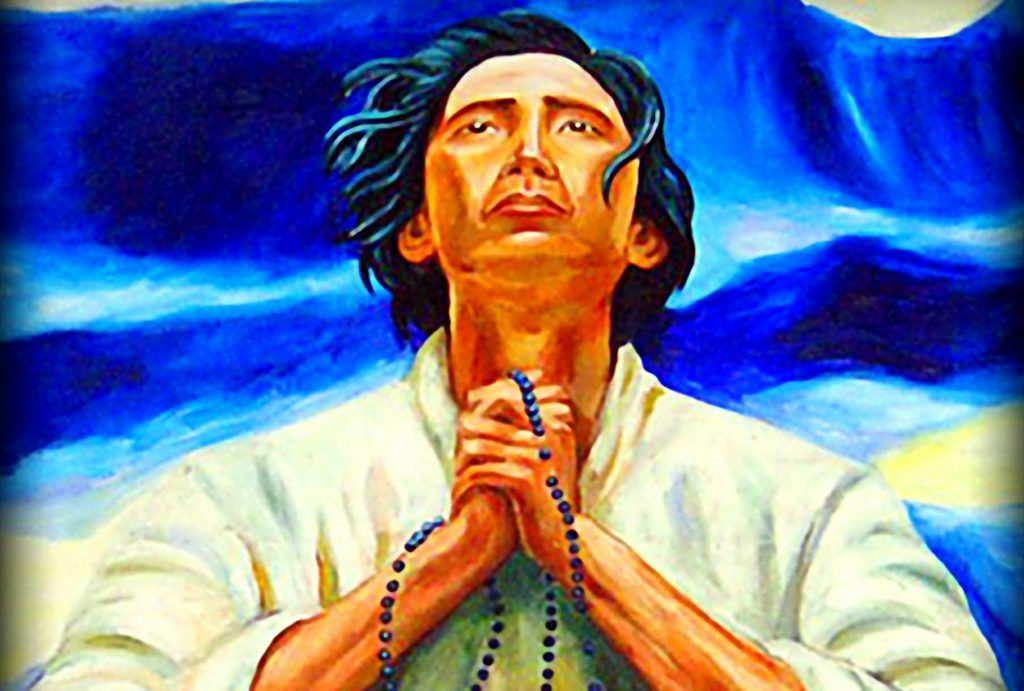
Saint Lorenzo Ruiz of Manila
First Filipino Saint and Martyr
Feast Day: September 28
Born: c. 1594, Manila, Philippines
Died: September 29, 1637, Nagasaki, Japan
Canonized: October 18, 1987, by Pope John Paul II
Patron: The Philippines; altar servers; overseas Filipino workers; people falsely accused; and those who remain faithful in times of persecution
Saint Lorenzo Ruiz of Manila is one of the most beloved saints of the Philippines. A husband, father, catechist, and layman, he was falsely accused of murder and eventually joined Dominican missionaries traveling to Japan. There he faced imprisonment, torture, and the demand that he renounce the Christian faith. He remained faithful to Christ until his death.
Lorenzo Ruiz became the first Filipino to be canonized a saint. His life is a powerful testimony that holiness is not reserved for priests and religious. A layperson with a family, ordinary work, and ordinary responsibilities can become a great witness to Christ.


Early Life in Manila
Lorenzo Ruiz was born in Manila around 1594, during the period of Spanish rule in the Philippines. He was born into a Christian family and received his Catholic formation in Manila.
According to traditional accounts, his father was Chinese and his mother was Filipino. Lorenzo grew up in an environment in which different cultures and languages met, and this background later became significant when he accompanied missionaries to Japan.
He served as an altar server and later worked as a parish clerk and calligrapher. His work brought him into close contact with the Church and with the Dominican missionaries in Manila.
Lorenzo eventually married and became the father of a family.
This is an important part of his story.
He was not a priest.
He was not a monk.
He was not a bishop.
He was a lay Catholic, a husband and a father.
His holiness grew in the midst of ordinary family and professional responsibilities.
A Faithful Husband and Father
Lorenzo married and had children. His vocation as a husband and father was an important part of his life before martyrdom.
The Church’s recognition of Lorenzo Ruiz therefore has a special message for Catholic families.
Holiness can be lived:
- in marriage;
- in raising children;
- in ordinary employment;
- in parish service;
- in friendship;
- in daily prayer;
- and in moments of great difficulty.
Saint Lorenzo shows that an ordinary Christian life can become an extraordinary witness when it is rooted in Christ.
His Service to the Church
Lorenzo served as a confraternity member and church clerk, assisting the Dominican community in Manila.
He was associated with the Dominican Order and participated actively in the religious life of his community.
His ability to write and his familiarity with the Church made him useful in parish ministry.
Before his martyrdom, therefore, Lorenzo had already spent years serving the Church in simple ways.
His life reminds us that God can use seemingly small acts of service for His purposes.
A person who serves quietly in a parish may never become famous.
But God sees the heart.
A Sudden Crisis
Around 1636, Lorenzo’s peaceful family life was suddenly disrupted.
He became involved in a serious criminal accusation. According to traditional accounts, he was accused of involvement in the death of a Spanish man.
Fearing arrest and believing that he would not receive a fair trial, Lorenzo sought refuge with Dominican missionaries who were preparing to travel to Japan.
He left Manila with them.
At first, he intended to find safety.
Instead, he was being led toward martyrdom.
Journey to Japan
The missionaries traveled to Japan at a time when Christianity was facing severe persecution.
Christian missionaries had entered Japan during the sixteenth century, and many Japanese people had embraced the Catholic faith. But political and religious circumstances eventually led authorities to prohibit Christianity and persecute missionaries and Christians.
By the time Lorenzo arrived, the situation was extremely dangerous.
The missionaries knew that they might be arrested.
Lorenzo himself had the opportunity to turn back.
Instead, he continued.
This decision would change his life forever.
Arrest and Imprisonment
After arriving in Japan, Lorenzo and his companions were eventually arrested.
They were imprisoned and subjected to severe interrogation.
The authorities demanded that they renounce Christianity.
Lorenzo was given an opportunity to save his life by abandoning his faith.
He refused.
His response has become one of the most famous statements associated with his martyrdom:
“I am a Christian and wholeheartedly do I accept death for God; had I a thousand lives, all these to Him shall I offer.”
The exact wording varies among translations and historical retellings, but the tradition preserves the essential meaning of his declaration: Lorenzo chose fidelity to Christ rather than saving his life through apostasy.
The Martyrs of Nagasaki
Lorenzo Ruiz was not alone.
He suffered martyrdom together with several Dominican missionaries and Japanese Christians.
The group included:
- Saint Antonio González, Dominican priest
- Saint Guillermo Courtet, Dominican priest
- Saint Miguel de Aozaraza, Dominican priest
- Saint Vicente Shiwozuka de la Cruz, Dominican priest
- Saint Lorenzo Ruiz, lay Filipino
- Saint Lazaro of Kyoto, a Japanese lay catechist associated with the group
They are remembered together among the Martyrs of Nagasaki.
Their witness demonstrates the universality of the Church.
They came from different places and backgrounds, yet they were united by one faith in Jesus Christ.
Torture and Martyrdom
Lorenzo and his companions endured imprisonment and torture.
One of the cruelest methods used against them was the tsurushi, sometimes called the “gallows and pit” method. The victim was suspended upside down over a pit, often with ropes around the body and a board or restraint preventing movement.
The suffering could continue for a prolonged period.
The martyrs were repeatedly pressured to renounce Christ.
They refused.
Lorenzo died in Nagasaki on September 29, 1637.
He was approximately forty years old.
His death transformed the Filipino Christian memory of martyrdom.
A man who had left Manila seeking safety became the first Filipino martyr recognized universally by the Catholic Church as a saint.
“I Am a Christian”
One of the central themes of Lorenzo Ruiz’s life is his Christian identity.
He was a Filipino.
He was married.
He was a father.
He was a worker.
He was a parish servant.
He was falsely accused.
He was an immigrant in another land.
But when confronted with the ultimate question of his identity, his faith in Christ stood at the center.
The traditional account of his final testimony expresses this conviction:
“I am a Christian.”
For Lorenzo, Christianity was not merely a cultural identity.
It was a relationship with Jesus Christ for which he was prepared to sacrifice everything.
The First Filipino Saint
Saint Lorenzo Ruiz was beatified by Pope John Paul II on February 18, 1981, during the Pope’s pastoral visit to the Philippines.
He was canonized by Pope John Paul II on October 18, 1987, in Rome.
He became the first Filipino saint.
His canonization was a historic moment for the Catholic Church in the Philippines and for Filipino Catholics throughout the world.
During the canonization, Lorenzo was presented as a model of Christian faithfulness and martyrdom.
A Saint for Filipino Catholics
Saint Lorenzo Ruiz holds a particularly important place in Filipino Catholic spirituality.
His image can be found in churches and homes throughout the Philippines. Parishes, schools, organizations and communities have been placed under his patronage.
His story has also traveled far beyond the Philippines because millions of Filipinos live and work in other countries.
Lorenzo’s own journey—from Manila to Japan—makes his story especially meaningful to people who leave their homeland in search of work, safety or a better future.
Saint Lorenzo Ruiz and Migrant Workers
Today many Filipinos live outside the Philippines.
They work as nurses, caregivers, teachers, engineers, seafarers, domestic workers, professionals and in countless other occupations.
Saint Lorenzo Ruiz can be an important spiritual companion for them.
He knew what it meant to leave his homeland.
He experienced uncertainty.
He lived in a foreign country.
He faced circumstances he could not control.
And he remained faithful to God.
His example encourages Christians living far from home to remember that physical distance from one’s homeland does not mean distance from God.
Wherever we are, Christ is with us.
A Saint for Families
Lorenzo was a husband and father before becoming a martyr.
This makes his witness particularly meaningful for Catholic families.
Parents sometimes wonder whether ordinary family life can really become a path to holiness.
Saint Lorenzo answers through his life:
Yes.
Holiness begins with fidelity to the responsibilities God has already entrusted to us.
A father can become holy by loving his family faithfully.
A mother can become holy through sacrificial love.
Children can grow in holiness through obedience and prayer.
Families can become places where Christ is encountered every day.
Courage in Times of Fear
Lorenzo did not begin his journey expecting to become a martyr.
His circumstances changed unexpectedly.
He was afraid.
He faced accusations.
He left his homeland.
He encountered persecution.
Yet when the decisive moment arrived, he found courage in Christ.
This is an important lesson.
Christian courage does not necessarily mean that we never experience fear.
Courage means remaining faithful even when we are afraid.
Saint Lorenzo’s life reminds us that grace can give strength beyond what we think we possess.
Faith Under Persecution
The martyrdom of Lorenzo Ruiz belongs to the larger history of Christian persecution in Japan.
Many Christians suffered and died during periods when Christianity was prohibited.
The Church remembers these martyrs because they remained faithful to Christ despite pressure to abandon their faith.
Their testimony raises an important question for Christians today:
What does my faith mean to me when following Christ becomes difficult?
Most Christians will never face the physical persecution experienced by Lorenzo.
But Christians can still experience pressure because of their faith.
There may be ridicule, misunderstanding, discrimination, social pressure or professional difficulties.
Saint Lorenzo encourages Christians to remain faithful without hatred toward those who oppose them.
Lorenzo Ruiz and Forgiveness
The Christian martyr does not seek revenge.
Lorenzo’s witness is ultimately about fidelity to Christ rather than hatred of his persecutors.
Jesus Himself prayed for His executioners:
“Father, forgive them; for they know not what they do.”
— Luke 23:34
The martyr follows Christ not only in suffering but also in love.
The victory of Christian martyrdom is therefore not the destruction of an enemy.
It is the triumph of faithful love.
Saint Lorenzo Ruiz and the Eucharist
Lorenzo was deeply connected with the sacramental life of the Church through his service as a parish worker.
His martyrdom can be understood in the light of the Eucharist.
At every Mass, Christ gives Himself completely to the Father for the salvation of the world.
The Christian who receives the Eucharist is invited to become a person of self-giving love.
Lorenzo ultimately gave his life because he believed that Christ was worth more than earthly security.
His martyrdom reminds us that Christian discipleship means learning to say:
“Lord, my life belongs to You.”
What Saint Lorenzo Ruiz Teaches Us
1. Holiness is possible for ordinary people
Lorenzo was a layman, husband and father.
His life demonstrates that ordinary Christians are called to holiness.
2. Family life can be a path to sainthood
Marriage and parenthood did not prevent Lorenzo from becoming a saint.
They were part of the life in which he served God.
3. Faith requires courage
When his faith was tested, Lorenzo remained faithful.
4. We should not allow fear to make our decisions for us
Lorenzo experienced fear and uncertainty, yet eventually placed his life in God’s hands.
5. We can serve God through ordinary work
His service as a parish clerk may have appeared simple, but it became part of his Christian vocation.
6. God can transform suffering into witness
Lorenzo’s imprisonment and death became a testimony that continues to inspire Christians.
7. Christian identity must be lived
It is not enough to call ourselves Christians.
Our lives should demonstrate our faith through prayer, charity, forgiveness and fidelity.
Saint Lorenzo Ruiz for the Modern World
The life of Saint Lorenzo Ruiz speaks powerfully to the modern Christian.
We live in a world where people frequently change countries, careers and circumstances.
Families may be separated by migration.
Young people may struggle with questions about identity.
Christians may sometimes feel pressure to hide their faith.
Many people experience false accusations or situations they cannot control.
Lorenzo tells us that our deepest identity is found in Christ.
Our circumstances can change.
Our country can change.
Our occupation can change.
Our social position can change.
But Christ remains faithful.
Saint Lorenzo Ruiz and the Cross
The Cross stands at the center of Lorenzo’s story.
He followed Christ through suffering and death.
But the Cross is never the final word.
The Resurrection is.
Christian martyrdom is therefore not a celebration of death itself. It is a witness to the hope that death does not have the final victory.
Saint Lorenzo Ruiz died because he refused to deny Christ.
The Church celebrates him because his life points beyond death toward eternal life.
A Prayer to Saint Lorenzo Ruiz
Saint Lorenzo Ruiz,
faithful servant of Jesus Christ,
pray for us.
You who lived as a faithful husband and father,
pray for our families.
You who served the Church in humble ways,
teach us to serve God faithfully in our daily duties.
You who left your homeland,
pray for migrants, travelers, workers and all who live far from their families.
You who endured false accusations,
pray for those who suffer injustice and misunderstanding.
You who faced persecution,
give courage to Christians who struggle because of their faith.
You who remained faithful to Christ until death,
help us never to abandon our Lord.
When we are afraid, strengthen us.
When we are discouraged, encourage us.
When we are tempted to compromise our faith,
remind us of the eternal treasure we have in Christ.
Saint Lorenzo Ruiz,
first Filipino saint and martyr,
pray for the Philippines,
pray for Filipino families throughout the world,
and pray for the whole Church.
May we remain faithful to Jesus
in good times and in difficult times.
Saint Lorenzo Ruiz of Manila, pray for us.
Amen.
Conclusion
Saint Lorenzo Ruiz began life as an ordinary Christian in Manila. He worked, married, raised a family and served his parish. Nothing about his early life suggested that he would become one of the most celebrated Christian martyrs in Philippine history.
Yet when his faith was tested, he remained faithful.
His journey from Manila to Nagasaki became a journey from ordinary Christian service to heroic witness.
He reminds us that sainthood is not reserved for famous people, clergy or religious. A husband can become a saint. A father can become a saint. A worker can become a saint. A layperson can become a saint.
Saint Lorenzo Ruiz teaches us to place Christ above fear, above earthly security and above every temporary difficulty.
His life can be summed up in the spirit of his famous testimony:
I am a Christian. My life belongs to Christ.
May Saint Lorenzo Ruiz help us to live our Christian faith with courage, humility and love.
Saint Lorenzo Ruiz of Manila, first Filipino saint and martyr, pray for us!
Feast Day
September 28
Canonization
October 18, 1987 — Pope John Paul II
Patronage
The Philippines, altar servers, overseas Filipino workers, and those who suffer false accusations
Biblical Reflection
“Be faithful unto death, and I will give you the crown of life.”
— Revelation 2:10
Leave a Reply