
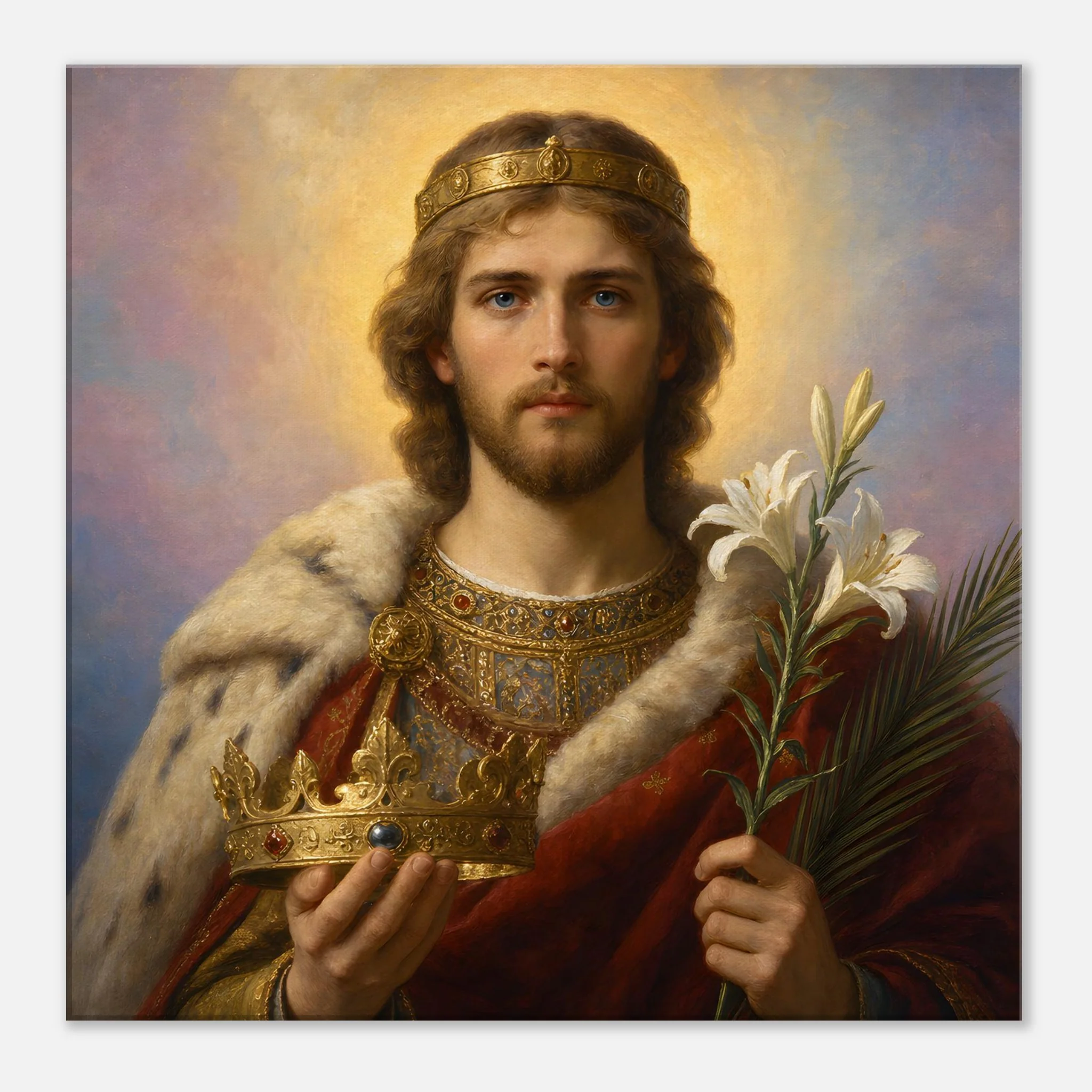
Duke, Martyr and Patron of the Czech Nation
Feast Day: September 28
Born: c. 907
Died: September 28, 935
Also known as: St Wenceslaus, St Václav
Patron: Bohemia and the Czech nation
State in life: Duke and martyr
Saint Wenceslaus of Bohemia was a Christian ruler whose life united faith, charity, courage and responsibility. He was a young prince who sought to govern his people according to the Gospel and who ultimately gave his life for Christ. His feast is celebrated on September 28, and he is honored as the patron saint of the Czech nation.
Pope Benedict XVI, celebrating the memorial of Saint Wenceslaus in Stará Boleslav in 2009, presented him as a model of holiness particularly for those who exercise responsibility over communities and peoples. The Pope emphasized that Wenceslaus preferred the kingdom of heaven to the attraction of worldly power.
Early Life
Wenceslaus was born in Bohemia at the beginning of the tenth century, probably around 907. He was the son of Duke Vratislaus I and Drahomira. His grandmother was Saint Ludmila, one of the earliest important Christian figures in Bohemia.
Wenceslaus was raised under the influence of his grandmother, who gave him a strong Christian education. Saint Ludmila herself had received Christianity together with her husband, Duke Borivoj, and became an important figure in the Christianization of Bohemia.
The Christian faith that Wenceslaus received in his youth became the foundation of his life. His education was not merely intellectual. He was taught to live according to the Gospel through prayer, self-discipline, charity and service.
This formation would later influence the way he exercised political authority.
A Young Prince Shaped by Christian Faith
Wenceslaus’ father died while he was still young. His mother, Drahomira, initially acted as regent. During this period, tensions existed between Christian and pagan elements within Bohemian society.
Wenceslaus eventually assumed responsibility for the government of the duchy. He sought to strengthen Christianity and to establish peaceful and orderly relations with neighboring peoples.
According to traditional accounts, he supported priests, encouraged the building and decoration of churches, and worked to strengthen Christian life in his territory. The Catholic Encyclopedia records that he introduced German priests and supported the Latin Christian tradition in Bohemia.
His Christian faith was therefore not something separated from his public responsibilities. He tried to allow the Gospel to influence his decisions as a ruler.
A Ruler Who Served the Poor
One of the most beautiful aspects of the traditional memory of Saint Wenceslaus is his concern for people who were poor and vulnerable.
Pope Benedict XVI, in his 2009 homily, referred to early accounts describing Wenceslaus as someone who assisted ministers of the Church, cared for churches, helped the poor, clothed the naked, fed the hungry and welcomed pilgrims. He was also remembered for protecting widows and treating people with love regardless of whether they were rich or poor.
These qualities reveal an important Christian understanding of authority.
For Saint Wenceslaus, being a ruler did not mean simply possessing power. Leadership meant responsibility.
He understood that those entrusted with authority are called to serve.
The Christian Meaning of Leadership
The life of Saint Wenceslaus reminds us that authority can become a form of charity.
A Christian leader is called to ask:
- Who needs my protection?
- Who is suffering?
- Who is being forgotten?
- Who needs encouragement?
- Who cannot repay me?
- Am I using my position for myself or for others?
The Gospel repeatedly teaches that greatness is found in service. Saint Wenceslaus tried to embody this principle in the responsibilities entrusted to him.
His Devotion to the Church
Wenceslaus worked to strengthen Christian life in Bohemia. He supported the clergy and churches and encouraged the growth of Christianity.
The Vatican’s account of his life describes him as a prince instructed in divine and human wisdom by his grandmother Ludmila, strict with himself, peaceful in governing, and charitable toward the poor.
His example demonstrates that personal holiness and public responsibility need not be separated.
A person can seek holiness while carrying great responsibilities.
Indeed, responsibility can itself become a path to holiness when it is exercised with justice, humility and love.
A Life of Personal Discipline
Saint Wenceslaus was also remembered for his personal asceticism and purity of life.
The traditional accounts describe him as being disciplined in his personal life and deeply devoted to Christian prayer and morality. His holiness was therefore not limited to public acts of charity. He sought to order his own life according to the Gospel.
This is an important lesson.
It is easy to speak about changing the world while neglecting our own hearts.
Christian holiness begins within.
Before asking others to live according to the Gospel, we must allow the Gospel to transform ourselves.
Conflict Within the Family
Wenceslaus’ Christian commitments were not universally welcomed.
His brother Boleslaus became increasingly opposed to him. The political and religious tensions of the time contributed to conflict within the ruling family.
Eventually, Boleslaus arranged for Wenceslaus to be killed.
On September 28, 935, Wenceslaus was murdered at Stará Boleslav, traditionally at the entrance of a church. The Catholic Encyclopedia records that he was killed by his brother and his accomplices because of religious and political tensions.
Thus the young ruler became a martyr.
He did not die on a distant battlefield. His martyrdom came through betrayal within his own family.
The Martyrdom of Saint Wenceslaus
The death of Wenceslaus occurred on September 28, 935.
His death transformed his memory among the Christian people of Bohemia. He came to be regarded not merely as a former ruler but as a martyr who had given his life for Christ.
His relics were eventually transferred to the Church of Saint Vitus in Prague, where his cult became closely associated with the religious and national identity of Bohemia.
The Church remembers him not because he possessed earthly authority, but because he used his life in the service of God and ultimately remained faithful to Christ even unto death.
Forgiveness Instead of Revenge
One of the striking elements emphasized by Pope Benedict XVI is Wenceslaus’ attitude toward his brother.
The Pope noted that Wenceslaus, animated by the Gospel, was able to forgive his brother even though Boleslaus sought to kill him.
This places Saint Wenceslaus within the great Christian tradition of forgiveness.
Jesus teaches:
“Love your enemies and pray for those who persecute you.”
— Matthew 5:44
Christian forgiveness does not mean pretending that evil is good or that injustice does not matter. Rather, it means refusing to allow hatred and revenge to become masters of the heart.
The martyrdom of Wenceslaus therefore becomes a testimony to the power of Christian forgiveness.
The Crown of Saint Wenceslaus
Saint Wenceslaus eventually became deeply associated with the Bohemian crown.
Pope Benedict XVI pointed out a remarkable feature of Czech history: although Boleslaus took the throne after Wenceslaus’ death, the crown of the rulers who followed was associated with Wenceslaus’ name rather than that of his murderer.
The memory of the martyr therefore outlived the power of the man who killed him.
This reflects an important truth of Christian history:
Violence can destroy a body, but it cannot destroy a witness to Christ.
The power of a martyr does not come from political authority. It comes from fidelity.
Patron of Bohemia and the Czech Nation
Saint Wenceslaus became the principal patron of Bohemia and is honored as the patron saint of the Czech nation.
His feast is celebrated on September 28. The day has particular significance in the Czech Republic, where Saint Wenceslaus remains an important national and Christian figure. The Vatican itself identifies September 28 as the liturgical memorial of Saint Wenceslaus, Patron Saint of the Czech Republic.
His legacy has therefore extended beyond the boundaries of his lifetime.
He became a symbol of Christian identity, faithful leadership and sacrificial service.
Saint Wenceslaus and the Meaning of True Power
The life of Wenceslaus offers a different understanding of power.
The world often associates power with wealth, influence, position and control.
The Gospel presents another form of power: the power to serve, forgive, sacrifice and remain faithful.
Pope Benedict XVI described Wenceslaus as a model for leaders because he chose the kingdom of heaven over worldly glory.
This is particularly relevant today.
Every person has some form of responsibility. Parents exercise authority in families. Teachers guide students. Priests serve communities. Public officials serve society. Employers guide workplaces. Older siblings influence younger ones.
The example of Saint Wenceslaus asks every leader:
Is my authority making me more loving, more just and more humble?
Saint Wenceslaus and the Poor
The Church’s memory of Wenceslaus gives particular attention to his charity toward the poor.
He is traditionally remembered as one who fed the hungry, clothed the naked, helped the needy and welcomed pilgrims.
This is deeply connected with the Gospel of Matthew 25, where Christ identifies Himself with the hungry, thirsty, stranger, naked, sick and imprisoned.
Christian charity is therefore not an optional decoration added to faith.
It is one of the visible expressions of faith.
Saint Wenceslaus reminds us that devotion to Christ must lead us toward compassion for those who suffer.
Saint Wenceslaus and Young People
Wenceslaus was still a relatively young man when he carried significant responsibilities.
His life is therefore particularly meaningful for young Christians.
Holiness does not have to wait until old age.
A young person can:
- pray sincerely;
- remain faithful to Christ;
- resist harmful influences;
- serve the poor;
- respect parents and elders;
- forgive others;
- stand for what is right;
- use talents responsibly;
- become an example to others.
Saint Wenceslaus shows that youth can become a time of extraordinary Christian witness.
A Saint for Those Who Face Family Difficulties
The story of Wenceslaus is also especially meaningful for people experiencing conflict within their families.
His own life was marked by painful divisions. His relationship with his brother eventually ended in betrayal and death.
Yet the Christian message associated with Wenceslaus is not hatred.
It is forgiveness.
Families today can experience misunderstandings, disagreements, jealousy, financial tensions and wounds that remain for years.
Saint Wenceslaus invites us to bring such wounds before Christ.
Sometimes reconciliation takes time. Sometimes difficult situations require wise boundaries and protection from harm. But the Christian heart must continually resist hatred.
Lessons from Saint Wenceslaus
1. Faith must influence our daily responsibilities
Wenceslaus did not separate his Christian faith from his responsibilities as a ruler.
Our faith should influence how we work, speak, decide and treat others.
2. Authority is a responsibility
Leadership is not primarily about privilege.
It is about service.
3. The poor must never be forgotten
The traditional memory of Wenceslaus emphasizes his concern for the poor and vulnerable.
Christ calls His disciples to recognize Him in those who suffer.
4. Forgiveness is stronger than revenge
Wenceslaus’ example points toward forgiveness even amid serious personal conflict.
5. Holiness is possible for young people
Wenceslaus reminds young Christians that holiness can begin early.
6. Faith may require courage
Christian discipleship sometimes demands courage when our convictions are challenged.
7. Earthly glory does not last
Saint Wenceslaus possessed earthly authority, but his lasting legacy came from his faith.
As Pope Benedict XVI reminded the faithful, worldly success and glory are temporary, while the call to holiness remains.
Saint Wenceslaus and the Eucharistic Life
Although the historical circumstances of his Eucharistic devotion are not documented in the same detail as his later cult, his life belongs to the Christian tradition in which the Eucharist is the source of strength for faithful discipleship.
The Eucharist teaches us precisely what Saint Wenceslaus tried to live:
self-giving love.
Christ gives Himself for us.
The Christian is called to learn from Christ and become a gift for others.
Every celebration of Holy Mass therefore challenges us to move from the altar toward the poor, the lonely, the suffering and those who need our forgiveness.
Saint Wenceslaus and the Cross
The martyrdom of Wenceslaus ultimately points toward Christ.
Jesus did not conquer through violence. He conquered through the Cross.
Wenceslaus likewise did not leave behind a legacy based merely on political strength. His enduring memory is connected with faithfulness unto death.
The blood of a martyr is not a message of hatred.
It is a witness that Christ is worth more than earthly power.
Pope Benedict XVI expressed this beautifully in his 2009 homily, noting that the martyr’s blood was not a cry for hatred or revenge but was associated with forgiveness and peace.
Prayer to Saint Wenceslaus
Saint Wenceslaus, faithful servant of Christ,
pray for us.
You who were formed in the Christian faith,
help us to remain faithful to Jesus.
You who served the poor,
teach us to recognize Christ in those who suffer.
You who ruled with responsibility,
pray for all leaders and those entrusted with authority.
You who faced betrayal within your own family,
pray for families divided by conflict and wounds.
You who forgave,
teach us to overcome hatred and revenge.
You who gave your life for Christ,
obtain for us courage in times of trial.
Help us to prefer God’s kingdom
to worldly success and earthly glory.
May our lives become a witness to the Gospel
through prayer, charity, forgiveness and service.
Saint Wenceslaus, Martyr and Patron of Bohemia,
pray for us.
Amen.
Conclusion
Saint Wenceslaus of Bohemia stands before the Church as a witness to Christian leadership, charity, forgiveness and courageous faith.
He was a prince, but he understood that authority must become service. He was young, yet he took his faith seriously. He lived amid political and religious conflict, yet he sought peace. He suffered betrayal, yet the Christian memory of his life emphasizes forgiveness rather than revenge. Finally, he gave his life for Christ and became a martyr.
His story reminds us that holiness is not measured by worldly power.
True greatness is found in faithfulness to Christ.
Saint Wenceslaus teaches us to serve rather than dominate, to forgive rather than seek revenge, to protect the vulnerable rather than ignore them, and to choose the eternal kingdom of God over temporary earthly glory.
May his intercession help us to become faithful disciples of Jesus Christ.
Saint Wenceslaus, pray for us!
Feast Day
September 28
Patronage
Bohemia and the Czech nation
Liturgical Memorial
Saint Wenceslaus, Duke and Martyr
Short Reflection
“What value does earthly success have when compared with the kingdom of God?”
The life of Saint Wenceslaus invites us to examine what we consider truly important. Position, wealth and human recognition pass away. Faith, charity, forgiveness and holiness endure.
May we, like Saint Wenceslaus, keep our eyes fixed on Christ.
References
- Pope Benedict XVI, Holy Mass on the Liturgical Memorial of Saint Wenceslaus, Patron Saint of the Czech Nation, Stará Boleslav, September 28, 2009.
- The Catholic Encyclopedia, “St. Wenceslaus,” New Advent.
- The Catholic Encyclopedia, “St. Ludmilla,” New Advent.
- Vatican Apostolic Letter of Pope Pius XI, Caritatem Docet, March 4, 1929, commemorating the millennium of Saint Wenceslaus.
- Vatican, Martyrologium / Memorial of Saint Wenceslaus, September 28.
Leave a Reply