
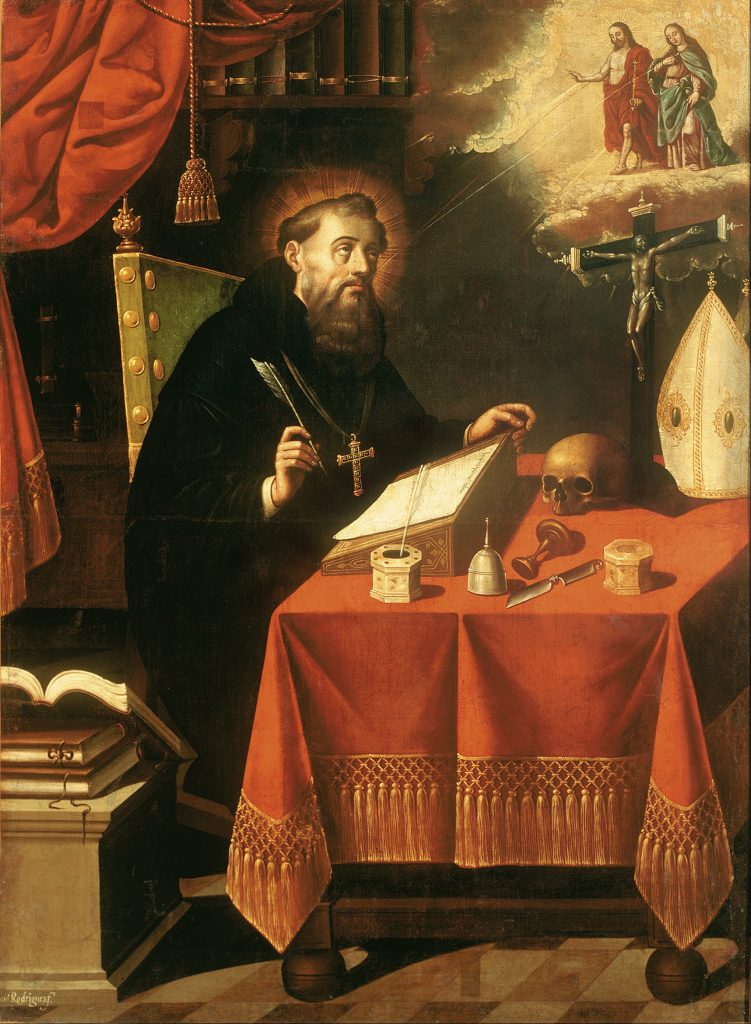
Saint Augustine of Hippo (354–430) stands among the greatest theologians in Christian history. His theology grew out of Scripture, the Christian tradition, pastoral experience, philosophical reflection, and—perhaps most importantly—his own dramatic experience of conversion and grace.
Augustine did not write a systematic theology in the modern sense. His theological ideas are scattered throughout his Confessions, City of God, On the Trinity, On Christian Doctrine, On the Free Choice of the Will, On Grace and Free Will, On Nature and Grace, sermons, letters, and many other works. His theology also developed over time, particularly through his controversies with the Manichaeans, Donatists, and Pelagians. (Stanford Encyclopedia of Philosophy)
At the heart of Augustine’s theology is a profound conviction:
God is the supreme Good, human beings are created for God, sin turns the human heart away from God, and God’s grace restores the human person so that he or she may return to God in love.
1. God: The Supreme Good
For Augustine, theology begins with God.
God is not merely one being among many. God is the source, Creator, and supreme end of everything that exists.
Everything created is good because it comes from God. Yet created things are finite and therefore cannot provide the ultimate happiness for which the human person longs.
This explains Augustine’s famous insight in the Confessions:
“You have made us for Yourself, and our heart is restless until it rests in You.”
The human heart is restless because it has been created for the infinite God. We naturally seek happiness, but we often seek it in created things rather than in the Creator.
Augustine’s theology therefore has a fundamentally God-centered character.
The ultimate question is not simply:
“How can I become a better person?”
but:
“How can I return to God, for whom I was created?”
2. God’s Divine Simplicity and Transcendence
Augustine strongly emphasizes that God is not composed of parts.
God does not possess goodness as something added to Him; God is good.
God does not merely possess wisdom; God is wisdom.
God does not merely possess being; He is the fullness of being.
God is immutable—He does not change as creatures change.
He is eternal.
He is omnipotent.
He is perfectly good.
Augustine’s understanding of God’s transcendence was deeply influenced by Christian Platonism, but it was transformed by biblical revelation. His philosophical background helped him articulate Christian doctrines concerning God’s immutability, eternity, and spiritual nature. (Stanford Encyclopedia of Philosophy)
3. Creation
Augustine firmly teaches that God created everything.
Creation is not the result of a struggle between two eternal powers, as Manichaeism had claimed.
There are not two ultimate principles—one good and one evil.
There is only one God.
Everything that exists as creation is dependent upon God.
Therefore creation itself is fundamentally good.
This became extremely important in Augustine’s rejection of Manichaeism.
The material world is not evil simply because it is material.
Matter is God’s creation.
The human body is God’s creation.
Marriage, properly understood, is good.
The created world reveals the wisdom and goodness of its Creator.
4. Creation ex nihilo
Augustine teaches that God created the universe from nothing.
God did not simply organize pre-existing matter as a craftsman organizes material.
The entire created order depends upon God for its existence.
This means that creation is radically dependent upon God.
Nothing can exist independently of its Creator.
This doctrine also gives Augustine’s theology a strong sense of humility: creatures are not self-sufficient.
5. God Created Time
One of Augustine’s most famous theological reflections concerns time.
God did not create the world within an already existing time.
Rather, God created the world and time itself.
Consequently, asking what God was doing “before” creation is problematic, because “before” already assumes time.
Augustine explores this extensively in Confessions, Book XI.
His reflection on time became one of the most influential discussions of time in Western philosophy and theology.
6. The Trinity
The doctrine of the Holy Trinity occupies an enormous place in Augustine’s theology.
Christian faith confesses:
- one God;
- the Father;
- the Son;
- and the Holy Spirit.
There are not three gods.
There is one divine nature and three divine Persons.
Augustine’s major treatment of the Trinity appears in ** De Trinitate (On the Trinity)**, one of the great theological works of late antiquity.
He begins from Scripture and Christian faith and then seeks to understand, as far as human reason can, how the one God can exist eternally as Father, Son, and Holy Spirit.
7. The Father, Son, and Holy Spirit
Augustine emphasizes that the three divine Persons are fully and equally God.
The Father is God.
The Son is God.
The Holy Spirit is God.
Yet the Father is not the Son, and the Son is not the Holy Spirit.
The distinctions between the Persons do not divide God’s essence.
Augustine therefore carefully distinguishes unity of essence from distinction of Persons.
8. The Trinity and the Human Mind
One of Augustine’s most original theological approaches is his search for an image of the Trinity within the human person.
He explores relationships such as:
- memory;
- understanding;
- will;
and also:
- lover;
- beloved;
- love.
These analogies do not explain the Trinity completely. God infinitely transcends human psychological experience.
But Augustine believes that because human beings are created in God’s image, something about the Trinity can be reflected in the human mind.
His On the Trinity therefore becomes both a theology of God and a profound theology of the human person. (Stanford Encyclopedia of Philosophy)
9. The Human Person
Augustine possesses a remarkably profound understanding of the human person.
Human beings are created by God and directed toward God.
The human person is not simply a body.
Neither is the body evil.
Augustine understands the human being as a unity of body and soul, with the rational soul possessing a unique capacity to know truth and love God.
Human beings are therefore creatures who can transcend the merely material world through knowledge and love.
10. Humanity Created in God’s Image
Genesis teaches that humanity is created in the image and likeness of God.
Augustine takes this seriously.
The human mind possesses a special capacity to know truth and to love.
This is why Augustine repeatedly turns inward.
His famous spiritual movement is:
from the external world → to the inner self → to God.
But Augustine does not mean that God is merely a psychological projection.
Rather, the interior search leads beyond the self toward the eternal Truth who is God.
11. The Restless Human Heart
Perhaps Augustine’s most famous contribution to Christian spirituality is his theology of the restless heart.
Human beings seek happiness.
We seek:
- pleasure;
- wealth;
- knowledge;
- relationships;
- reputation;
- power;
- security;
- beauty;
- success.
Yet none of these can completely satisfy the human heart.
Why?
Because the heart has been created for God.
Augustine’s personal journey became an illustration of this theology.
He tried many forms of happiness before discovering that only God could provide lasting fulfillment.
12. Knowledge and Illumination
Augustine believes that human beings can know truth because God illuminates the human mind.
This does not mean that God constantly gives miraculous revelations.
Rather, Augustine sees human knowledge as ultimately dependent upon God’s eternal Truth.
The human mind can recognize truth because it participates, in a creaturely way, in a reality grounded in God.
This is part of Augustine’s doctrine of divine illumination, one of the major features of his epistemology. (Stanford Encyclopedia of Philosophy)
13. Faith and Reason
Augustine does not see faith and reason as enemies.
For him, Christianity is not irrational.
Faith seeks understanding.
Reason can help the believer understand what has been received through faith.
At the same time, human reason has limits.
We cannot discover God completely through philosophical reasoning.
Divine revelation is necessary.
Thus Augustine’s approach may be summarized:
Faith seeks understanding, and understanding deepens faith.
This became an important foundation for later Christian intellectual traditions.
14. Scripture
Scripture occupies a central position in Augustine’s theology.
He continually returns to:
- Genesis;
- Psalms;
- the Gospel of John;
- Saint Paul’s letters;
- and other biblical books.
For Augustine, Scripture is God’s Word communicated through human authors.
He believes that difficult passages should be approached with humility.
He also allows for legitimate diversity of interpretation when interpretations remain faithful to truth and Christian faith.
His On Christian Doctrine became one of the most influential works on Christian biblical interpretation and preaching. (Stanford Encyclopedia of Philosophy)
15. The Unity of Scripture
Augustine sees the Old and New Testaments as one divine economy of salvation.
The Old Testament anticipates Christ.
The New Testament reveals Christ.
Thus Scripture has a profoundly Christ-centered unity.
For Augustine, reading Scripture correctly ultimately leads toward the mystery of Christ and God’s plan of salvation.
16. Christology
Jesus Christ is central to Augustine’s theology.
Christ is:
- truly God;
- truly human;
- the eternal Son;
- the mediator between God and humanity;
- the Redeemer;
- the teacher of truth;
- and the source of grace.
Augustine’s Christology is firmly rooted in the Church’s confession of the Incarnation.
The eternal Word became human without ceasing to be God.
17. Christ as Mediator
Humanity’s fundamental problem is separation from God through sin.
Human beings cannot overcome this separation through philosophy, morality, or human effort alone.
Christ is the Mediator.
He unites humanity and divinity in His own Person.
Through Christ, humanity is reconciled to God.
This is why Augustine’s theology of grace cannot be separated from his Christology.
Grace comes to humanity through Christ.
18. The Cross
The Cross reveals God’s love and defeats sin.
Christ’s death is not merely the tragic death of a good teacher.
It is part of God’s saving action.
The Cross demonstrates both:
- the seriousness of sin;
- and the immeasurable mercy of God.
Augustine therefore sees Christian salvation as fundamentally Christological.
19. Resurrection
The Resurrection is essential to Augustine’s theology.
Christ conquers death.
The Resurrection is the foundation of Christian hope.
Human beings are not destined for eternal existence as disembodied souls.
The Christian hope is the resurrection of the body and eternal life with God.
This becomes especially important in Augustine’s City of God, particularly its final books.
20. Sin
Augustine’s theology of sin is one of his most influential contributions.
Sin is fundamentally a turning away from God.
It is not simply breaking an external rule.
Sin is a disorder of love.
We love created things more than the Creator.
We place ourselves at the center instead of God.
Thus sin is ultimately a disorder of the human will.
21. Pride
For Augustine, pride is at the root of sin.
The sinner wants to become the center.
Instead of receiving existence as a gift from God, the creature seeks independence from God.
Pride therefore represents a movement:
away from God → toward the self.
Humility reverses this movement.
22. Original Sin
Augustine’s doctrine of original sin became enormously influential in Western Christianity.
He teaches that humanity’s first parents fell into sin and that the consequences of that fall affect the entire human race.
Human beings are born into a condition wounded by sin.
Original sin involves:
- alienation from God;
- disordered desire;
- weakened will;
- mortality;
- and the need for grace.
Augustine’s mature theology of original sin developed especially in the controversies with Pelagianism. Modern scholarship notes that his understanding became particularly developed in the period around 395–397 and was further elaborated during the Pelagian controversy. (Stanford Encyclopedia of Philosophy)
23. Concupiscence
Augustine uses the term concupiscence for disordered desire.
Human beings experience an internal conflict:
We know what is good, yet we sometimes desire what is contrary to the good.
The human will is therefore divided.
This explains Augustine’s famous description of his own conversion.
He wanted to surrender to God but was still attached to his old way of life.
The fallen human condition is therefore not merely intellectual ignorance.
It is also a problem of desire.
24. The Will
Augustine takes human freedom seriously.
Human beings possess free will and are responsible for their choices.
However, sin has wounded the will.
This is an important development in Augustine’s thought.
His earlier works place greater emphasis on human freedom, while his later anti-Pelagian writings emphasize more strongly humanity’s dependence upon grace. Nevertheless, Augustine continues to affirm genuine human choice and responsibility. (New Advent)
25. Freedom Before and After the Fall
Augustine distinguishes between the condition of humanity before the Fall and humanity after the Fall.
Before the Fall, Adam possessed a greater capacity to remain in righteousness.
After the Fall, humanity remains capable of choosing but is deeply weakened by sin.
Thus Augustine’s theology does not simply say:
“Human beings have no free will.”
Rather, it says:
Human freedom has been wounded and needs healing by grace.
This distinction is crucial for understanding Augustine accurately.
26. Grace
Grace is perhaps the central theme of Augustine’s mature theology.
Grace is God’s free and undeserved gift.
Human beings cannot save themselves.
Grace:
- awakens faith;
- heals the will;
- enables love;
- forgives sin;
- empowers obedience;
- and leads the believer toward eternal life.
Augustine explicitly teaches that God’s grace is not given because of prior human merit; rather, good merits themselves arise through grace. (New Advent)
27. Prevenient Grace
Augustine’s theology emphasizes that God’s grace comes first.
God does not wait for fallen humanity to become worthy.
God initiates salvation.
Grace precedes and enables the human response.
This is often called prevenient grace.
The human response is real, but it is made possible by God’s prior action.
This became one of the most influential aspects of Augustine’s mature theology. (Stanford Encyclopedia of Philosophy)
28. Grace and Human Cooperation
It would nevertheless be inaccurate to describe Augustine simply as denying human responsibility.
He continues to speak about human choice.
Grace does not turn human beings into robots.
Rather, grace heals and liberates the will so that it can genuinely choose the good.
Thus Augustine’s mature theology can be summarized as:
Grace does not destroy freedom; grace heals and liberates freedom.
29. Predestination
Augustine also develops a theology of divine election and predestination.
God knows and chooses those who will receive salvation.
This teaching emerged especially strongly in Augustine’s mature engagement with Saint Paul’s Letter to the Romans and the Pelagian controversy. (Stanford Encyclopedia of Philosophy)
Augustine emphasizes that salvation is ultimately God’s mercy and cannot be claimed as a human achievement.
At the same time, Augustine continues to affirm human responsibility.
The relationship between:
- divine sovereignty;
- grace;
- human freedom;
- and predestination
is one of the most difficult aspects of his theology.
30. Augustine and the Pelagian Controversy
Pelagius emphasized human responsibility and moral ability.
Augustine believed that Pelagian teaching underestimated the damage caused by original sin and the necessity of grace.
The disagreement centered on questions such as:
- Can human beings live without sin through their natural powers?
- Is grace merely instruction?
- Is grace necessary for every good act?
- Does salvation ultimately depend upon God’s initiative?
- What is the condition of humanity after Adam’s sin?
Augustine answered that grace is absolutely necessary.
The controversy profoundly shaped his mature theology. (Stanford Encyclopedia of Philosophy)
31. Baptism
Baptism is central to Augustine’s understanding of Christian salvation.
Baptism:
- incorporates the person into Christ;
- remits sins;
- brings the person into the Church;
- and is a sacramental sign of God’s grace.
Augustine strongly defended the baptism of infants.
His theology of original sin was closely connected with his understanding of infant baptism.
32. The Church
Augustine has a profoundly ecclesial theology.
Christianity is not merely an individual relationship with Jesus.
Christ establishes a Church.
The Church is:
- the Body of Christ;
- the people of God;
- the community of believers;
- the bearer of the sacraments;
- and the historical community within which God’s grace operates.
Augustine’s conflicts with the Donatists made his ecclesiology particularly important.
33. The Church as the Body of Christ
Augustine sees Christ and the Church in profound communion.
Christ is the Head.
Christians are members of His Body.
The unity of Christians is therefore not merely organizational.
It is sacramental and spiritual.
This is why division within Christianity is so serious in Augustine’s theology.
34. The Donatist Controversy
The Donatists argued, among other things, that the validity of sacraments depended upon the moral status of the minister.
Augustine rejected this understanding.
The sacrament’s power ultimately comes from Christ, not from the personal holiness of the minister.
A sinful priest does not turn Christ’s sacrament into an invalid sacrament simply because of his personal sinfulness.
This principle became very important for Catholic sacramental theology.
35. The Sacraments
Augustine’s sacramental theology emphasizes that God uses visible signs to communicate invisible grace.
The sacrament is not merely a symbol in the modern sense.
It is a divine instrument within the Church.
The sacramental action points toward and communicates God’s saving work.
36. The Eucharist
Augustine has a profoundly sacramental understanding of the Eucharist.
The Eucharist is Christ’s Body and Blood.
It is also the sacrament of ecclesial unity.
Receiving Christ should transform Christians into a united people.
Thus Augustine connects:
Eucharist → Christ → Church → charity → unity.
37. Charity
Love—or caritas—is central to Augustine’s moral theology.
The Christian life is fundamentally a life of rightly ordered love.
We must love:
- God above all things.
- Our neighbor for God’s sake.
- Created things according to their proper place.
Sin occurs when love becomes disordered.
Holiness occurs when love becomes rightly ordered.
38. Ordo Amoris — The Order of Love
Augustine’s moral theology can be understood through the concept often called ordo amoris, the order of love.
The problem is not simply that people love.
The problem is that they love things in the wrong order.
For example:
- loving money more than God;
- loving reputation more than truth;
- loving pleasure more than holiness;
- loving oneself more than God;
- loving created things as though they were ultimate.
Christian holiness means restoring the proper order of love.
39. Enjoyment and Use
In On Christian Doctrine, Augustine makes an important distinction between enjoying something and using something.
To “enjoy” something means to rest in it as one’s ultimate good.
Only God should be enjoyed in the absolute sense.
Created things should be used as means toward the ultimate good.
This does not mean that created things have no value.
Rather, their value must be understood in relation to God.
40. Happiness
For Augustine, happiness is the ultimate goal of human existence.
But true happiness cannot be found in:
- wealth;
- power;
- pleasure;
- fame;
- intellectual achievement;
- political success.
True happiness consists in possessing and enjoying God.
Therefore Augustine’s moral theology is ultimately beatific—directed toward eternal happiness in God.
41. Virtue
Augustine understands virtue differently from many ancient philosophers.
Virtue is not simply human self-mastery.
Christian virtue must be rooted in love of God.
A person may appear morally admirable but still be fundamentally oriented toward self-glory.
True virtue seeks God.
Thus humility and charity become essential.
42. Humility
Humility is extremely important in Augustine.
Pride turns the human person away from God.
Humility acknowledges:
- “I am a creature.”
- “I need God.”
- “I cannot save myself.”
- “Whatever good I possess ultimately comes from God.”
Augustine sees Christian humility supremely manifested in Christ.
43. Prayer
Augustine sees prayer as essential to Christian life.
Prayer does not inform God of something He does not know.
God already knows our needs.
Prayer changes the person who prays.
It teaches us to desire God.
It purifies our desires.
It brings our will into conformity with God’s will.
Thus prayer is fundamentally a school of love.
44. The Lord’s Prayer
Augustine gives great importance to the Our Father.
The prayer teaches Christians what to desire.
We ask for:
- God’s name to be hallowed;
- God’s kingdom to come;
- God’s will to be done;
- daily bread;
- forgiveness;
- freedom from temptation;
- and deliverance from evil.
The prayer therefore forms the Christian heart.
45. The Christian Life as Pilgrimage
Augustine views Christians as pilgrims in this world.
The Christian belongs ultimately to heaven.
Earth is not the final destination.
This does not mean Christians should despise the world.
Rather, they should use earthly goods responsibly while remembering that their ultimate homeland is with God.
46. The Two Cities
This theology reaches its fullest historical expression in The City of God.
Augustine speaks of two cities:
The City of God
Characterized by:
- love of God;
- humility;
- charity;
- eternal orientation.
The Earthly City
Characterized by:
- self-love;
- pride;
- domination;
- desire for earthly glory.
These are ultimately spiritual orientations rather than simply two political institutions.
Augustine explicitly distinguishes the two cities from the historical Church and state; the members of the two cities are mixed together in history and will be finally separated only at the end. (Stanford Encyclopedia of Philosophy)
47. Church and State
Augustine does not teach that the Church and state simply correspond to the two cities.
A Christian lives within earthly society.
The Christian should cooperate with legitimate social order while recognizing that no earthly political system is the Kingdom of God.
Political power is temporary.
God’s Kingdom is eternal.
This remains one of Augustine’s most influential contributions to Christian political thought.
48. Peace
Augustine defines peace in terms of order.
Peace is not simply the absence of war.
It is the tranquility produced by rightly ordered relationships.
He speaks of different forms of peace:
- peace within the person;
- peace in the family;
- peace in society;
- peace among nations;
- eternal peace in God.
The ultimate peace is found in God.
49. War and Political Reality
Augustine lived during political instability and military conflict.
His theology of war is more complex than the popular phrase “just war.”
He recognizes that Christians sometimes have to respond to aggression and protect innocent people.
But war should never be motivated by hatred, revenge, or pride.
Peace must remain the ultimate goal.
50. History as Providence
Augustine rejects the idea that history is merely a meaningless cycle.
History has direction.
God is sovereign over history.
Human beings make genuine choices, but God’s providence ultimately governs the course of creation.
History therefore moves toward an eschatological conclusion.
51. Eschatology
Augustine’s theology is deeply eschatological.
Human history will culminate in:
- judgment;
- resurrection;
- eternal life;
- or eternal separation from God.
The Christian therefore lives toward the final fulfillment of God’s Kingdom.
Earthly life is important but temporary.
52. Resurrection of the Body
Augustine strongly defends bodily resurrection.
Christian salvation is not escape from embodiment.
God redeems the whole person.
The body that dies will be raised and transformed.
The final Christian hope is therefore not simply “the soul going to heaven.”
It is the resurrection and glorification of the whole human person.
53. Eternal Life
The ultimate destiny of the redeemed is communion with God.
Augustine calls this the beatific vision—the fulfillment of humanity’s deepest desire in seeing and enjoying God.
All earthly knowledge is incomplete.
All earthly happiness is temporary.
In heaven, the human person finds the complete fulfillment for which he or she was created.
54. Evil
One of Augustine’s great theological achievements is his treatment of the problem of evil.
The Manichaean system had taught him to think of evil as an independent principle opposed to good.
Christianity led him away from this.
Augustine argues that evil is not a created substance.
Rather, evil is a privation of good—a corruption, disorder, or lack of the good that ought to be present.
This allows Augustine to affirm simultaneously:
- God created everything good;
- God is not the author of evil;
- evil is genuinely destructive;
- and evil ultimately has no independent existence comparable to God.
55. Moral Evil and Free Will
Augustine locates moral evil in the misuse of created freedom.
God created creatures capable of choosing.
The misuse of that freedom results in sin.
Thus evil is not something God created as a positive substance.
It arises from the disordering of created wills.
56. Suffering
Augustine does not provide a simplistic explanation of suffering.
The world is fallen.
Human beings experience:
- sickness;
- death;
- injustice;
- war;
- grief;
- natural disasters;
- and other forms of suffering.
Yet suffering does not have the final word.
God can bring good even from suffering.
The Cross of Christ is the supreme example.
57. Death
Death is an enemy because it is connected with humanity’s fallen condition.
But Christ has conquered death.
For Christians, death becomes a passage toward resurrection.
Augustine therefore holds together two truths:
Death is genuinely tragic.
Death does not have ultimate victory.
58. Mary
Augustine has an important place in the development of Christian Marian theology.
He emphasizes Mary’s holiness and her role in the mystery of Christ.
He also famously stresses that Mary’s greatness is not merely biological but spiritual:
she believed and obeyed God’s Word.
Mary therefore becomes an example of Christian discipleship.
59. The Saints
Augustine sees the saints as members of Christ’s Body and examples of God’s grace.
The saints do not save themselves.
Their holiness demonstrates what God’s grace can accomplish in human beings.
This is consistent with Augustine’s central theological principle:
grace comes first.
60. Augustine’s Theology of Conversion
Conversion is not simply a change of religious opinion.
It is a transformation of love.
Augustine’s own conversion illustrates this.
He moved:
from self → to God;
from pride → to humility;
from disordered desire → to charity;
from intellectual searching → to faith seeking understanding;
from slavery to sin → toward freedom in grace.
61. Augustine’s Theology of the Human Will
One of Augustine’s deepest psychological insights is that human beings can experience conflict within themselves.
We can say:
“I want to change.”
and simultaneously:
“I do not want to give up my old way of life.”
This is not merely intellectual confusion.
It is a conflict of loves and desires.
Augustine’s theology of grace therefore reaches deeply into human psychology.
62. Grace and Healing
Grace does not merely declare a person forgiven externally.
Grace heals the human person.
The will that was enslaved to sin begins to desire God.
The person who once loved created things above God begins to love God above all.
The sinner becomes capable of genuine charity.
Thus salvation is both:
forgiveness and transformation.
63. Augustine’s Theology of Baptism and Grace
Baptism is particularly important because it symbolizes and communicates the beginning of this new life.
The baptized person is incorporated into Christ.
The old life gives way to the new.
The Christian journey then continues through ongoing conversion.
64. Sin After Baptism
Augustine recognizes that Christians continue to struggle with sin after baptism.
Therefore Christian life involves:
- repentance;
- prayer;
- Eucharistic participation;
- charity;
- Scripture;
- and continual conversion.
Grace is not simply something received once and then forgotten.
Christian existence remains dependent upon God.
65. The Sacramental Life
Augustine’s theology emphasizes the Church’s sacramental life as a means through which God communicates grace.
The sacraments belong to the visible Church.
They unite Christians to Christ.
They nourish faith.
They strengthen charity.
They establish ecclesial communion.
66. The Eucharist and the Church
For Augustine, the Eucharist creates and reveals the unity of the Church.
Christ gives Himself to His people.
Those who receive Christ are called to become one body.
Therefore Eucharistic participation without charity contradicts the meaning of the Eucharist.
67. Christian Love of Neighbor
Love of God necessarily produces love of neighbor.
The Christian cannot claim to love God while deliberately refusing love to another person.
The neighbor is to be loved because he or she is created by God and called to communion with God.
68. Augustine and Charity Toward the Poor
Augustine repeatedly exhorts Christians to care for the poor.
Possessions are not evil.
But possessions must be used according to charity.
Wealth becomes spiritually dangerous when it becomes an object of ultimate love.
The Christian must recognize the needs of others.
69. Marriage
Augustine regards marriage as a genuine good.
He identifies important goods of marriage including:
- offspring;
- fidelity;
- and sacramental permanence.
His theology of sexuality was shaped by both Christian tradition and the controversies of his time, and some aspects of his treatment of sexuality are heavily debated today.
Nevertheless, marriage itself is not evil in Augustine’s theology.
70. The Meaning of Sexual Desire
Augustine distinguishes between sexual desire as part of created human life and concupiscence as disordered desire.
His later writings place strong emphasis on the connection between concupiscence and the fallen human condition.
This is one of the areas where his theology became particularly controversial.
Modern scholarship emphasizes that Augustine’s understanding of concupiscence is broader than merely sexual desire: it refers more generally to disordered desire opposed to rightly ordered love. (Stanford Encyclopedia of Philosophy)
71. Christian Education
Augustine believed education should ultimately serve truth.
Knowledge should lead toward wisdom.
And wisdom should lead toward God.
Education that produces pride is spiritually dangerous.
Education that produces humility and love can become a path toward God.
72. Christian Preaching
Augustine was one of Christianity’s greatest preachers.
His theology of preaching is expressed especially in On Christian Doctrine.
The preacher must:
- understand Scripture;
- communicate clearly;
- persuade the heart;
- and above all, love the people being served.
Preaching is not a performance.
It is a ministry of truth and charity.
73. The Purpose of Theology
Augustine’s theology is ultimately practical.
Theology should lead to:
- worship;
- conversion;
- love;
- humility;
- holiness;
- and union with God.
Knowledge that does not produce love can become another form of pride.
74. Theology and Prayer
Augustine’s theology is inseparable from prayer.
His Confessions demonstrates this beautifully.
He does not merely write about God.
He speaks to God.
This is one of the reasons Augustine’s theology remains so spiritually powerful.
75. Theology as the Search for Truth
Augustine never loses his passion for truth.
He began his intellectual journey by seeking wisdom.
Christianity did not destroy that search.
It fulfilled it.
Truth ultimately leads to God because God is Truth itself.
76. Augustine and Neoplatonism
Augustine was significantly influenced by Platonist and Neoplatonist philosophy.
This helped him articulate ideas about:
- immaterial reality;
- the soul;
- the hierarchy of being;
- divine transcendence;
- and the movement of the soul toward God.
But Christianity fundamentally transformed these ideas.
Augustine rejected any notion that human beings could save themselves through philosophical contemplation alone.
Christ and grace are indispensable.
The Stanford Encyclopedia of Philosophy notes that Platonism remained an important ingredient in Augustine’s thought, while emphasizing that his philosophy and theology are inseparably shaped by Christian Scripture and revelation. (Stanford Encyclopedia of Philosophy)
77. Augustine and the Manichaeans
Augustine’s years among the Manichaeans profoundly influenced his theology.
Manichaeism proposed a dualistic universe of good and evil.
Augustine eventually rejected this.
Christianity taught him:
One Creator.
One ultimate source of being.
Creation is good.
Evil is a privation of good.
This was one of the most important intellectual transformations in his life.
78. Augustine and Human Dignity
Because human beings are created in God’s image, every human person possesses profound dignity.
Human beings are not merely biological organisms.
They are creatures capable of truth, love, moral responsibility, and communion with God.
79. Augustine’s Theology of Memory
Memory becomes an important theme in Augustine.
In Confessions, Book X, he explores the mysterious world of human memory.
Memory contains:
- images;
- experiences;
- knowledge;
- emotions;
- and desires.
Yet God is deeper than memory.
Augustine ultimately discovers that God cannot be reduced to something stored in the mind.
God is the source toward whom the mind is directed.
80. Augustine and Interior Spirituality
Augustinian spirituality repeatedly calls the believer inward.
But “inward” does not mean narcissistic self-absorption.
The journey is:
inward to self → beyond self → toward God.
The Christian discovers the truth of one’s own existence by discovering dependence upon God.
81. Augustine’s Theology of Beauty
Beauty is another important theme.
Created beauty can awaken desire for the Creator.
Augustine’s famous prayer:
“Late have I loved You, Beauty ever ancient, ever new.”
expresses this.
Created beauty is valuable, but it points beyond itself.
The ultimate Beauty is God.
82. The Meaning of Rest
Augustine’s concept of rest is deeply theological.
God created human beings for Himself.
Therefore no earthly achievement can produce ultimate rest.
The soul finds rest only when it comes to God.
This rest is not inactivity.
It is the fulfillment of desire.
83. The Final Vision of God
The ultimate destiny of humanity is the vision and enjoyment of God.
This is the beatific vision.
There the restless heart finds complete rest.
Knowledge, love, and happiness reach their fulfillment.
84. Augustine’s Theology of Hope
Hope is directed toward the fulfillment God has promised.
Christians live in the tension between:
already and not yet.
Christ has come.
Christ has conquered sin and death.
But the final consummation has not yet arrived.
Therefore the Christian lives in hope.
85. The Christian as Pilgrim
The Christian is a traveler.
Earth is not home in the ultimate sense.
The Christian therefore uses earthly goods without becoming enslaved to them.
This produces a spirituality of detachment.
We can enjoy creation.
But we must never make creation our god.
86. The Theology of Providence
God’s providence governs creation and history.
Yet providence does not make human choices meaningless.
Augustine works continually to affirm both:
God’s sovereignty
and
human responsibility.
This tension remains one of the deepest questions in Christian theology.
87. God’s Foreknowledge and Human Freedom
Augustine rejects the idea that God’s foreknowledge forces human beings to act against their will.
God knows what human beings freely choose.
Divine knowledge does not function as external coercion.
This question receives important treatment in The City of God, especially Book V. (New Advent)
88. The Problem of Divine Justice
Augustine recognizes that God’s judgments are sometimes mysterious.
Human beings cannot see the entire structure of divine providence.
Therefore humility is required.
We know that God is just even when we cannot understand every particular judgment.
89. Augustine’s Theology of Mercy
Mercy is central to Augustine’s understanding of God.
The sinner does not earn God’s mercy.
Mercy is precisely mercy because it is undeserved.
Augustine’s own life becomes evidence of this.
He regarded his conversion not as his achievement but as God’s work.
90. Augustine’s Theology of the Church’s Unity
Unity is not optional for Augustine.
Because Christ is one, His Body must seek unity.
Schism is therefore spiritually serious.
This explains the intensity of Augustine’s opposition to Donatism.
91. Augustine’s Theology of Truth and Charity
Augustine insists that truth and charity belong together.
Truth without charity can become harshness.
Charity without truth can become sentimentality.
Christian maturity requires both.
The believer must love the truth and communicate it in love.
92. Augustine’s Theology of the Christian Community
Christianity is communal.
Believers:
- pray together;
- worship together;
- receive the sacraments together;
- hear Scripture together;
- serve the poor together;
- and grow in holiness together.
The Christian is not saved into isolated individualism.
93. Augustine’s Theology of the Priesthood
As a bishop, Augustine saw ministry as service.
A bishop is not primarily a ruler.
He is a shepherd.
He must preach.
He must teach.
He must correct.
He must console.
He must pray.
He must serve.
This pastoral dimension is inseparable from Augustine’s theology.
94. Augustine’s Theology of the Bishop
Augustine famously describes the responsibility of episcopal ministry in terms of service to others.
The bishop has a responsibility for the people, not merely a position over the people.
This pastoral understanding remains influential in Christian reflection on ministry.
95. Theology of Suffering and the Cross
Augustine understands Christian suffering through Christ.
The believer does not suffer alone.
Christ has entered into human suffering.
The Cross demonstrates that God can bring victory through apparent defeat.
Therefore Christian suffering can become an occasion for faith, perseverance, and charity.
96. Augustine’s Theology of Death and Hope
Death reminds Christians that earthly life is temporary.
But Christian hope looks beyond death.
The Resurrection of Christ guarantees the resurrection of believers.
Therefore death is not the final word.
God is.
97. Augustine’s Greatest Theological Theme: Grace
If Augustine’s theology had to be summarized in one word, grace would be one of the strongest candidates.
Grace explains:
- creation;
- salvation;
- conversion;
- forgiveness;
- sanctification;
- perseverance;
- and eternal life.
The Christian cannot boast.
Everything is gift.
98. Augustine’s Theology in One Sentence
Augustine’s theology can be summarized approximately as follows:
The human person is created by God and for God, wounded by sin, incapable of restoring himself completely by his own power, redeemed through Christ, healed by grace, incorporated into the Church, transformed by rightly ordered love, and ultimately destined to find perfect happiness in the eternal vision of God.
This captures the fundamental movement of Augustine’s theology:
Creation → Fall → Grace → Christ → Church → Transformation → Eternal Glory.
99. The Great Spiritual Movement of Augustine’s Theology
Augustine’s entire theology can be understood as a journey.
1. From God
God creates.
2. Away from God
Human beings turn toward themselves through pride and sin.
3. Christ comes
The Incarnation reveals God’s mercy.
4. Grace acts
God heals and liberates the human will.
5. The human person responds
Faith, repentance, love, and obedience emerge.
6. The person enters the Church
The believer becomes part of Christ’s Body.
7. Charity transforms life
Love becomes rightly ordered.
8. The pilgrim journeys through history
The Christian lives between earthly existence and eternal destiny.
9. Resurrection
Christ’s victory becomes the believer’s hope.
10. Beatific vision
The restless heart finally rests in God.
100. The End and Goal of Augustine’s Theology
Everything ultimately points toward one reality:
God Himself.
Augustine’s theology begins with God and ends with God.
Creation comes from God.
Humanity is created for God.
Sin is turning away from God.
Grace brings us back to God.
Christ reconciles us to God.
The Church unites us to Christ.
The sacraments nourish our journey.
Charity orders our lives toward God.
History moves toward God’s final judgment.
Resurrection leads to eternal life.
And eternal life is the perfect enjoyment of God.
That is why the most appropriate summary of Augustine’s theology is found not in a technical theological formula but in the prayer with which he begins his Confessions:
“You have made us for Yourself, and our heart is restless until it rests in You.”
For Augustine, this is not merely a beautiful spiritual sentence. It is an entire theology of the human person.
We come from God.
We are sustained by God.
We are wounded when we turn away from God.
We are restored by God’s grace.
We are redeemed in Christ.
We are nourished in the Church.
We are transformed through love.
And we find our final happiness only in God.
That is the enduring theological vision of Saint Augustine of Hippo.
Major Augustinian works for further study
- Confessions — conversion, grace, sin, memory, time, desire, prayer and the search for God.
- The City of God — history, providence, society, politics, the two cities, resurrection and eternal destiny.
- On the Trinity — the Trinity, divine Persons, God’s unity and the human mind as God’s image.
- On Christian Doctrine — Scripture, interpretation, signs, charity and Christian preaching.
- On the Free Choice of the Will — freedom, evil and moral responsibility.
- On Grace and Free Will — grace and human freedom.
- On Nature and Grace — original sin and the necessity of grace.
- Enchiridion on Faith, Hope and Love — a concise presentation of Christian faith and moral life.
These works together show why Augustine remains one of the foundational theologians of Western Christianity and why his thought continues to influence Catholic theology, spirituality, philosophy and biblical interpretation. (Stanford Encyclopedia of Philosophy)
Leave a Reply