
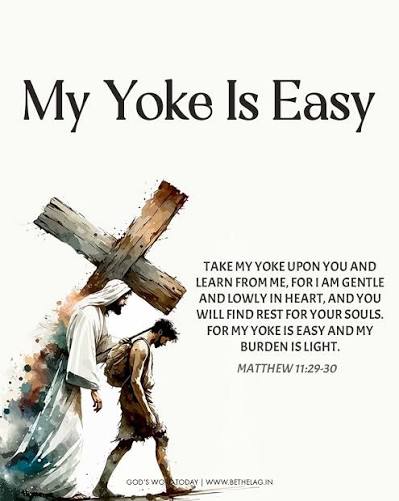
Jesus fulfills the prophecy of Zechariah as a humble Messiah who enters Jerusalem on a donkey, symbolizing peace rather than military conquest. His kingship is defined by sacrificial love and service, offering a universal invitation to those burdened by life to find spiritual rest in Him.
Taking up Christ’s yoke involves walking beside Him and exchanging worldly burdens for spiritual freedom. Guided by the Holy Spirit, believers are transformed through grace and communion. This path of discipleship does not remove life’s crosses but ensures that no one carries their heavy burdens alone.
“Take my yoke upon you.”
Today’s scripture reading presents a profound vision of the Kingdom of God and invites us to encounter its King. The readings lead us from the prophetic hope of Israel to its fulfillment in Jesus Christ, who reveals Himself as the humble Messiah, the giver of true rest, and the One who calls His disciples to share His life.
The First Reading presents the prophet Zechariah’s oracle of hope addressed to the post-exilic Jewish community living under foreign domination. In the midst of political uncertainty and oppression, the prophet proclaimed a message of hope:
“Rejoice greatly, O daughter Zion! Shout aloud, O daughter Jerusalem! Behold, your king comes to you; triumphant and victorious is he, humble and riding on a donkey.” (Zech. 9:9)
This image is remarkable. In the ancient world, victorious rulers entered cities mounted on war horses as symbols of conquest and military strength. Zechariah, however, presents a king who rides upon a donkey—a deliberate symbol of humility and peace. His kingdom will not be established through violence or coercion but through righteousness, reconciliation, and justice. The prophet thus presents a striking paradox: God’s chosen King manifests His authority not by domination but by meekness.
This prophecy reaches its perfect fulfillment in Jesus Christ. When Jesus enters Jerusalem riding upon a donkey, He consciously identifies Himself as the promised Messianic King. Yet His triumph will not culminate in political victory but in the Cross. Through His obedient self-emptying and sacrificial love, He inaugurates the Kingdom of God and reconciles humanity with the Father. The kingship of Christ is therefore revealed not in worldly power but in humble service and redeeming love.
The Gospel reveals the interior meaning of this kingdom. Jesus extends one of the most tender invitations found in all of Sacred Scripture:
“Come to me, all you who labor and are burdened, and I will give you rest.”
These words speak with particular force because they touch a reality that every human person experiences. Our world is weary.
From the earliest centuries, the Church has understood that the burdens Christ speaks of are many. Some are weighed down by sin; others by grief, illness, disappointment, or anxiety. Others simply grow weary under the demands of life itself.
Beneath all these burdens lies a deeper one: the human heart longs for a lasting home while living in a world where everything passes away. For this reason, Christ’s invitation is universal, for every heart ultimately longs for the rest that only God can give.
What is especially striking is that Jesus begins not with a command but with an invitation:
“Come to me.”
He does not say, “Come when your life is perfect,” or “Come when your faith is stronger.” He does not ask us first to solve every problem or overcome every weakness. He simply says, “Come.”
We come to Christ not merely with our feet but by faith; not simply by changing our location but by converting our lives. Every act of repentance, every sincere prayer, every confession of sin, every worthy reception of the Eucharist, every moment in which we entrust ourselves anew to His mercy.
Before Christ asks anything of us, He offers Himself to us. Before He calls us to discipleship, He establishes communion. Before He speaks of the Cross, He promises rest.
Yet the rest Christ offers is not an escape from life’s responsibilities. It is something far deeper. It is the peace that comes from knowing we belong to God. It is the freedom of a conscience reconciled through mercy. It is the quiet confidence that our lives remain securely in the Father’s hands even when our circumstances remain uncertain.
Immediately after promising rest, however, Jesus adds words that seem surprising:
“Take my yoke upon you.”
To modern ears, a yoke appears to be another burden. We often imagine that freedom consists in carrying no yoke at all. Scripture, however, presents a different understanding. The question is never whether we shall bear one, but whose yoke we shall bear.
Every human life is already yoked to something. We are continually shaped by what we love, what we pursue, and ultimately what we serve.
Some are yoked to success, believing that achievement alone will satisfy the heart. Others are bound by wealth, public approval, resentment, fear, or the illusion of complete self-sufficiency. The tragedy is that the very things we imagine will liberate us often become the powers that enslave us.
Christ therefore does not invite us to a life without commitment. Rather, He invites us to exchange the yoke that enslaves for the yoke that gives life.
In the Second Reading (Rom. 8:9, 11–13), St. Paul presents two contrasting yokes: the yoke of the flesh and the yoke of the Spirit. To live according to the flesh is to remain under the power of sin and death, relying on oneself rather than on God’s grace.
To live according to the Spirit is entirely different. The Spirit of the risen Christ dwells within believers, gradually transforming their minds, desires, and hearts according to the image of Christ Himself. Christian discipleship is therefore not merely the observance of external commandments but participation in the very life of God.
This is the yoke Christ invites us to bear. It is this new way of life that Jesus calls His yoke.
A yoke joins two together. When Christ says, “Take my yoke upon you,” He is not asking us simply to carry another burden. He is inviting us to walk beside Him. We are no longer left to rely on our own strength. He bears the greater weight, and His grace sustains us when our own strength fails.
Christ’s yoke leads us in another direction. It teaches us to choose what is good rather than merely convenient; to reject sin not simply from fear of punishment but because we have discovered something infinitely better. It teaches us to love generously, to forgive without resentment, to seek reconciliation rather than division, and to extend to others the same mercy we ourselves have received.
He is not offering an easier version of life. Rather, He is offering a better way to live. He invites us into the very life that He shares with the Father—a life shaped by love, freedom, and communion with God.
Far from diminishing our humanity, this way of life restores it. Every act of charity weakens the power of selfishness. Every choice for truth over falsehood, generosity over greed, hope over despair, and forgiveness over revenge makes the soul more fully alive.
The yoke of Christ is light because it liberates us from the tyranny of sin and forms us into the sons and daughters of God.
As we approach the altar today, Christ once again extends His invitation to each of us: “Come to me.” He knows every burden we carry, every hidden struggle, every fear, and every hope. He does not promise a life free from crosses, but He does promise that no cross need ever be carried alone. United with Him, our burdens become lighter because His grace bears us, His Spirit strengthens us, and His love transforms us.
May we therefore entrust ourselves anew to the humble King foretold by Zechariah, fulfilled in Christ, and made present among us in the Eucharist. Walking beside Him, yoked to Him in faith and love, may we discover the true rest that the human heart has always sought—the peace that comes from living as beloved children of the Father. Amen.
✍ Fr James Abraham
Leave a Reply