
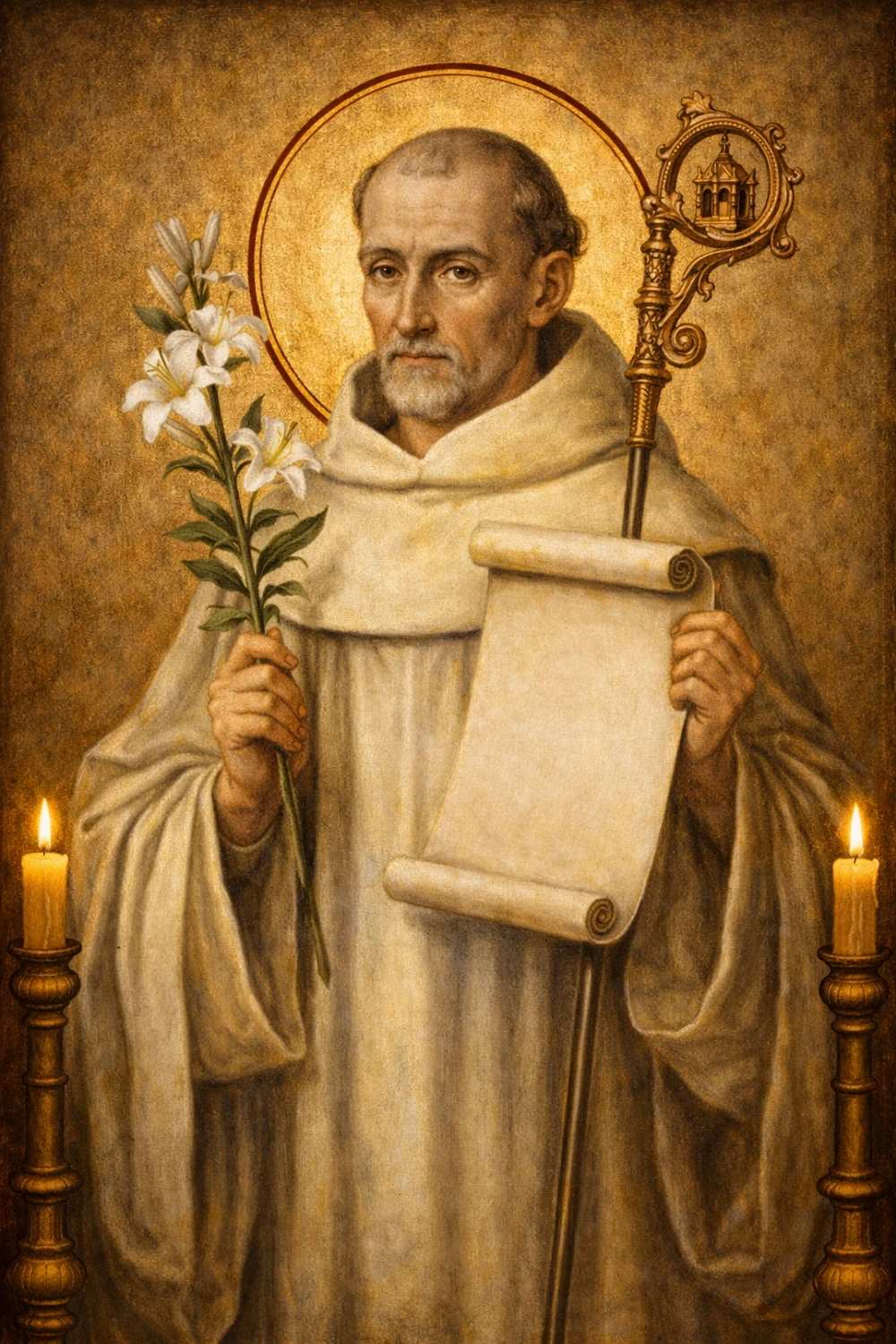
Feast Day: August 20
Saint Bernard of Clairvaux (1090–1153) was one of the most influential Christian figures of the 12th century. A Cistercian monk, abbot, mystic, preacher, theologian, reformer and spiritual writer, he played a remarkable role in shaping the religious life of medieval Europe.
Known for his profound love of Christ, devotion to the Blessed Virgin Mary, powerful preaching and commitment to monastic reform, Bernard became one of the most important spiritual teachers of the Middle Ages.
He is honored as a Doctor of the Church, a title given to saints whose teaching has made an exceptional contribution to Christian theology and spirituality.
The Catholic Church celebrates his feast on August 20.
✝️ Who Was Saint Bernard of Clairvaux?
Saint Bernard was born in 1090 at Fontaines, near Dijon, in Burgundy, France, into a noble family.
Although he was born into wealth and privilege, Bernard eventually chose a life of prayer, simplicity and religious discipline.
He entered the newly founded Cistercian Order at the monastery of Cîteaux in 1112, bringing with him a group of companions who also desired a more rigorous Christian life.
Only a few years later, Bernard was sent to establish a new monastery at Clairvaux.
There he became Abbot of Clairvaux, a position he held for the remainder of his life.
Under his leadership, Clairvaux became one of the most important centers of Cistercian spirituality in Europe.
👶 Early Life
Bernard was born around 1090 into the noble family of Tescelin and Aleth of Montbard.
His mother, Saint Aleth, was a deeply religious woman whose influence played an important role in Bernard’s spiritual development.
Bernard received an excellent education for his time, studying literature and theology.
He was intelligent, eloquent and deeply reflective.
As a young man, he experienced the attractions and responsibilities associated with aristocratic life. Yet he gradually developed a strong desire to dedicate himself completely to God.
His decision was not merely a personal conversion.
Bernard also persuaded several members of his family and friends to embrace religious life.
🕊️ Entering the Cistercian Order
In 1112, Bernard entered the monastery of Cîteaux.
The Cistercian movement had developed as a reform within Benedictine monasticism. Its members sought to return to a simpler and stricter interpretation of the Rule of Saint Benedict.
The Cistercians emphasized:
- Prayer
- Silence
- Manual labor
- Simplicity
- Community life
- Detachment from worldly wealth
- Contemplation
- Scripture
Bernard embraced this way of life enthusiastically.
His commitment was so strong that he inspired around 30 relatives and friends to join him in religious life.
Among them were several of his brothers.
🏞️ Founding Clairvaux Abbey
In 1115, Bernard was sent by the Cistercian abbot Stephen Harding to establish a new monastery in the Valley of Absinthe in Burgundy.
The new monastery became known as Clairvaux, meaning approximately “Clear Valley.”
Bernard was only about 25 years old when he became its abbot.
The beginnings were difficult.
The monastery was situated in a remote and challenging environment, and the monks lived a strict life of poverty and labor.
Yet under Bernard’s leadership, Clairvaux flourished.
It eventually became one of the most influential Cistercian monasteries in Europe.
🌿 Bernard as Abbot
Bernard took monastic discipline seriously.
He believed that monks should seek God through:
- Prayer
- Silence
- Scripture
- Work
- Community
- Humility
- Love
He was not interested in Christianity merely as an intellectual system.
For Bernard, Christianity had to become a personal relationship with Jesus Christ.
His spirituality emphasized conversion of the heart.
He wanted Christians not simply to know about God but to love God.
❤️ Bernard’s Spirituality
At the center of Bernard’s spirituality was love.
For him, Christian life was fundamentally a journey toward deeper love of God.
He famously described stages through which human love can be purified and transformed.
His writings frequently return to themes such as:
- God’s love
- Human love
- Mercy
- Grace
- Humility
- Repentance
- Contemplation
- Christ’s humanity
- The Cross
- The Virgin Mary
Bernard’s spirituality was deeply personal and emotional.
He encouraged Christians to approach Christ not simply as a distant divine ruler but as the loving Savior who invites humanity into intimate communion with God.
✝️ Devotion to Jesus Christ
Bernard had an especially strong devotion to the humanity of Jesus Christ.
He encouraged Christians to meditate on:
- The birth of Jesus
- His suffering
- His Passion
- His wounds
- His Cross
- His mercy
- His love
For Bernard, contemplating Christ’s humanity could lead the believer toward a deeper understanding of divine love.
His Christ-centered spirituality had a profound influence on later Christian mysticism.
🌹 Saint Bernard and the Blessed Virgin Mary
Saint Bernard is especially remembered for his profound devotion to the Blessed Virgin Mary.
He regarded Mary as an important model of:
- Faith
- Humility
- Obedience
- Purity
- Trust
- Intercession
His Marian writings became highly influential throughout medieval Christianity.
Bernard is traditionally associated with the development and popularity of the prayer “Memorare,” although historians debate whether he actually composed the prayer in its present form.
His Marian theology strongly emphasized Mary’s role as a compassionate mother who leads believers toward Christ.
⭐ “Look to the Star, Call Upon Mary”
One of the most famous passages traditionally associated with Bernard’s Marian spirituality encourages Christians to look toward Mary as a guiding star.
The imagery became deeply influential in Catholic devotion.
For Bernard, Mary never replaces Christ.
Rather, authentic Marian devotion always leads believers toward Jesus.
This Christ-centered understanding remains one of the important characteristics of Bernard’s Marian spirituality.
📖 Saint Bernard as a Writer
Bernard was an exceptionally gifted writer.
His works include:
- Sermons
- Letters
- Biblical commentaries
- Spiritual treatises
- Theological reflections
- Monastic instructions
His writings reveal a profound knowledge of Scripture and an extraordinary ability to express spiritual truths through vivid images.
His style is often poetic, passionate and deeply personal.
📜 Famous Works
Among Bernard’s most important writings are:
On Loving God (De diligendo Deo)
This is one of his best-known spiritual works.
Bernard explores the nature of divine and human love and explains how the soul gradually learns to love God more perfectly.
On the Degrees of Humility and Pride
Bernard examines humility as a foundation of Christian spirituality.
He argues that authentic spiritual growth requires recognition of one’s dependence upon God.
Sermons on the Song of Songs
These sermons are among Bernard’s greatest mystical writings.
He interprets the Song of Songs as an expression of the relationship between God and the human soul.
The language of bride and bridegroom becomes an image of the profound union between Christ and the Church and, spiritually, between Christ and the individual believer.
In Praise of the Virgin Mother
This work contains Bernard’s reflections on the Blessed Virgin Mary and the mystery of the Incarnation.
It became highly influential in medieval Marian spirituality.
🧠 Bernard as a Theologian
Bernard was not a theologian in the modern academic sense.
His theology was deeply connected to prayer and spiritual experience.
He believed that theological knowledge should lead to:
faith → conversion → love → holiness.
Knowledge without love could become empty.
For Bernard, the purpose of theology was ultimately to help the human person encounter God.
⚔️ Bernard and the Second Crusade
One of the most controversial aspects of Bernard’s life was his involvement in preaching the Second Crusade.
In 1146, Bernard preached publicly in support of the crusade at the request of Pope Eugene III.
His extraordinary reputation and eloquence helped generate enthusiasm for the campaign.
However, the Second Crusade ultimately ended in failure.
The crusading movement also raises difficult historical and moral questions, particularly regarding violence, religious conflict and the relationship between Christian faith and warfare.
Bernard’s involvement is therefore an important but complex part of his historical legacy.
🏛️ Bernard and the Papacy
Bernard had enormous influence within the Church.
His former disciple Eugene III became pope in 1145.
Bernard wrote to and advised popes, bishops, kings and other political leaders.
He frequently intervened in Church controversies and attempted to defend what he regarded as authentic Christian teaching.
Despite his enormous influence, Bernard repeatedly emphasized that his authority came from his religious vocation rather than political power.
⚖️ The Schism of Antipope Anacletus II
One of Bernard’s most important ecclesiastical interventions involved the papal schism of the 12th century.
After the election of Pope Innocent II and the rival claim of Anacletus II, Bernard strongly supported Innocent.
He traveled extensively and appealed to rulers and bishops to recognize Innocent II as the legitimate pope.
His efforts contributed significantly to the eventual resolution of the dispute.
This episode demonstrates how influential Bernard had become beyond the walls of Clairvaux.
🏰 A Monk Who Became a European Influencer
Bernard’s life illustrates the extraordinary influence that religious leaders could exercise in medieval Europe.
Although he lived as a monk, he corresponded with:
- Popes
- Bishops
- Kings
- Princes
- Theologians
- Monks
- Reformers
He traveled widely despite suffering from poor health.
His letters were circulated throughout Europe.
His preaching attracted large crowds.
His monastery produced numerous new Cistercian foundations.
🏛️ Growth of the Cistercian Order
Bernard played an enormous role in the expansion of the Cistercian movement.
Under his influence, Clairvaux became a major spiritual center.
Many monasteries were founded from Clairvaux, spreading Bernard’s spirituality across Europe.
At the time of his death, the Cistercian Order had grown into one of the most important monastic movements in Western Christianity.
Bernard’s influence helped make the Cistercians a major force in medieval religious culture.
🕯️ Bernard’s Understanding of Monastic Life
Bernard believed that monastic life was not an escape from reality.
Rather, it was a radical way of seeking God.
He emphasized:
Prayer
The monk should continually turn toward God.
Silence
Silence creates space for listening.
Humility
Humility protects the soul from pride.
Work
Physical labor forms part of the disciplined Christian life.
Community
Christian holiness is lived with others.
Charity
Love of God must produce love of neighbor.
🌿 His Love of Nature
Bernard lived in close contact with the natural world.
The Cistercian ideal emphasized simplicity and a life closely connected with the land.
Forests, fields, rivers and valleys surrounding monasteries were not merely economic resources. They also provided settings for contemplation.
Bernard’s writings often use images drawn from nature, agriculture, gardens and landscapes.
🩺 Poor Health
Bernard suffered from poor health throughout much of his adult life.
His demanding schedule of travel, preaching, writing and administrative work placed tremendous strain on his body.
Nevertheless, he continued his activities despite frequent illness.
His physical weakness contrasts strikingly with the enormous energy he displayed in his spiritual and ecclesiastical work.
🕊️ Death of Saint Bernard
Saint Bernard died on August 20, 1153, at Clairvaux Abbey.
He was approximately 63 years old.
His death marked the end of the life of one of the most influential religious figures of medieval Europe.
He was buried at Clairvaux.
His feast day is celebrated on August 20, the anniversary of his death.
✨ Canonization
Bernard was canonized in 1174 by Pope Alexander III, only about two decades after his death.
His reputation for holiness had spread rapidly throughout Europe.
In 1830, Pope Pius VIII declared him a Doctor of the Church.
He is therefore officially known as:
Saint Bernard of Clairvaux, Doctor of the Church.
📚 Bernard’s Most Important Spiritual Teachings
1. Love God
Bernard taught that the ultimate purpose of human existence is union with God through love.
2. Begin with humility
A person must recognize his or her dependence upon God’s grace.
3. Know Christ personally
Christianity is not merely intellectual knowledge. It is relationship with Christ.
4. Contemplate the Cross
The Passion of Christ reveals the depth of God’s love.
5. Allow grace to transform you
Human effort alone cannot produce holiness.
6. Love your neighbor
Love of God must overflow into charity toward others.
7. Seek inner conversion
True reform begins in the human heart.
💬 Famous Sayings Associated with Saint Bernard
Bernard’s writings contain many memorable spiritual reflections.
One of his best-known teachings concerns the nature of love:
“The measure of love is to love without measure.”
Another famous reflection attributed to his spiritual tradition emphasizes the importance of knowing oneself:
“If you have no knowledge of yourself, you will not know God.”
His writings repeatedly return to the central Christian conviction that God’s love transforms the human heart.
🌹 Saint Bernard and Catholic Devotion to Mary
Bernard’s influence on Catholic Marian spirituality has been enormous.
His sermons and theological reflections helped develop medieval devotion to Mary.
He emphasized Mary’s:
- Motherhood
- Humility
- Obedience
- Virginity
- Faith
- Intercessory role
At the same time, Bernard’s Marian spirituality remains fundamentally Christ-centered.
For him, Mary is not the destination.
Christ is the destination.
Mary points believers toward her Son.
🎵 Saint Bernard and Sacred Music
Bernard’s name is sometimes connected with the development of medieval religious music and the reform of Cistercian liturgical practice.
The Cistercians sought a simpler and more disciplined form of worship.
Their monasteries became important centers of:
- Chant
- Manuscript production
- Biblical study
- Theology
- Spiritual writing
The famous medieval hymn “Jesu dulcis memoria” has traditionally been associated with Bernard, although its authorship is uncertain.
🏛️ Bernard’s Influence on Western Christianity
Bernard’s influence continued long after his death.
He influenced:
- Catholic spirituality
- Cistercian monasticism
- Medieval theology
- Marian devotion
- Christian mysticism
- Preaching
- Biblical interpretation
- Spiritual literature
Later spiritual writers continued to draw from his understanding of divine love and contemplation.
🌍 Why Saint Bernard Still Matters Today
Although Bernard lived almost nine centuries ago, his central spiritual questions remain relevant.
Modern people also struggle with:
- Anxiety
- Pride
- Distraction
- Materialism
- Loneliness
- Lack of purpose
- Spiritual emptiness
- Difficulty finding silence
Bernard’s answer was not complicated:
Return to God.
He encouraged people to slow down, examine their hearts, meditate on Christ and allow God’s love to transform their lives.
🕯️ Lessons from the Life of Saint Bernard
Lesson 1: Greatness can grow from humility
Bernard became one of Europe’s most influential people while living as a monk.
Lesson 2: Spiritual leadership requires sacrifice
He spent himself in service of the Church.
Lesson 3: Knowledge should lead to love
For Bernard, theology was valuable when it brought people closer to God.
Lesson 4: Prayer changes the heart
Contemplation was central to his spirituality.
Lesson 5: Christ should remain at the center
Bernard’s spirituality constantly returns to Jesus.
Lesson 6: Mary leads us to Christ
His Marian devotion was profoundly Christ-centered.
Lesson 7: True reform begins within
External reform is incomplete without conversion of heart.
🙏 A Prayer Inspired by Saint Bernard
Lord Jesus Christ,
through the intercession of Saint Bernard of Clairvaux,
teach us to seek You with sincere hearts.
Give us the humility to recognize our need for Your grace,
the wisdom to understand Your word,
the courage to follow Your path,
and the love to serve our brothers and sisters.
Like Saint Bernard,
may we discover the beauty of prayer,
the power of silence,
the joy of contemplation,
and the transforming strength of Your love.
Bless our families, our communities and our Church.
May Mary, the Mother of Jesus,
lead us always closer to her Son.
Amen.
📅 Saint Bernard of Clairvaux – Quick Facts
| Category | Detail |
|---|---|
| Name | Saint Bernard of Clairvaux |
| Born | 1090 |
| Birthplace | Fontaines, Burgundy, France |
| Died | August 20, 1153 |
| Age at death | About 63 |
| Religious Order | Cistercian |
| Position | Abbot of Clairvaux |
| Known for | Monastic reform, preaching, theology and mysticism |
| Major devotion | Jesus Christ and the Blessed Virgin Mary |
| Canonized | 1174 |
| Canonized by | Pope Alexander III |
| Doctor of the Church | 1830 |
| Declared Doctor by | Pope Pius VIII |
| Feast Day | August 20 |
| Patronage | Beekeepers, wax workers and several other groups |
| Famous work | On Loving God |
| Spiritual theme | Love of God |
| Religious family | Cistercian |
🌟 Saint Bernard’s Lasting Legacy
Saint Bernard of Clairvaux stands among the great spiritual teachers of the Catholic tradition.
He was simultaneously:
a monk, an abbot, a preacher, a theologian, a mystic, a reformer, a writer and a spiritual father.
His life demonstrates how a person devoted to prayer can have an extraordinary influence on the wider world.
His greatest message can be summarized in one word:
❤️ LOVE
Love of God.
Love of Christ.
Love of neighbor.
Love expressed through humility, prayer, sacrifice and service.
For Bernard, the Christian journey was ultimately a journey from knowing about God to loving God.
That message remains at the heart of his enduring legacy.
“The measure of love is to love without measure.”
Saint Bernard of Clairvaux, pray for us. 🙏
Leave a Reply