
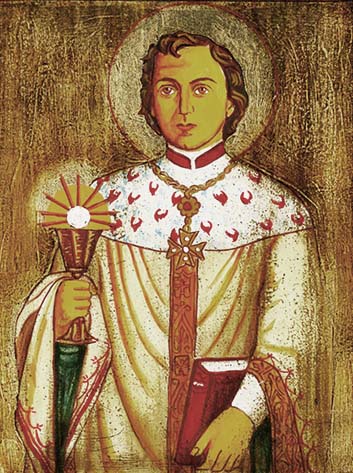
Prince Who Renounced a Crown for Christ
Feast Day: September 7
Saint Cloud, also known as Saint Clodoald (Chlodoald), was a sixth-century Frankish prince who gave up the prospect of an earthly crown to dedicate himself completely to God. Born around 522, he was a grandson of King Clovis I and Saint Clotilde. After surviving a violent struggle for the Frankish throne, Cloud chose the path of prayer, solitude, priesthood, charity, and service to the poor. He died around 560 and is commemorated on September 7. (Diocèse de Paris)
His life is a beautiful Christian witness to the truth that earthly power and possessions are temporary, while holiness and union with God are eternal.


Early Life and Royal Family
Cloud was the youngest son of Chlodomer (Clodomir), King of Orléans, and therefore belonged to the Merovingian royal family. His grandfather was Clovis I, one of the most important rulers in the early history of the Franks, while his grandmother was the devout Queen Saint Clotilde.
Cloud’s father was killed in battle when the boy was still very young. After Chlodomer’s death, Cloud and his two brothers, Theobald and Gunthaire, were placed under the care of their grandmother Clotilde.
The children, however, were caught in a ruthless political struggle. Their uncles, Childebert and Clotaire, sought control of their father’s kingdom. Cloud’s two brothers were murdered, but Cloud escaped. The young prince was thus spared from the fate that had overtaken his brothers. (Orthodox Church in America)
The tragedy profoundly affected Cloud’s life. Rather than seeking revenge or attempting to recover the royal power that might have been his, he turned his heart toward God.
Choosing God Instead of a Crown
Cloud’s decision was remarkable. He was born into royalty and had every reason to desire wealth, power and political influence. Yet he gradually came to understand that the crown of an earthly kingdom could not compare with the eternal kingdom of Christ.
He embraced the religious life and placed himself under the guidance of holy men. According to tradition, he spent time with Saint Severin, a hermit near Paris, learning the discipline of prayer, silence and self-denial. (Diocèse de Paris)
One of the most striking symbols of his renunciation was his abandonment of his royal status. The traditional account describes Cloud cutting his hair and receiving the monastic habit. In doing so, he publicly demonstrated that he preferred the spiritual riches of Christ to the privileges of royalty. (Diocese of Saint Cloud)
His life recalls the words of Jesus:
“What profit would there be for one to gain the whole world and forfeit his life?”
— Matthew 16:26
A Life of Prayer and Solitude
Cloud desired a life of greater solitude. He withdrew from the distractions of the royal world and sought places where he could devote himself more completely to prayer.
His years of solitude were not years of inactivity. He prayed, studied Scripture, practiced penance and sought to grow in holiness. His reputation for holiness gradually spread, and people began coming to him for spiritual guidance and assistance. (Diocese of Saint Cloud)
His solitude eventually became a source of blessing for others.
This is an important lesson in Christian spirituality: true solitude is not selfish isolation when it is lived for God. A person who enters deeply into prayer can return to the world with greater compassion, wisdom and love.
From Hermit to Priest
Cloud eventually recognized that God was calling him to serve His people more directly.
In approximately 551, he was ordained a priest by Eusebius, Bishop of Paris. He then exercised his priestly ministry among the people living around Nogent, near Paris. (Diocèse de Paris)
As a priest, Cloud preached the Gospel, celebrated the Eucharist, cared for the poor and ministered to those who sought his help.
His royal birth did not make him distant from ordinary people. On the contrary, he became a servant of the poor and humble.
His Charity Toward the Poor
Cloud’s life demonstrates a striking transformation.
He had once possessed the possibility of royal wealth. Later, when property and possessions came into his hands, he used them not simply for himself but for the benefit of those in need. The Diocese of Saint Cloud records the tradition that he sold some of the property restored to him and distributed the proceeds to the poor. (Diocese of Saint Cloud)
He also established a church dedicated to Saint Martin of Tours.
Thus the former prince became a servant of Christ and His people.
His life illustrates the Christian principle:
Possessions become blessings when they are placed at the service of love.
Saint Cloud and the Place Named After Him
Cloud lived at Nogent, a settlement near Paris. His presence and ministry eventually became so closely associated with the place that, after his death, it came to be known by a form of his name—Saint-Cloud.
The Diocese of Paris notes that after his death, his veneration grew and his relics were honored. The settlement eventually took the name Saint-Cloud. (Diocèse de Paris)
The town of Saint-Cloud, today a suburb west of Paris, therefore preserves the memory of the prince who chose the religious life.
Death
Saint Cloud died around 560, traditionally on September 7, at approximately 38 years of age. He was buried at the church he had founded at Nogent. His reputation for holiness continued after his death, and devotion to him spread. (Diocèse de Paris)
His feast is celebrated on September 7.
The French Catholic Church lists Saint Cloud as the saint of the day on September 7, and the Roman Martyrology remembers him as a priest at Nogent who, after the murder of his father and brothers, rejected an earthly kingdom and consecrated himself to the Lord. (Église catholique en France)
Patronage
Saint Cloud is especially associated with France, the town of Saint-Cloud, and the Diocese of Saint Cloud in Minnesota, which bears his name.
He is also traditionally regarded as a patron of nail makers and metalworkers. (Nominis)
In 1891, Pope Leo XIII named Saint Cloud the patron of the newly established Diocese of Saint Cloud in Minnesota. His feast continues to be celebrated there each year on September 7. (Diocese of Saint Cloud)
Spiritual Lessons from Saint Cloud
1. God is greater than worldly power
Cloud could have pursued royal authority, but he discovered a greater kingdom—the Kingdom of God.
His life asks us:
What would we choose if we had to decide between worldly success and holiness?
2. Forgiveness is greater than revenge
Cloud had every human reason to seek revenge against those who had murdered his brothers. Instead, he chose a life dedicated to God.
His response demonstrates the transforming power of the Gospel.
3. True wealth is spiritual
Cloud exchanged royal privilege for the poverty and simplicity of religious life. He discovered that spiritual riches are more valuable than possessions.
4. Prayer produces service
Cloud’s solitude did not make him indifferent to people. His prayer led him toward greater service, charity and pastoral ministry.
5. Christian leadership means service
Although born a prince, Cloud became a priest and servant. His life gives a Christian understanding of leadership: the greatest leader is the one who serves.
6. God can transform suffering into a vocation
Cloud’s childhood was marked by violence and tragedy. Yet God brought something beautiful from his painful circumstances.
His story reminds us that our wounds and difficulties do not have to determine the final meaning of our lives.
Saint Cloud and the Meaning of Christian Renunciation
Perhaps the most beautiful feature of Saint Cloud’s life is his deliberate renunciation.
He did not simply lose a crown—he chose something greater.
The Gospel tells us that Jesus asked His disciples to seek first the Kingdom of God. Cloud lived that principle in a particularly dramatic way. He had access to earthly privilege, but he recognized that Christ was worth more.
His life therefore presents a powerful question for every Christian:
What am I holding on to that prevents me from giving myself completely to God?
For some, it may be money. For others, reputation, ambition, comfort, resentment or the desire for recognition.
Saint Cloud teaches that holiness often begins when we are willing to say:
“Lord, You are more important to me than anything this world can offer.”
Prayer to Saint Cloud
Prayer to Saint Cloud
O glorious Saint Cloud,
you were born to an earthly throne
but chose instead the eternal Kingdom of God.
You renounced worldly power,
embraced prayer and solitude,
served the poor,
and gave yourself generously to Christ and His Church.
Obtain for us the grace
to value heavenly treasures above earthly possessions,
to remain faithful to God in times of suffering,
and to use whatever gifts we have
for the service of others.
Teach us to forgive those who hurt us,
to seek God’s will above our own desires,
and to place our entire lives
in the hands of Divine Providence.
Pray for us, Saint Cloud,
that we may grow in holiness,
love Christ more deeply,
serve the poor with compassion,
and remain faithful to the Gospel until death.
May we learn from your example
that no earthly crown can compare
with the glory of belonging completely to Christ.
Saint Cloud, pray for us.
Amen.
Feast Day
Saint Cloud — September 7
Saint Cloud’s life can be summed up in one beautiful choice: he exchanged a royal crown for the cross of Christ and discovered the true riches of heaven.
His story remains especially meaningful in a world that often measures success by wealth, status and power. Saint Cloud reminds us that the greatest victory is not to possess a kingdom, but to allow Christ to reign in our hearts. (Diocese of Saint Cloud)
Leave a Reply