
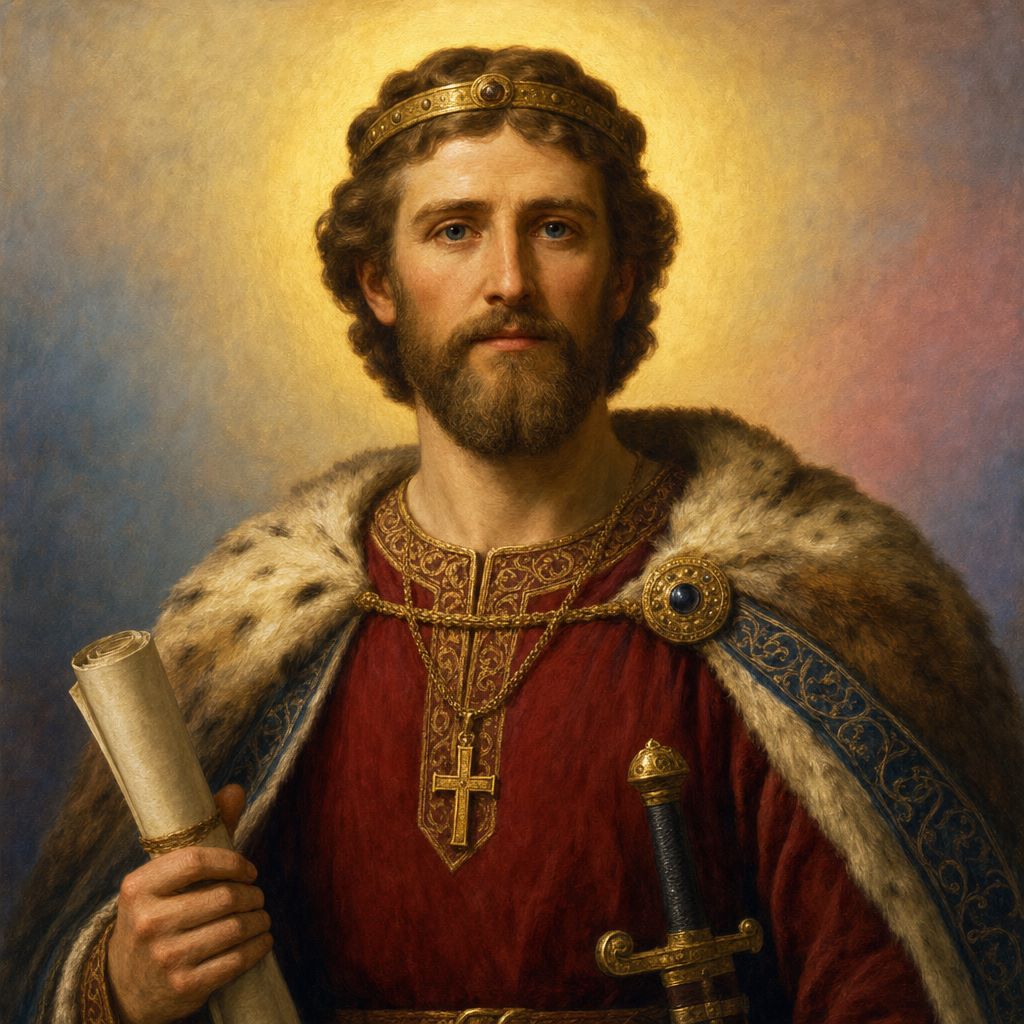
Feast Day: 12 October
Saint Edwin of Northumbria (c. 586–632/633) was a powerful Anglo-Saxon king whose conversion to Christianity became a significant turning point in the evangelization of northern England. Remembered as a ruler who embraced the Christian faith after years of political struggle, he helped establish Christianity more firmly in the Kingdom of Northumbria.
Early Life and Reign
Edwin was born around 586 and belonged to the royal family of Deira, one of the kingdoms that later formed Northumbria. His early life was marked by political conflict and exile. Eventually, he gained power and became one of the most influential rulers in Anglo-Saxon England.
As king, Edwin strengthened his kingdom, expanded his authority, and established greater stability. His reign brought Northumbria considerable political prominence.
Conversion to Christianity
A decisive moment in Edwin’s life came through his marriage to Æthelburh of Kent, a Christian princess. She travelled to Northumbria with Paulinus, a missionary bishop, who sought to share the Christian faith with the king and his people.
Edwin did not accept Christianity immediately. According to the Ecclesiastical History of the English People by Saint Bede, he reflected deeply on the Christian message and consulted his advisers before making his decision. He was also influenced by the faith and witness of those around him.
In 627, Edwin received baptism at York, traditionally associated with Easter. His conversion encouraged the spread of Christianity throughout Northumbria. He supported the missionary work of Paulinus and helped establish York as an important centre of the Church.
3. A King Who Promoted Justice and Peace
Saint Bede records that Edwin’s reign was marked by peace and effective government. Travellers could journey through his kingdom with greater security, reflecting the order he established. His leadership demonstrates that political authority carries a responsibility to protect the vulnerable and promote the common good.
4. Martyrdom and Legacy
In 633, Edwin was killed at the Battle of Hatfield Chase while fighting the forces of Cadwallon of Gwynedd and Penda of Mercia. His death brought a temporary setback to Christianity in Northumbria, but the faith later flourished under Christian rulers such as Saint Oswald.
Edwin came to be venerated as a saint and martyr, and his feast is celebrated on 12 October. His life remains an important chapter in the history of Christianity in England.
5. Spiritual Lessons from Saint Edwin
Saint Edwin teaches us that faith requires thoughtful discernment, courage, and a willingness to change. Though he was a powerful king, he did not accept Christianity without reflection. Once convinced, he publicly embraced the faith and supported its growth among his people.
His example reminds leaders, parents, and all Christians to use their influence responsibly, protect the weak, and allow faith to shape their decisions.
Prayer to Saint Edwin
Saint Edwin, faithful king and witness to Christ, intercede for us that we may seek God’s truth with sincere hearts. Teach us to exercise our responsibilities with justice, to lead others through good example, and to remain steadfast in faith during trials. May we use our gifts and influence for the good of others and the glory of God. Amen.
Saint Edwin of Northumbria, pray for us!
References
- Saint Bede, Ecclesiastical History of the English People, Book II, Chapters 9–20.
- Catholic Encyclopedia: St. Edwin.
- Oxford Dictionary of National Biography: Edwin (c. 586–633).
Leave a Reply