
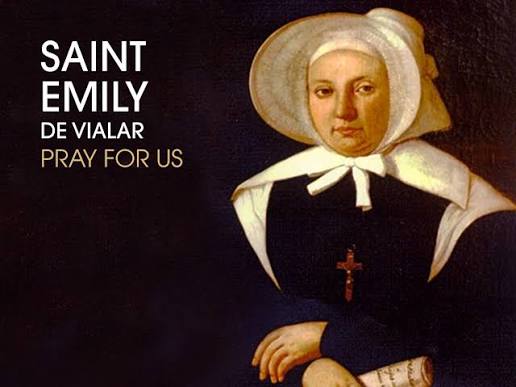
Feast Day: August 24
Born: September 12, 1797, Gaillac, France
Died: August 24, 1856, Marseille, France
Canonized: June 17, 1951, by Pope Pius XII
Founder: Sisters of St. Joseph of the Apparition
Saint Emily de Vialar was a remarkable French religious woman, missionary and foundress whose life was devoted to the poor, the sick, children and the proclamation of the Gospel. Born into a wealthy family, she could have lived a comfortable and privileged life, but she gradually discovered that God was calling her to something far greater: to spend herself in the service of those most in need.
Her life became a beautiful testimony to missionary courage, generosity and trust in Divine Providence. She founded the Congregation of the Sisters of St. Joseph of the Apparition in 1832, and despite poverty, opposition, misunderstandings and persecution, she established communities across Europe, Africa and Asia. By the time of her death, the congregation had founded 42 houses, stretching from North Africa to Burma.
Early Life
Emily de Vialar was born on September 12, 1797, in Gaillac, France, into the family of Baron Jacques de Vialar and Antoinette Portal. Her father was a physician, and Emily was the eldest of three children.
She was born during a difficult period in French history, when the Catholic Church was experiencing the consequences of the French Revolution and religious persecution. Emily was baptized secretly, reflecting the difficulties faced by Catholics during that period.
From her earliest years, Emily received a strong Christian formation. Her mother taught her to read, and the young girl developed a deep love for God and concern for those who were suffering.
At the age of thirteen, she was sent to Paris for her education. Her mother accompanied her on the journey, but tragically, Antoinette became seriously ill and died in 1810. Emily was only thirteen years old.
The loss of her mother deeply affected her.
At fifteen, she returned to Gaillac to live with her father and her two younger brothers. Her relationship with her father was difficult, especially because Emily did not want to enter into marriage. Instead, she felt increasingly attracted to a life of prayer and service.
The Call to Serve the Poor
Emily gradually discovered that her vocation was not simply to withdraw from the world but to encounter Christ in the suffering people around her.
For approximately fifteen years, she dedicated herself to charitable activities in Gaillac. She taught poor children and cared for people who were sick. She also established charitable services connected with her family home.
Because of her generosity, she became known as “the good angel of Gaillac.”
Emily understood that Christian charity could never remain merely a feeling.
For her, love had to become action.
The poor needed food.
The sick needed care.
Children needed education.
People needed to hear about Christ.
This conviction would eventually lead her to establish a missionary congregation.
The Death of Her Grandfather and a New Mission
A major turning point came when Emily received an inheritance from her grandfather. Rather than using the money primarily for herself, she saw it as something entrusted to her by God.
She began using her resources to support charitable works, including schools and institutions for the poor.
Her generosity gradually attracted other women who wanted to share her life and mission.
Emily understood that Providence had placed resources in her hands not simply for her own comfort but for the service of others.
This became one of the defining characteristics of her spirituality:
Everything belongs to God, and everything must ultimately be used for God’s glory and the good of His people.
The Foundation of the Sisters of St. Joseph of the Apparition
In 1832, Emily took a decisive step.
At Christmastide of that year, she founded the Congregation of the Sisters of St. Joseph of the Apparition in Gaillac. The new religious community was dedicated to serving the poorest of the poor and educating young girls.
The congregation was born from a simple but profound Gospel conviction:
Christ is present in those who suffer.
Emily wanted her sisters to be women of prayer and action. They were to educate children, care for the sick and serve people who were forgotten by society.
The congregation soon received ecclesiastical support. Archbishop François-Marie de Gauly of Albi played an important role in helping the new institute develop.
What began as a small community gradually became an international missionary congregation.
A Missionary Heart
Emily de Vialar was not content with serving only the people of her own town.
Her heart was missionary.
She wanted the Gospel to reach people in distant lands, particularly those who had little access to Christian education and charitable care.
The Sisters of St. Joseph of the Apparition eventually established communities in places including North Africa, the Middle East and Asia. By the time of Emily’s death, 42 houses had been founded, extending from North Africa to Burma.
This was an extraordinary achievement for a woman living in the nineteenth century, when travel was difficult and communications were slow.
Emily’s missionary vision was larger than geographical boundaries.
She saw the whole world as a mission field.
A Woman Who Trusted Providence
The expansion of Emily’s work was not without suffering.
There were financial difficulties, opposition, misunderstandings and conflicts. The congregation experienced periods of instability, and Emily herself endured painful trials.
At one point, problems involving the administration of the congregation in Gaillac and financial difficulties forced her to leave her hometown. She had already spent much of her inheritance on charitable institutions.
Humanly speaking, the situation appeared disastrous.
But Emily continued to trust God.
Eventually she found support in Marseille from Eugène de Mazenod, founder of the Missionary Oblates of Mary Immaculate. This allowed her to begin a new chapter of her apostolic life.
Her story demonstrates an important spiritual truth:
God’s work may pass through periods of apparent failure without actually being a failure.
The Storm at Sea
One of the most memorable episodes in Saint Emily’s missionary life occurred during a sea journey.
In 1845, while travelling from Tunisia toward Algeria, the ship on which she was travelling was caught in a violent storm. The storm continued for nine days.
In the midst of the danger, Emily entrusted herself to God.
She made a promise that wherever the ship reached safety, she would establish a house dedicated to Saint Paul.
Eventually, the ship reached Malta, the island traditionally associated with Saint Paul’s shipwreck recorded in the Acts of the Apostles.
Emily kept her promise and established a Catholic school there, including one of the early Catholic schools for young women.
For Emily, this experience was more than an escape from danger. It became another confirmation that missionary work depended upon God’s Providence.
Service to the Poor
Saint Emily’s spirituality was deeply practical.
She did not see the poor merely as recipients of charity. She saw them as brothers and sisters in Christ.
Her congregation cared for people suffering from poverty, illness and abandonment. Education was an important part of the mission because Emily understood that education could restore dignity and open opportunities for the future.
The sisters also became involved in schools, hospitals and other charitable institutions.
The Vatican describes Emily as someone who consecrated her life to the poorest of the poor, caring for people in many forms of misery while also educating young girls.
This combination of evangelization, education and charitable service became central to the identity of the congregation she founded.
Missionary Expansion
The Sisters of St. Joseph of the Apparition spread rapidly.
Emily’s missionary vision took her and her sisters beyond France. Communities were established in areas of North Africa and the Middle East, and eventually the congregation reached Asia.
Her missionary approach was remarkable for its breadth.
She understood that the Gospel must be communicated not only through preaching but also through:
- Education
- Healthcare
- Care for the poor
- Service to children
- Formation of women
- Presence among marginalized communities
- Personal witness
- Prayer and sacrificial love
In this way, Saint Emily anticipated a missionary spirituality that would become increasingly important in the Catholic Church.
Difficulties and Persecution
The life of Saint Emily was far from easy.
The growth of her congregation brought its own challenges. There were disagreements, financial problems and opposition.
She experienced moments when people misunderstood her intentions. She also suffered because of the weakness and failures of people around her.
Yet she did not abandon her vocation.
Her perseverance is one of the most inspiring aspects of her life.
It is easy to begin a good work.
It is much harder to continue when the work becomes difficult.
Emily continued.
She trusted that the work belonged ultimately to God.
Her Years in Marseille
In the later years of her life, Emily found a new base for her work in Marseille.
The city became an important centre of her apostolic activity. She continued to guide her congregation and encourage the sisters in their missionary service.
Even after experiencing enormous difficulties, she remained committed to the poor and to the spread of the Gospel.
Her life had become an offering.
She had given away her wealth.
She had given her time.
She had given her energy.
She had given her reputation.
She had given herself.
Her Death
Saint Emily de Vialar died in Marseille on August 24, 1856.
Significantly, August 24 became the date on which the Church celebrates her feast in the General Roman Calendar. The Sisters of St. Joseph of the Apparition also traditionally celebrate her on June 17, the anniversary associated with her canonization.
She died having established an extraordinary missionary legacy.
The congregation she founded continued to grow after her death, and today the sisters serve on all five continents.
Her earthly life ended, but her missionary spirit continued through the women who followed her charism.
Canonization
The Church recognized Emily’s holiness more than a century after her death.
She was canonized by Pope Pius XII on June 17, 1951.
Her canonization confirmed what generations of Christians had already recognized: that Emily de Vialar had lived the Gospel with extraordinary generosity.
She had transformed her wealth into charity, her suffering into perseverance and her faith into missionary action.
Spirituality of Saint Emily de Vialar
1. Love Must Become Action
Saint Emily teaches us that Christian love cannot remain merely a beautiful idea.
If we love Christ, we must also love those whom Christ loves.
The hungry need food.
The sick need care.
The lonely need companionship.
Children need education.
The poor need dignity.
The forgotten need someone to remember them.
Saint Emily turned compassion into concrete service.
2. Use God’s Gifts for Others
Emily inherited wealth, but she did not allow wealth to possess her.
She understood that material resources are gifts entrusted to us.
Her life asks an important question:
What am I doing with what God has entrusted to me?
Our possessions, education, talents, time and opportunities can become instruments of God’s love.
3. Trust Divine Providence
Emily experienced failure, financial problems, opposition and uncertainty.
Yet she continued.
Her life demonstrates that God’s Providence does not mean that everything will be easy. It means that even when the path is difficult, God can continue to lead us.
Sometimes Providence becomes visible only after the storm has passed.
4. Care for the Whole Person
Saint Emily did not separate evangelization from human development.
She cared for the spiritual and physical needs of people.
She educated children.
She cared for the sick.
She served the poor.
She sought to bring people closer to God.
This is a profoundly Catholic understanding of mission: to proclaim Christ and to serve the human person.
5. Have a Missionary Heart
Emily’s heart crossed borders.
She understood that Christ’s command to make disciples of all nations applies to the entire Church.
Not everyone is called to become a missionary religious, but every Christian can have a missionary heart.
We can bring Christ:
- To our family
- To our workplace
- To our parish
- To those who are suffering
- To those who have lost hope
- To those who have drifted away from God
Mission begins wherever we are.
Saint Emily de Vialar and the Gospel
The Gospel repeatedly reminds us that Christ identifies Himself with those who are suffering.
In Matthew 25:40, Jesus says:
“Whatever you did for one of the least of these brothers of mine, you did for me.”
Saint Emily lived this Gospel passage.
She saw Christ in the poor.
She saw Christ in the sick.
She saw Christ in children who needed education.
She saw Christ in people who were abandoned.
Her life therefore gives a practical answer to the question:
How can I love Jesus whom I cannot see?
We love Him by loving the people whom He places before us.
Saint Emily’s Message for Today
Our world has changed enormously since the nineteenth century. Yet poverty, loneliness, sickness and exclusion remain.
There are people around us who need exactly the kind of compassionate presence that Saint Emily offered.
Some need material help.
Some need education.
Some need medical attention.
Some need forgiveness.
Some need a listening ear.
Some simply need someone to tell them:
“You are not forgotten.”
Saint Emily challenges Christians to move beyond comfortable Christianity.
Faith must become service.
Prayer must lead to charity.
Love must become sacrifice.
And the Gospel must become visible in our lives.
A Saint for Missionaries
Saint Emily de Vialar is particularly inspiring for missionaries, religious sisters, teachers, healthcare workers and all those involved in charitable service.
Her life demonstrates that missionary work requires:
Faith when the future is uncertain.
Courage when obstacles appear.
Patience when people misunderstand.
Perseverance when plans fail.
Compassion when people suffer.
Trust when human resources are exhausted.
Her missionary congregation eventually reached every continent, demonstrating how a small act of obedience to God’s call can produce consequences far beyond what one person could imagine.
A Beautiful Lesson from Her Life
Saint Emily’s life can be summarized in one simple movement:
She received — and she gave.
She received a Christian faith — and she shared it.
She received an inheritance — and she used it for the poor.
She received talents — and she used them in service.
She received difficulties — and transformed them into opportunities for deeper trust.
She received a missionary calling — and crossed borders to serve.
She received suffering — and offered it to God.
This is the essence of Christian discipleship.
God never gives merely for ourselves.
Every gift becomes a mission.
Prayer to Saint Emily de Vialar
O Saint Emily de Vialar,
faithful servant of God and loving mother of the poor,
you dedicated your life to Christ
and spent yourself in the service of those in need.
Obtain for us a heart filled with compassion.
Teach us to recognize Jesus
in the poor, the sick, the lonely and the forgotten.
Help us to use the gifts God has given us
for the benefit of others.
When difficulties come,
teach us to trust Divine Providence.
When our plans fail,
give us the courage to begin again.
When we are discouraged,
remind us that God’s grace is always at work.
Pray for missionaries throughout the world.
Pray for priests, religious sisters, teachers, doctors, nurses
and all who dedicate themselves to the service of humanity.
Pray especially for children and families who are poor or abandoned.
Obtain for us the grace
to love Christ faithfully
and to serve Him generously in our brothers and sisters.
Saint Emily de Vialar,
missionary of charity and servant of the poor,
pray for us.
Amen.
Conclusion
Saint Emily de Vialar’s life is a powerful testimony to the transforming power of Christian love.
She was born into privilege but chose service.
She possessed wealth but chose generosity.
She experienced opposition but chose perseverance.
She encountered storms but chose trust.
She faced difficulties but continued her mission.
She began with works of charity in her hometown and eventually became the foundress of an international missionary congregation.
The Church celebrates her on August 24, the anniversary of her death in 1856. Her life continues to remind us that holiness is not found merely in extraordinary experiences. It is found in the daily decision to love God and to serve His people.
Saint Emily teaches us that when we place our gifts in God’s hands, even a small beginning can become a great mission.
May her example inspire us to become, in our own time and place, instruments of God’s mercy, servants of the poor and courageous witnesses of the Gospel.
Saint Emily de Vialar, pray for us!
Leave a Reply