
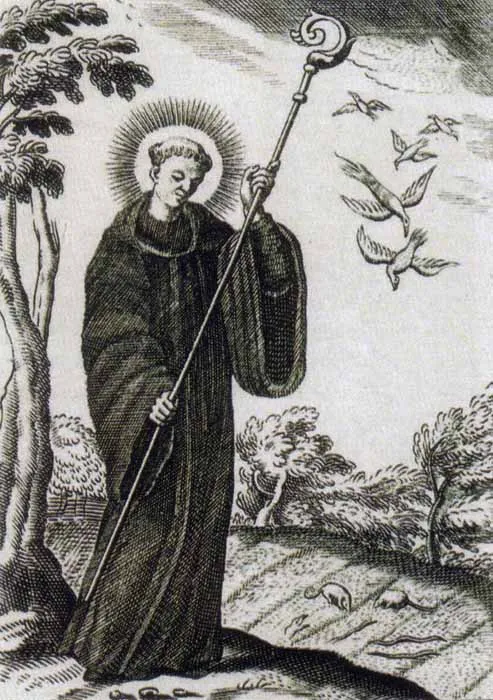
Apostle of the Allgäu and Founder of Füssen Monastery
Feast Day: September 6
Saint Magnus of Füssen, also known as Saint Mang or Maginold/Magnoald, was an early medieval missionary and monk who is traditionally honoured as the “Apostle of the Allgäu.” He is especially associated with the evangelization of the region around Füssen, Kempten, and the eastern Allgäu in present-day Bavaria, Germany. His feast is celebrated on September 6. (Bistum Augsburg)
Magnus is a fascinating saint because his historical life is partly hidden beneath centuries of legend. The sources about him contain chronological difficulties, and historians distinguish carefully between what can be established historically and what belongs to the later medieval tradition. Nevertheless, his enduring importance is beyond doubt: his missionary work became closely connected with the Christianization and development of the Allgäu.


Early Life
The precise birthplace and date of Magnus are uncertain. He is generally placed in the late seventh or early eighth century, with traditional dates around 699–772, although some older sources give different dates. The Diocese of Augsburg gives 699 as his birth year and September 6, 772 as his death date, while modern historical accounts emphasize that the evidence is not sufficient to establish these dates with certainty. (Bistum Augsburg)
He is also known by several names, including Maginold, Magnoald, Magnus, and Mang. The name Magnus is Latin for “great.”
According to tradition, Magnus had an association with the monastic world around St. Gall in present-day Switzerland. His traditional biography connects him with Saint Gall and Saint Columbanus, although this part of his Vita is historically problematic. The surviving medieval Life of Magnus appears to have combined traditions concerning more than one person named Magnus/Maginold. (New Advent)
Consequently, it is safer to say that Magnus belonged to the missionary-monastic movement associated with the great Irish and Columbanian foundations of the region rather than to repeat every detail of the traditional biography as established history.
Missionary to the Allgäu
The most historically significant part of Magnus’s story is his missionary activity in the Allgäu.
Around 746, according to the tradition accepted by the Diocese of Augsburg, Magnus was sent to evangelize the eastern Allgäu, probably under the authority of Bishop Wikterp of Augsburg. He worked with companions, including Tozzo and Theodor, in a region where Christianity was still developing. (Bistum Augsburg)
The missionaries faced the difficult task of bringing the Christian faith to scattered communities in a largely rural landscape. Evangelization at this time was not simply a matter of preaching sermons. Missionaries established places of prayer, formed Christian communities, cultivated relationships with local inhabitants and helped create stable centres from which the faith could spread.
Magnus is associated particularly with Kempten, Waltenhofen and Füssen.
At Waltenhofen, near Füssen, a chapel was established. Magnus eventually moved toward the area of Füssen and settled near the Lech River. There he established a small cell or hermitage that became the foundation of the later monastic settlement. (Bistum Augsburg)
The Foundation at Füssen
The place where Magnus settled was strategically important. Füssen stood near the ancient Roman route known as the Via Claudia Augusta, connecting the Alpine region with Augsburg and northern Italy.
Magnus’s simple hermitage gradually attracted disciples and developed into a religious community. With the support of Frankish rulers and local benefactors, the settlement grew into what became the monastery of St. Mang.
The monastery would eventually become one of the important religious centres of the region, and the town itself became inseparably associated with its missionary founder. (Encyclopedia.com)
Thus, Magnus’s achievement was not merely the conversion of individuals. He helped establish a permanent Christian centre from which faith, prayer, education and social development could continue for generations.
Evangelization and the Transformation of the Land
The medieval missionary was often simultaneously preacher, monk, community-builder and cultivator of the land.
Traditions concerning Magnus associate him not only with preaching but also with the development of agriculture and settlement. Some accounts connect his work with the discovery and exploitation of iron deposits in the region. (Encyclopedia.com)
This illustrates an important aspect of early Christian mission. The missionaries sought to create communities in which the Gospel could become part of everyday life. Churches and monasteries became places of worship, but they could also serve as centres of learning, agriculture, craftsmanship and social organization.
Magnus and the Legends of the Dragon
The life of Saint Magnus is surrounded by dramatic legends.
One of the most famous traditions tells of Magnus confronting a terrible serpent or dragon. Other stories speak of his encounters with bears and other wild creatures. The Diocese of Augsburg preserves traditions concerning a great serpent near Kempten, a dragon at Roßhaupten and a bear associated with Magnus’s orchard. (Bistum Augsburg)
These stories should not automatically be interpreted as straightforward historical reports.
Medieval saints’ lives frequently used dramatic encounters with serpents, dragons and wild animals to express the saint’s victory over paganism, evil and the forces opposed to the Gospel. Indeed, historical scholarship has noted that the legendary Magnus became portrayed as a dragon-slayer, transforming the missionary’s victory over paganism into a dramatic battle with a monster. (Deutsche Biographie)
The symbolism is therefore important. The saint who enters a spiritually hostile environment armed not with military weapons but with faith, prayer and the Gospel becomes the conqueror of the forces of darkness.
The Staff of Saint Magnus
One of the most famous objects connected with Magnus is the Magnusstab, or Staff of Saint Magnus.
According to tradition, Magnus’s staff became associated with his miraculous power and with protection against pests and harmful creatures. It was used in later centuries in religious processions and blessings of fields. The tradition became particularly strong in the Allgäu. (Bistum Augsburg)
The staff represents more than a relic of a missionary. It became a symbol of the Church’s prayer for the protection and blessing of the people, their animals, their crops and their land.
Death
Tradition places Magnus’s death on September 6, at Füssen. The precise year is disputed, with dates around 750 and 772 appearing in different traditions. Modern sources stress that the historical evidence is insufficient to settle the chronology with complete certainty. (Allgäuer Zeitung)
His memory, however, remained deeply rooted in Füssen.
His relics were transferred to the church at Füssen in the ninth century. Tradition associates this translation with the year 851, when Bishop Lanto transferred the relics to a newly established church. The cult of Magnus subsequently became firmly established. (New Advent)
His burial place is traditionally associated with the crypt of the Basilica of St. Mang in Füssen.
The Problem of the Vita S. Magni
A responsible account of Saint Magnus should mention the historical difficulties surrounding his biography.
The principal medieval source is the Vita S. Magni, or Life of Saint Magnus. Unfortunately, this text contains numerous chronological inconsistencies. It appears to have combined traditions concerning different figures named Magnus/Maginold and incorporated elements from the traditions surrounding Saints Columbanus and Gall. (New Advent)
The Vita was transmitted and revised over the centuries. A version was associated with the transfer of Magnus’s relics in the ninth century, and it was later edited again in the eleventh century by Otloh of St. Emmeram. (New Advent)
Therefore, historians cannot simply take every episode in the medieval Life as a literal historical account.
This does not mean that Magnus himself was merely legendary. Rather, it means that the historically reliable core of his life must be distinguished from later devotional embellishments.
The most secure picture is that of an early medieval missionary associated with the monastic tradition of the region who worked in the Allgäu and established a religious centre at Füssen.
Patron of the Allgäu
Saint Magnus became the principal patron of the Allgäu, as well as of Füssen and Kempten. He has also been traditionally invoked for protection against snakebite, rodents, worms and other pests, and for the protection of cattle. He was associated particularly with eye diseases as well. (Encyclopedia.com)
His cult spread throughout southern Germany, Tyrol and Switzerland.
The popularity of Magnus demonstrates how deeply the saints became integrated into the daily life of medieval Christian communities. Farmers prayed for protection of their fields, families invoked the saint in times of danger, and communities celebrated his feast as part of their religious calendar.
Saint Magnus and Füssen Today
The memory of Magnus remains particularly strong in Füssen.
The Basilica of St. Mang stands as a visible reminder of the missionary tradition associated with him. The saint’s name is embedded in the history and identity of the city.
The church, crypt, relic traditions and surviving objects associated with Magnus preserve a connection between the modern city and the missionary world of the early Middle Ages.
His cult also survives in popular devotion and local celebrations around his feast day on September 6. (Katholisch Füssen)
Spiritual Message of Saint Magnus
The life of Saint Magnus offers several important lessons for Christians today.
1. The Gospel requires courage
Magnus entered a difficult missionary environment. He did not wait for ideal conditions. He went into places where Christianity was still taking root.
The missionary spirit requires courage to bring Christ into places where faith is weak, forgotten or misunderstood.
2. Evangelization is patient work
Magnus did not transform the Allgäu overnight. His missionary work involved years of presence, preaching, prayer and community building.
The Christian apostolate is often a work of patient perseverance.
3. Prayer and work belong together
Magnus’s tradition combines prayer, missionary activity and the development of human communities.
Christian holiness is not separation from the needs of ordinary people. The saint seeks to bring Christ into the concrete realities of human life.
4. The Christian must confront evil with faith
The legends of Magnus fighting serpents and dragons can be understood spiritually. The Church’s mission is ultimately a struggle against sin, fear and everything that keeps humanity away from God.
The Christian does not conquer evil through violence but through faith, truth, charity and the power of Christ.
5. A small beginning can become a great work
Magnus began with a humble cell at Füssen. That small beginning eventually developed into a significant monastery and Christian centre.
This is a powerful reminder that God can accomplish great things through small beginnings.
Patronage
Saint Magnus of Füssen is traditionally invoked as patron of:
- The Allgäu
- Füssen
- Kempten
- Farmers and agricultural communities
- Cattle
- Protection against snakes and snakebite
- Protection against mice and rats
- Protection against worms and other pests
- Those suffering from certain eye ailments
Feast Day
September 6 is the feast day of Saint Magnus of Füssen. The Diocese of Augsburg lists his memorial on this date, and he is particularly honoured in Füssen and throughout the Allgäu. (Bistum Augsburg)
Conclusion
Saint Magnus of Füssen stands at the meeting point of history, missionary zeal and medieval Christian tradition. Although many details of his biography remain uncertain and his medieval Vita contains legendary elements, his historical legacy is clear.
He is remembered as a missionary who helped establish Christianity in the Allgäu and whose humble foundation at Füssen developed into the great religious centre of St. Mang.
His story reminds us that the work of evangelization does not always begin with spectacular achievements. It may begin with one missionary, one prayer, one small chapel and one faithful community.
From such small beginnings, God can build something that lasts for centuries.
Saint Magnus of Füssen, Apostle of the Allgäu, pray for us!
Sources
The historical and biographical details above are based especially on the Diocese of Augsburg, the Catholic Encyclopedia, Deutsche Biographie, and the Catholic parish information of Füssen. (Bistum Augsburg)
Catholic Encyclopedia — St. Magnus
Leave a Reply