
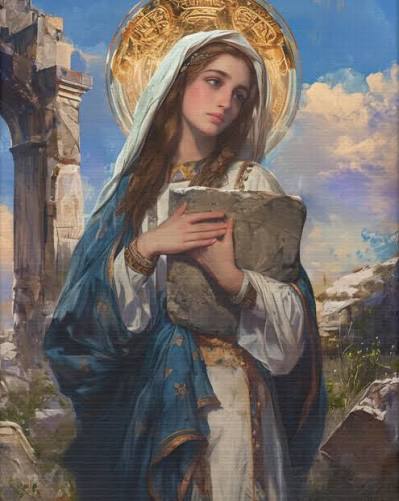
The Noble Virgin Who Chose Christ Above Earthly Glory
Feast Day: July 25 (Western tradition; commemorated on different dates in some Eastern calendars)
Titles: Virgin, Nun, Desert Mother
Patronage: Consecrated virgins, women in religious life, those seeking purity of heart, and those discerning a vocation to the consecrated life.
Saint Euphrasia of Rome (also known as Euphraxia) is remembered as one of the great virgin saints of the early Church. Born into wealth and nobility during the fourth century, she willingly renounced privilege, marriage, and worldly honors to dedicate her life entirely to Jesus Christ. Her story is one of humility, prayer, obedience, charity, and unwavering fidelity to God.
Although much of what is known about her comes from early Christian tradition rather than contemporary historical records, her life has inspired generations of monks, nuns, and lay Christians to seek holiness through simplicity and complete trust in God’s providence.
Historical Background
Saint Euphrasia lived during the fourth century, a period of profound change in the Roman Empire. Christianity, once fiercely persecuted, was gaining freedom following the Edict of Milan (313) issued by Emperor Constantine.
The Church was expanding rapidly, and many Christians sought deeper spiritual lives by withdrawing into deserts and monasteries. This era saw the rise of the Desert Fathers and Desert Mothers, whose example shaped Christian monasticism for centuries.
It was in this spiritual climate that Euphrasia embraced the religious life.
Noble Birth
According to tradition, Euphrasia was born in Constantinople or into a Roman noble family connected with the imperial court.
Her father, Antigonus, was a respected senator and close associate of Emperor Theodosius I. Her mother was a devout Christian who desired to raise her daughter in the faith.
When Euphrasia was still very young, her father died, leaving the family with considerable wealth and influence.
Rather than becoming attached to riches, her mother sought refuge in prayer and entrusted their future to God.
Journey to Egypt
Seeking a life closer to God, Euphrasia’s mother traveled with her daughter to Egypt, where numerous monasteries had become centers of holiness and spiritual renewal.
They settled near a convent of consecrated women.
The peace, discipline, and joy of the sisters deeply impressed young Euphrasia.
Although only a child, she felt drawn to their way of life.
A Child’s Desire to Belong to Christ
One day, Euphrasia asked the abbess to allow her to remain in the monastery.
The abbess hesitated because of the girl’s youth and noble background.
However, Euphrasia insisted that she desired no earthly honor but wished only to belong to Christ.
Her mother, recognizing this as a genuine vocation, joyfully consented.
Soon afterward, her mother died, leaving Euphrasia under the care of the religious community.
Refusing an Imperial Marriage
As Euphrasia grew older, Emperor Theodosius remembered that she had once been promised in marriage to a nobleman.
The emperor sent word that she should return to Constantinople to fulfill the engagement.
Euphrasia respectfully declined.
Instead, she wrote that:
- She wished to remain a bride of Christ.
- All her inheritance should be distributed to the poor.
- Her slaves should be granted freedom.
- Her wealth should be used for charitable works.
The emperor admired her holiness and granted her request.
This decision reflected one of the defining characteristics of the early Christian saints: choosing eternal treasures over worldly prestige.
Life in the Monastery
Euphrasia embraced the rigorous discipline of monastic life with remarkable enthusiasm.
She devoted herself to:
- Prayer
- Fasting
- Meditation on Scripture
- Manual labor
- Service to the sick
- Obedience to her superiors
- Humility in every task
She deliberately chose the simplest and most difficult work within the monastery, believing that no service was beneath one who followed Christ.
Extraordinary Humility
One of the most admired aspects of Saint Euphrasia’s life was her humility.
Although she had been raised among the Roman aristocracy, she never expected special treatment.
Instead, she volunteered for the most demanding chores:
- Carrying heavy loads.
- Cleaning.
- Preparing meals.
- Serving elderly sisters.
- Caring for the sick.
She believed that true greatness was found in serving others, echoing the words of Jesus:
“Whoever wishes to be great among you must be your servant.”
(Matthew 20:26)
Spiritual Trials
Like many saints, Euphrasia experienced periods of temptation and spiritual struggle.
Early monastic writers describe her perseverance in resisting:
- Pride
- Vanity
- Discouragement
- Spiritual dryness
Rather than relying on her own strength, she sought guidance from her abbess and trusted in God’s grace.
Her example illustrates the Christian understanding that holiness is often forged through perseverance in ordinary faithfulness.
Miracles Attributed to Saint Euphrasia
Early traditions recount several miracles associated with Euphrasia, including:
Healing the Sick
Her prayers were believed to bring healing to those suffering from illness.
Deliverance from Evil Spirits
Some accounts describe individuals being freed from demonic oppression through her prayers.
Miraculous Protection
The sisters of the monastery regarded her as a source of encouragement and divine consolation during times of hardship.
While these stories come from hagiographical tradition, they reflect the deep esteem in which she was held by the Christian community.
Death
Saint Euphrasia is believed to have died peacefully around A.D. 410, still relatively young.
Her passing was mourned by the sisters who had lived with her and witnessed her extraordinary charity and holiness.
Her reputation for sanctity spread throughout the Christian East and later reached the Western Church.
Veneration
Saint Euphrasia has been honored for centuries in both Eastern and Western Christian traditions.
Her life became especially influential among:
- Women’s religious communities.
- Monastic orders.
- Consecrated virgins.
- Christians discerning religious vocations.
Although she is less widely known today than some early saints, her witness continues to inspire those called to lives of prayer and self-giving.
Spiritual Lessons from Saint Euphrasia
1. Christ Is the Greatest Treasure
Euphrasia willingly gave up wealth, influence, and an advantageous marriage because she recognized that nothing surpasses a relationship with Christ.
2. Humility Leads to Holiness
Her willingness to perform ordinary tasks reminds Christians that sanctity is built through everyday acts of love and service.
3. Obedience Is a Path to Freedom
She embraced the guidance of her abbess, demonstrating that Christian obedience is rooted in trust and love rather than compulsion.
4. Simplicity Brings Joy
Despite renouncing luxury, Euphrasia found deep joy in a life centered on prayer, community, and charity.
5. Generosity Reflects the Gospel
By giving away her inheritance and freeing her servants, she embodied Christ’s call to care for the poor and to value people over possessions.
A Christian Reflection
Saint Euphrasia’s life reminds modern Christians that discipleship often requires courageous choices. While few are called to the cloistered life she embraced, every believer is invited to place Christ above wealth, status, and personal ambition.
In a world that often measures success by power or possessions, Euphrasia points to a different path: one of humility, generosity, and wholehearted devotion to God. Her witness echoes Jesus’ invitation:
“Seek first the kingdom of God and His righteousness, and all these things will be given to you besides.”
(Matthew 6:33)
A Prayer to Saint Euphrasia
O Saint Euphrasia, faithful bride of Christ, you joyfully abandoned earthly riches to seek the everlasting treasures of heaven. Teach us to love God above all things, to serve others with humility, and to remain faithful in prayer even during times of trial. Pray for those discerning their vocation, for women in consecrated life, and for all who strive to live the Gospel with simplicity and courage. May your example inspire us to seek holiness in our daily lives and to place our complete trust in the Lord. Through Christ our Lord. Amen.
Legacy
Though she lived more than sixteen centuries ago, Saint Euphrasia of Rome continues to speak to the Church through her quiet yet powerful example. She reminds us that true nobility is not inherited through birth but cultivated through holiness. Her life demonstrates that wealth, privilege, and social standing find their highest purpose when surrendered to God in love.
Her legacy endures in monasteries, convents, and Christian communities that continue to value prayer, humility, charity, and faithful service. In an age marked by ambition and materialism, Saint Euphrasia remains a timeless witness that lasting joy is found not in possessing the world but in belonging completely to Christ.
Timeline
| Approximate Date | Event |
|---|---|
| c. A.D. 380 | Born into a noble Christian family associated with the imperial court |
| Childhood | Travels with her mother to Egypt and encounters monastic life |
| Youth | Enters a convent and dedicates herself to Christ |
| Young adulthood | Declines an imperial marriage proposal; distributes her inheritance to the poor and frees her servants |
| c. A.D. 410 | Dies peacefully in her monastery in Egypt |
| Following centuries | Venerated as a saint in Eastern and Western Christian traditions |
Interesting Facts
- Her life survives primarily through early hagiographical writings rather than contemporary historical records.
- She is also known by the name Euphraxia, especially in Eastern Christian tradition.
- She is regarded as one of the notable early women who embraced the monastic movement in Egypt.
- Her story highlights the flourishing of Christian monasticism during the fourth century.
Leave a Reply