
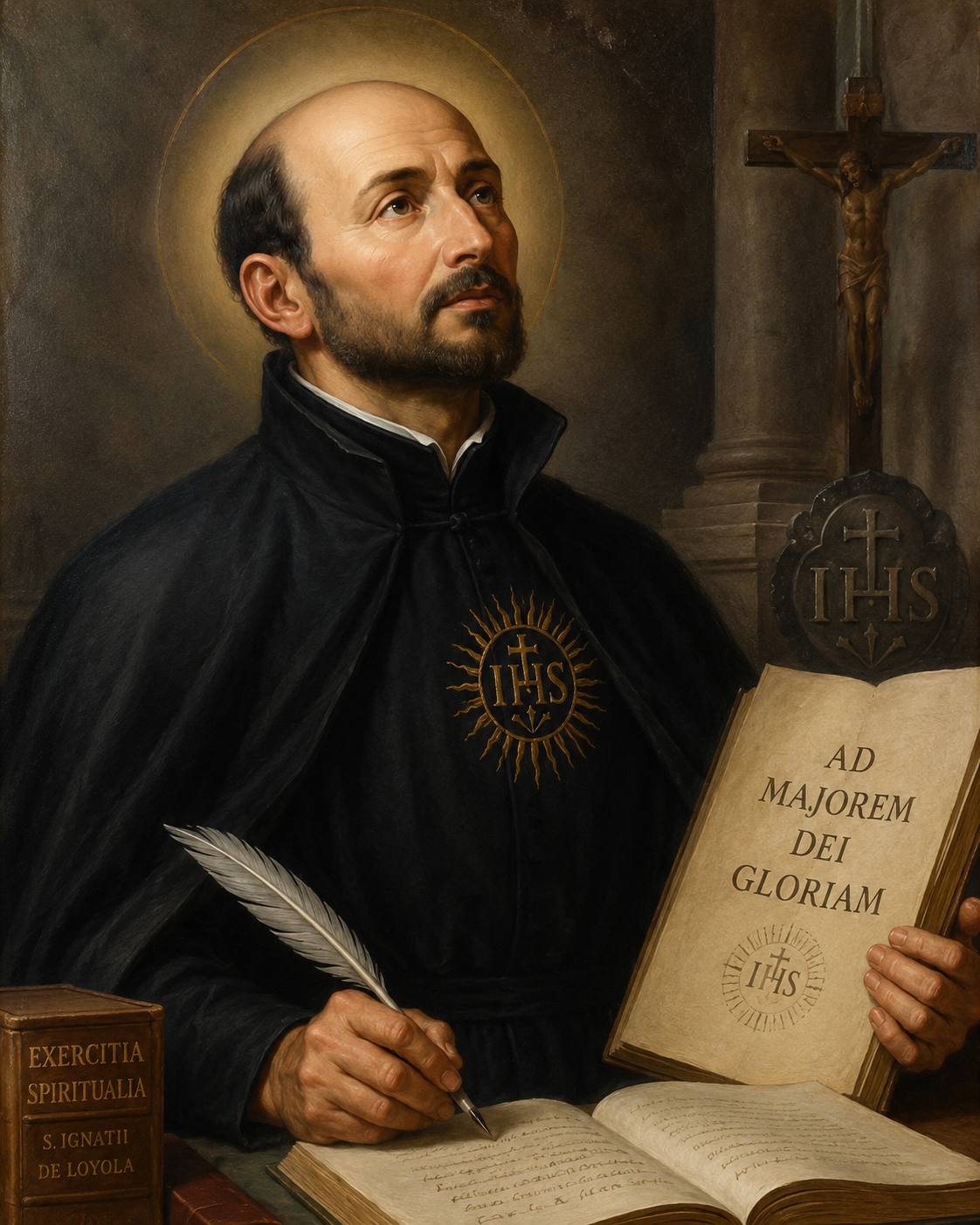
A Soldier Who Became One of Christianity’s Greatest Spiritual Leaders
Among the most influential figures in the history of Christianity, Saint Ignatius of Loyola stands out as a remarkable example of personal transformation, unwavering faith, and visionary leadership. From his early life as a soldier seeking honor and glory to becoming the founder of the Society of Jesus (Jesuits), Ignatius dedicated his life to serving God through education, missionary work, and spiritual renewal.
His teachings continue to inspire millions of people around the world, and his spiritual masterpiece, the Spiritual Exercises, remains one of the most influential works of Christian spirituality. More than four centuries after his death, the ideals of Saint Ignatius continue to shape schools, universities, retreat centers, and missionary efforts across the globe.
Early Life
Saint Ignatius of Loyola was born as Íñigo López de Loyola in 1491 at the family castle in Loyola, in the Basque region of northern Spain. He was the youngest of several children born into a noble family and grew up during a period marked by political change, exploration, and the Renaissance.
As a young man, Ignatius dreamed of becoming a famous knight. He admired military heroes, courtly life, and tales of chivalry. Courage, honor, and personal achievement were the ideals that guided his early years.
He entered military service and gained a reputation for bravery and determination, although his ambitions at that stage were focused more on worldly success than on spiritual matters.
The Turning Point: The Battle of Pamplona
The defining moment of Ignatius’s life came in 1521 during the Battle of Pamplona. While defending the city against French forces, he was struck by a cannonball that shattered one of his legs and severely injured the other.
The injury forced him to return to his family home for a long and painful recovery.
Unable to pursue his usual interests, Ignatius asked for books about knights and heroic adventures. Since none were available, he was instead given two religious books: a life of Christ and a collection of stories about the saints.
Reading these works transformed him.
He noticed that dreams of military glory brought only temporary excitement, while thoughts of serving Christ and imitating the saints filled him with lasting peace and joy. This realization marked the beginning of a profound spiritual conversion that completely changed the direction of his life.
A Life Dedicated to God
After recovering, Ignatius renounced his former ambitions and resolved to dedicate his life entirely to God.
He made a pilgrimage to the Benedictine monastery of Montserrat, where tradition holds that he spent an entire night in prayer before the statue of the Virgin Mary. There he laid down his sword and military attire, symbolizing his decision to become a soldier of Christ.
He then spent many months in the nearby town of Manresa, living simply, praying, fasting, and serving the poor.
During this period, Ignatius experienced deep spiritual insights that would later become the foundation of his famous Spiritual Exercises. These months of prayer and reflection shaped his understanding of discernment, self-examination, and God’s presence in everyday life.
The Spiritual Exercises
One of Saint Ignatius’s greatest gifts to the Church is the Spiritual Exercises, a structured guide for prayer, meditation, and spiritual reflection.
Rather than being a book to read from beginning to end, the Spiritual Exercises are designed as a program of retreat that helps participants:
- Grow closer to God.
- Reflect honestly on their lives.
- Discern God’s will.
- Deepen their relationship with Christ.
- Develop habits of prayer and service.
For centuries, the Spiritual Exercises have guided clergy, religious communities, and laypeople seeking spiritual renewal.
Education and Formation
Recognizing that he needed a solid education to serve the Church effectively, Ignatius began studying as an adult.
He attended schools in Spain before continuing his education in Paris, where he enrolled at the University of Paris. Although significantly older than many of his classmates, he pursued his studies with determination.
In Paris he met several companions who would become lifelong collaborators in his mission, including:
- Saint Francis Xavier
- Saint Peter Faber
- Diego Laínez
- Alfonso Salmerón
- Nicolás Bobadilla
- Simão Rodrigues
Together they formed a close-knit community centered on prayer, study, and service.
Founding the Society of Jesus
On August 15, 1534, Ignatius and his companions gathered in a small chapel on Montmartre in Paris and made vows of poverty, chastity, and service.
Their original intention was to travel to the Holy Land. When this became impossible because of political circumstances, they offered themselves to the Pope for whatever mission the Church required.
In 1540, Pope Paul III officially approved the Society of Jesus, commonly known as the Jesuits.
Ignatius became its first Superior General.
What began as a small group of friends soon developed into one of the largest and most influential religious orders in the Catholic Church.
Mission and Vision
Saint Ignatius envisioned a religious community that would respond wherever the needs of the Church were greatest.
The Jesuits became known for:
- Missionary work across continents.
- Excellence in education.
- Scientific research.
- Spiritual retreats.
- Social justice.
- Care for the poor and marginalized.
- Dialogue between faith and culture.
Unlike many religious communities of the time, Jesuits were not limited to monasteries. They travelled extensively, adapting to local cultures while proclaiming the Gospel.
Global Missionary Work
Within a few decades of its founding, Jesuit missionaries had reached Asia, Africa, and the Americas.
One of the most famous Jesuits, Saint Francis Xavier, carried Christianity to India, Southeast Asia, and Japan.
Jesuits established schools, colleges, seminaries, and missions while also contributing to linguistics, astronomy, mathematics, geography, and cultural exchange.
Their willingness to learn local languages and engage respectfully with different cultures distinguished many of their missionary efforts.
Leadership and Administration
Although Ignatius rarely travelled after settling in Rome, he guided the rapidly growing Society of Jesus through thousands of letters sent to Jesuits working around the world.
His leadership emphasized:
- Humility.
- Obedience.
- Intellectual excellence.
- Personal discernment.
- Adaptability.
- Service to others.
- Deep prayer.
He believed that faith should inspire action and that Christians should seek God in every aspect of daily life.
Death and Canonization
Saint Ignatius died in Rome on July 31, 1556, after years of tireless service to the Church.
His influence continued to grow after his death.
In 1622, Pope Gregory XV canonized Ignatius alongside several other prominent saints, including Saint Francis Xavier and Saint Teresa of Ávila.
Today he is honored as the founder of the Jesuits and one of Christianity’s greatest spiritual teachers.
Ignatian Spirituality
The spirituality developed by Saint Ignatius emphasizes finding God in all things.
Some of its central principles include:
Discernment
Carefully reflecting on life’s decisions through prayer and reason.
Service
Using one’s talents for the greater glory of God and the good of others.
Reflection
Examining daily experiences to recognize God’s presence.
Excellence
Encouraging individuals to use their gifts responsibly while continually striving for growth.
Compassion
Serving the poor, promoting justice, and respecting the dignity of every person.
One phrase often associated with Ignatian spirituality is the Latin expression Ad Majorem Dei Gloriam (AMDG), meaning “For the Greater Glory of God.” It reflects the conviction that every action should ultimately honor God and serve others.
Legacy
Today the Society of Jesus is among the largest Catholic religious orders in the world, serving in more than one hundred countries.
Jesuits administer:
- Universities and colleges.
- Schools.
- Seminaries.
- Retreat centers.
- Research institutions.
- Social service organizations.
- Refugee and humanitarian ministries.
- Parishes and missions.
Their work extends into education, healthcare, scientific research, interfaith dialogue, environmental stewardship, and advocacy for peace and justice.
Ignatian spirituality also inspires countless laypeople through retreats, educational programs, and spiritual direction.
Lessons from the Life of Saint Ignatius
The life of Saint Ignatius offers timeless lessons:
- Personal setbacks can become opportunities for profound transformation.
- Prayer and reflection can guide wise decisions.
- Education is a powerful tool for serving society.
- Leadership is rooted in humility and service.
- Faith should inspire compassionate action.
- Every individual has gifts that can be used for the common good.
His journey from wounded soldier to spiritual leader reminds us that true greatness is found not in power or recognition but in wholehearted service to God and humanity.
Conclusion
Saint Ignatius of Loyola’s remarkable life demonstrates how one person’s conversion can influence generations. His vision gave birth to the Society of Jesus, transformed Christian spirituality through the Spiritual Exercises, and inspired a tradition of education, mission, and service that continues to benefit people around the world.
More than five centuries after his birth, his legacy endures in classrooms, churches, universities, retreat houses, and humanitarian missions on every continent. His invitation to “find God in all things” remains a source of inspiration for believers seeking to unite faith with everyday life and to work for the greater good of humanity.
Leave a Reply