
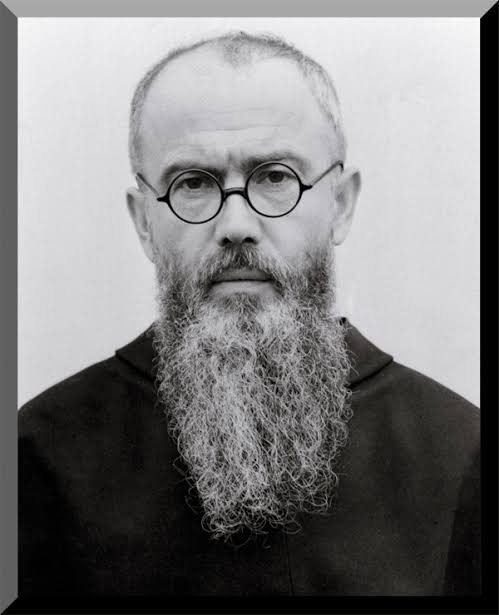
Feast Day: August 14
Born: January 8, 1894
Died: August 14, 1941
Place of Death: Auschwitz Concentration Camp, Poland
Canonized: October 10, 1982
Canonized by: Pope John Paul II
Patron Saint of: Drug addicts, prisoners, political prisoners, journalists, families, and the pro-life movement
Known as: The Martyr of Charity
Introduction
Saint Maximilian Maria Kolbe is one of the most inspiring saints of the twentieth century. His life was a remarkable combination of deep prayer, intense devotion to the Blessed Virgin Mary, intellectual brilliance, missionary zeal, courage, modern communication, and heroic self-sacrifice.
He was a Franciscan priest who used every possible means—including magazines, publishing houses, radio, and the modern media of his time—to spread the Gospel and devotion to the Immaculate Virgin Mary. Yet the event for which he is most remembered took place in the darkness of the Nazi concentration camp at Auschwitz.
When a fellow prisoner, a husband and father, was selected to die of starvation as punishment for another prisoner’s escape, Father Maximilian Kolbe stepped forward and offered his own life in exchange.
His simple words revealed the greatness of Christian love:
“I am a Catholic priest. I want to take his place.”
The Nazi officer accepted the exchange.
Maximilian Kolbe entered the starvation bunker and died after offering his life for another man. In doing so, he became a living image of the words of Jesus:
“No one has greater love than this, to lay down one’s life for one’s friends.”
— John 15:13
His life teaches the world that even in the midst of hatred, cruelty, war, and death, love is stronger.
1. Birth and Early Childhood
Saint Maximilian Kolbe was born on January 8, 1894, in the town of Zduńska Wola in Poland, which was then under Russian control.
His baptismal name was Raymund Kolbe. His parents were Julius Kolbe and Marianne Dąbrowska, a deeply religious Catholic couple.
The family was poor and lived a simple life. Yet faith occupied an important place in their home. Raymund grew up with his brothers in an atmosphere where prayer, sacrifice, and trust in God were part of everyday life.
As a child, Raymund was intelligent, energetic, and at times strong-willed. Like many saints, however, his holiness did not mean that he was born perfect. His spiritual journey involved conversion, discipline, and a growing awareness of God’s call.
One incident from his childhood became particularly important.
2. The Vision of the Blessed Virgin Mary
When Raymund was about twelve years old, he experienced a profound spiritual vision that would shape the rest of his life.
According to his own account, after his mother had once asked him what would become of him because of his lively and sometimes difficult behavior, the young Raymund began praying before an image of the Blessed Virgin Mary.
During prayer, he experienced a vision of Mary.
She appeared to him holding two crowns.
One crown was white, representing purity.
The other crown was red, representing martyrdom.
Mary asked him which crown he wished to choose.
Raymund answered that he wanted both.
This experience became a prophetic symbol of his future life.
He would strive for holiness and purity, symbolized by the white crown.
And eventually, he would give his life as a martyr, symbolized by the red crown.
Throughout his life, Maximilian would belong completely to Mary, whom he lovingly called the Immaculate.
3. Entering the Franciscan Order
Raymund and his elder brother entered the Franciscan Order of the Conventual Franciscans.
When he entered religious life, Raymund received the name Maximilian.
Later, because of his profound devotion to the Blessed Virgin Mary, he added the name Maria.
Thus, he became known as:
Maximilian Maria Kolbe.
He continued his studies and proved to be an exceptionally gifted student.
He studied philosophy and theology and earned doctorates in both fields. He was particularly interested in mathematics, science, philosophy, theology, and the relationship between faith and the modern world.
Maximilian understood that the Church was entering a rapidly changing age.
New technologies were transforming society. Newspapers, printing presses, radio, transportation, and international communication were influencing millions of people.
Instead of fearing modern technology, Maximilian Kolbe asked an important question:
Why should evil be the only force using modern communication effectively?
He believed that the Church must use every legitimate means available to spread the Gospel.
This vision would make him one of the great pioneers of Catholic evangelization through modern media.
4. Ordination to the Priesthood
Maximilian Kolbe was ordained a priest in 1918.
The world was experiencing enormous political and social upheaval. Europe had been devastated by the First World War. New ideologies were spreading, and many people were moving away from faith.
Father Maximilian believed that the answer to the darkness of the world was not hatred but holiness.
He placed his entire apostolic mission under the protection of the Blessed Virgin Mary.
His goal was clear:
To win souls for Christ through Mary, the Immaculate.
5. The Militia of the Immaculata
In 1917, while still a young Franciscan student in Rome, Maximilian Kolbe founded the Militia Immaculatae, also known as the Army of the Immaculate.
Its purpose was spiritual rather than political or military.
Kolbe wanted Catholics to consecrate themselves to the Blessed Virgin Mary and to work for the conversion and salvation of souls.
The movement encouraged its members to:
- Live a holy Christian life.
- Consecrate themselves to the Immaculate Virgin Mary.
- Pray for the conversion of sinners.
- Spread the Gospel.
- Defend the Catholic faith.
- Use modern means of communication for evangelization.
- Bring people closer to Jesus through Mary.
For Maximilian Kolbe, devotion to Mary was never separated from Christ.
Mary was important because she leads believers to her Son.
He believed that the more completely a person belongs to Mary, the more completely that person can belong to Christ.
6. “Niepokalanów”: The City of the Immaculate
One of Maximilian Kolbe’s greatest achievements was the establishment of Niepokalanów, meaning “City of the Immaculate.”
It became a remarkable Franciscan community dedicated to prayer, evangelization, publishing, and missionary work.
The friars lived according to Franciscan simplicity while also operating one of the largest Catholic publishing centers in Europe.
They published magazines and religious materials for thousands of readers.
The most famous publication was The Knight of the Immaculate.
Maximilian Kolbe believed that newspapers and magazines could become powerful instruments for spreading truth.
He once expressed the spirit of his mission in a way that can still inspire Christians today:
Use every available means to bring people closer to Christ.
At Niepokalanów, modern technology was not viewed as an enemy of faith.
It became a tool for evangelization.
The community eventually included:
- A large number of Franciscan brothers.
- Printing presses.
- Publishing facilities.
- Religious magazines.
- Workshops.
- A missionary training center.
- Various forms of media communication.
The community became one of the most remarkable examples of Catholic media apostolate in the twentieth century.
7. Missionary Journey to Japan
Maximilian Kolbe’s missionary vision was not limited to Poland.
In 1930, he traveled to Japan with a small group of Franciscan missionaries.
The missionaries arrived with very little money and limited resources. Yet Maximilian remained confident in Divine Providence and in the protection of the Blessed Virgin Mary.
Within a short period, he began publishing a Japanese edition of The Knight of the Immaculate.
He also founded a Japanese version of Niepokalanów called Mugenzai no Sono, meaning “Garden of the Immaculate.”
Remarkably, the monastery was built on a hillside that was considered unsuitable by some observers.
However, this location would later prove providential.
When the atomic bomb destroyed much of Nagasaki in 1945, the monastery survived because of its position behind the mountain.
Maximilian Kolbe’s missionary work in Japan showed his extraordinary courage and vision.
He did not believe that Christianity should remain confined to one culture or nation.
The Gospel was for the whole world.
8. A Missionary with a Modern Vision
Saint Maximilian Kolbe was far ahead of his time.
Today, the Church uses:
- Websites
- Social media
- Online videos
- Podcasts
- Digital publications
- Television
- Radio
- Mobile applications
for evangelization.
Maximilian Kolbe recognized this missionary possibility decades before the digital age.
If he lived today, one can imagine that he would enthusiastically use the internet and modern communication technologies for the proclamation of the Gospel.
His example is especially relevant for Catholic writers, journalists, bloggers, website administrators, content creators, priests, religious, and all those involved in digital evangelization.
The lesson of his life is simple:
Every legitimate means of communication can become an instrument of evangelization when it is placed at the service of truth and love.
9. The Beginning of World War II
The peaceful work of Niepokalanów was soon interrupted by war.
In September 1939, Nazi Germany invaded Poland.
Poland suffered enormously under the Nazi occupation.
Catholics, Jews, intellectuals, clergy, political leaders, and countless innocent civilians were persecuted.
The Nazis attempted to destroy Polish culture, suppress religious life, and eliminate those considered enemies of their regime.
Father Maximilian Kolbe continued his ministry despite the danger.
The Franciscan community at Niepokalanów provided assistance to refugees and people displaced by the war.
The community also sheltered people who were in danger, including Jews.
Kolbe’s commitment to human dignity did not depend on nationality, religion, or social position.
He saw every suffering person as someone loved by God.
10. Arrest and Imprisonment
The Nazis eventually arrested Father Maximilian Kolbe.
He was first arrested in 1939 and later released.
However, the danger did not disappear.
On February 17, 1941, he was arrested again by the Gestapo.
This time, his journey would lead toward martyrdom.
After imprisonment and interrogation, he was transferred to the notorious Auschwitz concentration camp.
He arrived there in May 1941 and was given the prisoner number 16670.
Auschwitz was a place of unimaginable suffering.
Prisoners were subjected to:
- Forced labor.
- Beatings.
- Hunger.
- Humiliation.
- Disease.
- Executions.
- Constant fear.
In this environment, Father Maximilian Kolbe continued to live as a priest.
His priesthood was not taken away by his prison uniform.
His freedom was limited, but his capacity to love remained free.
11. A Priest in Auschwitz
Life in Auschwitz was brutal.
The prisoners were often treated as if they were not human beings.
The Nazi system attempted to destroy not only the bodies of prisoners but also their dignity and hope.
Yet witnesses remembered Father Kolbe as a man of remarkable spiritual strength.
He encouraged others.
He prayed.
He comforted the suffering.
He shared what little he possessed.
He remained calm in the face of cruelty.
Many prisoners were filled with despair. But Kolbe tried to remind them that hatred would not have the final victory.
His presence itself became a form of resistance.
He resisted evil not through violence but through faith, courage, and love.
12. The Escape of a Prisoner
In July 1941, a prisoner escaped from Auschwitz.
As punishment, the camp authorities followed a terrible practice.
Ten prisoners from the same group were selected to die in a starvation bunker.
The chosen prisoners would receive neither food nor water.
They would slowly die.
The prisoners were selected.
One of them was a Polish soldier named Franciszek Gajowniczek.
When he was selected, he cried out in despair:
“My wife! My children!”
His words revealed the pain of a husband and father who believed he would never see his family again.
Then something extraordinary happened.
Father Maximilian Kolbe stepped out of the line.
Approaching the Nazi officer, he offered himself in place of Gajowniczek.
The officer asked who he was.
Kolbe replied:
“I am a Catholic priest.”
He offered his own life so that the husband and father could live.
To the astonishment of the prisoners, the exchange was accepted.
13. “I Want to Take His Place”
This moment is one of the most powerful examples of Christian love in modern history.
Maximilian Kolbe had no human obligation to die for Franciszek Gajowniczek.
He did not know him as a family member.
He was not required to volunteer.
He could have remained silent.
But he chose love.
He chose to give his life so that another person could return to his wife and children.
In that moment, the Gospel became visible.
Jesus said:
“No one has greater love than this, to lay down one’s life for one’s friends.”
— John 15:13
Maximilian Kolbe did not merely preach these words.
He lived them.
14. The Starvation Bunker
Father Kolbe and the other selected prisoners were taken to the starvation bunker.
Normally, such places were filled with screams, despair, and agony.
But witnesses remembered something different.
From the cell came the sound of:
- Prayer.
- Hymns.
- The Rosary.
- Religious songs.
Father Kolbe encouraged the dying prisoners and prepared them spiritually for death.
One by one, the prisoners died.
Yet Father Kolbe survived longer than the others.
Eventually, on August 14, 1941, the eve of the Feast of the Assumption of the Blessed Virgin Mary, he was killed by a lethal injection of carbolic acid.
His body was later cremated.
He was forty-seven years old.
The child who had accepted both the white crown of purity and the red crown of martyrdom had fulfilled the prophecy of his childhood vision.
15. The Man Whose Life Was Saved
The man for whom Maximilian Kolbe gave his life, Franciszek Gajowniczek, survived Auschwitz.
He was eventually reunited with his family.
For decades, he told the world about the sacrifice of the Franciscan priest.
Gajowniczek lived until 1995.
He was present at the canonization of Saint Maximilian Kolbe in 1982.
The meeting of the man who had been saved with the memory of the man who had died for him gave extraordinary witness to the reality of Kolbe’s sacrifice.
One man died.
Another was given the opportunity to live.
Through this act, Maximilian Kolbe demonstrated that a single decision of love can change the history of another human life.
16. Beatification and Canonization
The Church recognized Maximilian Kolbe as a martyr.
He was beatified in 1971 by Pope Paul VI.
Later, on October 10, 1982, Pope John Paul II canonized him a saint.
Pope John Paul II described him as a “Martyr of Charity.”
This title expresses the heart of Kolbe’s witness.
Many martyrs die because they refuse to deny their faith.
Maximilian Kolbe certainly suffered because of his identity and mission as a Catholic priest under a regime hostile to the Church.
But the immediate act that led to his death was an extraordinary act of love.
He freely offered himself for another person.
His martyrdom was therefore a martyrdom of charity.
17. Saint Maximilian Kolbe and the Blessed Virgin Mary
To understand Maximilian Kolbe, one must understand his love for the Blessed Virgin Mary.
He constantly referred to Mary as the Immaculate.
His spirituality was based on total dedication to God through Mary.
However, his devotion to Mary was deeply Christ-centered.
He believed that Mary always leads people toward Jesus.
For him, consecration to Mary was not an alternative to following Christ.
It was a way of following Christ more completely.
The life of Kolbe demonstrates this clearly.
His Marian devotion produced:
- Greater love for Christ.
- Greater commitment to the Church.
- Greater missionary zeal.
- Greater willingness to serve others.
- Greater courage in suffering.
- Greater readiness for self-sacrifice.
True devotion to Mary, according to the example of Saint Maximilian Kolbe, does not end with Mary.
It leads to Jesus.
18. The Spirituality of Total Consecration
Saint Maximilian Kolbe encouraged Christians to consecrate themselves completely to Jesus through Mary.
This meant offering one’s:
- Life.
- Talents.
- Work.
- Suffering.
- Relationships.
- Future.
- Successes.
- Failures.
to God.
His spirituality was one of complete availability.
The question was not:
“What do I want to do with my life?”
The deeper question was:
“How can my life belong completely to God?”
This attitude gave him tremendous freedom.
A person who has already given everything to God is no longer controlled by fear of losing everything.
Maximilian Kolbe eventually gave even his life.
19. Saint Maximilian Kolbe and the Meaning of Love
The world often speaks about love as an emotion.
But Saint Maximilian Kolbe teaches that love is more than emotion.
Love is a decision.
Love involves sacrifice.
Love asks:
What can I give for the good of another person?
The ultimate expression of love is not merely saying:
“I love you.”
It is being willing to sacrifice for the other.
Kolbe’s life challenges every Christian.
Most people will never be asked to die in a concentration camp.
But every day provides opportunities for smaller acts of self-sacrifice.
We can give:
- Our time.
- Our attention.
- Our forgiveness.
- Our patience.
- Our resources.
- Our comfort.
- Our pride.
Sometimes the greatest martyrdom is the daily martyrdom of love.
20. Lessons from Saint Maximilian Kolbe
1. Love is stronger than hatred
Auschwitz was built upon hatred.
Maximilian Kolbe responded with love.
The Nazis possessed weapons, prisons, and political power.
But they could not force Kolbe to become hateful.
His body was imprisoned.
His love remained free.
2. Every person has dignity
Kolbe gave his life for another prisoner because he recognized the value of human life.
In a world that often measures people according to power, wealth, productivity, nationality, or social status, Kolbe reminds us that every human being has dignity.
3. Modern media can be used for evangelization
Kolbe used the technology of his time for the Gospel.
Today, Christians have access to tools that he could only have imagined.
The internet can spread confusion and hatred.
But it can also spread truth, hope, prayer, Scripture, and the message of Christ.
The question is:
How are we using the tools God has placed in our hands?
4. Holiness requires courage
Holiness is not weakness.
Maximilian Kolbe was physically weak because of illness throughout much of his life, but spiritually he was extraordinarily strong.
Courage does not mean the absence of fear.
It means doing what is right even when there is a cost.
5. Mary leads us to Christ
Kolbe’s devotion to Mary gave him the strength to become more deeply united with Jesus.
His life is a beautiful example of authentic Marian spirituality.
6. Small acts of love prepare us for great sacrifices
No one suddenly becomes a saint in a single moment.
Kolbe’s final sacrifice was prepared through years of prayer, discipline, service, missionary work, and daily self-giving.
The great sacrifices of life are often made possible by the small sacrifices we practice every day.
21. Saint Maximilian Kolbe and Today’s World
The message of Saint Maximilian Kolbe is perhaps more relevant today than ever.
We live in a world affected by:
- War.
- Violence.
- Religious persecution.
- Political hatred.
- Social division.
- Misinformation.
- Digital addiction.
- Despair.
- Loneliness.
Kolbe speaks directly to this world.
He teaches that Christians should not simply complain about the darkness.
They must bring light.
They must not allow hatred to produce more hatred.
They must respond with truth and love.
He also reminds us that modern technology is morally neutral in itself.
The same internet that can spread hatred can also spread the Gospel.
The same social media platform that can promote falsehood can be used to share Scripture and prayer.
The same digital tools that can waste time can become instruments of evangelization.
Saint Maximilian Kolbe challenges the Church:
Do not abandon the modern world. Bring Christ into it.
22. A Saint for Digital Evangelizers
Saint Maximilian Kolbe can be considered a special inspiration for those involved in Catholic media and digital evangelization.
Although he lived long before the internet, his missionary philosophy was remarkably modern.
He did not ask:
“Should the Church use modern media?”
He asked how modern media could be used more effectively for the salvation of souls.
His example can inspire:
- Catholic websites.
- Christian bloggers.
- YouTube evangelizers.
- Podcast creators.
- Religious publishers.
- Catholic journalists.
- Social media missionaries.
- Priests and religious.
- Lay missionaries.
Every article, image, prayer, reflection, video, or message shared online can potentially reach a person who needs hope.
We may never know how many lives can be touched through a single act of digital evangelization.
Saint Maximilian Kolbe teaches us to use every available opportunity for Christ.
23. Reflection: “Who Is My Franciszek?”
One of the most challenging questions inspired by Saint Maximilian Kolbe is:
Who is the person for whom I am called to sacrifice?
Most of us will not be asked to enter a starvation bunker.
But perhaps there is someone waiting for our help.
Perhaps it is:
- A child who needs attention.
- An elderly parent who needs care.
- A struggling family member.
- A person who needs forgiveness.
- A poor person who needs assistance.
- A lonely friend.
- Someone who needs encouragement.
- Someone who needs to hear about Jesus.
Sometimes love requires us to step out of the line.
Sometimes love requires us to say:
“I will help.”
“I will stay.”
“I will forgive.”
“I will sacrifice.”
This is the spirituality of Saint Maximilian Kolbe.
24. A Prayer to Saint Maximilian Kolbe
Saint Maximilian Kolbe,
You loved Jesus Christ with your whole heart
and placed your life under the loving protection
of the Blessed Virgin Mary.
You used your talents, intelligence, energy,
and every available means to bring souls closer to God.
In the darkness of Auschwitz,
you did not allow hatred to conquer your heart.
Instead, you gave your life
so that another person might live.
Teach us to love as you loved.
Give us courage when we are afraid,
hope when we are discouraged,
and generosity when we are tempted to think only of ourselves.
Help us to use our talents
and the opportunities of the modern world
for the glory of God and the good of others.
Through the intercession of the Blessed Virgin Mary,
may we grow in purity, faith, courage,
and self-sacrificing love.
Saint Maximilian Kolbe,
Martyr of Charity,
pray for us.
Amen.
Conclusion
Saint Maximilian Kolbe’s life can be summarized in one word:
LOVE
He loved Christ.
He loved the Blessed Virgin Mary.
He loved the Church.
He loved the mission of evangelization.
He loved the suffering.
And finally, he loved a stranger enough to die in his place.
In Auschwitz, the Nazis attempted to create a world in which hatred and death had the final word.
But in the middle of that darkness, a Catholic priest stepped forward and freely gave his life for another.
The guards had power over his body.
They could imprison him.
They could starve him.
They could kill him.
But they could not destroy his love.
That is why Saint Maximilian Kolbe remains victorious.
His life continues to proclaim the message of Christ:
“Do not be overcome by evil, but overcome evil with good.”
— Romans 12:21
On his feast day, August 14, the Church remembers not merely a victim of hatred, but a victor of love.
Saint Maximilian Kolbe teaches us that the greatest power in the world is not violence, wealth, political authority, or technology.
The greatest power is love that is willing to sacrifice.
May his life inspire us to belong completely to Christ, to trust in the loving intercession of Mary, and to use every gift God has given us for the good of others.
Saint Maximilian Maria Kolbe, Martyr of Charity and Apostle of the Immaculate, pray for us!
Leave a Reply