
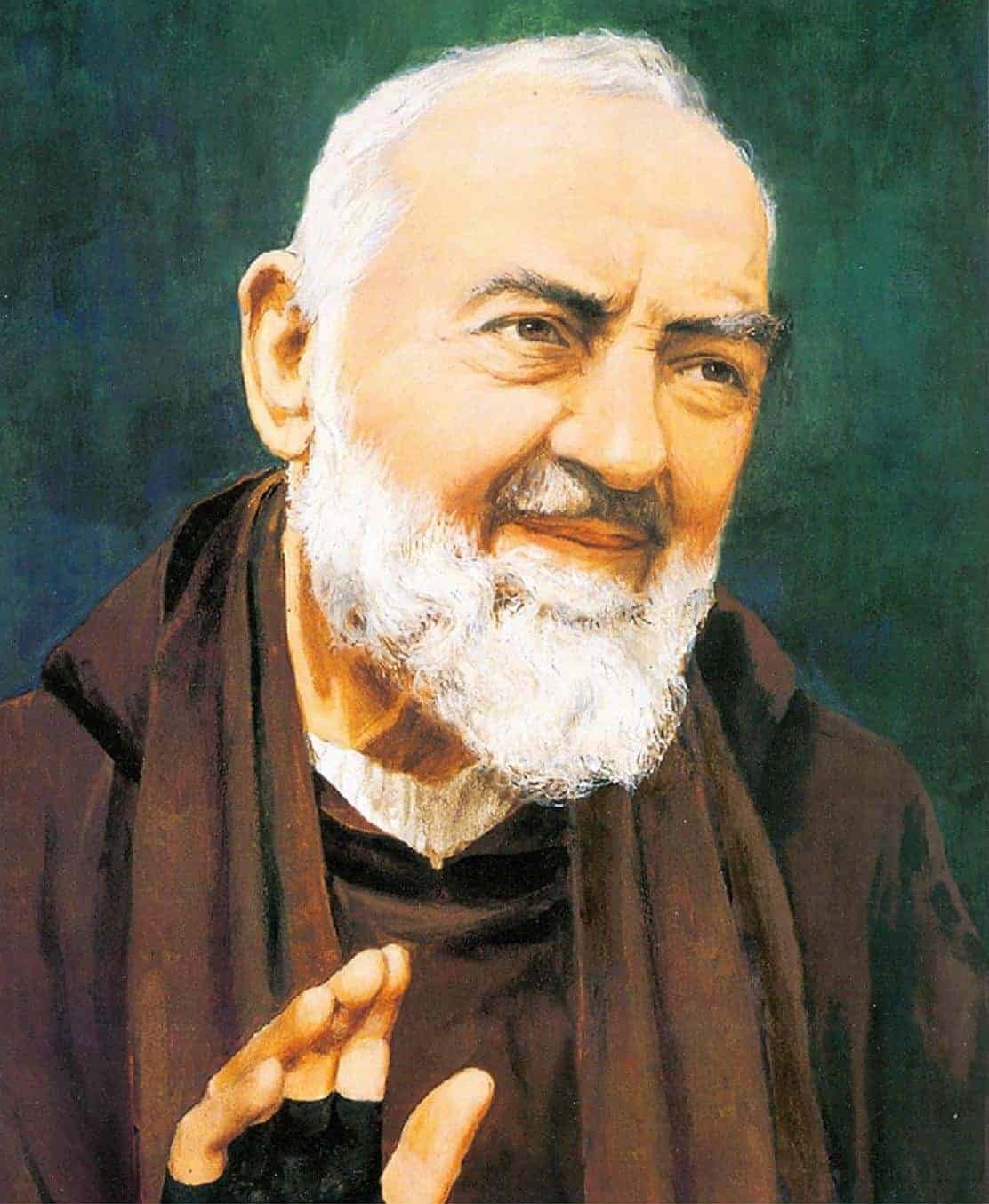
Saint Padre Pio of Pietrelcina
The Capuchin Priest, Confessor, and Stigmatist
Feast Day: September 23
Saint Pio of Pietrelcina, popularly known as Padre Pio, was an Italian Capuchin friar and priest whose life was marked by deep prayer, love for the Eucharist, devotion to the Sacrament of Reconciliation, suffering, charity, and an extraordinary dedication to the salvation of souls.
Born Francesco Forgione on May 25, 1887, in Pietrelcina, Italy, Padre Pio entered the Capuchin Franciscan Order as a young man and was ordained a priest in 1910. From 1916 until his death in 1968, he was closely associated with San Giovanni Rotondo, where his ministry of prayer, confession, spiritual direction, and the celebration of Holy Mass drew countless people.
He became especially known for the stigmata, the wounds resembling those of Christ’s Passion, which became visible on his hands, feet, and side in 1918. Yet the central message of Padre Pio’s life was not the extraordinary phenomena associated with him. It was Jesus Christ, the Cross, the Eucharist, prayer, repentance, and love for souls.
The Vatican describes the Cross as being at the centre of Padre Pio’s life and apostolic mission. He sought to unite himself with Christ crucified and to serve others through his priestly ministry.
Early Life of Francesco Forgione
Francesco Forgione was born on May 25, 1887, in Pietrelcina, in the Archdiocese of Benevento, Italy.
His parents were Grazio Forgione and Maria Giuseppa De Nunzio. He was baptized the following day and received the name Francesco.
From his childhood, Francesco showed a strong attraction toward prayer and religious life. He grew up in a simple Catholic family and was formed in the faith through family prayer, parish life, and devotion to God.
His early years were also marked by periods of poor health. Nevertheless, his desire to dedicate himself completely to God continued to grow.
At the age of twelve, he received Confirmation and made his First Holy Communion.
The young Francesco increasingly desired to become a Capuchin friar. His vocation eventually led him to the novitiate at Morcone.
Francesco Becomes Brother Pio
On January 6, 1903, at the age of sixteen, Francesco entered the novitiate of the Capuchin Friars at Morcone.
On January 22, he received the Franciscan habit and took the religious name Brother Pio. He continued his religious formation and studies despite recurring health difficulties.
On January 27, 1907, he made his solemn profession of religious vows.
His religious life was founded on the traditional Franciscan ideals of:
- Poverty
- Chastity
- Obedience
- Prayer
- Penance
- Humility
- Love of Christ
- Service of others
For Padre Pio, religious life was not simply a change of lifestyle. It was a total offering of himself to God.
Padre Pio Becomes a Priest
Padre Pio was ordained a priest on August 10, 1910, in Benevento.
He was only twenty-three years old.
His priesthood became the centre of his entire life. The Eucharist and the Sacrament of Reconciliation would especially mark his ministry.
The Vatican later described the celebration of Holy Mass as the pinnacle of his apostolic activity. He also devoted himself extensively to hearing confessions and providing spiritual direction.
Padre Pio understood the priesthood in relation to Christ’s own sacrifice. He desired to offer himself with Christ for the salvation of souls.
The Eucharist was therefore not simply one activity among many in his life.
The Eucharist was at the heart of his priesthood.
Padre Pio and San Giovanni Rotondo
In 1916, Padre Pio was sent to the Capuchin friary at San Giovanni Rotondo.
He first arrived there on July 28, 1916, and returned permanently in September of that year. He remained associated with San Giovanni Rotondo until his death in 1968.
What initially seemed to be a temporary assignment became the setting for the major part of his priestly ministry.
The small Capuchin friary gradually became a destination for thousands of people.
People came to:
- Attend his Mass
- Go to confession
- Seek spiritual guidance
- Ask for prayers
- Bring their sufferings
- Entrust their families to God
- Seek consolation and hope
His reputation spread far beyond San Giovanni Rotondo, and eventually people came from many parts of Italy and from other countries.
Yet Padre Pio repeatedly sought to direct attention away from himself and toward God.
He described himself simply as “a poor friar who prays.”
The Stigmata of Padre Pio
One of the most remarkable aspects of Padre Pio’s life was the stigmata.
The stigmata refers to wounds resembling those of the crucified Christ.
Padre Pio experienced mystical phenomena associated with Christ’s Passion even before the permanent visible stigmata appeared.
On September 20, 1918, while praying after Mass in the choir of the Capuchin church at San Giovanni Rotondo, Padre Pio received the visible wounds on his hands, feet, and side. The official Padre Pio portal records his later account of the event and his reluctance to speak about the extraordinary experience.
The wounds remained with him for approximately fifty years.
The phenomenon attracted enormous attention, including medical examinations and ecclesiastical investigations.
But Padre Pio himself did not treat the stigmata as a reason for personal glory.
For him, the wounds pointed toward the Passion of Jesus Christ.
The Vatican placed this aspect of his life within the larger context of his imitation of Christ crucified.
The important spiritual lesson is therefore not simply that Padre Pio bore extraordinary wounds.
It is that he sought to share in the suffering of Christ and offer his life for the salvation of souls.
Padre Pio and the Eucharist
The Holy Eucharist occupied a central place in Padre Pio’s spirituality.
His daily priestly life revolved around the celebration of Mass, prayer, thanksgiving, confession, and spiritual ministry.
Those who attended his Mass often spoke about his profound recollection and the intensity with which he celebrated the sacred mysteries.
The Vatican states that the celebration of Holy Mass was the pinnacle of Padre Pio’s apostolic activity.
For Padre Pio, the Mass was not merely a religious ceremony.
It was the sacramental participation in the mystery of Christ’s saving sacrifice.
His devotion to the Eucharist teaches Catholics an important lesson:
The closer we come to Jesus in the Eucharist, the more deeply we are called to love, sacrifice, repent, and serve.
Padre Pio and the Sacrament of Confession
Another major part of Padre Pio’s ministry was the Sacrament of Reconciliation.
Large numbers of people came to him for confession.
According to the Vatican, Padre Pio devoted himself extensively to the sacramental reconciliation of penitents and spiritual direction.
His ministry of confession reflected his profound conviction that God’s mercy is available to sinners who sincerely turn back to Him.
He could be demanding because he took sin seriously.
But his purpose was not to discourage people.
It was to lead them toward conversion, repentance, God’s mercy, and a renewed relationship with Christ.
Through confession, he sought to help souls break away from sin and return to the grace of God.
Padre Pio: Prayer and Suffering
Prayer and suffering were two great themes of Padre Pio’s spiritual life.
He experienced physical illness, opposition, misunderstanding, restrictions, and intense suffering.
Yet he tried to unite his suffering with the Passion of Christ.
Pope John Paul II, during Padre Pio’s canonization, emphasized this dimension of his life. He presented Padre Pio as a witness to the way difficulties and sufferings, when accepted in faithful love, can become a path toward holiness.
This does not mean that suffering is good in itself.
Rather, the Christian faith teaches that suffering can be united with Christ and offered in love.
Padre Pio’s life gives a powerful example of this Christian mystery.
The Difficult Years
Padre Pio’s life was not always peaceful or publicly celebrated.
The extraordinary phenomena associated with him led to questions, investigations, controversy, and restrictions.
The official biography records that in 1931 the Holy Office removed his faculties for priestly ministry except for celebrating Mass privately in the friary chapel. These restrictions were lifted on July 14, 1933.
These years were a profound test of obedience and humility.
Padre Pio continued his spiritual life even when his public ministry was restricted.
This period reminds us of an important truth:
Holiness is not measured by popularity or public recognition.
A saint’s deepest work may take place in hidden prayer, obedience, sacrifice, and fidelity.
Padre Pio and Spiritual Direction
Padre Pio became a spiritual father to many people.
Those who approached him often sought advice concerning:
- Prayer
- Family difficulties
- Conversion
- Vocational discernment
- Sin and temptation
- Suffering
- Christian responsibilities
- The spiritual life
He encouraged people to take their relationship with God seriously.
He emphasized prayer, the sacraments, repentance, and perseverance.
His spiritual direction always had a Christ-centred purpose:
to help souls come closer to Jesus.
Padre Pio and the Ministry of Charity
Padre Pio’s spirituality was not limited to prayer and the confessional.
He also wanted to respond to human suffering through concrete works of charity.
One of the greatest fruits of his apostolate was the establishment of the Casa Sollievo della Sofferenza, meaning “Home for the Relief of Suffering.”
The project took shape during the 1940s, and its foundation stone was laid in 1947. The hospital was inaugurated in 1956.
The institution reflected Padre Pio’s desire to care for the whole person.
He wanted people to encounter both compassion and Christian hope.
For Padre Pio, love of God could never be separated from love of neighbour.
Padre Pio and the Prayer Groups
Another lasting fruit of Padre Pio’s ministry was the development of Prayer Groups.
These groups grew from his desire to encourage people to pray together and to live their Christian faith more deeply.
Prayer became the foundation of this spiritual movement.
The Prayer Groups associated with Padre Pio continue to exist in many parts of the world.
They reflect one of the simplest messages of his life:
Pray, trust God, and remain close to Christ.
Padre Pio and Karol Wojtyła
One particularly memorable connection in Padre Pio’s life was his meeting with the young Polish priest Karol Wojtyła, who later became Pope John Paul II.
According to the official Padre Pio portal, Wojtyła came to San Giovanni Rotondo in 1948 and went to confession with Padre Pio.
Years later, as Pope John Paul II, he presided over Padre Pio’s beatification in 1999 and canonization in 2002.
This connection became an important part of the history surrounding Padre Pio’s spiritual legacy.
The Last Years of Padre Pio
As Padre Pio grew older, his health became increasingly fragile.
Nevertheless, he continued his priestly ministry for as long as his strength permitted.
His life remained centred on:
- Prayer
- Holy Mass
- Confession
- Spiritual direction
- Suffering
- Charity
- Love for Jesus
- Love for Mary
In the final years, his physical condition deteriorated significantly.
He died peacefully in San Giovanni Rotondo on September 23, 1968, at the age of eighty-one.
The official biography records that he died while repeatedly invoking the names of Jesus and Mary.
His funeral drew an extraordinary number of people.
But his earthly death was not the end of his influence.
His spiritual legacy continued to grow.
The Beatification of Padre Pio
After his death, devotion to Padre Pio spread rapidly.
The Church formally began the process for his beatification and canonization.
The Vatican records that the cause progressed through the required canonical investigations, including examination of his heroic virtues and an approved miracle.
On May 2, 1999, Pope John Paul II beatified Padre Pio in St Peter’s Square.
His liturgical feast was assigned to September 23, the anniversary of his death.
The Canonization of Saint Padre Pio
On June 16, 2002, Pope John Paul II canonized Padre Pio of Pietrelcina in St Peter’s Square.
He was officially proclaimed:
Saint Pio of Pietrelcina.
The canonization Mass drew enormous crowds of pilgrims.
In his homily, Pope John Paul II highlighted the centrality of the Cross in Padre Pio’s life and connected his witness with Christ’s call to take up the yoke of discipleship.
Saint Padre Pio was therefore not canonized simply because of extraordinary experiences associated with his life.
The Church recognized in him a life of heroic Christian virtue, prayer, sacrifice, priestly ministry, charity, obedience, and love for Christ and souls.
The Spirituality of Saint Padre Pio
The spirituality of Padre Pio can be summarized through several important themes.
1. Love for Jesus Christ
Jesus was at the centre of his life.
Padre Pio’s spirituality was deeply Christ-centred, especially through the Cross and Eucharist.
2. Love for the Eucharist
The Mass was the heart of his priestly ministry.
He encouraged people to recognize the greatness of the Eucharistic mystery.
3. Love for Confession
He dedicated enormous amounts of time to the Sacrament of Reconciliation.
He wanted sinners to experience conversion and God’s mercy.
4. Prayer
Padre Pio repeatedly encouraged people to pray.
Prayer was not simply one activity among many.
It was the foundation of Christian life.
5. Suffering United with Christ
His life teaches us that suffering can be offered to God and united with the Passion of Jesus.
6. Love for the Blessed Virgin Mary
Padre Pio had a deep devotion to the Virgin Mary and encouraged people to entrust themselves to her maternal intercession.
The Rosary had an important place in his daily spiritual life.
7. Charity
His spiritual life expressed itself through practical love, especially in his concern for suffering people.
8. Obedience
Even during periods of investigation and restriction, obedience remained an important part of his religious vocation.
Why Is Padre Pio So Loved Around the World?
Millions of Catholics continue to feel drawn to Saint Padre Pio.
There are many reasons for this devotion.
He was a priest who:
- Prayed intensely.
- Celebrated the Eucharist with profound devotion.
- Spent countless hours hearing confessions.
- Welcomed suffering people.
- Encouraged sinners to return to God.
- Had a deep devotion to Mary.
- Served the sick and suffering.
- Embraced the Cross.
- Lived his Capuchin vocation faithfully.
- Pointed people toward Jesus.
His popularity should therefore not be separated from the central message of his life.
Padre Pio always leads us back to Christ.
Lessons We Can Learn from Saint Padre Pio
The life of Saint Padre Pio offers many practical lessons for Christians today.
Pray every day.
Prayer keeps our hearts turned toward God.
Go regularly to Confession.
The Sacrament of Reconciliation is a source of grace and conversion.
Love the Eucharist.
The Mass should never become merely a routine.
Carry your crosses with Christ.
Our suffering can be united with the suffering of Jesus.
Do not be discouraged by trials.
Difficult periods can become opportunities for deeper trust in God.
Remain faithful to your vocation.
Padre Pio remained faithful to his priestly and religious vocation even during difficult times.
Serve those who suffer.
Christian holiness must express itself in charity.
Trust in God’s mercy.
Even when we fail, we should return to God with repentance and confidence.
Pray for others.
Our prayer can become an act of love and intercession.
Saint Padre Pio and the Cross
Perhaps the most important key to understanding Padre Pio is the Cross.
The Vatican’s official biography places the Cross at the centre of his life and apostolic mission.
Padre Pio did not seek suffering for its own sake.
Rather, he sought to unite himself with Christ crucified.
His stigmata, his priesthood, his Mass, his confessional ministry, his illnesses, his trials, and his charitable work all need to be understood in the light of Christ.
This is why the words of Saint Paul were so appropriate to his spirituality:
“But far be it from me to glory except in the cross of our Lord Jesus Christ.”
— Galatians 6:14
For Padre Pio, the Cross was not a sign of defeat.
It was the path of Christ’s love.
A Prayer to Saint Padre Pio
O Saint Padre Pio,
humble servant of God and faithful priest of Jesus Christ,
you devoted your life to prayer,
the Eucharist, confession, and the salvation of souls.
Teach us to love Jesus more deeply.
Help us to approach the Holy Eucharist with faith and reverence.
Help us to seek God’s mercy in the Sacrament of Reconciliation.
When we are suffering,
teach us to unite our crosses with the Cross of Christ.
When we are discouraged,
help us to trust in God’s loving providence.
When we are tempted,
strengthen us to remain faithful.
Pray for our families,
our children,
the sick and suffering,
those who have lost hope,
and all who have asked for our prayers.
Obtain for us the grace to live with faith,
hope, humility, and charity.
Saint Padre Pio of Pietrelcina,
pray for us.
Amen.
Saint Padre Pio – Important Dates
| Date | Event |
|---|---|
| May 25, 1887 | Francesco Forgione is born at Pietrelcina |
| May 26, 1887 | He is baptized |
| January 6, 1903 | Enters the Capuchin novitiate at Morcone |
| January 22, 1903 | Receives the name Brother Pio |
| January 27, 1907 | Makes solemn profession |
| August 10, 1910 | Ordained a priest |
| July 28, 1916 | First arrives at San Giovanni Rotondo |
| September 20, 1918 | Receives the visible stigmata |
| 1947 | Foundation stone of Casa Sollievo della Sofferenza |
| 1956 | Casa Sollievo della Sofferenza is inaugurated |
| September 23, 1968 | Dies at San Giovanni Rotondo |
| May 2, 1999 | Beatified by Pope John Paul II |
| June 16, 2002 | Canonized by Pope John Paul II |
| September 23 | Liturgical feast of Saint Padre Pio |
The principal dates above are documented by Vatican and official Padre Pio sources.
Frequently Asked Questions About Saint Padre Pio
Who was Saint Padre Pio?
Saint Padre Pio of Pietrelcina was an Italian Capuchin friar and Catholic priest, born Francesco Forgione in 1887. He became known for his intense prayer, priestly ministry, confession, Eucharistic devotion, charity, and the stigmata.
When is the feast of Saint Padre Pio?
The liturgical feast of Saint Padre Pio is celebrated on September 23, the anniversary of his death.
When was Padre Pio born?
Padre Pio was born on May 25, 1887, in Pietrelcina, Italy.
What was Padre Pio’s real name?
His baptismal name was Francesco Forgione. He received the religious name Pio when he entered the Capuchin novitiate.
When was Padre Pio ordained a priest?
He was ordained a priest on August 10, 1910, in Benevento.
When did Padre Pio receive the stigmata?
The visible stigmata appeared on September 20, 1918, while Padre Pio was praying in the choir of the Capuchin church at San Giovanni Rotondo.
When did Padre Pio die?
Padre Pio died on September 23, 1968, at San Giovanni Rotondo, aged eighty-one.
When was Padre Pio canonized?
Pope John Paul II canonized Padre Pio on June 16, 2002, in St Peter’s Square.
What is Padre Pio especially known for?
He is especially known for his priestly ministry, celebration of Holy Mass, long hours hearing confessions, prayer, spiritual direction, charity, devotion to Christ’s Passion, and the stigmata.
Conclusion
Saint Padre Pio of Pietrelcina was an extraordinary Catholic priest whose life was deeply rooted in Jesus Christ, the Holy Eucharist, the Cross, prayer, Confession, suffering, and charity.
The extraordinary aspects of his life naturally attract attention, but his deepest legacy is much simpler.
He was a priest who prayed.
He was a confessor who brought sinners to God’s mercy.
He was a man who embraced the Cross.
He was a servant of the sick and suffering.
He was a son devoted to the Blessed Virgin Mary.
And above all, he was a disciple who sought to live for Jesus Christ.
His life continues to remind us that holiness does not consist merely in extraordinary experiences. It consists in loving God, remaining faithful to one’s vocation, accepting the Cross, serving others, and persevering in prayer.
May the example of Saint Padre Pio inspire us to approach the Eucharist with greater love, Confession with greater sincerity, prayer with greater faith, and our daily crosses with greater trust in God.
As Pope John Paul II emphasized at Padre Pio’s canonization, his life bore witness to the transforming power of carrying Christ’s yoke with faithful love.
Saint Padre Pio of Pietrelcina,
faithful priest of Christ,
lover of the Cross,
friend of sinners,
servant of the suffering,
and humble son of Saint Francis,
pray for us.
Amen.
Leave a Reply