
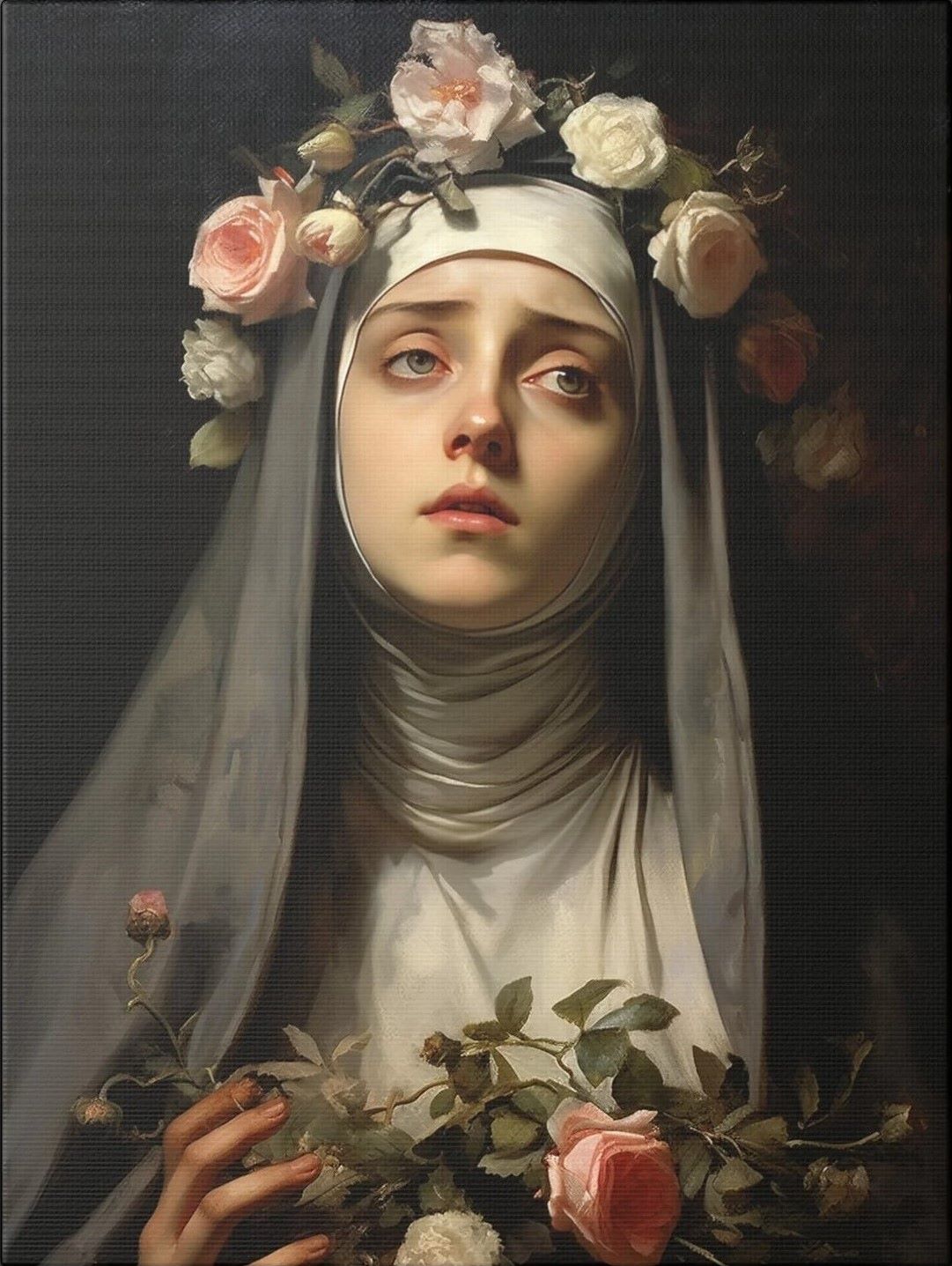
The First Saint of the Americas
Feast Day: August 23
Born: April 20, 1586
Died: August 24, 1617
Canonized: April 12, 1671
Patroness of: Peru, the Americas, the Philippines, florists, gardeners, and people suffering from family difficulties
Saint Rose of Lima is one of the most beloved saints of the Catholic Church and holds a unique place in the history of Christianity in the New World. She was the first person born in the Americas to be canonized a saint.
Her life was outwardly simple. She did not travel across continents, establish a religious order, or hold a position of authority in the Church. Yet, from her small home in Lima, Peru, she became a powerful witness to the Gospel through a life of prayer, penance, charity, and extraordinary love for Jesus Christ.
Saint Rose teaches us that holiness does not depend upon fame, wealth, education, or public recognition. A person can live an apparently hidden life and yet become a light for the entire world.
Her story is the story of a young woman who loved Christ above everything else and sought to belong completely to Him.
1. Birth and Family
Saint Rose of Lima was born on April 20, 1586, in Lima, Peru, which at that time was part of the Spanish Empire.
Her baptismal name was Isabel Flores de Oliva. She was born into a large family of Spanish descent. Her father, Gaspar Flores, was originally from Spain, while her mother, Oliva, was born in Lima.
From childhood, Isabel was surrounded by the Catholic faith. The Church played a central role in the life of the people, and the young girl grew up learning about Jesus, the Blessed Virgin Mary, and the saints.
According to tradition, when she was still an infant, someone noticed the extraordinary beauty of her face and called her “Rose.” The name remained with her, and eventually she became known to the world as Rose of Lima.
There is also a cherished tradition that her mother once saw the face of the child transformed in appearance into that of a beautiful rose. Whether understood as a pious tradition or a sign remembered by her family, the name “Rose” became inseparably connected with her identity and her spiritual journey.
Later, she took the religious name Rose of Saint Mary.
2. A Child Drawn to Prayer
From an early age, Rose showed an unusual attraction to prayer and spiritual life.
Like many children, she played and lived within the ordinary circumstances of family life. But there was something deeper in her heart. She desired to belong completely to God.
She loved silence and prayer. She reflected upon the sufferings of Jesus and developed a deep devotion to the Blessed Virgin Mary.
As she grew older, Rose began to understand more deeply the meaning of Christ’s love.
She was especially attracted to the life of sacrifice.
Her spirituality was shaped by a powerful desire to respond to the love that Jesus had shown on the Cross.
For Rose, the Crucified Christ was not merely a religious image.
He was the One she loved.
Her entire life gradually became an answer to one question:
“How can I love Jesus more completely?”
3. Her Extraordinary Beauty and the Struggle Against Vanity
Rose was known for her physical beauty.
This, however, became a source of difficulty rather than pride.
In the society in which she lived, beauty could attract admiration and attention. Her parents hoped that she might eventually marry and help improve the family’s financial situation.
Rose, however, had another desire.
She felt called to give her entire life to Christ.
She feared that excessive attention to her appearance could become a distraction from God. According to traditional accounts of her life, she sometimes took extreme measures to reduce the attention given to her physical beauty.
These stories must be understood within the spiritual and cultural context of her time. The important message is not to imitate every physical practice associated with her life.
Rather, Rose wanted to remind herself that true beauty comes from holiness, virtue, and love.
The world may admire outward appearance.
But God looks at the heart.
Rose’s life challenges us today, in an age deeply concerned with appearance, popularity, and social approval.
The question is not:
“How do people see me?”
The deeper question is:
“Who am I before God?”
4. A Heart Completely Given to Christ
As Rose grew into adulthood, her desire to belong completely to Jesus became stronger.
She eventually made a private vow of perpetual virginity.
Her decision was not always easy for her family to understand.
Her parents hoped that she would marry.
But Rose believed that Christ was calling her to a different form of life.
She saw Jesus as the Bridegroom of her soul.
Her relationship with Christ became the centre of her existence.
This spiritual language may sound unusual in modern times, but it expresses a profound Christian truth: every human heart is ultimately created for complete communion with God.
Rose’s entire life became a response to this divine love.
She did not reject people.
Instead, her love for Christ opened her heart more deeply to the suffering of others.
The more she prayed, the more she served.
The more she sought God, the more compassionate she became.
5. The Influence of Saint Catherine of Siena
One of the saints who greatly inspired Rose was Saint Catherine of Siena, the famous Dominican mystic and Doctor of the Church.
Rose admired Catherine’s intense love for Christ, her life of prayer, and her courage.
She desired to follow a similar path.
However, circumstances did not allow Rose simply to enter a convent and withdraw completely from the world.
Instead, she eventually became associated with the Third Order of Saint Dominic, now known as the Lay Fraternities of Saint Dominic.
This allowed her to live a life of prayer and dedication to God while remaining connected to her family and living in her own home.
She became known as Rose of Saint Mary.
Her Dominican spirituality emphasized:
- Love for Jesus Christ
- Prayer and contemplation
- Devotion to the Blessed Virgin Mary
- Penance and conversion
- Charity toward the poor
- A life rooted in the Gospel
6. A Hidden Life of Prayer
One of the most remarkable aspects of Saint Rose’s life was her intense dedication to prayer.
Her family home became the setting for a profound spiritual journey.
According to tradition, she built a small hermitage in the garden of her family’s property. There she spent long periods in prayer and contemplation.
She desired silence because silence helped her listen to God.
In our modern world, silence has become increasingly rare.
We are surrounded by:
- Mobile phones
- Television
- Social media
- Messages
- Notifications
- News
- Entertainment
- Constant activity
Saint Rose reminds us that a person can become so busy listening to the world that he or she forgets to listen to God.
Prayer is not simply speaking to God.
Prayer also involves listening.
In silence, Rose discovered the presence of Christ.
Her hidden prayer became the source of her public charity.
This is an important lesson:
A Christian who wants to serve others effectively must also spend time with God.
Without prayer, service can become mere activity.
But when service flows from prayer, it becomes an expression of God’s love.
7. Love for the Poor and the Sick
Saint Rose did not use prayer as an escape from human suffering.
She saw Christ in those who were poor, sick, abandoned, and suffering.
At her family home, she cared for people in need.
Tradition tells us that she converted part of her home and garden area into a place where she could assist the sick.
She cared especially for those who had little or no one to care for them.
This was one of the greatest expressions of her spirituality.
Rose loved the Jesus she encountered in prayer.
She also loved the Jesus she encountered in the suffering human person.
The words of Christ in Matthew’s Gospel became visible in her life:
“Whatever you did for one of the least of these brothers and sisters of mine, you did for me.”
For Saint Rose, charity was not a theory.
It was personal.
She served people.
She touched their wounds.
She cared for their needs.
She gave her time.
She gave her strength.
She gave her heart.
Her life reminds us that genuine holiness is never separated from love for our neighbour.
8. A Life of Work and Responsibility
Rose’s family experienced financial difficulties.
Therefore, she did not simply spend all her time in prayer.
She also worked.
She used her skills to contribute to the needs of her family.
Rose became known for working with her hands, including needlework and gardening. The flowers she cultivated and the work she performed became practical ways of supporting her household.
This is a beautiful aspect of her life.
Saint Rose was a mystic, but she was not disconnected from ordinary responsibilities.
She prayed deeply.
But she also worked.
She contemplated God.
But she also helped her family.
She loved heaven.
But she also served the people around her.
This balance makes her especially relevant today.
Holiness is not found only in churches and monasteries.
A person can become holy:
- While raising a family.
- While working in an office.
- While caring for elderly parents.
- While studying.
- While performing ordinary household duties.
- While serving the poor.
- While carrying daily responsibilities with love.
Every ordinary action can become holy when it is offered to God.
9. Her Sufferings and Spiritual Struggles
The life of Saint Rose was not free from suffering.
She experienced physical illness and weakness.
She also passed through periods of spiritual darkness and intense inner struggle.
Many saints have described moments when they felt abandoned, dry in prayer, or unable to experience God’s consolation.
Rose experienced such trials.
Yet she remained faithful.
This is an important message for Christians.
Faith is not always a feeling.
Sometimes we pray and feel great peace.
At other times, prayer may feel difficult.
Sometimes we understand God’s plan.
At other times, we are surrounded by questions.
Saint Rose teaches us to remain faithful even when we do not understand.
She continued to pray.
She continued to serve.
She continued to trust.
Her life reminds us that holiness does not mean living without struggles.
Rather, holiness means remaining faithful to God in the midst of struggles.
10. Understanding Her Penance
Saint Rose is famous for the severe penances associated with her life.
Like many saints of her time, she practiced fasting and other forms of bodily mortification.
Her desire was to discipline herself and unite her sufferings with the sufferings of Christ.
However, her penitential practices must be understood carefully.
The Church does not ask every Christian to imitate the extreme practices associated with certain saints.
Christian penance must always respect human dignity, health, and the guidance of wise spiritual direction.
The deeper lesson of Rose’s penance is the importance of self-control.
Today, perhaps our greatest forms of penance may be very different.
We may need to practice:
- Controlling our anger.
- Limiting unnecessary use of mobile phones.
- Avoiding harmful habits.
- Speaking kindly instead of harshly.
- Forgiving those who hurt us.
- Giving time to someone who needs us.
- Sharing with the poor.
- Choosing prayer instead of constant distraction.
- Saying “no” to selfishness.
These can be profound forms of modern Christian penance.
The spirit of Saint Rose is not about harming ourselves.
It is about learning not to become slaves to our desires.
11. A Mystic in the Heart of the World
Saint Rose experienced profound moments of prayer and spiritual union with God.
Accounts of her life describe mystical experiences and visions.
Such experiences made her well known, but Rose did not seek extraordinary signs.
Her deepest desire was simply to love Christ.
This is an important distinction.
The goal of Christian life is not visions.
The goal is holiness.
The goal is love.
A person may experience extraordinary spiritual consolations and still fail to love others.
Another person may never experience anything extraordinary and yet become a great saint through humility, patience, and charity.
Saint Rose’s mystical life was authentic because it produced the fruits of the Gospel:
- Humility
- Charity
- Patience
- Service
- Sacrifice
- Faithfulness
The true sign of a holy spiritual life is not extraordinary experiences.
It is an ordinary life transformed by extraordinary love.
12. “Lord, Increase My Sufferings…”
A famous tradition attributes these words to Saint Rose:
“Lord, increase my sufferings, and with them increase Your love in my heart.”
Whether expressed exactly in these words or preserved through the spiritual tradition surrounding her life, the sentiment reflects Rose’s deep spirituality.
She understood that love sometimes involves suffering.
Parents understand this.
A mother may sacrifice her comfort for her child.
A father may work tirelessly for his family.
A priest may carry the burdens of his people.
A religious may give up personal desires for the sake of a vocation.
A person may forgive even when forgiveness is painful.
Love often costs something.
Rose did not seek suffering merely for the sake of suffering.
She desired to unite everything with Christ.
Her spirituality was centred on the Cross because she believed that the Cross revealed the greatest love.
13. Her Final Illness and Death
During the final period of her life, Saint Rose became seriously ill.
Her health had already been weakened by years of hardship and intense ascetic practices.
She was welcomed into the home of Gonzalo de la Maza, a government official and benefactor, where she received care.
Even during her illness, she continued to unite her suffering with Christ.
Saint Rose died on August 24, 1617, at the age of only 31 years.
Her death caused deep sorrow throughout Lima.
People from different parts of society recognized that an extraordinary woman of holiness had lived among them.
Her funeral drew immense crowds.
The woman who had spent much of her life in prayer and relative simplicity was now recognized by the people as someone who had lived completely for God.
14. The Growth of Devotion to Saint Rose
After her death, devotion to Rose spread rapidly.
The people of Peru already regarded her as a holy woman.
Reports of her virtues and intercession helped devotion spread throughout Latin America and beyond.
Her life became especially important for the Church in the Americas.
Until then, the great saints known throughout the Catholic world had largely come from Europe, the Middle East, and other ancient centres of Christianity.
Rose became a powerful sign that holiness belongs to every land and every people.
The Gospel had taken root in the Americas.
And from that soil, the Church now presented a saint to the world.
Saint Rose was beatified by Pope Clement IX in 1667 and canonized by Pope Clement X on April 12, 1671.
She became the first saint born in the Americas to be formally canonized by the Catholic Church.
15. Patroness of Peru and the Americas
Saint Rose of Lima became one of the most important patrons of Latin America.
She is especially honored as the patroness of Peru and has traditionally been recognized as a patroness of the Americas.
Her influence also spread beyond Latin America, and she is honored in many countries around the world.
Her name continues to inspire churches, schools, hospitals, religious communities, and charitable institutions.
For the people of Peru, she remains a national and spiritual treasure.
But her message belongs to the entire Church.
She reminds Christians everywhere that holiness can flourish in every culture, country, family, and generation.
Lessons from the Life of Saint Rose of Lima
1. True Beauty Comes from Within
Saint Rose was physically beautiful, but she did not want her life to be defined by outward appearance.
The world often tells us:
“Be beautiful so that people will notice you.”
Saint Rose teaches:
“Be holy so that your life will reflect Christ.”
Physical beauty fades.
But the beauty of a loving and holy heart lasts forever.
2. Prayer Gives Strength
Rose spent long hours in prayer.
Her strength did not come from human power alone.
She drew strength from her relationship with God.
We may not be able to spend hours in a hermitage, but every Christian can create moments of silence.
Even ten minutes of sincere prayer can begin to transform our day.
3. Love for God Must Become Love for Others
Saint Rose prayed deeply, but she also served generously.
Prayer and charity belonged together.
We cannot claim to love God while remaining indifferent to those who suffer around us.
Every act of kindness can become a prayer.
4. Ordinary Work Can Become Holy
Rose worked with her hands and helped support her family.
She teaches us that holiness is not separate from daily life.
A kitchen can become a place of holiness.
An office can become a place of holiness.
A classroom can become a place of holiness.
A hospital can become a place of holiness.
Wherever love is offered to God, ordinary life can become sacred.
5. Faithfulness Is More Important Than Feelings
Saint Rose experienced spiritual struggles and suffering.
Yet she remained faithful.
Sometimes we may not feel God’s presence.
But God does not disappear simply because we do not feel Him.
Faith means continuing to trust.
6. Every Christian Is Called to Holiness
Perhaps the greatest message of Saint Rose is this:
You do not have to be famous to become a saint.
Rose lived in a family.
She worked.
She prayed.
She cared for the sick.
She experienced suffering.
She struggled.
And through all these ordinary circumstances, she allowed God to transform her.
That same invitation is given to every one of us.
Saint Rose of Lima and Our Lives Today
The life of Saint Rose speaks powerfully to our modern world.
Today, many people are searching for happiness through:
- Wealth
- Appearance
- Social media popularity
- Career success
- Pleasure
- Recognition
None of these things, by themselves, can completely satisfy the human heart.
Saint Rose had discovered something greater.
She had discovered that the human heart is ultimately made for God.
This does not mean Christians should abandon their responsibilities or reject the good things of life.
Rather, we must put everything in its proper place.
Work is good.
Family is good.
Education is good.
Success can be good.
But God must remain at the centre.
When we possess everything but lose God, something essential is missing.
When we have God, even suffering can become a path toward deeper love.
A Prayer to Saint Rose of Lima
O glorious Saint Rose of Lima,
you gave your young life completely
to the love and service of Jesus Christ.
Teach us to seek the beauty
that comes from a pure and loving heart.
Help us to love God
above all earthly things
and to find time each day for prayer.
Inspire us to see Christ
in the poor, the sick, the lonely,
and all those who suffer.
Teach us to remain faithful
when life becomes difficult,
and to trust God
even when we do not understand His plan.
Saint Rose,
you who discovered the joy
of belonging completely to Christ,
pray that our lives may also
be filled with faith, hope, and love.
Intercede for our families,
our communities,
and all those who are suffering.
May we follow your example
of humility, prayer, sacrifice,
and generous love.
Saint Rose of Lima, pray for us.
Amen.
Conclusion
Saint Rose of Lima lived only thirty-one years, but her life continues to inspire millions of people more than four centuries later.
She was a daughter, a worker, a Dominican tertiary, a woman of prayer, a servant of the poor, and a lover of Christ.
Her life reminds us that sanctity is not reserved for a privileged few.
It is possible to become holy in the middle of ordinary life.
Saint Rose found Christ in prayer.
She served Christ in the poor.
She carried her crosses with faith.
She used her talents and strength for others.
And she gave her entire heart to God.
Her story invites each of us to ask:
What is the purpose of my life?
If Saint Rose could answer, perhaps she would point us toward the One who was the centre of everything she did:
Jesus Christ.
May we learn from her to seek not merely a successful life, but a holy life; not merely admiration from the world, but faithfulness to God; not merely temporary happiness, but the eternal joy for which we were created.
Leave a Reply