
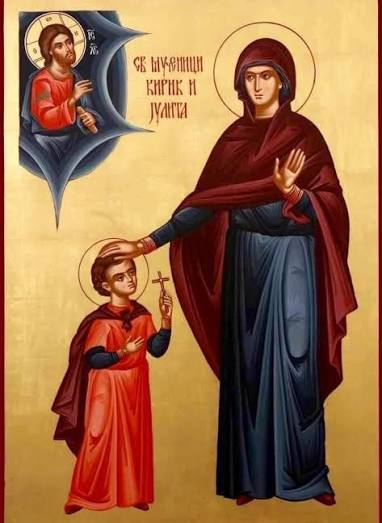
A Mother and Son Who Chose Christ Over Life Itself
Feast Day: July 15
“Out of the mouths of infants and children You have ordained praise.” — Psalm 8:2
Among the most moving stories of Christian martyrdom is that of Saints Kuriakose (Cyriacus) and Julitta, a mother and her three-year-old son who gave their lives for Jesus Christ during the fierce persecutions of the early Church. Their witness demonstrates that faith is not measured by age or strength but by unwavering trust in God. Julitta’s steadfast confession of Christ and the innocent courage of little Kuriakose have inspired Christians for more than seventeen centuries.
The Eastern Churches, including the Syro-Malabar Church, lovingly remember them as Saint Kuriakose and Saint Julitta, while in the Western tradition they are generally known as Saint Cyricus (Quiricus) and Saint Julitta.
Who Were Saints Kuriakose and Julitta?
Saint Julitta was a wealthy Christian widow who lived in Iconium (modern-day Konya in Turkey) during the late third or early fourth century. She had one son, Kuriakose (Cyriacus), who was only about three years old.
This was a time when Christians lived under constant threat of persecution. Refusing to worship the Roman gods or the emperor could result in imprisonment, torture, or death.
When the persecution intensified under Emperor Diocletian, Julitta chose to flee with her young son rather than deny her faith. Taking only two faithful servants with her, she left her home in search of safety.
However, their journey eventually brought them to Tarsus, where they were recognized as Christians and arrested.
The Roman Persecution
The persecution under Emperor Diocletian (303–311 AD) was among the most severe in Christian history.
Christians were ordered to:
- Offer sacrifices to pagan gods.
- Burn incense before images of the emperor.
- Renounce Christ publicly.
Those who refused often faced:
- Confiscation of property.
- Imprisonment.
- Torture.
- Execution.
Julitta firmly refused to deny Jesus Christ.
The Trial Before the Governor
Julitta and little Kuriakose were brought before the governor Alexander of Tarsus.
The governor demanded that Julitta offer sacrifice to the Roman gods.
She boldly replied that she worshipped only Jesus Christ, the true God.
Infuriated, the governor ordered her to be beaten mercilessly.
Meanwhile, little Kuriakose was taken from his mother’s arms and placed beside the governor.
The Courage of Little Kuriakose
According to the ancient tradition, the governor attempted to calm the child and persuade him to reject Christ.
Instead, the little boy repeatedly cried:
“I am a Christian!”
The governor, enraged by the child’s fearless confession, struck him violently.
Tradition tells us that he then threw the child down the stone steps of the judgment seat. The little boy suffered fatal injuries and died almost immediately.
Thus, at only three years of age, Kuriakose became one of the youngest martyrs honored by the Church.
His courage fulfilled Christ’s words:
“Whoever acknowledges Me before others, I also will acknowledge before My Father in heaven.” (Matthew 10:32)
Julitta’s Final Witness
Rather than despair at the death of her son, Julitta thanked God that Kuriakose had entered heaven before her.
The governor again demanded that she sacrifice to idols.
She answered:
“I worship only Jesus Christ.”
She was subjected to further torture.
Finally, she was condemned to death and beheaded, joining her son in eternal glory.
Historical Sources
The story of Saints Kuriakose and Julitta has been preserved through early Christian traditions and martyrologies. While historians recognize that some details of the surviving accounts may have been embellished over time—as is common with many ancient martyr narratives—the Church has long venerated them as authentic early martyrs who died during the Diocletian persecution.
Their witness was widely known by the fifth century, and devotion to them spread throughout both the Eastern and Western Christian worlds.
Spread of Their Devotion
The veneration of Saints Kuriakose and Julitta spread rapidly across Christendom.
Churches dedicated to them appeared in:
- Syria
- Asia Minor
- Constantinople
- Greece
- Italy
- France
- Spain
- England
Many ancient churches still bear their names.
The devotion became especially strong in the Eastern Churches.
Their Relics
The relics of Saints Kuriakose and Julitta have a long and complex history.
Over the centuries, relics attributed to them have been enshrined in several churches across Europe and the Middle East. Among the best-known are:
- The Abbey of Saint-Cyr-et-Sainte-Julitte in Nevers, France, an important medieval center of devotion.
- Churches in Rome, where relics associated with early martyrs have long been venerated.
- Several Orthodox churches in Greece and the Middle East, which preserve relics or ancient traditions connected with the saints.
As with many early martyrs, the distribution of relics across different churches reflects centuries of translation (the ceremonial transfer of relics) and widespread devotion.
Patronage
Saints Kuriakose and Julitta are patrons of:
- Children
- Mothers
- Families
- Orphans
- Those suffering persecution
- The sick
- Those seeking courage in faith
Many parents ask their intercession for the protection of their children.
Devotion in India
The devotion to Saint Kuriakose is especially vibrant among the Saint Thomas Christians of Kerala.
Many churches, chapels, and shrines are dedicated to Saint Kuriakose, including well-known pilgrimage centers where thousands gather annually for the feast. The saint is affectionately invoked as a powerful intercessor for children, families, and those facing illness or hardship. In many Syro-Malabar families, “Kuriakose” remains a cherished baptismal name, reflecting the deep and enduring devotion to this young martyr.
The combined witness of Saint Kuriakose and Saint Julitta continues to inspire Christian parents to nurture their children in faith, courage, and love for Christ.
Lessons from Their Lives
1. Faith Is Worth Every Sacrifice
Julitta chose fidelity to Christ over wealth, comfort, and even her own life.
2. Parents Shape the Faith of Their Children
Although Kuriakose was only a small child, he had already learned to love Jesus from his mother.
Parents remain the first and most important teachers of the faith.
3. Courage Has No Age
The Church honors Kuriakose because holiness is not limited by age.
Children, too, can become powerful witnesses to Christ.
4. Love Is Stronger Than Fear
Julitta did not allow fear of death to overcome her love for God.
Her courage continues to inspire Christian mothers around the world.
A Christian Reflection
The story of Saints Kuriakose and Julitta reminds believers that discipleship often demands courage and perseverance. Their witness echoes Jesus’ teaching:
“Whoever loves son or daughter more than me is not worthy of me.” (Matthew 10:37)
Julitta’s steadfast faith and Kuriakose’s innocent confession reveal that true strength comes not from physical power but from trust in God. Their lives encourage Christian families to cultivate a faith that is lived with conviction, passed on across generations, and sustained even in times of suffering.
Prayer to Saints Kuriakose and Julitta
O Saints Kuriakose and Julitta, faithful mother and courageous child, you remained steadfast in your love for Christ even in the face of persecution and death. Intercede for our families, especially for mothers and children. Obtain for us the grace to remain faithful to the Gospel, to raise our children in the knowledge and love of God, and to trust in the Lord during every trial. Through your prayers, may we grow in courage, hope, and holiness, until we share with you the joy of eternal life. Amen.
Conclusion
Saints Kuriakose and Julitta stand among the most touching examples of Christian martyrdom. Their story is not merely one of suffering but of victorious faith—a mother’s unwavering devotion and a child’s fearless confession of Christ. Across the centuries, they continue to remind the faithful that the love of God is stronger than fear, stronger than persecution, and even stronger than death.
As the Church celebrates their feast on July 15, may their witness inspire families everywhere to remain rooted in Christ, to hand on the faith with love and courage, and to trust that those who remain faithful to the end will receive the crown of life (Revelation 2:10).
Leave a Reply