
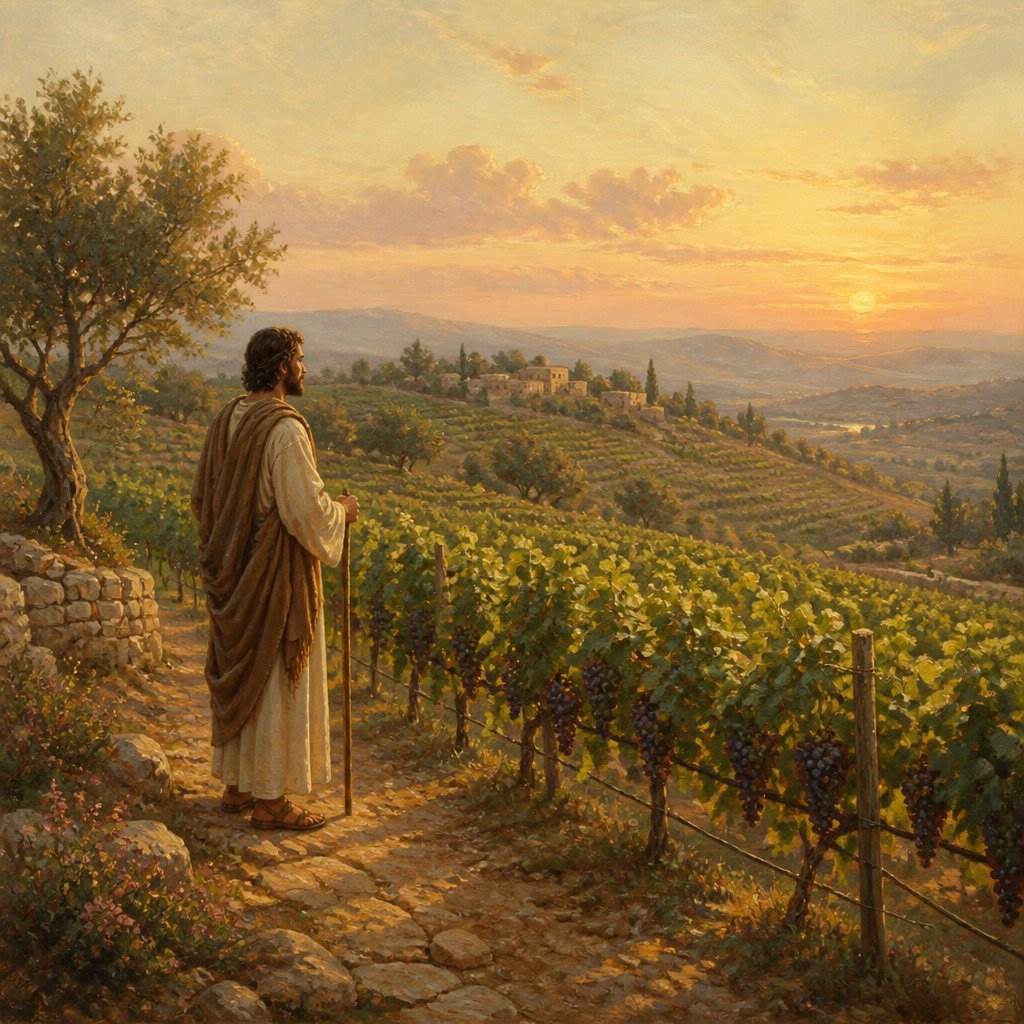
The Vineyard Belongs to God
Matthew 21:33-43
Jesus tells a parable about a vineyard: a story that reveals the depth of God’s loving care for His people.
The landowner carefully prepares his vineyard. He plants the vines, builds a protective fence, digs a winepress, and raises a watchtower. Then he entrusts the vineyard to tenants and goes away.
St. Jerome explains that the vineyard represents the house of Israel, God’s beloved people. The fence signifies God’s protection and providence. The winepress points to the altar, sacrifice, and worship. The tower signifies the Temple and the Law, from which God’s people were meant to watch for the coming of the Messiah. God had given Israel His worship, His prophets, His Law, His Temple, and His Word—everything necessary to prepare for the Messiah.
Everything is ready. Nothing essential is lacking.
The vineyard is not the tenants’ possession; it belongs to the one who planted it. Those entrusted with caring for God’s people are not owners, but servants. Their calling is not merely to live faithfully themselves, but to help others grow in faith and holiness. That is the truth the tenants forget, and it is the tragedy Jesus places before us.
As Pope Francis has often reminded the Church, those who lead are called to nurture, tend, and protect the vineyard—not to take possession of it for their own interests.
God gave the vineyard’s caretakers room to act freely. He does not treat us as machines. He entrusts us with real choices and real responsibilities. But freedom is not permission to forget the Owner. It is the space in which love becomes faithful service.
We can use our freedom to cultivate what is good. Or we can neglect what God has given us, resist correction, and keep for ourselves what was meant for His glory.
This responsibility belongs to each of us according to our vocation. Parents, priests, teachers, catechists, and all who serve the Church are called to help others bear good fruit. Yet we can all be tempted to forget the One who planted and cares for the vineyard.
God entrusts each of us with gifts and responsibilities: our faith, our families, our parish, our work, and the people who depend on us. We are not owners of these gifts, but stewards. He looks for the fruits of faith, obedience, justice, mercy, and love.
Each of us can ask: Am I helping those entrusted to me draw closer to God, or am I making the vineyard serve my own interests?
The Lord gives us responsibility not to possess His gifts, but to serve faithfully and help His people flourish.
When the harvest draws near, the owner sends servants to receive the fruit of the vineyard. But the tenants beat some, kill others, and stone others. They do not merely refuse to give the owner his due. They reject the very people sent to remind them that the vineyard belongs to someone else.
St. Jerome sees in these servants the prophets whom Israel repeatedly rejected, persecuted, and killed, who were sent to call his people back to faithfulness. Yet God does not abandon them after the first refusal. He sends more servants. His patience is not indifference to sin; it is mercy still calling us to return.
God does not abandon His people at the first refusal. He continues to call, to warn, to invite, and to seek our return. When God’s Word unsettles us, when our conscience reminds us of a neglected duty, or when someone calls us to make things right, we should recognize an invitation from the Lord: Return to the purpose for which the vineyard was given to you. Begin again.
At last, the landowner sends his son. When the tenants saw the son, they said to one another, ‘This is the heir. Come, let us kill him and acquire his inheritance.’ Their words expose the heart of sin: they know the Son’s identity yet choose what they want over what is right. We may not say aloud, “Let us seize the inheritance,” but we can live as though our time, talents, relationships, and responsibilities belong only to us.
The tenants’ crime is not merely that they reject the owner’s servants. They want to keep the vineyard for themselves. This is a warning against treating God’s gifts as though they were our possessions. Their rejection of the heir as an attempt to set their own claim to righteousness in place of faith in Christ.
The vineyard—and the people and gifts placed within it—belong to God. We are stewards, called to cultivate them faithfully and offer Him their fruits.
The owner’s final act reveals the depth of divine mercy. He sends his son, even though He knows the possibility of rejection. God’s mercy reaches out even when it may be refused. That does not make our response less important; it makes the invitation more urgent.
The parable finds its center in Christ: “The stone rejected by the builders has become the cornerstone.”
The rejected Son does not come merely to reclaim what belongs to His Father; but through His death and Resurrection, He gathers a people as His inheritance. As Saint Augustine observes, the evil intentions of the tenants turn against them: they kill the heir in order to seize the inheritance, but through His death Christ receives His people.
But the cornerstone also demands a decision.
If we continually reject Christ, refuse mercy, and cling to sin, then the stone becomes a sign of judgment.
So today, let us not hear this parable only as a story about other people. Jesus leads His hearers to pronounce judgment on the wicked tenants, and then He turns that judgment into a mirror. We must ask: Where have I acted as though God’s vineyard belongs to me? Where have I resisted His servants? Where have I rejected His Word? Where have I tried to keep the inheritance while excluding the Son?
The good news is that Christ does not come merely to take something from us. He comes to make us His own and to bring us into His inheritance. He is the cornerstone who joins what was separated and gathers one people from every nation. If He is the cornerstone, then our choices, relationships, priorities, work, and service will be built upon Him.
Let us therefore receive the Son whom the Father has sent. Let us return the vineyard to its true Lord—not by abandoning our responsibilities, but by fulfilling them faithfully. Let our homes become places of prayer and forgiveness. Let our parish become a place of service and communion. Let our daily work become an offering. Let our lives bear the fruit of faith, hope, and love.
The vineyard belongs to God.
Christ is the cornerstone.
And our calling is to remain faithful stewards until the day the Lord comes seeking fruit.
Amen.
✍ Fr. Tojan Abraham MCBS, Memphis, USA
Leave a Reply