
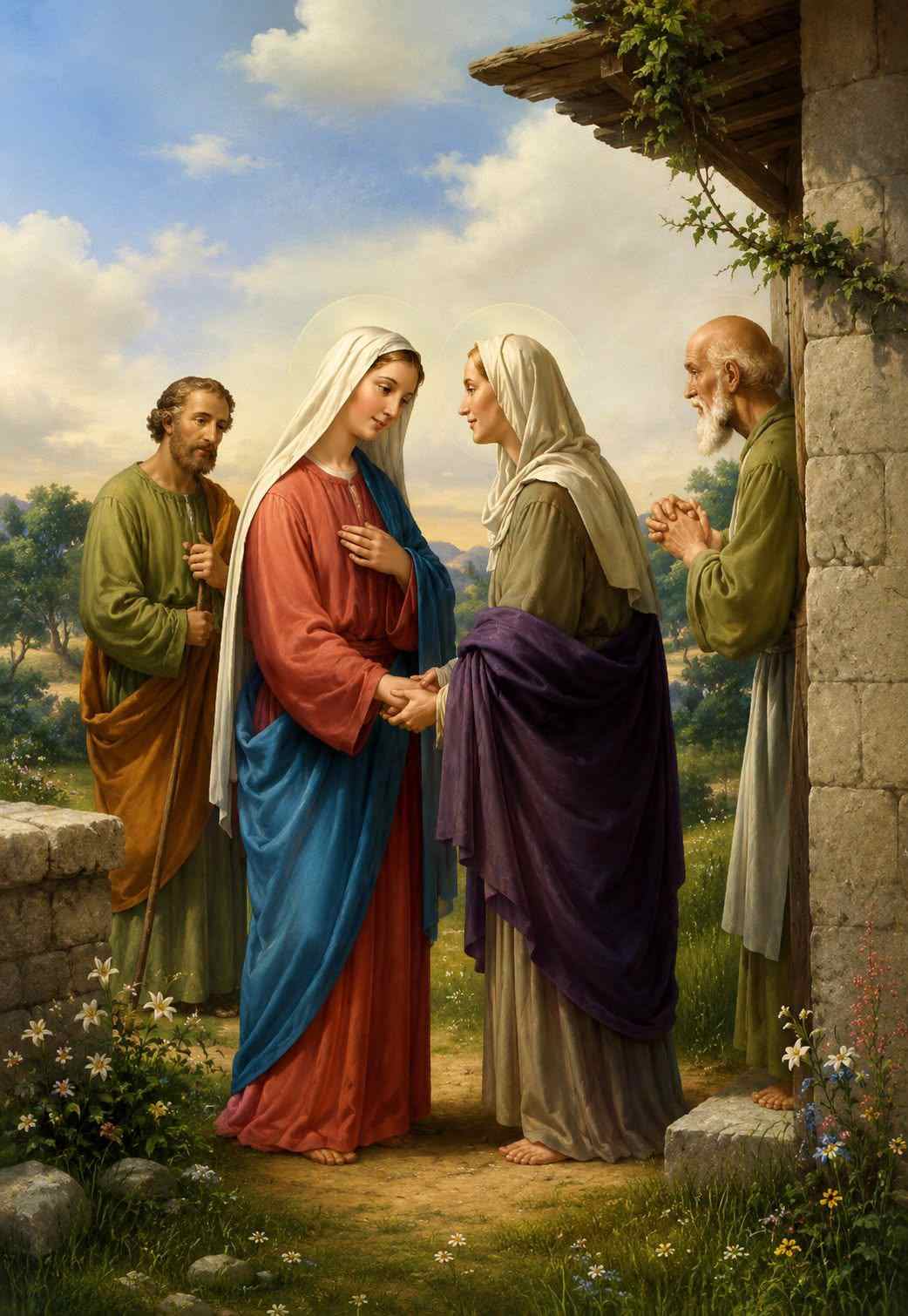
A Celebration of Humility, Joy, and Loving Service
“Blessed are you among women, and blessed is the fruit of your womb.” (Luke 1:42)
The Feast of the Visitation of the Blessed Virgin Mary, celebrated by the Catholic Church on 31 May, commemorates one of the most beautiful encounters recorded in the Gospel of Saint Luke. It recalls the journey of the Virgin Mary to visit her elderly cousin Elizabeth shortly after the Annunciation. Though seemingly simple, this event is filled with profound spiritual meaning. It is a celebration of faith in action, joyful service, humility, and the recognition of God’s saving presence.
The Visitation is more than a family reunion. It is the meeting of the Old and New Covenants, the encounter of two miraculous pregnancies, and the first proclamation of Christ’s presence in the world. It is also the occasion on which Mary offers one of the most inspiring hymns of praise ever composed—the Magnificat.
Biblical Foundation
The account of the Visitation is found in Luke 1:39–56.
After the Archangel Gabriel announced that Mary would become the Mother of the Messiah, he also revealed that her elderly relative Elizabeth had conceived a son despite her old age.
Without hesitation, Mary “set out and traveled to the hill country in haste” to visit Elizabeth. This journey covered nearly 130–150 kilometers from Nazareth to the hill country of Judea. It likely took several days on foot.
When Mary greeted Elizabeth, something extraordinary happened.
“When Elizabeth heard Mary’s greeting, the infant leaped in her womb, and Elizabeth, filled with the Holy Spirit, cried out in a loud voice: ‘Most blessed are you among women, and blessed is the fruit of your womb.’” (Luke 1:41–42)
The unborn child, John the Baptist, recognized the presence of Jesus even before birth. Christian tradition sees this as John’s first prophetic act.
Elizabeth continued:
“And how does this happen to me, that the mother of my Lord should come to me?” (Luke 1:43)
This is the first recorded acknowledgment of Mary as the Mother of the Lord, a title that points directly to Christ’s divinity.
Mary then responded with the magnificent hymn known as the Magnificat (Luke 1:46–55), praising God’s mercy, justice, and faithfulness.
Mary remained with Elizabeth for about three months before returning home.
Historical Development of the Feast
Although Christians reflected upon the Visitation from the earliest centuries, the feast developed gradually within the Church’s liturgical calendar.
The feast was first celebrated in some local Churches during the Middle Ages.
In 1263, the Franciscan Saint Bonaventure encouraged devotion to the mystery.
The feast gained wider acceptance when Pope Urban VI promoted it in 1389, praying that the Blessed Virgin would bring peace and unity to a divided Church during the Western Schism.
Originally, the feast was celebrated on 2 July, immediately after the Octave of the Nativity of Saint John the Baptist.
Following the liturgical reforms after the Second Vatican Council, the feast was moved to 31 May, placing it naturally between the Annunciation (25 March) and the Birth of John the Baptist (24 June), thereby following the chronological order of the Gospel events.
The Spiritual Meaning of the Visitation
1. Mary’s Immediate Response to God’s Call
Mary had just received the greatest privilege in human history: becoming the Mother of God.
Instead of thinking only about herself, she immediately thought of someone else.
The Gospel says:
“Mary set out in haste.”
Her journey demonstrates that authentic faith always leads to loving service.
A Christian who truly welcomes Christ becomes eager to share Him with others.
2. Charity in Action
Mary traveled a long and difficult road simply to assist Elizabeth.
She expected no recognition.
She asked for nothing in return.
For approximately three months she helped Elizabeth during the final stage of pregnancy.
The Visitation teaches that love is shown not merely through words but through practical acts of kindness.
3. Christ Is Brought to Others Through Mary
Mary carried Jesus within her.
Wherever she went, Christ went.
The first person to receive Jesus outside the womb of Mary was Elizabeth.
The first to rejoice in His presence was John the Baptist.
The first home to welcome Christ became filled with the Holy Spirit.
This reveals Mary’s unique role in salvation history: she brings people to Jesus and Jesus to people.
4. Joy in God’s Presence
One of the dominant themes of the Visitation is joy.
Elizabeth rejoices.
John leaps in the womb.
Mary sings.
The Holy Spirit fills the household.
Christian joy is not merely emotional happiness but the deep peace that comes from encountering Christ.
5. Humility
Mary never draws attention to herself.
Instead, she points entirely toward God.
Her Magnificat begins:
“My soul proclaims the greatness of the Lord.”
Every line glorifies God’s mercy rather than Mary’s own greatness.
This humility remains one of the defining characteristics of authentic Christian discipleship.
The Magnificat: Mary’s Song of Praise
The Magnificat (Luke 1:46–55) is among the Church’s greatest prayers.
It echoes many Old Testament passages, especially the song of Hannah.
Its principal themes include:
- God’s mercy
- God’s faithfulness
- Care for the poor
- Justice
- Humility
- Fulfillment of God’s promises
- Salvation history
Every evening throughout the world, the Church prays the Magnificat during Evening Prayer (Vespers), making Mary’s hymn a daily prayer of praise.
Elizabeth’s Example of Faith
Elizabeth demonstrates remarkable spiritual insight.
Filled with the Holy Spirit, she recognizes:
- Mary’s unique dignity.
- Jesus’ divine identity.
- Mary’s faith.
She declares:
“Blessed are you who believed that what was spoken to you by the Lord would be fulfilled.”
Elizabeth teaches believers to rejoice in God’s work in others rather than become jealous or resentful.
John the Baptist’s First Witness
The unborn John the Baptist leaps for joy in Elizabeth’s womb.
The Church has long interpreted this event as John’s sanctification before birth.
Even before his birth, he fulfills his mission of pointing toward Christ.
This passage has also become one of the biblical foundations for the Church’s teaching on the dignity and sanctity of unborn human life.
Lessons for Christians Today
The Visitation offers timeless lessons.
Faith Should Lead to Action
Mary did not remain inactive after receiving God’s grace.
True faith expresses itself through service.
Serve Without Seeking Recognition
Mary’s greatest works occurred quietly.
Most Christian service happens unnoticed but is precious in God’s sight.
Bring Christ Everywhere
Christians are called to carry Christ into homes, workplaces, schools, hospitals, and society through both words and actions.
Rejoice in Others’ Blessings
Elizabeth celebrated Mary’s vocation instead of envying it.
Christians are invited to rejoice whenever God blesses another person.
Live in Humility
Mary teaches believers to direct all praise to God.
Humility opens the heart to God’s grace.
The Visitation in Christian Art
The Visitation has inspired countless masterpieces throughout Christian history.
Artists often depict:
- Mary embracing Elizabeth.
- John leaping in Elizabeth’s womb.
- Elizabeth kneeling before Mary.
- The meeting in a peaceful Judean village.
- Mary’s radiant humility.
These artistic portrayals emphasize joy, maternal love, and the recognition of Christ’s hidden presence.
Patronage and Devotion
The mystery of the Visitation is especially meaningful for:
- Expectant mothers
- Families
- Caregivers
- Healthcare workers
- Missionaries
- Those engaged in charitable service
- People discerning God’s will
Many Catholic communities celebrate the feast through Marian processions, recitation of the Rosary, works of charity, and reflection on the Magnificat.
Living the Spirit of the Visitation
The Feast of the Visitation challenges every Christian to imitate Mary’s generous love.
Like Mary, believers are called to:
- Respond quickly to God’s invitations.
- Place others before themselves.
- Carry Christ into every situation.
- Serve joyfully.
- Praise God in every circumstance.
- Become instruments of peace and hope.
The Visitation reminds us that holiness is often found in ordinary acts of love offered with extraordinary faith.
Conclusion
The Feast of the Visitation of the Blessed Virgin Mary celebrates far more than a meeting between two relatives. It marks the first missionary journey of Christ, carried in the womb of His Mother, and the joyful recognition of the Savior by Elizabeth and the unborn John the Baptist. In this encounter, the Church discovers a model of faith that blossoms into loving service, humility, and praise.
Mary’s visit transformed a household because she brought Jesus with her. Today, every Christian is invited to follow her example: to carry Christ into the world through acts of compassion, encouragement, and selfless love. As we celebrate this feast, may we echo Mary’s words in our own lives: “My soul proclaims the greatness of the Lord,” and may our actions reveal His presence wherever we go.
External References
- Luke 1:39–56
- Catechism of the Catholic Church (CCC 717, 721–726, 2619)
- Vatican II – Lumen Gentium, Chapter VIII
- Pope Saint Paul VI – Marialis Cultus
Call to Action
As we celebrate the Feast of the Visitation of the Blessed Virgin Mary, let us imitate Mary’s generosity by carrying Christ to others through acts of love, compassion, and humble service. Share this reflection with your family and friends, and may Our Lady inspire you to proclaim God’s greatness in your daily life.
Leave a Reply