
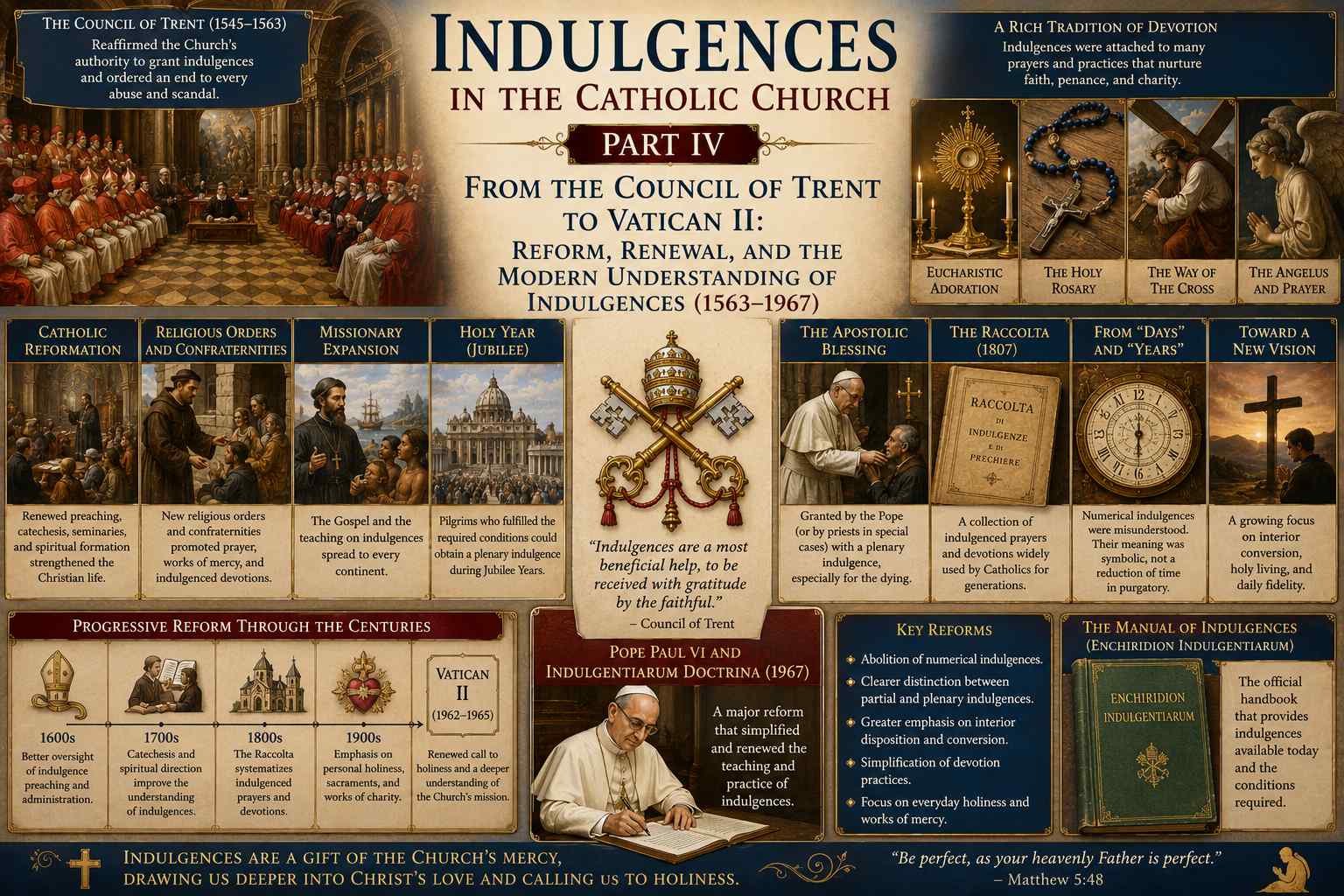
Part IV
From the Council of Trent to Vatican II: Reform, Renewal, and the Modern Understanding of Indulgences (1563–1967)
Introduction
The Council of Trent marked a turning point in the history of indulgences. While reaffirming their theological legitimacy, the Council also acknowledged that abuses had obscured their true purpose. The centuries that followed witnessed a gradual process of reform, clarification, and standardization. Rather than abandoning indulgences, the Church sought to restore them to their proper place within the Christian life—as aids to conversion, prayer, penance, and charity.
From the close of the Council of Trent until the reforms of Pope Paul VI, indulgences became more carefully regulated and increasingly integrated into the spiritual life of ordinary Catholics.
Trent’s Lasting Reform
One of the Council’s final decrees addressed indulgences directly.
The Council reaffirmed:
- that Christ entrusted the Church with the authority to grant indulgences,
- that indulgences are spiritually beneficial,
- that they encourage repentance and holy living,
- and that the faithful should continue to make use of them.
At the same time, the Council ordered bishops to eliminate every appearance of abuse.
It specifically condemned:
- dishonest fundraising,
- exaggerated preaching,
- commercial exploitation,
- and any practice that caused scandal among the faithful.
The Council emphasized that indulgences should always direct believers toward sincere conversion rather than external observances alone.
The Age of Catholic Renewal
The period after Trent became known as the Catholic Reformation or Counter-Reformation.
Rather than focusing solely on responding to Protestant criticisms, the Church undertook a broad program of internal renewal.
This renewal included:
- improved seminaries for priestly formation,
- better preaching,
- renewed catechesis,
- liturgical reform,
- missionary expansion,
- and greater emphasis on personal holiness.
Indulgences were increasingly linked to these broader spiritual reforms.
The Rise of Popular Devotions
Between the sixteenth and nineteenth centuries, Catholic devotional life flourished.
Many familiar practices became associated with indulgences, including:
- Eucharistic adoration,
- meditation before the Blessed Sacrament,
- the Holy Rosary,
- the Way of the Cross,
- the Angelus,
- spiritual reading,
- acts of charity,
- visits to churches,
- and prayers for the faithful departed.
These indulgences encouraged Catholics to cultivate habits of prayer throughout daily life rather than viewing indulgences as isolated spiritual privileges.
The Jesuit Influence
The newly founded Society of Jesus played an important role in promoting authentic Catholic spirituality.
Inspired by Saint Ignatius of Loyola, Jesuit missionaries and educators emphasized:
- frequent confession,
- regular reception of Holy Communion,
- examination of conscience,
- retreats,
- catechesis,
- and missionary outreach.
Indulgences became integrated into this broader vision of ongoing spiritual conversion rather than extraordinary religious events.
New Religious Orders and Spiritual Renewal
Other religious communities also contributed to the renewal of indulgenced devotions.
Among them were:
- the Order of Friars Minor,
- the Order of Preachers,
- the Order of Discalced Carmelites,
- the Congregation of the Mission,
- and numerous confraternities.
Many devotional confraternities received specific indulgences that encouraged works of mercy, prayer, and service to the poor.
Missionary Expansion
From the sixteenth century onward, Catholic missionaries carried the Church’s teaching on indulgences across the world.
Missionaries established Christian communities in:
- the Americas,
- Africa,
- India,
- China,
- Japan,
- Southeast Asia,
- and Oceania.
Indulgenced prayers and devotions became familiar elements of Catholic life wherever the Church spread.
Although local customs varied, the essential theological principles remained universal.
The Holy Year (Jubilee) Tradition
One of the most enduring expressions of indulgences was the Holy Year, or Jubilee.
Originating in 1300, the practice continued after Trent with increasing regularity.
Pilgrims who fulfilled the required spiritual conditions could obtain a plenary indulgence by:
- making designated pilgrimages,
- receiving the Sacraments,
- praying for the Pope’s intentions,
- and performing prescribed acts of devotion.
The Jubilee became a visible sign of reconciliation, renewal, and God’s mercy.
The Apostolic Blessing
Another significant development was the indulgence attached to the Apostolic Blessing.
Granted by the Pope—or by priests authorized in particular circumstances, especially for the dying—it carried a plenary indulgence for those properly disposed.
This practice highlighted the Church’s pastoral concern that the faithful be strengthened by grace at life’s final moments.
The Raccolta
By the nineteenth century, numerous indulgences had accumulated over centuries.
To provide order and consistency, the Church published collections of indulgenced prayers.
The best known was the Raccolta, first issued in 1807 and expanded in later editions.
It included:
- traditional prayers,
- litanies,
- novenas,
- devotional practices,
- aspirations,
- acts of faith,
- acts of hope,
- acts of charity,
- and numerous indulgenced works.
For generations, the Raccolta became one of the most widely used devotional books in the Catholic world.
Understanding “Days” and “Years”
One persistent misunderstanding involved the traditional designation of indulgences as:
- forty days,
- one year,
- seven years,
- three hundred days,
- and similar expressions.
These numbers did not indicate time removed from purgatory.
Instead, they referred symbolically to the equivalent value of the ancient canonical penances once assigned in the early Church.
Nevertheless, many Catholics misunderstood these designations.
Recognizing this confusion, the Church eventually abandoned the numerical system.
The Twentieth Century
The twentieth century witnessed rapid changes in Catholic theology, biblical studies, liturgy, and pastoral practice.
Increasing emphasis was placed on:
- active participation in the liturgy,
- Scripture,
- interior conversion,
- personal holiness,
- and the universal call to sanctity.
Many theologians argued that indulgences should be understood less as juridical calculations and more as expressions of God’s mercy that encourage authentic spiritual growth.
This perspective would profoundly influence later reforms.
The Second Vatican Council
Although the Second Vatican Council did not issue a separate decree on indulgences, its teaching profoundly shaped the Church’s pastoral approach.
Vatican II emphasized:
- the universal call to holiness,
- the centrality of Christ,
- the importance of Scripture,
- active participation in the liturgy,
- ecumenical dialogue,
- and continual conversion.
These themes encouraged a renewed understanding of indulgences within the broader context of Christian discipleship.
Pope Paul VI and Indulgentiarum Doctrina (1967)
The most significant modern reform came under Pope Paul VI.
On 1 January 1967, he issued the Apostolic Constitution Indulgentiarum Doctrina, which thoroughly revised the discipline of indulgences.
The document retained the Church’s traditional doctrine while introducing important reforms.
Among the most significant changes were:
1. Abolition of Numerical Indulgences
References such as:
- “300 days,”
- “7 years,”
- “40 days,”
were abolished because they had become widely misunderstood.
Henceforth, indulgences would simply be classified as:
- Partial Indulgences
- Plenary Indulgences
2. Greater Emphasis on Interior Conversion
The document stressed that indulgences are effective only when accompanied by:
- sincere repentance,
- faith,
- charity,
- detachment from sin,
- and participation in the sacramental life of the Church.
External actions alone were never sufficient.
3. Simplification
Many obsolete or rarely used indulgences were removed.
The Church sought to emphasize those practices most beneficial for the spiritual life.
4. Focus on Everyday Holiness
Rather than concentrating on extraordinary devotions alone, the reform highlighted ordinary Christian living.
Acts worthy of indulgences included:
- prayer,
- works of mercy,
- sacrifices offered with love,
- patient acceptance of suffering,
- Scripture reading,
- Eucharistic adoration,
- and faithful fulfillment of daily duties.
The emphasis shifted from accumulating indulgenced acts to fostering genuine holiness.
The New Manual of Indulgences
Following these reforms, the Church published the Enchiridion Indulgentiarum (Manual of Indulgences), replacing the Raccolta.
This official handbook provides:
- general grants of partial indulgences,
- specific plenary indulgences,
- prayers,
- devotional practices,
- and the conditions required for obtaining them.
It remains the authoritative guide used throughout the Catholic Church today.
Conclusion
From the Council of Trent to the reforms of Pope Paul VI, the Church undertook a remarkable journey of renewal. While preserving the doctrine of indulgences, she continually refined their pastoral application, corrected misunderstandings, and encouraged the faithful to see indulgences not as spiritual transactions but as invitations to deeper conversion.
The reforms of Indulgentiarum Doctrina marked the culmination of centuries of development. By simplifying the discipline and emphasizing interior holiness, the Church presented indulgences in a way that is faithful to tradition while speaking clearly to the modern world.
Today, indulgences remain an expression of the Church’s maternal care, inviting believers to draw more deeply from the inexhaustible mercy of Christ.
Looking Ahead: Part V
In the concluding installment, we will explore Indulgences in the Catholic Church Today, including:
- The difference between partial and plenary indulgences
- The current conditions for obtaining an indulgence
- The Enchiridion Indulgentiarum
- Major indulgences available today
- Jubilee indulgences
- The Portiuncula Indulgence
- Divine Mercy Sunday
- The Apostolic Blessing
- Indulgences for the faithful departed
- Common misconceptions
- Frequently Asked Questions
- Why indulgences remain relevant in the twenty-first century
Leave a Reply