
Introduction
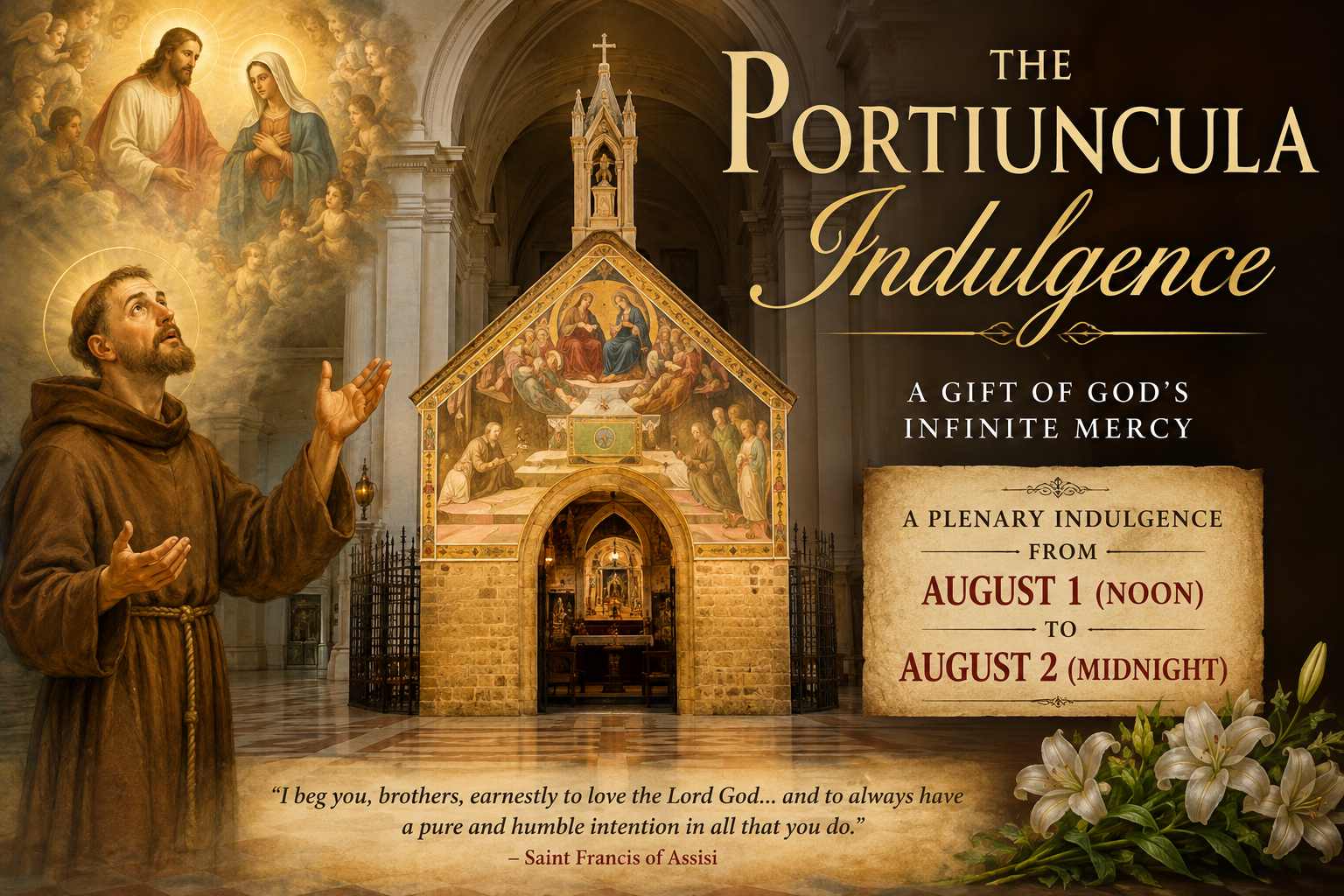
Among the many spiritual treasures of the Catholic Church, the Portiuncula Indulgence occupies a special place. Rooted in the spirituality of Saint Francis of Assisi, this extraordinary indulgence reminds Christians that God’s mercy is boundless and available to all who sincerely repent. Often called the Pardon of Assisi, it offers the faithful an opportunity to receive a plenary indulgence through prayer, confession, Holy Communion, and detachment from sin.
Celebrated annually from August 1 (noon) until midnight on August 2, the Portiuncula Indulgence continues to inspire millions of Catholics around the world to seek reconciliation with God and renew their spiritual lives.
What Is the Portiuncula?
The word Portiuncula means “little portion” in Italian. It refers to a tiny chapel dedicated to Our Lady of the Angels, located just outside Assisi in Italy.
The chapel is one of the holiest places in Franciscan history. When Saint Francis of Assisi discovered the neglected little church around 1205, he lovingly restored it with his own hands. It soon became the spiritual birthplace of the Franciscan movement.
Here Francis:
- Founded the Order of Friars Minor.
- Welcomed Saint Clare of Assisi into religious life.
- Received numerous mystical graces.
- Spent many hours in prayer and contemplation.
- Died peacefully in 1226 after asking to be brought back to the Portiuncula.
Today the tiny chapel is enclosed within the magnificent Basilica of Saint Mary of the Angels, one of the world’s most important Franciscan pilgrimage sites.
The Origin of the Portiuncula Indulgence
The tradition dates to the year 1216.
According to Franciscan tradition, one night while praying in the Portiuncula, Saint Francis experienced a vision of Jesus Christ and the Blessed Virgin Mary, surrounded by angels.
Jesus asked Francis:
“Francis, what do you desire for the salvation of souls?”
Moved by compassion for sinners, Francis replied that he wished all who entered the chapel with sincere repentance could receive complete forgiveness of their sins and the remission of temporal punishment.
Christ granted the request but instructed Francis to seek confirmation from the Pope.
Francis immediately traveled to Pope Honorius III, who approved this remarkable privilege.
Unlike many indulgences of the medieval period, Francis asked that no money, offerings, or pilgrimages be required.
He desired only that people come with:
- genuine repentance,
- sacramental confession,
- Holy Communion,
- and heartfelt prayer.
Thus began the “Pardon of Assisi.”
What Is an Indulgence?
An indulgence is one of the Church’s most misunderstood teachings.
The Catholic Church teaches that although sin is forgiven through the Sacrament of Reconciliation, there often remains the temporal consequences of sin.
An indulgence removes this temporal punishment through the merits of Christ and the communion of saints.
There are two kinds:
- Partial Indulgence – removes part of the temporal punishment.
- Plenary Indulgence – removes all temporal punishment due to forgiven sins.
The Portiuncula Indulgence is a plenary indulgence, provided all the required conditions are fulfilled.
The Spiritual Meaning
Saint Francis never viewed indulgences as a shortcut to heaven.
Rather, he saw them as an invitation to:
- deeper conversion,
- sincere repentance,
- sacramental life,
- renewed charity,
- and complete trust in God’s mercy.
The indulgence reflects one of Francis’s deepest convictions:
God’s mercy is greater than every human sin.
The Portiuncula therefore celebrates not merely forgiveness, but transformation.
Conditions for Receiving the Portiuncula Indulgence
The Church currently grants the Portiuncula Indulgence under the usual conditions for obtaining a plenary indulgence.
A Catholic should:
- Visit a parish church, Franciscan church, or the Portiuncula itself.
- Receive Sacramental Confession (within the customary time before or after).
- Receive Holy Communion.
- Pray for the intentions of the Pope (for example, one Our Father and one Hail Mary).
- Recite the Apostles’ Creed and the Our Father.
- Be completely detached from all sin, even venial sin.
These conditions are ordinarily fulfilled between noon on August 1 and midnight on August 2.
Why August 2?
August 2 commemorates the original granting of the indulgence.
Throughout the Franciscan world this day is celebrated as the Feast of Our Lady of the Angels of the Portiuncula, emphasizing God’s abundant mercy through the intercession of the Blessed Virgin Mary.
Many churches remain open throughout the day to welcome pilgrims seeking confession, Mass, and prayer.
The Franciscan Vision of Mercy
The Portiuncula Indulgence beautifully summarizes the spirituality of Saint Francis.
Francis believed:
- Mercy is stronger than judgment.
- Humility opens the heart to grace.
- Forgiveness restores human dignity.
- Every sinner can become a saint.
His ministry focused less on condemning sinners than on leading them back to Christ.
The indulgence became a visible expression of that mission.
The Basilica Today
The Basilica of Saint Mary of the Angels welcomes hundreds of thousands of pilgrims every year.
Visitors can pray inside the original stone chapel preserved beneath the basilica’s immense dome. Many describe the experience as surprisingly intimate despite the grandeur surrounding it.
The site continues to be one of the spiritual hearts of the Franciscan family.
Lessons for Modern Christians
In a world often marked by resentment, division, and anxiety, the Portiuncula Indulgence offers a timeless message:
- No one is beyond God’s forgiveness.
- Reconciliation is always possible.
- Mercy transforms lives.
- Grace begins with humility.
- Confession is not merely an obligation but a gift.
- Holiness grows through continual conversion.
Saint Francis reminds believers that God never tires of forgiving those who return with sincere hearts.
Frequently Asked Questions
Is the Portiuncula Indulgence only for Franciscans?
No. Any baptized Catholic who fulfills the required conditions may receive it.
Can it be offered for someone who has died?
Yes. Like other plenary indulgences, it may be applied to oneself or offered for the souls in purgatory.
Must I travel to Assisi?
No. Although the original indulgence is connected with the Portiuncula chapel, the Church permits the faithful to obtain it by visiting a parish church or a Franciscan church under the prescribed conditions.
Can it be received more than once?
The plenary indulgence associated with the Portiuncula is ordinarily obtained once during its designated observance, provided all the required conditions are met.
The Enduring Legacy
More than eight centuries after Saint Francis first pleaded for mercy on behalf of sinners, the Portiuncula Indulgence continues to proclaim the heart of the Gospel.
It is not merely a historical devotion but a living invitation to experience God’s forgiveness in a profound way. Every year, countless Catholics respond by approaching the sacraments, praying with renewed faith, and embracing lives of reconciliation.
The humble chapel that Saint Francis lovingly repaired still points the world toward the greatest miracle of all: the infinite mercy of God. Through the Portiuncula Indulgence, believers are reminded that no matter how far they have wandered, the Father’s embrace remains open, calling them home with love, forgiveness, and hope.
Here is an original prayer suitable for personal devotion, parish use, or publication.
Prayer for Obtaining the Portiuncula Indulgence
In the name of the Father, and of the Son, and of the Holy Spirit. Amen.
Heavenly Father,
I come before You with a humble and contrite heart, trusting in Your infinite mercy and boundless love. I thank You for the precious gift of the Portiuncula Indulgence, granted through the faithful witness of Saint Francis of Assisi, who desired that all Your children might experience the fullness of Your forgiveness.
Lord Jesus Christ, You came into the world not to condemn sinners but to save them. Through Your Passion, Death, and glorious Resurrection, You opened for us the gates of heaven and reconciled us to the Father. Wash me clean of every stain of sin, and strengthen my resolve to turn away from all that separates me from Your love.
Holy Spirit, fill my heart with sincere repentance. Help me to approach the Sacrament of Reconciliation with honesty and humility, to receive Holy Communion with deep faith and gratitude, and to pray faithfully for the intentions of the Holy Father. Grant me the grace to be detached from every sin, even the smallest, so that I may receive the plenary indulgence with a pure heart.
Merciful Father, through the merits of Jesus Christ, the intercession of the Blessed Virgin Mary under the title of Our Lady of the Angels, and the prayers of Saint Francis, may this sacred indulgence bring about a true renewal in my life. May it deepen my love for You, strengthen my faith, and inspire me to live the Gospel with joy and simplicity.
I also offer this indulgence, if it be Your holy will, for the souls in purgatory, especially those most forgotten and in greatest need of Your mercy. Welcome them into the eternal joy of Your heavenly kingdom, where every tear is wiped away and Your saints rejoice forever.
Lord, teach me to be an instrument of Your peace. May I forgive as I have been forgiven, love as I have been loved, and serve as Christ has served. Let my life become a witness to Your mercy, so that others may come to know the hope and healing found in You.
I entrust myself completely to Your loving care and ask that the grace of this indulgence bear lasting fruit in my soul, leading me ever closer to holiness and to the eternal joy of Your presence.
Through Christ our Lord.
Amen.
Closing Invocation
Saint Francis of Assisi, pray for us.
Our Lady of the Angels, pray for us.
All the Angels and Saints, pray for us.
Sacred Heart of Jesus, have mercy on us.
Immaculate Heart of Mary, pray for us.
In the name of the Father, and of the Son, and of the Holy Spirit. Amen.
This prayer is intended to accompany the spiritual practices associated with the Portiuncula Indulgence. To receive the indulgence itself, the faithful should also fulfill the Church’s prescribed conditions: sacramental confession, Holy Communion, prayer for the Pope’s intentions, a visit to the designated church, and complete detachment from sin.
Leave a Reply