
Part V
Indulgences in the Catholic Church Today: Current Teaching, Practice, and Spiritual Significance
Introduction
After nearly two thousand years of theological reflection, pastoral development, and ecclesiastical reform, indulgences remain an integral part of the spiritual life of the Catholic Church. Far from being relics of the medieval past, indulgences continue to express the Church’s conviction that Christ’s redeeming grace transforms believers, heals the effects of sin, and strengthens the faithful in their journey toward holiness.
The modern discipline of indulgences, shaped especially by Pope Paul VI in the Apostolic Constitution Indulgentiarum Doctrina (1967), emphasizes interior conversion, charity, and communion with Christ. Rather than encouraging merely external religious acts, the Church invites the faithful to see indulgences as a gift flowing from God’s mercy and the Communion of Saints.
This concluding article explains how indulgences are understood and practiced in the Catholic Church today.
What Is an Indulgence?
The Catholic Church defines an indulgence as:
“The remission before God of the temporal punishment due to sins whose guilt has already been forgiven.”
An indulgence therefore:
- does not forgive sins, because forgiveness comes through Baptism or the Sacrament of Reconciliation;
- does not replace Confession;
- does not guarantee salvation;
- does not permit future sin;
- does not remove the need for repentance.
Instead, it applies the merits of Christ and the saints to remit the temporal consequences that remain after sin has been forgiven.
Partial and Plenary Indulgences
The Church today recognizes two forms of indulgences.
1. Partial Indulgence
A partial indulgence remits part of the temporal punishment due to forgiven sins.
It is granted for many ordinary acts of Christian life performed with sincere faith, such as:
- devout prayer,
- reading Sacred Scripture,
- works of mercy,
- acts of charity,
- patient acceptance of suffering,
- teaching or defending the faith,
- and offering one’s daily work to God.
Partial indulgences encourage continual growth in holiness through everyday Christian living.
2. Plenary Indulgence
A plenary indulgence remits all temporal punishment due to sins already forgiven.
Because it represents the fullest application of the Church’s spiritual treasury, it requires greater spiritual preparation.
A plenary indulgence may generally be obtained only once each day, except in certain circumstances provided by the Church, particularly at the hour of death.
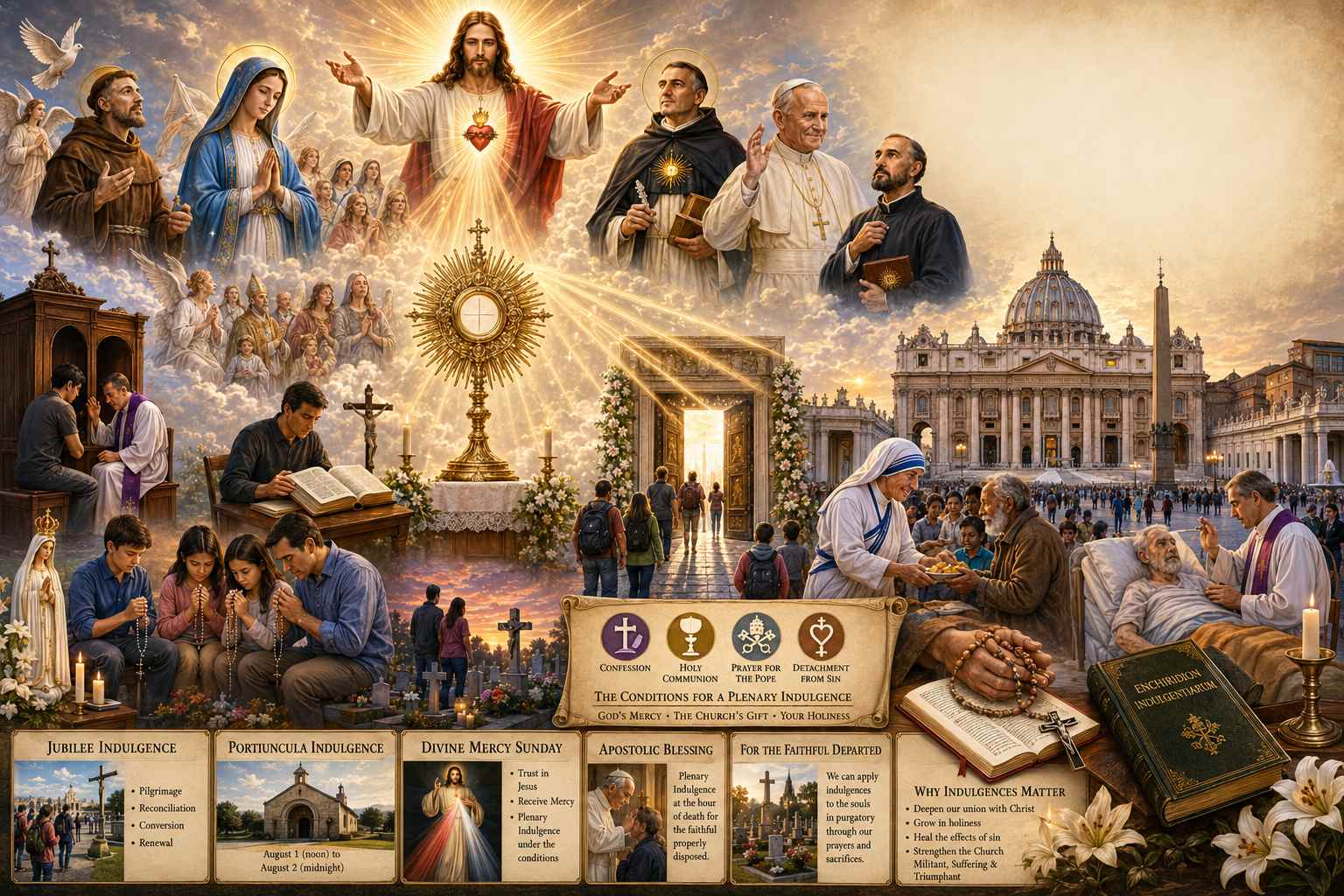
Ordinary Conditions for a Plenary Indulgence
To obtain a plenary indulgence, the faithful ordinarily must fulfill all of the following conditions:
1. Sacramental Confession
The person should receive the Sacrament of Reconciliation within the customary period before or after performing the indulgenced work.
One confession may suffice for several plenary indulgences if the person remains in the state of grace.
2. Holy Communion
Holy Communion should be received for each plenary indulgence sought.
Participation in the Eucharist unites the faithful more deeply with Christ, whose merits are the source of every indulgence.
3. Prayer for the Pope’s Intentions
The faithful should pray for the intentions of the Holy Father.
Traditionally, one Our Father and one Hail Mary are sufficient, although any suitable prayers may be used.
4. Complete Detachment from Sin
This is often considered the most demanding condition.
The faithful must possess sincere interior freedom from attachment to every sin, including venial sin.
Without this disposition, the indulgence becomes partial rather than plenary.
5. Performance of the Indulgenced Work
Finally, the prescribed indulgenced act itself must be completed according to the norms established by the Church.
Common Indulgenced Works Today
The Church grants indulgences for many acts that foster prayer, charity, and spiritual growth.
Some of the most common include:
Reading Sacred Scripture
Reading the Bible prayerfully for at least thirty minutes may obtain a plenary indulgence under the usual conditions.
Eucharistic Adoration
Adoring the Blessed Sacrament for at least thirty minutes may obtain a plenary indulgence.
The Holy Rosary
Reciting the Rosary in:
- a church,
- a family,
- a religious community,
- or another gathering of the faithful
may obtain a plenary indulgence.
The Way of the Cross
Prayerfully making the Stations of the Cross before legitimately erected stations may obtain a plenary indulgence.
Eucharistic Processions
Participating devoutly in Eucharistic processions, especially on the Solemnity of Corpus Christi, carries indulgences according to the Church’s norms.
Spiritual Retreats
Participating in a retreat lasting at least several full days may receive a plenary indulgence.
First Holy Communion
Those who receive their First Holy Communion—and the faithful who devoutly participate in the celebration—may receive a plenary indulgence under the prescribed conditions.
First Mass of a Newly Ordained Priest
Certain indulgences are attached to participation in these special liturgical celebrations.
Renewal of Baptismal Promises
Renewing one’s baptismal promises during the Easter Vigil or on the anniversary of one’s Baptism carries an indulgence under the Church’s norms.
Indulgences for the Faithful Departed
One of the most beautiful aspects of Catholic teaching is that indulgences may be offered for the souls undergoing purification.
The faithful may apply indulgences:
- to themselves,
- or to the faithful departed.
They cannot be applied to another living person.
Especially significant are:
- visits to cemeteries during the first days of November,
- prayers for the deceased,
- and participation in All Souls’ Day observances.
These practices express the Church’s belief in the enduring Communion of Saints.
The Jubilee Indulgence
Throughout the Church’s history, Jubilee Years have been extraordinary occasions of grace.
During a Jubilee, the Pope designates special churches, pilgrimage sites, or other acts through which the faithful may obtain a plenary indulgence, provided they fulfill the ordinary conditions.
The Jubilee emphasizes:
- reconciliation,
- mercy,
- pilgrimage,
- conversion,
- and renewed commitment to Christian discipleship.
The Portiuncula Indulgence
Celebrated annually from August 1 (noon) until midnight on August 2, the Portiuncula Indulgence, also called the Pardon of Assisi, remains one of the Church’s most cherished indulgences.
Instituted through the tradition associated with Saint Francis of Assisi, it invites the faithful to seek God’s mercy by:
- visiting a parish or Franciscan church,
- receiving Confession,
- receiving Holy Communion,
- praying for the Pope’s intentions,
- reciting the Apostles’ Creed and the Our Father,
- and being detached from all sin.
It beautifully reflects the Franciscan emphasis on God’s boundless mercy.
Divine Mercy Sunday
In recent decades, Saint John Paul II encouraged devotion to Divine Mercy Sunday, celebrated on the Second Sunday of Easter.
Under the conditions established by the Church, participation in Divine Mercy devotions may obtain a plenary indulgence.
This devotion emphasizes complete trust in Christ’s infinite mercy.
The Apostolic Blessing
The Church grants a plenary indulgence at the hour of death to the faithful who are properly disposed and receive the Apostolic Blessing.
Even when no priest is available, Holy Mother Church lovingly provides that a person who has habitually prayed during life may receive this indulgence at the moment of death, trusting in God’s mercy.
The Manual of Indulgences
Today the official guide is the Enchiridion Indulgentiarum (Manual of Indulgences).
It contains:
- general grants,
- particular grants,
- approved prayers,
- indulgenced devotions,
- and the official norms governing indulgences.
It replaced the older Raccolta following the reforms of Pope Paul VI.
Common Misconceptions
Despite modern catechesis, several misunderstandings remain.
Myth: Indulgences forgive sins.
Truth: Only God forgives sins through Christ, ordinarily in Baptism and the Sacrament of Reconciliation.
Myth: Indulgences can be purchased.
Truth: The Church absolutely rejects any attempt to buy spiritual grace.
Myth: Indulgences shorten a specific number of years in purgatory.
Truth: The Church no longer expresses indulgences in terms of days or years.
Myth: Indulgences are magical.
Truth: They require faith, repentance, sacramental life, and sincere conversion.
Myth: Indulgences replace good works.
Truth: Indulgences encourage prayer, charity, and works of mercy.
Why Indulgences Matter Today
Modern society often seeks quick solutions without lasting transformation. The Church presents indulgences as something entirely different: a call to deeper communion with Christ.
Indulgences remind Catholics that:
- holiness is a lifelong journey;
- God’s mercy heals as well as forgives;
- prayer has eternal value;
- acts of charity participate in Christ’s redeeming love;
- the faithful on earth remain united with the saints in heaven and the souls being purified;
- and every Christian is called to continual conversion.
Properly understood, indulgences foster gratitude rather than fear, hope rather than anxiety, and love rather than legalism.
Frequently Asked Questions
Can I receive more than one plenary indulgence in a day?
Ordinarily, only one plenary indulgence may be obtained each day, except in the special case of the indulgence granted at the hour of death.
Can I gain an indulgence for another living person?
No. Indulgences may be applied either to oneself or to the faithful departed.
What happens if one condition is missing?
If all the required conditions for a plenary indulgence are not fulfilled, the indulgence becomes partial.
Do indulgences still exist?
Yes. They remain an official and active part of the Church’s spiritual life and are regularly granted under the norms established by the Holy See.
Conclusion
The history of indulgences is ultimately the history of the Church’s pastoral care for souls. From the rigorous public penance of the early Christians to the reforms of the modern era, the Church has consistently sought to lead the faithful toward repentance, holiness, and deeper communion with Christ.
Today, indulgences are best understood not as privileges of the past but as living expressions of God’s mercy. They invite believers to frequent the sacraments, pray with devotion, perform works of charity, and remain united with the whole Communion of Saints.
In an age longing for healing and reconciliation, indulgences continue to proclaim a timeless truth: the mercy of Christ is inexhaustible, the Church is its faithful steward, and every Christian is called to continual conversion and holiness.
Series Summary
This five-part series has explored:
- Biblical Foundations and the Early Church – the theological roots of indulgences.
- The High Middle Ages – the formal development of indulgences and the rise of pilgrimage and crusade indulgences.
- The Reformation and the Council of Trent – the distinction between doctrine and abuse, and the Church’s reform.
- From Trent to Vatican II – the standardization, renewal, and reform of indulgence practice.
- The Church Today – the current teaching, conditions, principal indulgences, and enduring spiritual significance of indulgences.
Together, these five parts present a comprehensive overview of one of the Catholic Church’s most enduring and often misunderstood spiritual treasures, rooted in the mercy of God and ordered toward the sanctification of His people.
Leave a Reply