
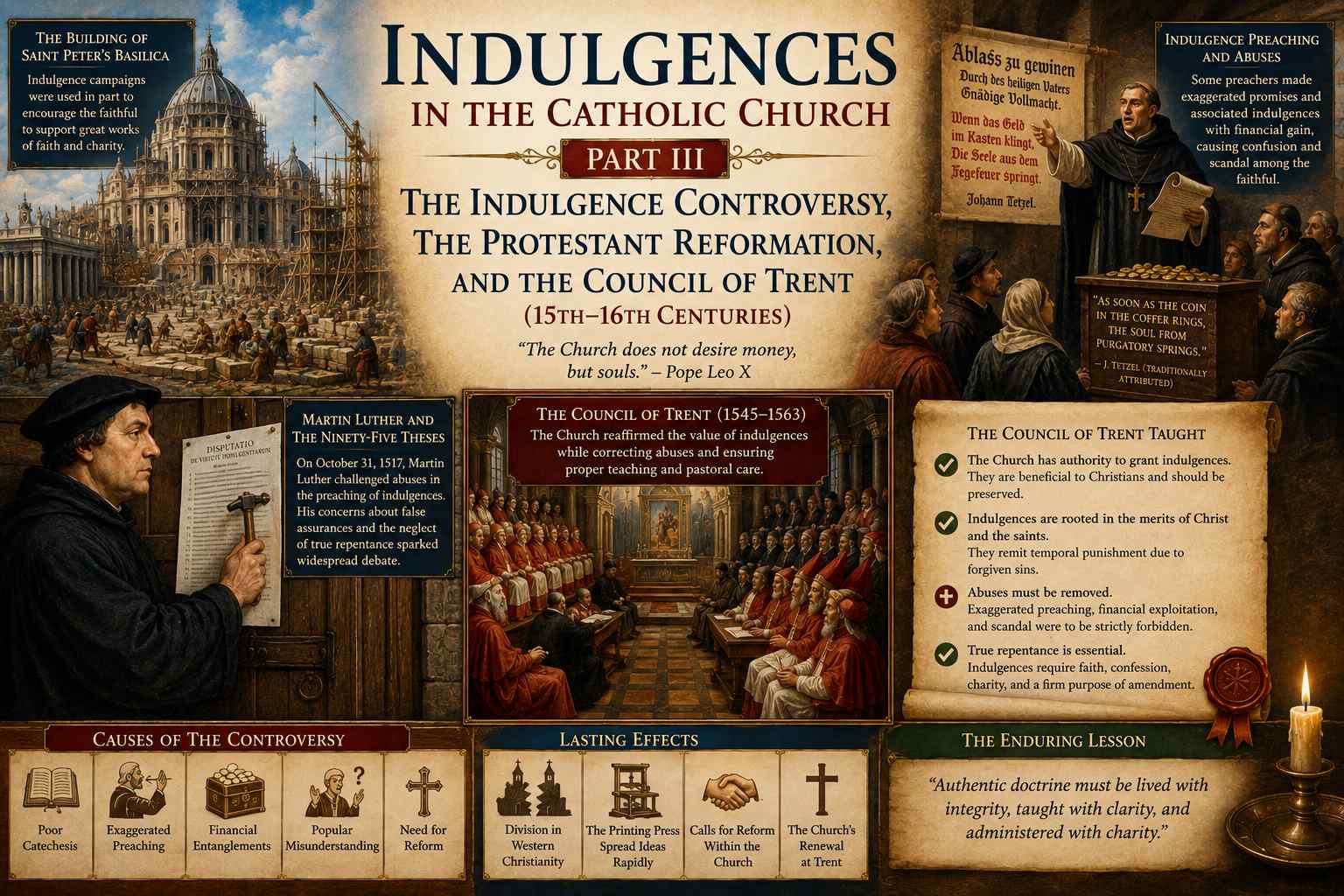
Part III
The Indulgence Controversy, the Protestant Reformation, and the Council of Trent (15th–16th Centuries)
Introduction
No period in the history of indulgences has attracted more attention than the sixteenth century. It was during this era that the Church faced one of the greatest crises in Christian history—the Protestant Reformation. Although indulgences themselves were rooted in centuries of theological development, abuses in their preaching and administration became one of the catalysts for reform movements within Christianity.
It is essential to distinguish between the Catholic doctrine of indulgences, which the Church maintained as part of its teaching on repentance and the Communion of Saints, and the abuses that developed in some places, which many Church leaders themselves recognized and sought to correct.
This distinction is critical for understanding both the Reformation and the Catholic response.
Europe on the Eve of the Reformation
By the late fifteenth century, Western Europe was undergoing profound change.
Several developments shaped the religious landscape:
- the rise of powerful nation-states,
- the invention of the printing press,
- increasing literacy,
- the growth of universities,
- calls for reform within the Church,
- widespread concern about clerical corruption,
- and renewed interest in the original sources of Scripture and the Church Fathers.
Many bishops, theologians, and ordinary believers desired genuine renewal in the Church long before the Reformation began.
The Growing Misunderstanding of Indulgences
The Church officially taught that indulgences:
- did not forgive sins,
- could not replace repentance,
- required sacramental confession,
- depended upon sincere conversion,
- concerned only temporal punishment,
- and derived entirely from the merits of Christ.
Yet in many places popular understanding differed from official teaching.
Several factors contributed:
Poor Catechesis
Many Christians possessed only a limited understanding of theology.
Complex distinctions between:
- forgiveness,
- absolution,
- penance,
- satisfaction,
- temporal punishment,
- and indulgences
were often poorly explained.
Exaggerated Preaching
Some itinerant preachers used dramatic language to encourage participation in indulgence campaigns.
Although many preached faithfully, others overstated the effects of indulgences, giving listeners the mistaken impression that salvation itself could be obtained through indulgenced acts.
Financial Associations
During this period, indulgences were sometimes connected with charitable donations supporting:
- hospitals,
- churches,
- monasteries,
- charitable institutions,
- crusades,
- and major building projects.
Although the Church insisted that grace could never be purchased, the close association between donations and indulgence preaching sometimes created scandal and misunderstanding.
The Building of Saint Peter’s Basilica
One of the most famous indulgence campaigns was connected with the rebuilding of Saint Peter’s Basilica.
The original Constantinian basilica had deteriorated significantly.
Beginning under Pope Julius II, an ambitious reconstruction project began.
The enormous undertaking required financial support from throughout Europe.
Some indulgence campaigns were authorized partly to encourage charitable contributions toward the project.
While the official teaching remained unchanged, abuses in the promotion of these campaigns became increasingly controversial.
Johann Tetzel
Among the best-known indulgence preachers was Johann Tetzel.
Tetzel preached indulgences in parts of Germany during the early sixteenth century.
He became famous for promotional methods that many contemporaries considered excessive.
A popular slogan traditionally attributed to him states:
“As soon as the coin in the coffer rings, the soul from purgatory springs.”
Whether Tetzel actually used these exact words remains debated by historians, but the phrase accurately reflects the popular perception of some indulgence preaching at the time.
Church authorities themselves later criticized such exaggerations.
Martin Luther and the Ninety-Five Theses
On 31 October 1517, Martin Luther, an Augustinian friar and professor at Wittenberg, published his famous Ninety-Five Theses.
Contrary to popular belief, Luther did not initially reject every aspect of Catholic teaching.
Many of his early objections focused specifically on indulgence preaching.
Among his concerns were:
- exaggerated promises made by some preachers,
- exploitation of ordinary believers,
- neglect of genuine repentance,
- misunderstanding of papal authority,
- false security regarding salvation.
Several of Luther’s criticisms were directed at abuses rather than the doctrine itself.
However, as the controversy expanded, Luther eventually rejected the theological foundation of indulgences altogether, along with other aspects of Catholic teaching, including papal authority and several sacraments.
The Printing Press and Rapid Spread
The invention of movable type by Johannes Gutenberg transformed the controversy.
Within weeks, Luther’s theses had spread throughout Germany.
Within months, they had circulated across Europe.
The printing press amplified theological debate in ways previously impossible.
For the first time, religious controversy became an international public discussion.
Catholic Responses Before Trent
Not all Catholic theologians defended the existing administration of indulgences.
Many agreed that reform was necessary.
Several bishops:
- restricted abusive preaching,
- emphasized proper catechesis,
- condemned exaggerations,
- called for stricter oversight,
- and urged greater pastoral responsibility.
These efforts anticipated the comprehensive reforms that would later emerge from the Council of Trent.
The Council of Trent (1545–1563)
The Council of Trent became the Catholic Church’s definitive response to the Reformation.
Meeting over eighteen years, the council clarified Catholic doctrine on:
- Scripture and Tradition,
- justification,
- the sacraments,
- the Eucharist,
- priesthood,
- and indulgences.
Regarding indulgences, the Council taught that:
The Church Reaffirmed
The Council solemnly declared that:
- indulgences are beneficial to Christians,
- the Church possesses authority to grant them,
- their use should be preserved,
- they remain rooted in Christ’s merits.
Thus the Council rejected calls for abolishing indulgences entirely.
The Council Reformed
At the same time, Trent acknowledged that abuses had occurred.
The Council ordered:
- elimination of dishonest practices,
- suppression of financial exploitation,
- careful supervision of indulgence preaching,
- removal of scandal,
- better instruction of the faithful.
This balanced approach distinguished authentic doctrine from improper practice.
The Difference Between Doctrine and Abuse
One of the most important historical lessons concerns the distinction between:
Doctrine
- developed over centuries,
- grounded in Scripture and Tradition,
- affirmed by ecumenical councils,
- centered on Christ’s mercy.
Abuses
- arose from poor administration,
- imprudent preaching,
- inadequate education,
- financial entanglements,
- and human weakness.
The Council of Trent insisted that abuses should be corrected—not that the doctrine itself was false.
Theological Clarification After Trent
Following Trent, Catholic theologians emphasized several principles with renewed clarity.
Indulgences:
- never forgive mortal sin,
- never replace confession,
- never guarantee salvation,
- never excuse future sin,
- never eliminate the need for conversion,
- never function automatically.
Instead, they presuppose:
- faith,
- repentance,
- sacramental life,
- charity,
- and sincere desire for holiness.
Lasting Effects of the Reformation
The Reformation permanently changed Western Christianity.
Many Protestant communities rejected:
- purgatory,
- indulgences,
- the Treasury of the Church,
- papal authority,
- and prayers for the dead.
Meanwhile, the Catholic Church strengthened catechesis, standardized sacramental practice, and reformed many pastoral abuses.
The controversy over indulgences became one of the defining moments of Christian history and continues to shape ecumenical dialogue today.
Historical Legacy
Modern historians generally agree that the indulgence controversy cannot be explained by a single cause.
It involved:
- theological disagreements,
- political tensions,
- economic pressures,
- cultural change,
- ecclesiastical abuses,
- genuine calls for reform,
- and differing understandings of Church authority.
Recognizing this complexity helps avoid simplistic narratives and encourages a more balanced appreciation of the period.
Conclusion
The sixteenth century stands as both a warning and a witness. It revealed how authentic doctrine can be obscured by poor practice, inadequate teaching, and human weakness. The controversy over indulgences exposed the urgent need for reform, clearer catechesis, and greater pastoral responsibility.
Through the Council of Trent, the Catholic Church reaffirmed the theological legitimacy of indulgences while courageously addressing the abuses that had caused scandal. This renewal ensured that indulgences would continue to serve their proper purpose—not as a substitute for repentance, but as an expression of God’s mercy offered through the ministry of the Church.
The enduring lesson of this period is that authentic reform strengthens the Church by restoring clarity, fidelity, and holiness rather than abandoning sound doctrine.
Looking Ahead: Part IV
Part IV will examine the history of indulgences from the Council of Trent to the Second Vatican Council, including:
- Post-Tridentine reforms
- The standardization of indulgence practice
- The Raccolta and devotional indulgences
- Indulgences under modern popes
- The reforms of Pope Paul VI
- The Apostolic Constitution Indulgentiarum Doctrina (1967)
- The modern Enchiridion Indulgentiarum (Manual of Indulgences)
- How the Church understands indulgences today
Leave a Reply