
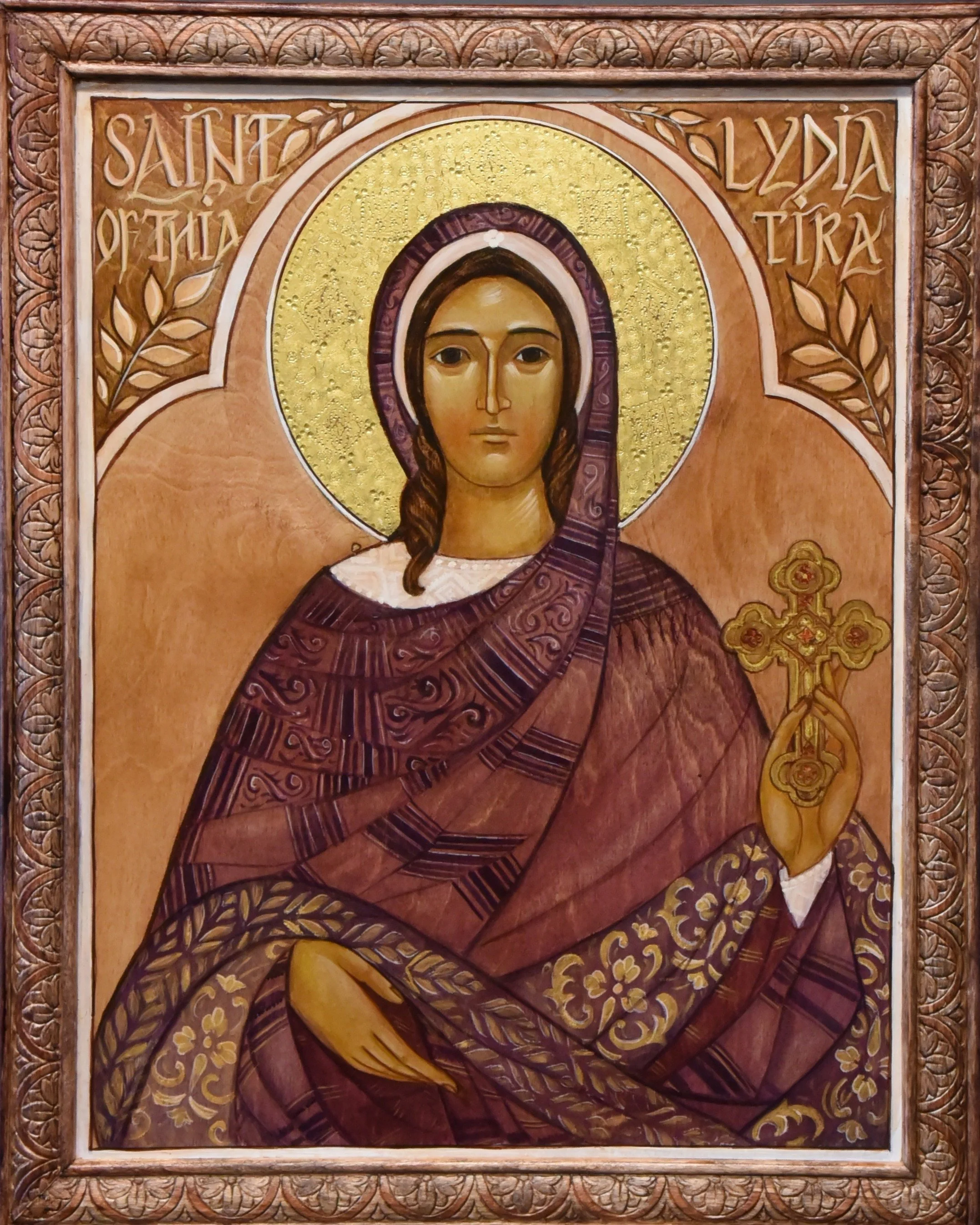
Feast Day: August 3 (Roman Martyrology; some traditions commemorate her on May 20 or at other times)
Saint Lydia Purpuraria, also known as Saint Lydia of Thyatira, occupies a unique and honored place in Christian history. Though mentioned only briefly in the New Testament, her encounter with Saint Paul changed not only her own life but also the course of Christianity in Europe. She is remembered as the first recorded Christian convert in Europe, a successful businesswoman, a generous benefactor of the early Church, and a shining example of faith, hospitality, and discipleship.
The account of Lydia is found in Acts 16:11–15 and Acts 16:40, where Saint Luke records her conversion during Paul’s second missionary journey. Through her openness to God’s grace and her willingness to place her home and resources at the service of the Gospel, Lydia became one of the earliest pillars of the Christian community in Philippi.
Her story reminds us that God calls people from every walk of life to participate in His mission and that ordinary acts of generosity can have extraordinary consequences.
Historical Background
Lydia lived during the first century A.D., a period when the Roman Empire stretched across Europe, Asia Minor, and North Africa. It was an era of expanding trade, bustling cities, and cultural exchange.
The Apostle Paul, guided by a vision of a man from Macedonia pleading, “Come over to Macedonia and help us” (Acts 16:9), crossed from Asia Minor into Europe. This marked the beginning of the Gospel’s spread across the European continent.
One of the first people Paul encountered there was Lydia.
A Woman from Thyatira
Luke introduces Lydia as:
“A dealer in purple cloth from the city of Thyatira, who was a worshiper of God.”
(Acts 16:14)
Thyatira, located in present-day western Türkiye, was renowned for its thriving textile industry, particularly for producing and dyeing luxurious purple fabrics.
Purple cloth was highly prized in the ancient world because the dye was expensive and difficult to produce. It became a symbol of wealth, dignity, and authority, often worn by royalty, government officials, and members of the upper classes.
Lydia’s profession indicates that she was an accomplished entrepreneur engaged in long-distance trade. Her work required business skill, financial independence, and extensive travel, making her one of the few named businesswomen in the New Testament.
The title “Purpuraria” comes from the Latin word purpura (“purple”) and refers to her occupation as a merchant or seller of purple cloth.
Living in Philippi
Although originally from Thyatira, Lydia lived or conducted business in Philippi, a prosperous Roman colony in Macedonia (modern-day northern Greece).
Philippi was an important commercial center situated along the famous Via Egnatia, the major Roman road connecting East and West.
Because the city had only a small Jewish population and apparently no synagogue, Jews and God-fearers gathered outside the city by a river for prayer.
It was there that Paul met Lydia.
The Encounter with Saint Paul
When Paul arrived in Philippi around A.D. 49–50, he sought out the local place of prayer on the Sabbath.
Luke recounts:
“The Lord opened her heart to respond to Paul’s message.”
(Acts 16:14)
These few words reveal a profound spiritual truth.
Lydia listened attentively to the Gospel, welcomed God’s grace, and responded with faith.
Her conversion was not merely an intellectual decision but a transformation of heart.
She became the first person in Europe whose conversion to Christianity is specifically recorded in the New Testament.
Baptism of Lydia and Her Household
Following her profession of faith, Lydia and her entire household were baptized.
Luke writes:
“When she and the members of her household were baptized, she invited us to her home.”
(Acts 16:15)
Household baptisms were common in the early Church and reflected the communal nature of family life in the Roman world.
Lydia’s immediate response to baptism demonstrates the deep sincerity of her faith and her desire to share the Gospel with those closest to her.
A Model of Christian Hospitality
One of Lydia’s defining virtues was hospitality.
After her baptism, she urged Paul and his companions to stay in her home:
“If you consider me a believer in the Lord, come and stay at my house.”
Her invitation was not simply an act of kindness.
By opening her home, Lydia effectively established one of Europe’s earliest Christian meeting places.
Her house became a center for:
- Prayer.
- Fellowship.
- Teaching.
- Missionary planning.
- Encouragement of believers.
After Paul and Silas were released from prison later in Acts 16, they returned to Lydia’s house to encourage the Christian community before leaving Philippi.
This strongly suggests that her home had become the gathering place for the local Church.
Lydia’s Importance in the Early Church
Although Scripture tells us little about Lydia after Acts 16, her influence was likely considerable.
She is remembered for:
- Supporting Paul’s missionary work.
- Providing hospitality to the early Christians.
- Helping establish the Church in Philippi.
- Demonstrating courageous public witness.
- Using her resources for evangelization.
Without generous believers like Lydia, the missionary journeys of the apostles would have faced far greater challenges.
A Successful Businesswoman
Lydia is particularly inspiring because she demonstrates that professional success and deep faith can complement one another.
She managed a respected business while remaining open to God’s call.
Her story reminds modern Christians that:
- Honest work is honorable.
- Business can become a vocation of service.
- Wealth becomes meaningful when used generously.
- Leadership includes compassion and hospitality.
She serves as a patron and inspiration for entrepreneurs, business leaders, and working professionals.
Lessons from Saint Lydia
1. Be Open to God’s Voice
Lydia listened carefully when Paul preached.
Her willingness to hear the Gospel changed her life forever.
2. Faith Leads to Action
Her baptism was immediately followed by generous hospitality.
Christian faith naturally expresses itself in loving service.
3. Use Your Gifts for God’s Kingdom
Lydia used her home, business, and resources to support the Church.
Every talent and blessing can become an instrument of evangelization.
4. Hospitality Is a Ministry
Welcoming others creates opportunities for faith to flourish.
Many Christian communities throughout history have begun around family tables and open homes.
5. Women Have Always Played Vital Roles in the Church
Lydia stands among the many women who helped nurture the earliest Christian communities through leadership, generosity, and faithful discipleship.
Patronage
Saint Lydia is regarded as the patron saint of:
- Businesswomen.
- Merchants.
- Textile workers.
- Cloth and fabric merchants.
- Dyers.
- Entrepreneurs.
- Christian hospitality.
- New converts.
Inspiring Quotes Inspired by Saint Lydia’s Life
- “A heart open to God becomes a home for His people.”
- “Faith begins by listening and grows through generous action.”
- “Hospitality opens doors where the Gospel enters.”
- “Every gift entrusted to us can become a blessing for others.”
- “God often builds His Church through ordinary acts of kindness.”
- “Success finds its highest purpose in serving others.”
- “The first step of faith is a willing heart.”
- “Open hearts create welcoming homes.”
- “True generosity leaves a lasting legacy.”
- “The Gospel flourishes wherever faith and hospitality meet.”
A Prayer Through the Intercession of Saint Lydia
Heavenly Father,
You opened the heart of Saint Lydia to receive the Gospel with faith and joy. Through her example, teach us to listen attentively to Your Word and to respond generously to Your call.
Help us to use our homes, our work, our talents, and our resources in service of Your Kingdom. May we welcome others with kindness, practice generous hospitality, and become faithful witnesses of Christ in our families, workplaces, and communities.
Through the intercession of Saint Lydia, strengthen all who seek to live their faith with courage, generosity, and love.
Through Christ our Lord.
Amen.
Legacy
Saint Lydia’s influence reaches far beyond the few verses that mention her.
She represents the countless faithful Christians whose quiet generosity helped spread the Gospel during the earliest days of the Church. Her home became a place where believers gathered, prayed, and found encouragement, making her one of the first hosts of a Christian house church in Europe.
She also stands as a remarkable example of women whose leadership, enterprise, and hospitality contributed significantly to the growth of the early Church.
Conclusion
Though Scripture records only a handful of verses about Saint Lydia Purpuraria, her impact on Christian history is immense. As the first recorded Christian convert in Europe, she welcomed the Gospel with an open heart and immediately put her faith into action. Her generosity, courage, and hospitality laid the foundation for the Christian community in Philippi and supported the missionary work of Saint Paul.
Saint Lydia reminds us that discipleship is not limited by profession, status, or background. Whether in business, family life, or community service, every believer is called to place their gifts at the service of God and others. Her example continues to inspire Christians to live with open hearts, generous hands, and unwavering faith, proving that even a single act of hospitality can help change the course of history.
Leave a Reply