
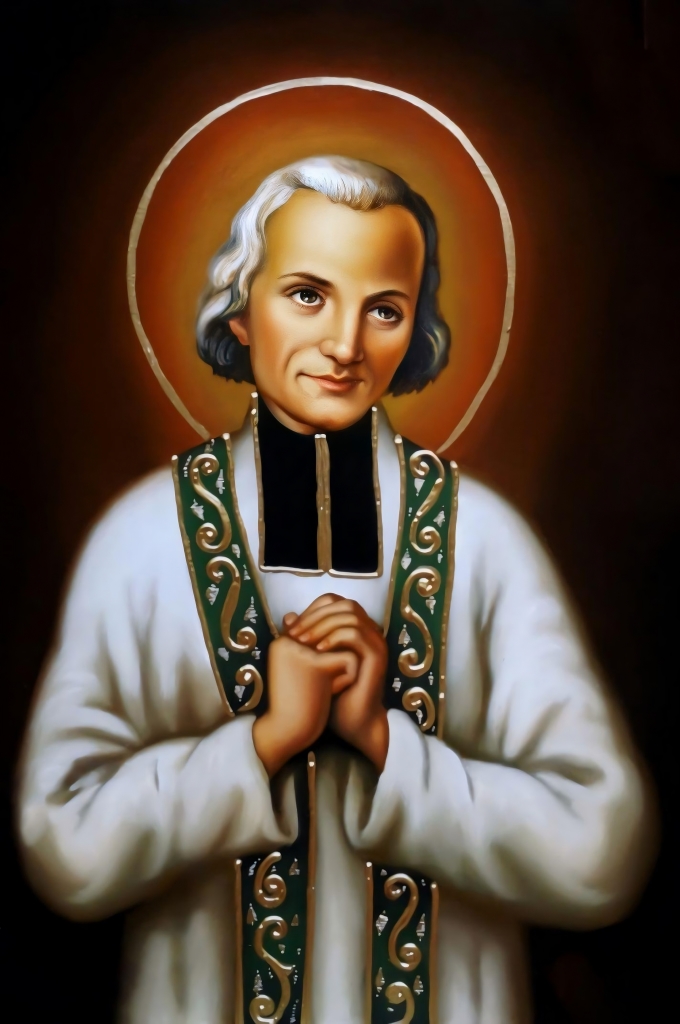
Feast Day: August 4
Saint John Vianney, affectionately known as the Curé of Ars, is one of the most beloved priests in the history of the Catholic Church. Renowned for his humility, holiness, tireless ministry in the confessional, and deep love for Christ, he transformed a small, spiritually neglected French village into one of the world’s most important places of pilgrimage.
His life is a powerful reminder that extraordinary holiness can flourish through ordinary faithfulness. Despite limited education, poor health, and many personal struggles, John Vianney became an instrument of God’s mercy, leading thousands of souls back to the Church. Today, he is honored as the Patron Saint of Parish Priests, inspiring clergy and lay faithful alike to pursue lives rooted in prayer, humility, and charity.
Early Life
John Mary Vianney (Jean-Marie Vianney) was born on May 8, 1786, in the small village of Dardilly, near Lyon, France. He was the fourth of six children born to Mathieu and Marie Beluze Vianney, a devout farming family.
His childhood coincided with the French Revolution, a period of intense persecution of the Catholic Church. Churches were closed, priests were forced into hiding, and public worship was often forbidden. John grew up witnessing his family secretly attending Mass celebrated by faithful priests who risked imprisonment or death.
These experiences strengthened his faith and planted within him a profound desire to serve God.
A Difficult Path to the Priesthood
John felt called to the priesthood at a young age, but his journey was anything but easy.
Because the Revolution had disrupted his education, he began formal studies much later than most candidates. He struggled especially with Latin, the language required for seminary training, and many believed he lacked the academic ability to become a priest.
Yet those who knew him recognized something far more important than intellectual brilliance—his deep faith, humility, perseverance, and love for God.
With the encouragement of compassionate mentors, John continued his studies despite repeated setbacks. After years of hard work and prayer, he was ordained a priest on August 13, 1815.
His bishop famously remarked that although John might not excel academically, he would surely bring great holiness to the priesthood.
Assigned to Ars
In 1818, Father Vianney was appointed parish priest of the tiny village of Ars, about twenty miles north of Lyon.
At the time, Ars was a community of only a few hundred people. Many had grown indifferent to religion after the turmoil of the French Revolution. Attendance at Mass was low, Sunday observance had weakened, and many people had drifted away from the sacraments.
Father Vianney quietly began the work of renewal.
He visited families in their homes, preached simple but heartfelt homilies, spent long hours in prayer before the Blessed Sacrament, and cared especially for the poor, the sick, and children. His gentle example gradually transformed the spiritual life of the village.
The Apostle of the Confessional
Saint John Vianney became especially renowned as a confessor.
His reputation for wisdom, compassion, and spiritual insight spread throughout France. Pilgrims traveled from every corner of the country seeking his guidance and the grace of the Sacrament of Reconciliation.
As the years passed, the number of visitors increased dramatically. It is estimated that tens of thousands of people came to Ars each year.
Father Vianney often spent 10 to 16 hours a day hearing confessions, and during busy seasons even longer. Though physically exhausted, he regarded this ministry as one of the greatest expressions of God’s mercy.
Those who met him frequently spoke of his remarkable ability to read hearts, gently leading penitents toward repentance, forgiveness, and renewed hope.
A Life of Prayer and Simplicity
John Vianney lived with extraordinary simplicity.
He owned very little, gave generously to the poor, and practiced personal sacrifices that reflected his desire to unite himself more closely with Christ.
His daily routine centered on:
- Celebration of the Holy Mass.
- Eucharistic adoration.
- The Divine Office.
- Hearing confessions.
- Visiting the sick.
- Teaching catechism.
- Personal prayer and meditation.
He believed that prayer was the foundation of every fruitful ministry.
One of his best-known teachings was:
“Prayer is nothing else than union with God.”
Love for the Eucharist
The Holy Eucharist was the heart of Saint John Vianney’s spiritual life.
He encouraged frequent participation at Mass, reverent reception of Holy Communion, and regular visits to the Blessed Sacrament.
He once observed that people would travel great distances to see extraordinary sights but often overlooked the greatest miracle of all—the real presence of Christ in the Eucharist.
His devotion inspired countless parishioners to rediscover the central place of the Mass in Christian life.
Care for the Poor and Children
Father Vianney believed that love for God must always be accompanied by love for neighbor.
He established La Providence, a home for orphaned and impoverished girls, ensuring they received food, education, and Christian formation.
He also devoted significant time to teaching children the faith, recognizing that their spiritual formation would shape the future of the Church.
Despite having little money himself, he consistently shared what he had with those in need.
Spiritual Trials
Like many saints, John Vianney experienced profound spiritual struggles.
He endured periods of discouragement, temptation, and intense spiritual warfare. According to his own testimony and that of those around him, he also experienced disturbing attacks from the devil, especially during times when many sinners were returning to God.
Rather than becoming fearful, he accepted these trials with patience, viewing them as reminders to rely completely on God’s grace.
His serenity in the face of suffering inspired many who sought his counsel.
His Teachings
Although he left no formal theological treatise, Saint John Vianney’s sermons, catechetical instructions, and conversations reveal several enduring themes:
- The infinite mercy of God.
- The importance of sincere repentance.
- The transforming power of prayer.
- Reverence for the Eucharist.
- Devotion to the Blessed Virgin Mary.
- The dignity of the priesthood.
- Charity toward the poor.
- Faithfulness in daily duties.
His preaching was simple, direct, and filled with practical wisdom, making profound spiritual truths accessible to ordinary people.
Death and Canonization
After more than forty years of faithful ministry in Ars, Saint John Vianney died peacefully on August 4, 1859, at the age of 73.
News of his death spread quickly, and thousands came to pay their respects.
Pope Pius X beatified him in 1905, and Pope Pius XI canonized him on May 31, 1925.
In 1929, Pope Pius XI declared him the Patron Saint of Parish Priests, recognizing his extraordinary example of pastoral dedication.
Patronage
Saint John Vianney is the patron saint of:
- Parish priests.
- Diocesan clergy.
- Confessors.
- Pastoral ministry.
- The village of Ars.
His intercession is sought especially by priests, seminarians, and those discerning a vocation to the priesthood.
Lessons from Saint John Vianney
1. Holiness Is Greater Than Talent
John Vianney struggled academically, yet his deep faith and perseverance enabled him to become one of the Church’s greatest saints.
2. Prayer Is the Source of Strength
His ministry flowed from countless hours spent in prayer before God.
3. God’s Mercy Has No Limits
Through the Sacrament of Reconciliation, he helped countless people experience forgiveness and new life.
4. Small Acts of Faithfulness Matter
By faithfully serving one small parish, he transformed lives far beyond its borders.
5. Humility Opens the Heart to Grace
Despite worldwide recognition, he remained humble, always directing praise to God rather than himself.
Inspiring Quotes of Saint John Vianney
- “The priesthood is the love of the Heart of Jesus.”
- “Prayer is nothing else than union with God.”
- “Our greatest cross is the fear of crosses.”
- “Humility is to the various virtues what the chain is in a rosary.”
- “Private prayer is like straw scattered here and there; if you set it on fire, it makes many little flames. But gather these straws into a bundle, and you get a mighty fire. Public prayer is like that.”
- “There is nothing so great as the Eucharist.”
- “God commands you to pray, but He forbids you to worry.”
- “If we really understood the Mass, we would die of joy.”
- “The saints did not all begin well, but they all ended well.”
- “The soul can only nourish itself with God.”
A Prayer Through the Intercession of Saint John Vianney
Heavenly Father,
You gave the Church Saint John Vianney as a faithful shepherd, a compassionate confessor, and a humble servant of Your people.
Through his intercession, strengthen all priests in their vocation to preach the Gospel, celebrate the sacraments, and guide Your people with wisdom and love.
Help us to grow in prayer, cherish the Holy Eucharist, seek Your mercy in the Sacrament of Reconciliation, and serve others with humility and compassion.
May the example of Saint John Vianney inspire us to pursue holiness in our daily lives and to trust always in Your unfailing grace.
Through Christ our Lord.
Amen.
Conclusion
Saint John Vianney transformed the small village of Ars not through extraordinary resources or remarkable scholarship, but through unwavering faith, constant prayer, and a profound love for God and His people. His ministry in the confessional, devotion to the Eucharist, and compassionate care for souls continue to inspire the Church more than a century after his death.
As the Patron Saint of Parish Priests, he reminds us that authentic Christian leadership is rooted in humility, self-sacrifice, and a heart devoted entirely to Christ. His witness encourages priests to serve faithfully and invites every believer to deepen their relationship with God through prayer, the sacraments, and acts of charity.
On his feast day, we give thanks for his enduring legacy and pray that his example may continue to inspire holy vocations and renew parish communities throughout the world.
Leave a Reply