
Feast Day: July 20 (Western Christianity); also commemorated on July 17 or other dates in some Eastern traditions
Patron Saint of: Childbirth, pregnant women, nurses, women in labor, farmers, and those seeking courage in suffering
Titles: Saint Margaret the Great Martyr, Margaret of Antioch in Pisidia, Marina of Antioch (Eastern Churches)
Saint Margaret of Antioch
Saint Margaret of Antioch is one of the most beloved virgin martyrs of the early Church. Although modern historians acknowledge that the historical details of her life are difficult to verify, her witness to unwavering faith, courageous resistance against persecution, and complete trust in Christ has inspired Christians for more than fifteen centuries. Throughout the Middle Ages, she became one of the most popular saints in Europe, counted among the celebrated Fourteen Holy Helpers and remembered as one of the saints who appeared to Saint Joan of Arc.
Her dramatic legend—including her confrontation with Satan in the form of a dragon—made her an enduring symbol of the Christian soul’s triumph over evil. Whether read literally or spiritually, the story continues to teach believers about perseverance, purity, and the victory of Christ over sin and death.
Historical Background
Margaret is believed to have lived during the reign of the Roman Emperor Diocletian (284–305 AD), whose persecution of Christians became one of the most severe in Roman history.
She is traditionally associated with Antioch in Pisidia, located in present-day Turkey. Some traditions mistakenly identify her with Antioch in Syria, leading to the common title “Margaret of Antioch.”
Although her Acts contain legendary elements, scholars generally agree that the devotion surrounding Margaret reflects the memory of an early Christian martyr whose example profoundly shaped Christian spirituality.
Early Life
According to ancient tradition, Margaret was born into a wealthy pagan family.
Her father, Aedesius, served as a pagan priest. Shortly after Margaret’s birth, her mother died, and she was entrusted to the care of a Christian nurse living in the countryside.
Growing up among Christian believers, Margaret learned about Jesus Christ and embraced Christianity with her whole heart.
She was baptized while still young and dedicated herself completely to God, resolving to remain a virgin for Christ.
When her father discovered her conversion, he became enraged.
Instead of celebrating his daughter’s virtues, he disowned her and expelled her from his household.
Margaret accepted poverty rather than deny her faith.
She earned her living by tending sheep, living a quiet and prayerful life.
The Roman Governor Olybrius
One day, while Margaret was watching her flock, the Roman governor Olybrius passed by.
Captivated by her extraordinary beauty, he desired to marry her.
He summoned her before him and promised wealth, honor, and social prestige if she accepted both his proposal and the Roman gods.
Margaret respectfully refused.
She declared:
“I belong to Jesus Christ. He is my Lord and my Bridegroom.”
Her refusal humiliated the governor.
His admiration quickly turned into anger.
He ordered her imprisonment.
Torture for Christ
The governor repeatedly attempted to persuade Margaret to abandon Christianity.
She remained steadfast.
As punishment, she endured horrific tortures.
Tradition describes that she was:
- beaten with rods
- scourged
- torn with iron combs
- burned with torches
- suspended on the rack
- imprisoned without food
Throughout these sufferings, Margaret continually prayed.
Observers were astonished that her wounds seemed to heal through God’s power.
Many who witnessed her courage became believers in Christ.
The Dragon Legend
The most famous episode of Margaret’s story occurs while she was imprisoned.
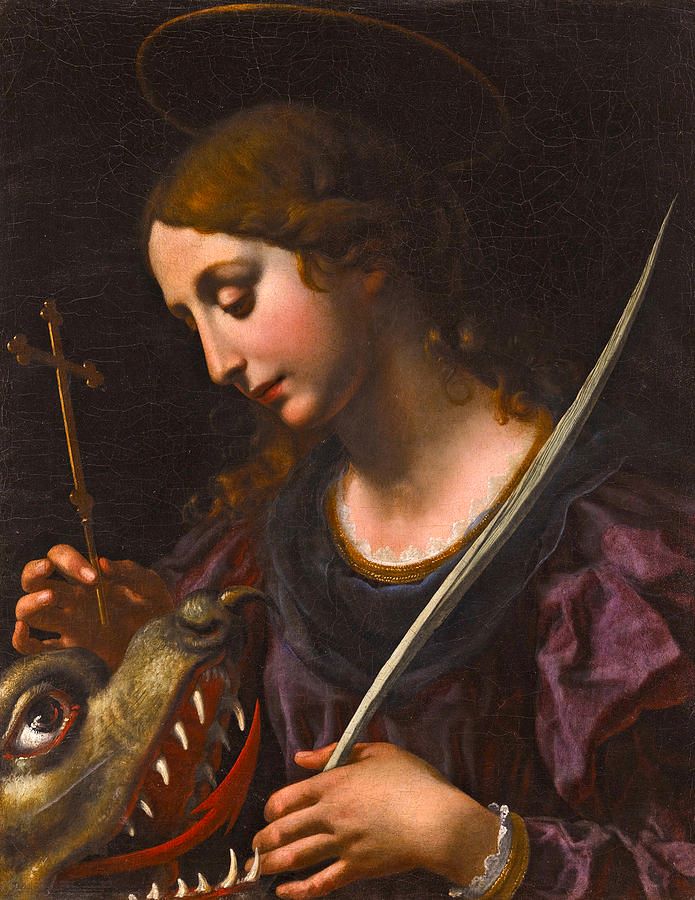
According to the medieval legend, Satan appeared before her in the form of an enormous dragon.
The dragon swallowed her whole.
Inside its belly, Margaret made the Sign of the Cross and prayed in the name of Jesus Christ.
Immediately the cross shattered the dragon from within.
Margaret emerged alive and unharmed.
In another version, the dragon simply burst apart when she held her cross before it.
Because of this story, Margaret is almost always depicted in Christian art standing over a defeated dragon.
Spiritual Meaning of the Dragon
Whether understood literally or symbolically, the dragon represents:
- Satan
- temptation
- fear
- persecution
- death
- evil
Margaret’s victory demonstrates that:
- Christ is stronger than Satan.
- Faith conquers fear.
- Holiness defeats evil.
- God’s grace overcomes every trial.
For centuries Christians have viewed the dragon story as a powerful illustration of spiritual warfare rather than merely a fantastic tale.
Victory over the Devil
Another tradition records that Satan appeared again, this time in human form.
Margaret rebuked him through prayer.
She seized him by the hair, threw him to the ground, and trampled upon him while making the Sign of the Cross.
This dramatic image became another favorite subject of medieval artists.
It symbolizes the Christian’s authority over evil through Christ.
Martyrdom
When torture failed to break her faith, Olybrius ordered Margaret’s execution.
She prayed one final time, thanking God for allowing her to remain faithful.
She asked God to bless all who remembered her martyrdom and sought her intercession.
She was then beheaded.
Tradition places her martyrdom around 304 AD.
Many spectators, moved by her courage, converted to Christianity.
Some accounts even claim thousands embraced the faith after witnessing her death.
Spread of Her Devotion
Devotion to Saint Margaret spread rapidly throughout the Christian world.
By the sixth century her feast was celebrated widely in the East.
Later, devotion reached Western Europe through Byzantine influence.
During the Middle Ages she became one of Christianity’s most beloved saints.
Churches, monasteries, hospitals, and chapels were dedicated to her throughout:
- England
- France
- Germany
- Italy
- Spain
- Eastern Europe
She became especially popular among expectant mothers.
One of the Fourteen Holy Helpers
Saint Margaret belongs to the famous group known as the Fourteen Holy Helpers.
These saints were especially invoked during times of plague, disease, childbirth, and danger.
The Fourteen Holy Helpers became enormously popular throughout Europe after the Black Death.
Margaret was particularly sought for:
- safe pregnancies
- protection during labor
- difficult childbirth
- strength during suffering
Patron Saint of Childbirth
Margaret’s miraculous escape from the dragon’s belly came to symbolize safe delivery from the womb.
For centuries women prayed:
- during pregnancy
- during labor
- after childbirth
Many medieval prayer books included prayers asking Saint Margaret to intercede for mothers and infants.
Hospitals often kept images of her in maternity wards.
Saint Joan of Arc
Saint Margaret gained renewed prominence in the fifteenth century.
Saint Joan of Arc testified during her trial that three saints frequently appeared to encourage and guide her:
- Saint Michael the Archangel
- Saint Catherine of Alexandria
- Saint Margaret of Antioch
Joan stated that Margaret strengthened her faith and encouraged perseverance.
This testimony further increased Margaret’s popularity across France.
Depictions in Christian Art
Saint Margaret is one of the easiest saints to recognize.
Artists commonly portray her with:
- a dragon beneath her feet
- a processional cross
- a palm branch of martyrdom
- a crown
- shepherd’s staff
- sheep
- chains broken by divine power
- a book of the Gospels
Sometimes she is shown emerging from the dragon alive.
These artistic symbols communicate the triumph of Christ over evil.
Margaret in Eastern Christianity
In the Eastern Churches she is usually known as Saint Marina.
She is honored as one of the Great Martyrs.
Eastern Christians celebrate her with beautiful hymns emphasizing:
- courage
- purity
- victory through Christ
- steadfast confession of faith
Icons often portray Marina striking a demon with a hammer, representing her victory over Satan.
Questions About Her Historicity
Modern scholarship recognizes that many parts of Margaret’s surviving biography contain legendary embellishments.
The dragon episode especially belongs to the genre of symbolic hagiography.
Because of historical uncertainty, her feast was removed from the General Roman Calendar in 1969 during its revision.
However, this did not mean that she was “decanonized.” Rather, the Church judged that there was insufficient historical evidence for universal liturgical celebration while continuing to recognize her as a saint. Her feast may still be celebrated in local calendars, and she remains honored in both the Catholic and Orthodox traditions.
Spiritual Lessons from Saint Margaret
1. Faith Is Worth Every Sacrifice
Margaret lost wealth, family, and eventually her life.
Yet she never lost Christ.
Christians are reminded that eternal treasures surpass earthly comforts.
2. Purity Is Strength
Margaret’s virginity represented her complete dedication to God.
Purity, in the Christian understanding, means wholehearted love directed toward God above all else.
3. Courage Defeats Fear
Margaret stood before governors, executioners, and death itself.
Her courage came not from physical strength but from confidence in Christ.
4. Evil Never Has the Final Word
The dragon symbolizes every force opposed to God.
Margaret’s victory proclaims that Christ has already conquered sin, Satan, and death.
5. Prayer Gives Strength
Throughout imprisonment and torture, Margaret never ceased praying.
Her life reminds believers that prayer sustains faith during life’s greatest trials.
A Prayer to Saint Margaret of Antioch
O glorious Saint Margaret, faithful virgin and courageous martyr, you remained steadfast in your love for Christ despite persecution and suffering. Pray for us, that we may remain faithful to the Gospel in times of trial and temptation. Intercede for mothers, expectant women, children, and all who seek God’s protection. Help us to overcome fear, resist evil, and trust completely in Jesus Christ, who is our Savior and Lord. May your example inspire us to live with courage, purity, and unwavering faith until we share in the eternal joy of heaven. Amen.
Legacy
Although history cannot verify every detail of Saint Margaret’s legendary Acts, her enduring legacy lies in what Christians have long recognized in her story: steadfast fidelity to Christ in the face of suffering. Her image standing over the defeated dragon continues to symbolize the Gospel’s promise that evil does not have the final victory. For countless believers—especially mothers, families, and those enduring hardship—Saint Margaret remains a source of hope and a reminder that God’s grace is stronger than fear.
More than seventeen centuries after her martyrdom, Saint Margaret of Antioch continues to inspire Christians to remain faithful under pressure, courageous in adversity, and confident that, through the Cross of Christ, every power of darkness is ultimately overcome.
Leave a Reply