
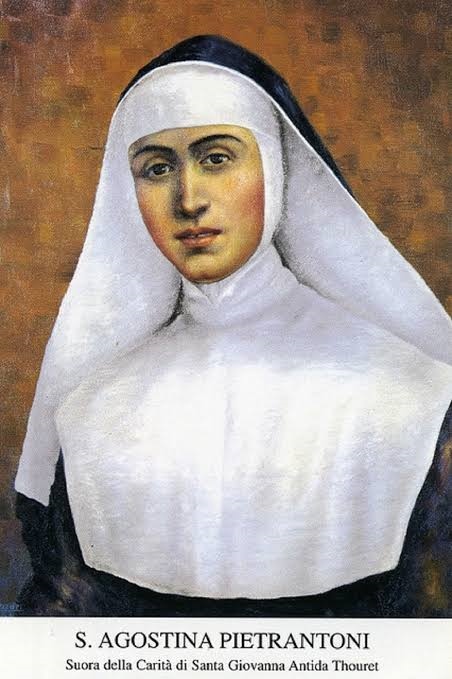
Virgin, Religious Sister and Martyr of Charity
Feast Day: November 13
Saint Agostina Pietrantoni was an Italian religious sister whose short but extraordinary life became a powerful witness to Christian charity, forgiveness and self-sacrificing love. A woman of deep faith and extraordinary dedication to the sick, she spent her life serving suffering people, even when her own life was threatened. She ultimately gave her life in the service of Christ and her neighbours. Her story reminds us that holiness is often found in ordinary acts of love performed with extraordinary generosity.
Early Life and Family
Saint Agostina Pietrantoni was born on March 27, 1864, in Pozzaglia Sabina, a small village in the province of Rieti, Italy. At baptism, she received the name Livia. She was the second of eleven children born to Francesco Pietrantoni and Caterina Costantini, a hardworking farming couple.
Livia grew up in a simple, deeply religious family where prayer, honesty, hard work and mutual assistance were important values. Her childhood was marked by responsibilities at home and in the fields. She helped her parents, cared for animals and looked after her younger brothers and sisters.
Because of the family’s difficult economic circumstances, she received only limited formal education. From a very young age, she understood the dignity of work and the importance of helping others.
At the age of seven, she began working with other children, carrying sacks of stones and sand for road construction. When she was twelve, she travelled to Tivoli with other young workers to participate in the seasonal olive harvest.
Even as a young girl, Livia demonstrated remarkable maturity. She cared for her companions, encouraged them in their difficulties and stood up courageously against unjust treatment by employers.
Her early life formed the foundation of the virtues that would later define her religious vocation: humility, courage, compassion and a generous spirit of service.
A Call to Religious Life
As Livia grew older, she became increasingly aware of God’s invitation to dedicate her life entirely to Him. Although her family hoped that she would marry, she felt a stronger desire to become a religious sister and serve Christ through the poor and suffering.
In 1886, at the age of twenty-two, she travelled to Rome and entered the Congregation of the Sisters of Charity of Saint Jeanne-Antide Thouret.
The congregation was founded on the spirituality of Christian charity and the service of the poor, following the example of Saint Vincent de Paul and Saint Jeanne-Antide Thouret.
After a period of formation, Livia received the religious habit and took the name Sister Agostina.
Her religious vocation was not an escape from the difficulties of ordinary life. Rather, she embraced religious life as an opportunity to serve others more completely.
She was particularly attracted to work that involved caring for the sick and those who were abandoned by society. She wanted her religious life to be expressed through concrete acts of compassion.
Service at Santo Spirito Hospital
Sister Agostina was assigned to Santo Spirito Hospital in Rome, one of the city’s oldest and most historically important hospitals.
The hospital cared for hundreds of patients, including children, the seriously ill and people suffering from infectious diseases. Medical facilities were limited, and caring for patients often involved considerable personal risk.
Initially, Sister Agostina worked in the children’s ward. She showed extraordinary tenderness towards sick children, treating each one with the affection and patience of a loving mother.
Later, she was transferred to the tuberculosis ward, where she cared for patients suffering from a disease that was frequently fatal at that time.
Many people feared approaching tuberculosis patients because of the danger of infection. But Sister Agostina did not allow fear to prevent her from serving them.
She attended to their physical needs, comforted them in their suffering and treated them with dignity.
Eventually, she herself contracted tuberculosis. Her illness became so serious that her survival seemed unlikely. However, she recovered unexpectedly, an event regarded by those who knew her as a remarkable grace.
After recovering, she returned to her nursing duties with the same enthusiasm and dedication.
Her approach to nursing was deeply spiritual. She did not see patients merely as sick people who needed medical attention. She saw Christ present in every suffering person.
She once expressed her spirituality in these beautiful words:
“In them I serve Jesus Christ … I feel inflamed with love for them all, ready to make any sacrifice, even to shed my blood for love.”
These words, recalled by Pope John Paul II during her canonization, beautifully express the spirituality that guided her entire life.
Courage in the Face of Hostility
Sister Agostina’s service was not always welcomed.
During this period, the religious atmosphere in Italy was marked by considerable tension between the Church and the political authorities. Religious symbols were removed from the hospital, and the sisters were restricted from openly speaking about God.
Nevertheless, Sister Agostina continued her mission.
Even when she could not speak openly about her faith, she proclaimed the Gospel through her actions. Her kindness, patience and dedication became a silent testimony to Christ.
She believed that Christian love must be expressed through practical service, especially towards those who were most difficult to love.
Among the patients at the hospital was a man named Giuseppe Romanelli, who repeatedly behaved aggressively and disrespectfully towards the sisters and other hospital workers.
Sister Agostina treated him with patience and compassion. She also showed kindness towards his elderly, blind mother when she visited him.
However, Romanelli’s behaviour became increasingly threatening. Despite repeated warnings, he continued to harass and intimidate the sisters.
Eventually, the hospital authorities decided to expel him because of his misconduct.
Romanelli became furious and directed his anger towards Sister Agostina. He sent her threatening messages and warned her that he would kill her.
Despite these threats, she continued her work. She did not abandon her patients or allow hatred to take control of her heart.
Her courage was not recklessness but a profound commitment to the vocation she had embraced.
Martyrdom: The Supreme Witness of Love
On November 13, 1894, Sister Agostina’s earthly life came to a tragic end.
Romanelli attacked her inside the hospital and stabbed her repeatedly. She was only thirty years old.
As she lay dying, her thoughts remained directed towards God and the Blessed Virgin Mary. According to the accounts of her final moments, she invoked Our Lady and expressed forgiveness towards her attacker.
Her death was a powerful testimony to the Christian commandment of love.
She had spent her life caring for the sick, including those who were difficult, aggressive and rejected by others. In the end, she died at the hands of someone she had attempted to serve with compassion.
Her martyrdom is remembered as a martyrdom of charity and fidelity to her religious vocation.
She demonstrated that Christian love is not simply a feeling but a commitment that remains faithful even in the face of suffering, rejection and danger.
Her life reminds us of the words of Jesus:
“Greater love has no one than this, that someone lay down his life for his friends.” (John 15:13)
Beatification and Canonization
After her death, devotion to Sister Agostina spread among the faithful. Many people recognised her extraordinary holiness and her heroic dedication to the sick.
Her cause for canonization was introduced, and the Church eventually recognised her heroic witness.
Pope Paul VI beatified her on November 12, 1972.
On April 18, 1999, Pope John Paul II canonized her in Saint Peter’s Square in Rome, together with Saint Marcellin Champagnat and Saint Giovanni Calabria.
During the canonization celebrations, the Pope highlighted her extraordinary charity and her dedication to the sick.
He presented her as a woman whose entire life had been consumed by love for God and service to her brothers and sisters.
Her liturgical feast is celebrated on November 13, the anniversary of her death.
Saint Agostina is also recognised as a patroness of nurses in Italy, honouring her extraordinary contribution to Christian healthcare and the service of the sick.
Spiritual Lessons from Saint Agostina Pietrantoni
The life of Saint Agostina offers several important lessons for Christians today.
1. Discover Christ in the Suffering
Saint Agostina recognised the presence of Jesus in the sick and suffering. She did not consider nursing merely a profession or a responsibility. For her, every patient was an opportunity to encounter Christ.
Her example invites us to recognise Jesus in those who are sick, elderly, lonely, poor and abandoned.
Jesus reminds us:
“Truly, I say to you, as you did it to one of the least of these my brothers, you did it to me.” (Matthew 25:40)
2. Make Ordinary Work an Offering to God
Saint Agostina did not perform extraordinary miracles during her daily nursing duties. Her holiness was expressed through ordinary activities performed with extraordinary love.
She cleaned wounds, comforted patients, attended to their needs and remained beside them in their suffering.
Her life teaches us that holiness does not necessarily require extraordinary achievements. It requires extraordinary love in ordinary responsibilities.
A mother caring for her children, a teacher educating students, a nurse attending to patients and a worker performing daily duties can all become instruments of God’s love.
3. Love Even Those Who Are Difficult
One of the most challenging aspects of Saint Agostina’s life was her attitude towards difficult and aggressive patients.
She continued to show kindness even towards those who insulted and threatened her.
Her example reminds us that Christian love cannot be restricted only to those who appreciate us or treat us kindly.
Jesus teaches us to love our enemies and pray for those who persecute us (Matthew 5:44).
However, her example should never be understood as an obligation to tolerate abuse or remain in unsafe situations. Protecting human dignity and reporting wrongdoing are also important responsibilities. Her witness calls us to reject hatred while recognising the importance of justice and safety.
4. Serve Without Expecting Recognition
Saint Agostina did not seek popularity, appreciation or personal rewards.
She served quietly, often performing difficult and unpleasant tasks without complaint.
Her life reminds us that the true value of charity is not measured by public recognition but by the love with which we serve.
God sees every hidden sacrifice and every act of kindness performed without expecting anything in return.
5. Forgiveness Is the Strength of Christian Love
Even in the face of death, Saint Agostina’s final response was marked by prayer and forgiveness.
She reminds us that forgiveness is not weakness. It is the strength that comes from allowing God’s love to overcome hatred.
Her life challenges us to surrender resentment and bitterness to God and to seek peace even in difficult relationships.
Saint Agostina and Healthcare Workers Today
Saint Agostina Pietrantoni has a special message for nurses, doctors, medical professionals and caregivers.
Healthcare workers frequently encounter suffering, fear, anxiety and death. Their work requires not only professional competence but also patience, compassion and emotional strength.
Saint Agostina reminds them that caring for the sick is a noble vocation and a beautiful expression of Christian love.
Her example is especially meaningful for those who work in hospitals, nursing homes, hospices and institutions caring for people with serious illnesses.
She also reminds society of the dignity and safety of healthcare workers. Those who dedicate their lives to caring for others deserve respect, protection and appreciation.
Her witness encourages us to create a culture in which compassion, justice and human dignity remain at the heart of healthcare.
A Saint for Our Times
The world often measures greatness through wealth, influence, achievements and recognition. Saint Agostina offers a completely different understanding of greatness.
She was a simple woman from a farming family who dedicated her life to serving sick people in a hospital. She possessed neither wealth nor worldly influence. Yet her life became a lasting testimony to the transforming power of God’s love.
She reminds us that holiness is not reserved for a privileged few. Every Christian is called to become a living witness to Christ through love, humility, sacrifice and service.
Her life also challenges us to examine our own relationships. Do we show kindness only to those who are pleasant towards us? Can we remain patient when others are difficult? Are we willing to give our time and attention to those who cannot repay us?
Saint Agostina teaches us that the measure of Christian love is not how much we receive but how generously we give.
Prayer to Saint Agostina Pietrantoni
Saint Agostina Pietrantoni, faithful servant of Christ and courageous witness of charity, pray for us.
You dedicated your life to caring for the sick, comforting the suffering and serving those who were abandoned. Obtain for us a compassionate heart that recognises Jesus in every person we meet.
Pray especially for nurses, doctors, healthcare workers and all caregivers. Give them patience in their daily responsibilities, courage in difficult circumstances and strength when they become exhausted.
Pray for those who are sick, especially those who suffer without anyone to care for them. May they experience the healing presence and comforting love of Jesus.
Teach us to forgive those who hurt us, to remain faithful in difficulties and to serve others without expecting anything in return.
May your example inspire us to transform our ordinary duties into extraordinary acts of love.
Saint Agostina Pietrantoni, martyr of charity, pray for us.
Amen.
Biblical Readings for Reflection
- Matthew 5:43–48 – Love your enemies and pray for those who persecute you.
- Matthew 25:31–46 – Whatever you did for the least of my brothers and sisters.
- John 13:1–15 – Jesus washes the feet of His disciples.
- John 15:9–17 – Love one another as I have loved you.
- 1 Corinthians 13:1–13 – The greatness of Christian love.
- Colossians 3:12–14 – Put on compassion, kindness, humility and love.
References and Further Reading
- Vatican, Agostina Livia Pietrantoni (1864–1894), Biography for the Canonization, 18 April 1999.
- Pope John Paul II, Homily at the Canonization of Marcellin Champagnat, Giovanni Calabria and Agostina Livia Pietrantoni, 18 April 1999.
- Pope John Paul II, Address to Pilgrims Gathered for the Canonization, 19 April 1999.
- Pope Paul VI, Homily at the Beatification of Sister Agostina Pietrantoni, 12 November 1972.
- Congregation for the Causes of Saints, official biographical record of Saint Agostina Pietrantoni.
Official Vatican sources:
- Biography of Saint Agostina Pietrantoni
- Pope John Paul II’s Canonization Homily
- Address to Pilgrims after Canonization
Saint Agostina Pietrantoni teaches us that the greatest expression of love is found in serving Christ through those who suffer. May her life inspire us to become instruments of compassion, healing and hope in our families, communities and the world.
Leave a Reply