
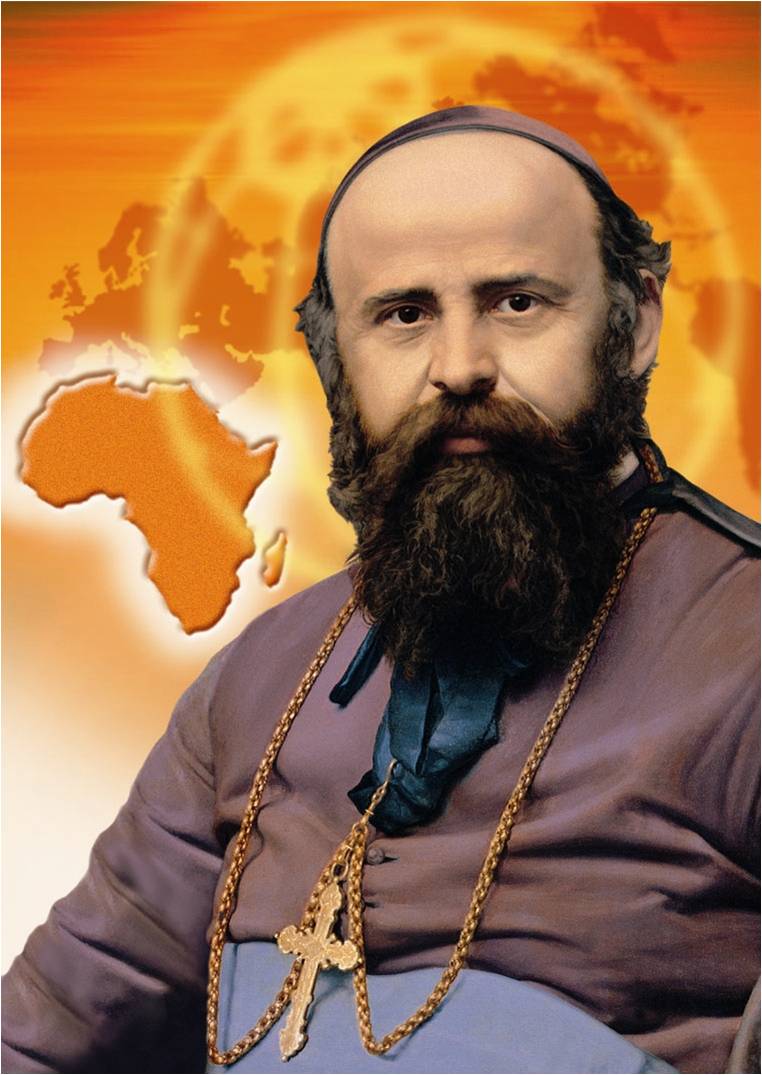
Feast Day: 10 October
Born: 15 March 1831, Limone sul Garda, Italy
Died: 10 October 1881, Khartoum, Sudan
Known for: Missionary to Central Africa, founder of the Comboni Missionaries of the Heart of Jesus and the Comboni Missionary Sisters
Canonized: 5 October 2003, by Pope John Paul II
Patronage and spiritual legacy: Missionary evangelization, the Church in Africa, and the service of the poor and marginalized.
Saint Daniel Comboni was one of the great Catholic missionaries of the nineteenth century. His life was marked by extraordinary missionary zeal, deep devotion to the Sacred Heart of Jesus, courageous service to the African people, and unwavering confidence in God’s providence. At a time when missionary work in Central Africa was fraught with disease, poverty, political instability, and enormous practical difficulties, he devoted his life to proclaiming the Gospel and preparing local people to become active agents of evangelization.
His life continues to inspire missionaries, priests, religious, catechists, and all Christians who seek to bring the love of Christ to those who are forgotten or marginalized.


1. Early Life and Family
Daniel Comboni was born on 15 March 1831 in Limone sul Garda, a small town in northern Italy. He was the fourth of eight children born to Luigi Comboni and Domenica Pace. His family was humble, and his parents worked as farmers and gardeners.
Although the family possessed little material wealth, Daniel grew up in an atmosphere of faith, sacrifice, and Christian devotion. His parents taught him the importance of prayer, hard work, and trust in God.
Daniel was naturally intelligent and deeply religious. As he grew older, he became increasingly interested in the missionary vocation. His desire to serve God was especially awakened through his studies at an institute in Verona directed by the priest Nicola Mazza, who was committed to the education of young people and the formation of missionaries.
There, Daniel learned about the spiritual and material challenges facing the peoples of Central Africa. The accounts of missionaries working under difficult conditions profoundly affected him. He gradually came to understand that God was calling him to dedicate his life to the evangelization and human advancement of the African continent.
What began as a youthful aspiration became a lifelong mission.
2. Discovering His Missionary Vocation
Daniel Comboni’s missionary vocation developed during a period when Central Africa was still largely unfamiliar to many Europeans. Missionary expeditions often faced extreme climatic conditions, tropical diseases, long journeys, and a shortage of resources.
Rather than allowing these difficulties to discourage him, Daniel became convinced that the African peoples deserved missionaries who would remain committed to their spiritual and human dignity.
He was ordained a priest on 31 December 1854. He continued his preparation for missionary work, studying, praying, and discerning how best to serve the people to whom he felt called.
In 1857, he joined a missionary expedition to Central Africa. This journey marked the beginning of his direct experience of African missionary life. The hardships were severe, and illness claimed the lives of several missionaries. Comboni himself became seriously ill and had to return to Europe.
For another person, such an experience might have marked the end of a missionary dream. For Daniel Comboni, however, it became an occasion for deeper discernment.
He did not interpret the failure of the expedition as a sign that Africa should be abandoned. Instead, he began to ask a more fundamental question: How could missionary work be organized so that it would be more sustainable and would genuinely involve African people themselves?
That question would shape the rest of his life.
3. The Visionary Plan: “Save Africa through Africa”

One of the most remarkable contributions of Saint Daniel Comboni was his conviction that the evangelization of Africa must actively involve African people themselves.
In 1864, while praying at the tomb of Saint Peter in Rome, Comboni experienced what he understood as a decisive inspiration for his missionary vocation. This led him to develop his famous Plan for the Regeneration of Africa, commonly summarized by the motto:
“Save Africa through Africa.”
The plan was innovative for its time. Instead of relying exclusively on European missionaries, Comboni wanted to establish centres of Christian formation in Africa where local people could receive education, professional training, and religious instruction. These centres would prepare African Christians to participate actively in the evangelization and development of their own communities.
His vision rested on several important principles:
- Formation of local leaders: African people should be equipped to become catechists, teachers, priests, and missionaries.
- Education and human advancement: Schools and training centres should help people develop their abilities and improve their communities.
- Collaboration: Missionary work required the participation of the whole Church, including priests, religious women, laypeople, and benefactors.
- Perseverance: The mission had to continue despite illness, financial difficulties, misunderstandings, and other obstacles.
- Respect for human dignity: Evangelization should be accompanied by practical concern for people suffering from poverty, exploitation, and slavery.
Comboni understood that a mission could not be sustained merely by sending outsiders into a distant land. It required the formation of local communities capable of carrying forward the work of the Gospel.
His vision anticipated an important principle of modern missionary activity: the local Church must be empowered to take responsibility for its own evangelization and pastoral life.
4. Founding the Comboni Missionaries
Daniel Comboni knew that his missionary vision required a permanent organization of people committed to the same spiritual purpose. He therefore worked tirelessly to establish missionary communities that could continue the work even after his death.
In 1867, he founded the Institute of the Sons of the Sacred Heart of Jesus, which developed into the Comboni Missionaries of the Heart of Jesus.
The congregation was dedicated to missionary evangelization, particularly among peoples who had limited access to the Gospel and those who suffered social and economic abandonment.
Comboni sought men who were willing to sacrifice personal comfort, accept difficult assignments, and remain faithful to Christ amid uncertainty. He wanted their missionary work to flow from a deep spiritual relationship with Jesus, especially Jesus whose Heart is pierced by love for humanity.
He also understood that women had an essential role in missionary service.
In 1872, he founded a female missionary institute that developed into the Comboni Missionary Sisters. Their work included evangelization, education, healthcare, and service to vulnerable communities.
The foundation of these two missionary institutes was a major achievement. Comboni was not simply establishing missions for his own lifetime; he was building communities that could carry his vision into the future.
Today, the Comboni missionary family continues to serve in various parts of the world, preserving the founder’s emphasis on the Gospel, intercultural fraternity, and service to people living on the margins of society.
5. A Missionary Who Challenged the Whole Church
Comboni believed that the evangelization of Central Africa was not the responsibility of a few courageous individuals alone. He wanted the entire Catholic Church to recognize Africa’s missionary importance.
He travelled extensively throughout Europe, appealing to bishops, priests, religious communities, wealthy benefactors, and ordinary Catholics. He explained the needs of the African missions and encouraged people to support them through prayer, financial assistance, and missionary vocations.
He also used publications to spread awareness of missionary activity. His work helped bring the challenges and aspirations of the African missions to the attention of a wider public.
During the First Vatican Council, Comboni advocated greater ecclesial commitment to the evangelization of Central Africa. He helped obtain the signatures of seventy bishops for a petition supporting this missionary endeavour.
His approach demonstrates an important truth: missionary work is not the responsibility of priests and religious alone. Every baptized Christian has a role in the Church’s mission, whether through direct evangelization, prayer, charitable service, financial support, or the witness of a holy life.
6. Bishop of Central Africa

On 2 July 1877, Daniel Comboni was appointed Vicar Apostolic of Central Africa. He was consecrated a bishop the following month.
This appointment brought greater responsibility, but it did not change the essential character of his vocation. He remained a missionary who wished to be close to the people he served.
As bishop, he had to oversee missionary communities, establish and maintain pastoral centres, encourage new vocations, and respond to the needs of the people across an immense territory. His responsibilities extended beyond the immediate proclamation of the Gospel to the practical organization and long-term development of the mission.
His episcopal ministry was marked by immense difficulties. Drought and famine devastated the region in 1877 and 1878. Disease, exhaustion, shortages of resources, and the loss of missionaries placed the entire mission under severe pressure.
Comboni also experienced criticism and misunderstanding. Some people considered his plans unrealistic, while others questioned the feasibility of establishing a lasting missionary presence under such harsh conditions.
Nevertheless, he refused to abandon the mission.
His perseverance did not mean that he ignored suffering or believed that every difficulty could be overcome by human effort alone. Rather, he placed his trust in God’s grace while continuing to work with whatever means were available.
For Comboni, faith was not an escape from the world’s problems. It was the source of courage to confront them.
7. His Love for Africa and the Fight against Slavery
Saint Daniel Comboni’s missionary vocation was accompanied by a deep concern for the suffering of African people. He encountered communities affected by poverty, exploitation, disease, and the devastating consequences of the slave trade.
He opposed slavery and worked to raise awareness of its destructive effects. His missionary efforts were inseparable from his concern for the dignity of the people to whom he ministered.
For Comboni, African people were not merely recipients of missionary activity. They were human beings created in God’s image, capable of leadership, education, holiness, and service to the Church.
His plan to prepare Africans to evangelize their own communities reflected his confidence in their abilities and spiritual potential.
His witness remains significant today. The Church’s mission must never be reduced to words alone; it must also include solidarity with people who experience injustice, exclusion, and deprivation.
At the same time, Comboni’s historical context reminds modern readers that missionary history must be understood carefully. His nineteenth-century work took place within a complicated period of European expansion and unequal power relations. His lasting spiritual contribution is best appreciated alongside a continuing commitment to the dignity, agency, cultures, and leadership of African peoples themselves.
8. Spirituality of the Sacred Heart of Jesus
At the centre of Saint Daniel Comboni’s life was his devotion to the Sacred Heart of Jesus.
He understood the Heart of Christ as the source of missionary love: a love that reaches out to the forgotten, seeks the lost, comforts the suffering, and offers itself without counting the cost.
The missionary vocation, in his understanding, could not be sustained by enthusiasm alone. It required a heart formed by prayer, sacrifice, humility, and confidence in God.
Comboni knew the emotional and physical demands of missionary life. He experienced disappointment, illness, opposition, and the grief of losing companions. His spirituality helped him remain faithful when visible results seemed small and the future appeared uncertain.
His example offers a lesson to every Christian, not only to those who travel to distant lands. A missionary spirit can be lived in a family, a parish, a hospital, a classroom, a religious community, or any place where a person serves others in the name of Christ.
The essential question is not how far we travel, but how generously we love.
9. His Final Mission and Death
In 1880, despite his deteriorating health and the enormous demands of his responsibilities, Comboni returned to Africa for the eighth and final time. He wished to remain close to his missionaries and the communities entrusted to his care.
The final period of his life brought further trials. He endured exhaustion, illness, the deaths of collaborators, and painful accusations. Yet he continued to devote himself to the mission.
On 10 October 1881, Daniel Comboni died in Khartoum, Sudan, at the age of fifty. He died among the people he had spent his life serving.
His reported final words expressed his confidence that the work to which he had given his life would continue beyond his death:
“I am dying, but my work will not die.”
These words became a fitting summary of his missionary legacy.
Comboni understood that the mission belonged to God and not to any one individual. A missionary might die, but the Gospel could continue to bear fruit through the lives of those who remained faithful to it.
His death did not bring his vision to an end. The missionary institutes he founded continued to develop, and his spiritual legacy inspired generations of missionaries to serve the poorest and most neglected communities.
10. Beatification and Canonization
The Catholic Church gradually recognized the holiness of Daniel Comboni and the enduring value of his missionary witness.

1996 — Beatification
Pope John Paul II beatified Daniel Comboni on 17 March 1996, recognizing his heroic Christian life and the miracle attributed to his intercession.

2003 — Canonization
On 5 October 2003, Pope John Paul II canonized Daniel Comboni in Saint Peter’s Square, officially declaring him a saint of the Catholic Church.
His canonization affirmed that his life of missionary dedication, courageous service, prayer, and perseverance offered an enduring example of Christian holiness.
Saint Daniel Comboni is commemorated on 10 October, the anniversary of his death and heavenly birth.
11. Important Lessons from the Life of Saint Daniel Comboni
The life of Saint Daniel Comboni offers several practical lessons for Christians today.
1. Never give up when God has called you
Comboni encountered failures, sickness, opposition, and disappointment. Yet he did not allow difficulties to destroy his missionary vocation.
His life teaches us that setbacks need not be the end of a good work. Sometimes they invite us to examine our methods, deepen our trust in God, and begin again with renewed wisdom.
2. Believe in the abilities of others
His vision, “Save Africa through Africa,” expressed his confidence in the ability of African people to lead their own evangelization.
We can follow this example by helping others discover their gifts rather than making them dependent on us. Parents, teachers, priests, religious, and community leaders are called to form people who can eventually take responsibility for their own lives and serve others.
3. Let love become service
Comboni’s devotion to the Sacred Heart was not limited to prayer or religious expressions. It inspired him to spend his life among people who needed spiritual guidance, education, and practical assistance.
Our devotion to Jesus should likewise lead us to care for the sick, accompany the lonely, support struggling families, and stand beside people who are neglected.
4. Mission begins with prayer
His missionary vision was deeply connected to prayer. His experience in Rome in 1864 became a decisive moment in the development of his plan for Africa.
Prayer helps us discern God’s will, examine our motives, and discover new possibilities when our own plans seem inadequate.
5. Holiness requires perseverance
Comboni did not live a comfortable or trouble-free life. He experienced physical suffering, misunderstanding, and the loss of many companions.
His example reminds us that holiness is not the absence of difficulties. It is the decision to remain faithful to God and charitable toward others in the midst of them.
6. Every Christian is called to be a missionary
Not everyone is called to travel to another country. Every Christian, however, can share the Gospel through words, actions, prayer, and service.
A kind word spoken to a discouraged person, the patient care of an elderly parent, the teaching of children in the faith, and the defence of human dignity can all become expressions of missionary discipleship.
12. Saint Daniel Comboni and the Mission of the Church Today
The missionary vision of Saint Daniel Comboni remains relevant in the contemporary Church.
Missionary activity today involves not only proclaiming the Gospel but also accompanying local communities, preparing leaders, educating children, promoting human dignity, and serving people affected by poverty, displacement, violence, and exclusion.
Comboni’s emphasis on forming local leaders challenges the Church to recognize and develop the gifts of people in every culture. Missionary communities must work with people rather than treating them merely as recipients of assistance.
His spirituality also reminds us that authentic evangelization begins with Christ. Without prayer and a genuine love for people, missionary work can become little more than an organizational activity.
The Church needs missionaries who combine contemplation with action, courage with humility, and fidelity to the Gospel with respect for the people they serve.
In this sense, Saint Daniel Comboni’s life remains an invitation to renew our missionary commitment.
13. Bible Verses for Reflection on Saint Daniel Comboni
The following Scripture passages illuminate important aspects of his missionary spirituality.
1. The Great Commission — Matthew 28:19–20
“Go ye therefore, and teach all nations.”
Christ entrusts his disciples with the responsibility of proclaiming the Gospel to all peoples. Comboni dedicated his life to this missionary mandate.
2. The Gospel to the Poor — Luke 4:18
“The Spirit of the Lord is upon me, because he hath anointed me to preach the gospel to the poor.”
This passage expresses the mission of Christ and the Church’s call to bring hope to the poor and those who suffer.
3. The Necessity of Evangelization — Romans 10:14
“How shall they hear without a preacher?”
Comboni recognized the urgent need for missionaries and encouraged the entire Church to participate in the evangelization of Africa.
4. Love in Action — 1 John 3:18
“Let us not love in word, neither in tongue; but in deed and in truth.”
His life reminds us that Christian love must be expressed through practical service.
5. Perseverance in Doing Good — Galatians 6:9
“And let us not be weary in well doing: for in due season we shall reap, if we faint not.”
This verse offers encouragement to everyone who continues to serve despite discouragement or delayed results.
14. Prayer to Saint Daniel Comboni

O Saint Daniel Comboni, courageous missionary and faithful servant of the Sacred Heart of Jesus, intercede for us before the throne of God.
You devoted your life to proclaiming the Gospel, serving the poor, and bringing hope to people who were neglected and forgotten. Through difficulties, sickness, disappointments, and suffering, you remained faithful to the mission entrusted to you.
Pray for all missionaries, priests, religious, catechists, and laypeople who work to spread the Gospel throughout the world. Strengthen those who are discouraged, protect those who face danger, and encourage those who feel exhausted by their responsibilities.
Intercede for the people of Africa and for all communities suffering from poverty, injustice, violence, and exploitation. May the Church continue to recognize the gifts of every people and help local communities grow in faith, dignity, and freedom.
Obtain for us a heart that resembles the Heart of Jesus: generous in love, courageous in difficulty, patient in suffering, and faithful in service.
Help us to recognize God’s call in our daily lives and to persevere when our efforts seem fruitless. May we never lose hope, knowing that every act of love offered in Christ can bear fruit in God’s time.
Saint Daniel Comboni, pray for us.
Through Christ our Lord. Amen.
15. Feast-Day Reflection: Let Your Mission Continue
The feast of Saint Daniel Comboni invites us to consider a simple but important question: Who needs the love of Christ through me today?
Perhaps there is someone in our family who needs forgiveness, a young person who needs encouragement, a poor neighbour who needs practical assistance, or a struggling parishioner who needs someone willing to listen.
We may sometimes imagine that missionary work belongs only to priests, religious, or people serving in distant countries. Comboni’s example reminds us that missionary love begins wherever God has placed us.
He also teaches us not to measure the value of our service solely by immediate success. Some efforts require years of patient work before their fruits become visible. Faithfulness matters even when the outcome remains uncertain.
Saint Daniel Comboni died without seeing the full development of the missionary work he had begun. Yet the communities he founded continued his mission long after his death.
His life reminds us that we may not live to see the completion of every good work we begin, but we can faithfully do our part and entrust its future to God.
On his feast day, let us renew our commitment to prayer, service, evangelization, and the dignity of every human person.
May Saint Daniel Comboni inspire us to become missionaries of hope wherever we live and work.
16. Short Biography of Saint Daniel Comboni
Saint Daniel Comboni (1831–1881) was an Italian Catholic missionary and bishop who dedicated his life to the evangelization and service of the peoples of Central Africa. Ordained a priest in 1854, he developed an innovative missionary plan summarized by the motto “Save Africa through Africa.” He founded the Comboni Missionaries in 1867 and the Comboni Missionary Sisters in 1872. Appointed Vicar Apostolic of Central Africa in 1877, he persevered through famine, disease, and numerous hardships. He died in Khartoum, Sudan, on 10 October 1881. Pope John Paul II beatified him in 1996 and canonized him in 2003. His feast is celebrated on 10 October.
References and Further Reading
- Holy See — Biography of Saint Daniel Comboni. Read the official Vatican biography.
- Vatican News — Pope Francis on the missionary zeal of Saint Daniel Comboni. Read the catechesis report.
- Comboni Missionaries — History and missionary vision. Read about the Comboni Missionaries.
- Vatican State — Saint Daniel Comboni, 10 October. Read the feast-day biography.
Leave a Reply