
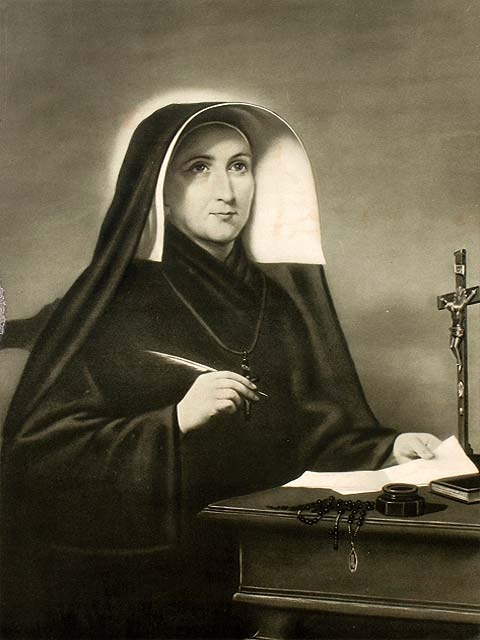
Feast Day: 26 August
Born: 5 July 1773, Le Blanc, France
Died: 26 August 1838, La Puye, France
Canonized: 6 July 1947 by Pope Pius XII
Religious Family: Daughters of the Cross, also known as Sisters of Saint Andrew
Patronage: Religious education, the poor, sick and abandoned
Introduction
Saint Jeanne-Élisabeth Bichier des Ages was a remarkable French woman whose life unfolded during one of the most turbulent periods in the history of France. Born into a noble Catholic family, she lived through the upheaval of the French Revolution, the persecution of the Church, imprisonment and political instability. Yet instead of allowing these circumstances to destroy her faith, she transformed suffering into an opportunity for prayer, charity and apostolic service.
Together with Saint André Hubert Fournet, she founded the religious congregation known as the Daughters of the Cross, also called the Sisters of Saint Andrew. The congregation devoted itself especially to the education of children and the service of the poor, sick and abandoned.
Her life beautifully demonstrates how Christian holiness can combine deep contemplation with tireless apostolic activity.
Pope Pius XII, who canonized her in 1947 together with Saint Michael Garicoïts, praised the extraordinary variety of gifts and virtues found in her life, describing her as a woman who responded faithfully to the circumstances in which Providence placed her.
A Daughter of a Catholic Family
Jeanne-Élisabeth was born on 5 July 1773 in Le Blanc, in the French region of Poitou.
She came from a respectable provincial aristocratic family and received a careful religious and intellectual education.
From her earliest years, she was known for her lively personality, intelligence, practical ability and strong Christian formation.
Although she came from a privileged social background, she learned to appreciate humble work. Pope Pius XII later recalled that she could move naturally from domestic duties to social situations and was capable of undertaking even the simplest household tasks with generosity.
This combination of refinement and simplicity would remain characteristic of her life.
The French Revolution
Jeanne-Élisabeth’s youth coincided with one of the most dramatic periods in French history.
The French Revolution, beginning in 1789, brought enormous political and social changes. The Church suffered persecution, religious communities were suppressed, priests were forced into hiding, and Catholic worship was severely restricted in many places.
For Jeanne-Élisabeth, this was not merely something happening in the political world.
It touched her family, her parish and her faith directly.
Churches were closed.
Priests were persecuted.
Catholics were forced to practice their faith secretly.
The young Elizabeth responded not with hatred but with courageous fidelity.
A Woman of Courage During Persecution
During the revolutionary period, Jeanne-Élisabeth became involved in protecting and assisting persecuted Catholics.
She helped maintain the faith of the people around her and supported priests who were forced to minister secretly.
Her family itself experienced imprisonment and hardship.
Pope Pius XII recalled how the skills she had learned in ordinary life later became useful during the revolutionary crisis. She could care for those around her, repair clothing, manage practical affairs and defend the interests of her family while also serving persecuted Catholics.
Her life reveals an important truth:
God can prepare us for future missions through the ordinary responsibilities of today.
The skills that seemed insignificant in her youth later became instruments of apostolic service.
The Influence of Saint André Fournet
A decisive turning point came when Jeanne-Élisabeth met Father André Hubert Fournet, a priest who became her spiritual director and collaborator.
Fournet recognized the gifts God had given her and helped her discern how those gifts could be used for the Church.
Their collaboration became the foundation of an extraordinary apostolic movement.
Father Fournet provided priestly and spiritual guidance.
Jeanne-Élisabeth brought organization, leadership, practical intelligence and a deep spirit of charity.
Together they responded to the needs of a Church recovering from persecution.
Their partnership demonstrates the beauty of complementary vocations.
The priest and the religious woman worked together—not for personal glory, but for the restoration of Christian life.
Rebuilding Christian Life
After the worst years of revolutionary persecution had passed, France faced another enormous problem.
Church buildings and institutions had been damaged or destroyed.
Religious education had suffered.
Many children had grown up without proper Christian instruction.
The poor and sick remained in need of care.
Jeanne-Élisabeth saw these needs clearly.
She understood that rebuilding the Church required more than repairing buildings.
The faith itself had to be rebuilt in people’s hearts.
She therefore devoted herself to:
- Christian education
- Catechism
- Care for the poor
- Service of the sick
- Assistance to abandoned people
- Restoration of religious practice
- Formation of women for apostolic service
Pope Pius XII described her early apostolic work as a combination of schools, catechism, charitable works and works of mercy.
The Birth of a Religious Congregation
Jeanne-Élisabeth did not initially set out with the ambition of becoming a foundress.
Her work developed gradually.
Women began joining her in her apostolic activities.
They prayed together.
They served together.
They cared for children and the poor together.
They formed a community.
Over time, this community developed into a religious congregation.
Jeanne-Élisabeth and Father Fournet prepared constitutions, and the community eventually received ecclesiastical approval.
In this way, she became the foundress of the Daughters of the Cross.
Pope Pius XII emphasized this gradual development, noting that she sought advice, visited religious communities, reflected and prayed before establishing the form of religious life God seemed to be asking of her.
The Daughters of the Cross
The new congregation had a distinctive apostolic character.
Its members were called to combine:
Prayer and action.
Contemplation and service.
Love of God and love of neighbour.
The sisters served especially among the poor and vulnerable.
They taught children.
They instructed people in the Catholic faith.
They cared for the sick.
They served those who had little support.
Their spirituality was therefore profoundly incarnational.
They did not seek God by escaping human suffering.
They sought God by serving Christ present in suffering humanity.
The Meaning of the Name “Daughters of the Cross”
The name Daughters of the Cross expresses the heart of Jeanne-Élisabeth’s spirituality.
The Cross was not merely an object of devotion.
It was a way of life.
To follow Christ means accepting sacrifice.
To serve the poor requires sacrifice.
To educate children requires patience.
To care for the sick requires generosity.
To remain faithful to the Church during persecution requires courage.
Jeanne-Élisabeth understood that the Cross and charity belong together.
The Christian does not merely look at the Cross.
The Christian learns from the Cross how to love.
The Monastery of La Puye
One of the most important places associated with Saint Jeanne-Élisabeth is La Puye.
As the congregation expanded, she acquired an old monastic property there and developed it into a center for her religious community.
The project required enormous practical work.
Buildings needed to be repaired and adapted.
Communities needed to be organized.
New sisters needed formation.
A growing number of apostolic works needed coordination.
Pope Pius XII described her remarkable ability to combine spiritual leadership with practical administration, even becoming deeply involved in the restoration and adaptation of the old monastery at La Puye.
A Woman of Extraordinary Activity
Saint Jeanne-Élisabeth was not a person who remained inactive in a convent.
She travelled extensively.
She visited communities.
She established new foundations.
She supervised religious formation.
She cared for the needs of the sisters.
She maintained correspondence.
She dealt with practical and financial matters.
She travelled through different parts of France despite the difficulties of transportation at the time.
Pope Pius XII compared the extent of her travels and foundations to the missionary journeys associated with Saint Teresa of Ávila.
Yet her exterior activity flowed from a deep interior life.
This is one of the most striking features of her spirituality.
Contemplation and Action
Saint Jeanne-Élisabeth teaches an important lesson about Christian activity.
Christian service must come from prayer.
Without prayer, apostolic activity can become merely humanitarian work.
Without charity, prayer can become detached from the needs of others.
Jeanne-Élisabeth united both.
She prayed deeply.
Then she served.
She contemplated Christ.
Then she went to the poor.
She loved the Eucharist.
Then she cared for the sick.
She sought God’s will.
Then she acted courageously.
Her life demonstrates the Gospel principle:
Love of God and love of neighbour are inseparable.
A Mother to Her Sisters
As the congregation grew, Jeanne-Élisabeth became much more than an administrator.
She was a spiritual mother.
She cared for the religious formation of the sisters.
She encouraged them.
She corrected them when necessary.
She supported them in difficulties.
She wanted them to become holy women capable of serving others.
Pope Pius XII highlighted the maternal character of her leadership, describing her care for the sisters as strong, vigilant and tender.
Her authority was therefore rooted not in domination but in love.
Her Love for the Poor
The poor occupied a central place in the apostolic mission of Jeanne-Élisabeth.
She recognized Christ in those who were suffering.
The poor were not merely recipients of assistance.
They were brothers and sisters in Christ.
This perspective changed the meaning of charity.
Christian charity is not simply giving things to people.
It is giving ourselves.
It means offering time.
It means listening.
It means accompanying.
It means serving with dignity.
It means seeing the face of Christ in the person who suffers.
Education as an Apostolate
One of the great contributions of the Daughters of the Cross was the education of children.
Jeanne-Élisabeth understood that rebuilding Christian society required forming the next generation.
Children needed:
- Knowledge
- Moral formation
- Christian instruction
- Discipline
- Compassion
- Faith
- Hope
- Love
Education was therefore not simply an academic task.
It was an apostolic mission.
The sisters helped children discover both the world of knowledge and the world of faith.
Service to the Sick
Saint Jeanne-Élisabeth also placed great importance on caring for the sick.
The Gospel repeatedly presents Jesus as compassionate toward those who suffer.
The sick are not burdens.
They are persons deserving dignity and love.
By caring for them, the Daughters of the Cross sought to imitate Christ.
This remains a powerful message for Christian communities today.
Hospitals, homes, parishes and families all need people willing to care patiently for those who suffer.
Her Own Sufferings
Jeanne-Élisabeth herself experienced physical suffering.
One particularly painful episode occurred when she underwent a serious surgical operation.
Pope Pius XII recalled her extraordinary patience during the operation and the public admiration that followed when people learned of the courage with which she endured her suffering.
Yet she did not seek admiration.
She accepted suffering as an opportunity to unite herself more deeply with Christ Crucified.
Her response to suffering was therefore not bitterness but surrender.
Humility Amid Recognition
As the reputation of the congregation spread, Jeanne-Élisabeth became known in wider circles.
People from different social classes sought her.
She was welcomed by influential people.
Even members of the royal court treated her with respect.
Yet she remained deeply humble.
Pope Pius XII described the striking contrast between her simplicity as an ordinary religious sister and the respect with which prominent people eventually received her.
This is a beautiful lesson in Christian humility.
A humble person does not need to become insignificant.
Humility means knowing that every gift comes from God.
A Friend and Collaborator of Other Saints
Saint Jeanne-Élisabeth’s life became connected with another great French saint: Saint Michael Garicoïts, founder of the Priests of the Sacred Heart of Jesus of Bétharram.
Pope Pius XII noted the close spiritual and apostolic relationship between the two saints.
Their friendship illustrates something beautiful about the communion of saints.
Holy people do not compete with one another.
They encourage one another.
They cooperate.
They strengthen each other’s apostolic work.
They recognize that every genuine vocation contributes to the one mission of Christ.
A Life of Travel and Foundation
The expansion of the Daughters of the Cross required Jeanne-Élisabeth to travel extensively.
She visited communities throughout France, often under difficult conditions.
Her journeys included areas such as Poitou, Burgundy, Franche-Comté, the Paris region and the Pyrenees.
She established and strengthened communities wherever the needs of the Church called her.
Her life demonstrates that religious vocation is not necessarily a life of physical stability.
Sometimes holiness requires going where people need the Gospel.
Her Final Years
After decades of intense apostolic work, Jeanne-Élisabeth’s health gradually declined.
Yet she continued to care for the congregation and its mission.
Her life had been filled with work, prayer, sacrifice, travel and service.
On 26 August 1838, she died at La Puye, the place so closely associated with the congregation she had founded.
Her death did not end her mission.
The Daughters of the Cross continued to spread and serve the Church.
Beatification and Canonization
The Church recognized the holiness of Jeanne-Élisabeth after a long process.
She was beatified by Pope Pius XI in 1934.
On 6 July 1947, Pope Pius XII canonized her together with Saint Michael Garicoïts. His address to pilgrims gathered for the canonization praised the rich harmony of her natural and supernatural gifts and her heroic response to the circumstances of her life.
Her canonization confirmed what generations of people had experienced through her life and apostolate: that a woman who served the Church amid revolutionary upheaval had become a true witness of Christ.
Her Spirituality
The spirituality of Saint Jeanne-Élisabeth can be summarized in several words:
Faith
She trusted God during political upheaval, persecution and uncertainty.
Prayer
Her apostolic activity was rooted in a deep relationship with God.
Charity
She devoted herself to the poor, sick and vulnerable.
Education
She understood the importance of forming children in both knowledge and faith.
Courage
She did not retreat when the Church suffered persecution.
Humility
Despite recognition and influence, she remained the simple “Good Sister.”
Obedience
She worked in communion with the Church and sought guidance in discerning her vocation.
Perseverance
She continued building the congregation despite enormous obstacles.
Lessons from the Life of Saint Jeanne-Élisabeth
1. God can use difficult times for great works
Jeanne-Élisabeth lived through revolution and persecution.
Yet from that difficult period emerged new apostolic initiatives.
Our own difficult circumstances can also become opportunities for grace.
2. Holiness can be practical
She was not detached from practical matters.
She managed property.
She organized communities.
She travelled.
She supervised construction.
She cared for finances.
She dealt with everyday problems.
Her holiness entered ordinary life.
3. Education is a powerful ministry
By educating children, she helped rebuild Christian society.
Christian education remains one of the most important apostolates of the Church.
4. The poor deserve our best
Charity should never be careless or condescending.
Saint Jeanne-Élisabeth treated the poor and sick with dignity.
5. Prayer must lead to action
True prayer produces charity.
The closer we come to Christ, the more sensitive we should become to the suffering of others.
6. Women have a vital apostolic role
Jeanne-Élisabeth demonstrates the enormous contribution women can make to the Church.
She founded communities, educated children, cared for the sick, organized charitable works and helped renew Christian life.
7. Collaboration strengthens the Church
Her partnership with Saint André Fournet and relationship with other spiritual leaders demonstrate the importance of working together.
The Church grows when different vocations cooperate rather than compete.
Saint Jeanne-Élisabeth and the Church Today
The Church today faces challenges that are different from those of revolutionary France, but some needs remain remarkably similar.
Many children need proper formation.
Families need support.
The poor need assistance.
The sick need compassionate care.
Young people need hope.
People need to rediscover Christ.
Communities need courageous witnesses.
Saint Jeanne-Élisabeth’s response remains relevant:
Pray deeply.
Live faithfully.
Serve generously.
Educate wisely.
Remain close to the poor.
Trust Providence.
A Message for Teachers
Saint Jeanne-Élisabeth is a particularly beautiful patronal example for Catholic teachers.
Teaching is not simply the transmission of information.
A teacher shapes minds and hearts.
Every child entrusted to a teacher is a person created in the image of God.
Catholic education should therefore form not only intelligent students but compassionate, responsible and faith-filled human beings.
Saint Jeanne-Élisabeth understood that education could transform society.
A Message for Religious Women
For consecrated women, her life offers a beautiful example of how contemplation and apostolic service can be united.
She was a woman of prayer.
She was also a woman of action.
She was contemplative without becoming inactive.
She was active without losing her interior life.
Her example encourages religious women to allow their apostolic works to flow from intimate friendship with Christ.
A Message for Families
Saint Jeanne-Élisabeth came from a family in which faith was important.
Her family background helped form the person she became.
This reminds parents of the enormous responsibility they have.
The first school of faith is the home.
Children learn faith not only from catechism books but from what they see:
Parents who pray.
Parents who forgive.
Parents who attend Mass.
Parents who care for the poor.
Parents who speak respectfully.
Parents who trust God in difficult times.
A holy family can become the seedbed of future vocations.
Prayer to Saint Jeanne-Élisabeth Bichier des Ages
O Saint Jeanne-Élisabeth Bichier des Ages,
faithful daughter of the Church
and loving servant of Christ,
pray for us.
You who remained faithful to God
during times of persecution and uncertainty,
strengthen our faith when we face difficulties.
You who devoted your life
to children, the poor and the sick,
teach us to recognize Christ
in every person who suffers.
You who founded the Daughters of the Cross,
pray for all religious women
who dedicate themselves to the service of God’s people.
Obtain for teachers the grace
to educate with wisdom, patience and love.
Pray for our families,
that homes may become schools of faith,
places of prayer and centers of charity.
Teach us to unite prayer with action,
contemplation with service,
and love of God with love of neighbour.
When we become discouraged,
help us to trust Divine Providence.
When we are tempted by pride,
teach us humility.
When we are afraid,
obtain for us courage.
When we encounter suffering,
help us to embrace the Cross of Christ
with faith and hope.
Pray for the Church,
for the Holy Father, bishops and priests,
for religious communities,
for missionaries and teachers,
and for all who serve the poor and suffering.
Saint Jeanne-Élisabeth,
daughter of the Cross,
help us to follow Jesus faithfully
and to spend our lives in loving service.
May we one day join you
in the eternal joy of God’s Kingdom.
Through Christ our Lord.
Amen.
Conclusion
Saint Jeanne-Élisabeth Bichier des Ages lived at a time when the Church in France had experienced enormous suffering.
Yet she did not respond to crisis with despair.
She responded with faith.
She saw ruined Christian communities and began rebuilding them.
She saw children without Christian education and began teaching them.
She saw the poor and sick and began serving them.
She saw women seeking a deeper Christian vocation and helped form a religious community.
She saw a wounded Church and offered her entire life for its renewal.
Her life reveals the remarkable power of one person who says yes to God.
She reminds us that holiness is not merely found in extraordinary mystical experiences. It can be found in organizing a school, teaching a child, caring for a sick person, repairing a building, travelling to establish a new community, comforting a suffering person or patiently carrying a cross.
Saint Jeanne-Élisabeth teaches us that love becomes holy when it becomes service.
Her feast is therefore an invitation to ask ourselves:
What can I do today to build God’s Kingdom?
Perhaps the answer will be something small.
Perhaps it will be something difficult.
Perhaps it will require courage.
But if it is done with love, it can become an offering to God.
May Saint Jeanne-Élisabeth Bichier des Ages intercede for the Church, for religious communities, for teachers and educators, for families, for children, for the poor and sick, and for all those who seek to serve Christ in the world.
May her example inspire us to live the words of Jesus:
“Whatever you did for one of the least of these my brethren, you did for me.”
— Matthew 25:40
Saint Jeanne-Élisabeth Bichier des Ages,
Daughter of the Cross and servant of the poor,
pray for us!
Leave a Reply